Yes, the lavish packages and guarantees are better in the short run, but they will need to be re-negotiated in the next downturn.
This works so long as the corporation doesn't try and muck around with how their profit is recorded. See "Hollywood Accounting" for examples of this in practice in union-using industries.
I talked with a guy who worked 42 years for the same company and was on the bargaining committee when a work stoppage occurred. He said they always thought the company kept two sets of books - the ones they showed the union and the actual books. Nevermind that he worked for a F500 company which was publicly traded at least half the time he worked there, and he worked for the largest facility in the company, driving much of the revenue for the company.
You also hear things about "the company going after tax write-off so they don't have to pay workers as much" when that write-off they're mad about is a standard cost of doing business deduction in the same way payroll is...the company is making a donation to a community organization or buying supplies, but they'd reduce their tax bill by just as much if they paid the money out to employees in the form of profit sharing, bonuses, or higher wages.
Non-profits are a way to buy political influence while getting a tax write-off.
Why?
What helps?
Expanding stakeholder participation, generous profit sharing, limiting CEO compensation, larger social safety net...?
To counteract this and get the employees a fairer share of the value they add to a company unions exist so that the power imbalance gets evened out between workers and management.
Are people just a thing in a financial transaction where each side tries to get the most out of the other at the least cost? If someone thinks that then it's kind of a sad view on humanity.
This isn't "abuse", it's a free market system.
This is an honest temptation. It's not just about the company health. It prioritizes some employees over other employees.
It's more than optimizing expenses.
However, the vast majority of executive compensation is in the form of equity, and labor's demand for more cash will punish the stock price. Plus there really isn't that many executives and you can't squeeze them enough to cover the extra spend on labor.
A small difference in wages won't attract people from far away to move to a new location because of all the thing I originally stated and ultimately while there are some good benefits to manufacturing in the US it's hard to beat Mexico or China because the costs are so much lower there for labor. On top of that because it's a relatively low skill field the potential hiring pool is very large so there's little need to pull in veteran higher wage (and higher healthcare cost) employees from other companies.
You're also now looking at the company's perspective rather than the employee's. The fact that there are other industries is a benefit to the employee -- if you can go to college and get paid twice as much as a software engineer then some people will take that option (benefiting them), which reduces the labor supply in the original industry (benefiting the remaining people).
I still don't think you could/should get rid of the unions though.
But in absence of other information my uneducated sympathy would tilt a bit towards the company and away from the union for one simple reason: many unions are essentially monopolies.
Yes, we all know a good union is a good thing and it can be beneficial for both the corporation and the workers. But what if a union happens to be "bad" it seems like the corporation has very little leverage.
We do have all sorts of laws and regulations preventing formation of large monopolies in corporate world. Do we have anything to prevent a de facto monopolization of workforce by a union?
In terms of equalizing bargaining power, unions make sense in a few narrow contexts -- say, single-employer mining towns -- but far less in cities where workers have many options open to them.
It's called "right-to-work" law. Some states have it and some states don't. But it prevents a union from requiring you to join as a condition of working for a company.
Create a less crooked union...?
GM and others are making fewer cars in the USA.
Why?
Hint: the solution is not to drop US wages to $5/hr.
I also see much handwringing about the crazy health insurance costs GM has to pay. That's unfortunately the cost of doing business in a country with an utterly broken healthcare model. There is no sane reason for why 'good' healthcare coverage should cost $13,000/capital/year... Yet, here we are.
But otherwise I agree with you.
--
As I'm sure you know: GM (and others) have long thwarted single payer. To keep more leverage over labor. To now complain about the expense is pretty rich.
Fair enough, but why stop there? What about all the other productive jobs lost due to cheaper foreign labor? It would be unfair to give special treatment just to auto workers. Either everyone should have a right to forever keep the profession of their choice, or no one should.
Soon enough you find yourself in the situation where everything is more expensive and everyone's standard of living is lower, because all comparative advantage has been lost.
This has been known for well over a hundred years, but people still have trouble accepting it.
You're assuming that the higher costs will necessarily all be passed along to the consumer rather than come from profit margins.
I think it's a valid assumption if the market were comprised of a lot of highly competitive firms rather than 3 not-very-competitive-at-all firms.
There's definitely a link, I think, between record high and increasing corporate profit / GDP ratios over the last 15 years and outsourcing.
For GM, it's probably about 4-5% average in the last years:
https://www.macrotrends.net/stocks/charts/GM/general-motors/...
> I think it's a valid assumption if the market were comprised of a lot of highly competitive firms rather than 3 not-very-competitive-at-all firms.
Consumer goods are generally highly competitive. There are no monopolies or exorbitant profit margins. The number of companies is irrelevant. Even if it was just a single company, as long as the profit margins are low, consumers are not at risk of being overcharged.
Outliers are companies like Apple, which have a monopoly on their IP, but that's a different story.
Why is optimizing labour costs the only option that such false dichotomies put on the table? Why are all other expenses sacred, but wages the first on the cutting block?
It's not a 'if we don't cut pay, we will live in a dysopia where nothing is affordable' situation.
It's a 'if we don't reign in the capital owners, the healthcare cartel, and management compensation, we are going to continue to live in a dystopia, where the vast majority of normal people continue to get squeezed to enrich those three groups.' (I'd also throw in loan servicing in there, but sadly, the existence of the bloated retail banking sector is a consequence of those three problems, not the cause.)
Most of a typical family's expenses are housing and healthcare. No amount of blue collar wage cutting is going to make either of those two line items affordable. But it sure as shit will make said blue collar family not be able to afford them. Wringing your hands over the cost of consumer goods, while ignoring those two elephants is bad policy.
We'd all be better off if we lived in a world where cars and widgets and clothes cost twice as much, but healthcare half as much. Well, most of us would, at least. You can find such a model on the other side of the pond.
No, we wouldn't, because people buy cars and clothes more often than they buy health care.
What costs a lot in the US is health insurance, not health care. And that's because the thing called health "insurance" isn't actually insurance; it's not just covering you against unforeseen large expenses. It's more like an expensive maintenance plan that you're forced to buy whether it's cost effective to you or not--like the full service maintenance plans that car dealers try to sell you, except that you can refuse to buy them from car dealers.
What really needs to happen is to separate out three very different things that are lumped together today into what is misleadingly called "health insurance":
(1) Routine, predictable maintenance expenses, like regular physical exams and vaccinations, and routine care for common illnesses like the flu. These should be provided by a competitive free market, like they were in the US before WW II when employers started offering health benefits to attract workers since wartime regulations prohibited them from offering higher wages. Competition would drive these costs down since the expenses are routine and it's reasonably easy for people to tell good providers from bad ones.
(2) Unforeseen, large, temporary expenses, like accidents. These are what would normally be covered by something properly called "insurance". For auto accidents, people's auto insurance is already required to cover them in most states; but for other kinds of accidents--slips and falls, broken bones while playing sports, etc.--an ordinary insurance model would be suitable, provided by health insurance companies.
(3) Expensive chronic conditions that require ongoing treatment (usually drugs, but not always). These are the hard ones to cover, but a system that was dedicated to covering them and nothing else would be much better than the bastardized system we have now that lumps everything together. These are the kinds of things where it makes sense to pool national resources and provide some kind of universal coverage, since it's usually not feasible to assign specific causes so an ordinary insurance model can't work. But if national resources were pooled to provide universal coverage for just these things, we could see how much they actually cost and we would be more focused on finding ways to reduce the frequency of such conditions.
> You can find such a model on the other side of the pond.
Really? Cars and clothes are twice as expensive as in the US?
Don't worry, your 401K has a decent chance of losing half its value before you retire.
As for multi-million dollar compensation, why don't you run the numbers and see how much the executive salary adds up to and then tell me how much money could be saved there. Maybe you'll have an argument then.
> Why is optimizing labour costs the only option that such false dichotomies put on the table? Why are all other expenses sacred, but wages the first on the cutting block?
If you run a multi-national company, in order to stay competitive, you need to look for the cheapest prices everywhere, including labor. Labor just happens to be the major cost factor, so naturally it's the first thing to optimize on. Your own wages are, naturally, the last thing you want to optimize on.
You can argue that these companies should be bribed into taking more expensive local labor, just keep in mind that this bears a cost that all of us pay.
> Most of a typical family's expenses are housing and healthcare. No amount of blue collar wage cutting is going to make either of those two line items affordable. But it sure as shit will make said blue collar family not be able to afford them. Wringing your hands over the cost of consumer goods, while ignoring those two elephants is bad policy.
Of course, housing and healthcare can't be outsourced in the same way that car manufacturing can be. If I follow your line of reasoning, manufacturing should get the same privilege, so that housing, healthcare and consumer goods will be less affordable. Like I said, this is possible, but you lose the comparative advantage, which is just leaving wealth on the table. Perhaps those auto workers should get a job in those more privileged industries instead?
> We'd all be better off if we lived in a world where cars and widgets and clothes cost twice as much, but healthcare half as much.
Fair enough, let's artificially suppress healthcare compensation in favor of manufacturing compensation. I'm sure it'll do "wonders" for the quality of either.
> You can find such a model on the other side of the pond.
On the other side of the pond, everyone earns less, especially healthcare workers.
Your mathematics don't make any sense.
If 60% of my household budget goes towards housing and healthcare, and 40% of it goes towards consumer goods, made by people like me.
If I lose 20% of my wages, for a 10% reduction in the cost of consumer goods, this will put me into a net -16% deficit.
Stop optimizing for the cost of consumer goods. They aren't the problem for a typical household. They haven't been a problem for a typical household since we've figured out mass production in the 70s. They never will be a problem for a typical household, unless we have a complete collapse of civilization.
> Fair enough, let's artificially suppress healthcare compensation in favor of manufacturing compensation. I'm sure it'll do "wonders" for the quality of either.
Every other country on Earth manages to provide equivalent or better healthcare, for much lower prices (Even adjusted for PPP). They don't have parasitic insurance and billing industries, they don't waste healthcare money on marketing spend, and they have reigned in physician salaries. None of those things have any impact on the quality of healthcare (Actually, the first two have a pretty major negative impact on the quality of care), but they do have plenty of impact on the cost of care.
> On the other side of the pond, everyone earns less, especially healthcare workers.
It's not what you earn, it's how much you have left over after you pay the bills.
Believe it or not, markets go both up and down. While it's true that the S&P 500 has shown great paper profits most of the time, for the longest time, other markets haven't been that lucky:
http://www.thebubblebubble.com/wp-content/uploads/2012/05/ni...
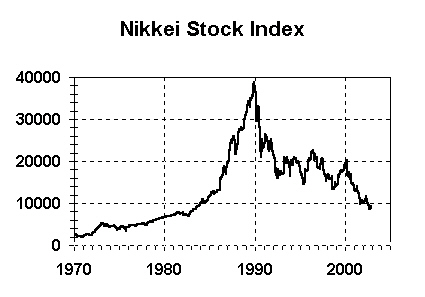
We haven't seen the end of a historically unprecedented low-interest phase yet. Even without a breakdown in nominal terms, at current rates of asset price inflation, a million dollars might not afford you a porty-potty in one of the better areas of the country.
> It's not what you earn, it's how much you have left over after you pay the bills.
Generally speaking, purchasing power in the US is higher and the tax burden is lower. Of course it really depends on where you live. If people earn more, prices will be higher as well. There is cheap housing in the US and expensive housing in Europe. You have to compare "similar" cities, e.g. San Francisco with London:
https://www.numbeo.com/cost-of-living/compare_cities.jsp?cou...
Also, for socialized healthcare, you will generally pay more than 10% of your paycheck, however high that may be.
I haven't done any mathematics.
> If I lose 20% of my wages, for a 10% reduction in the cost of consumer goods, this will put me into a net -14% deficit.
What's the basis for these numbers? First of all, foreign labor isn't 20% cheaper, it's 50-75% cheaper. That's why there's not that much manufacturing left in the US. Secondly, direct and indirect labor cost accounts for far more than fifty percent. Profit margins for consumer goods are usually in the single digits.
Remember, I'm talking about the scenario where everyone has their profession protected. In practice, you are either protected by virtue of not being outsourcable, or by government intervention. You don't see the government artificially keeping a huge domestic garment industry alive, for instance. We leave that labor in East Asia. Still, you can buy domestic garments, but they are massively more expensive.
In practice, assembly work in a car factory is not such a big factor of overall car costs as to raise prices of cars massively. You can argue that only these people should be protected, it just would be unfair.
> Every other country on Earth manages to provide equivalent or better healthcare, for much lower prices.
Every other country? What are you talking about? Most people in the world barely have any access to health care at a level close to that of the US.
Sure, people in Europe on average get a better deal, but again, they also earn less. Of course health care is cheaper if every doctor, every nurse, every clerk earns less. It also helps to not have million dollar malpractice settlements, or not letting pharma companies set their own prices.
It's not all sugar and spice though:
https://www.theguardian.com/commentisfree/2018/apr/06/nhs-fa...
https://www.telegraph.co.uk/news/health/news/6127514/Sentenc...
I find it very hard to believe that any union has ever destroyed any company. But if it has, then it probably was for the best and the company deserved to be destroyed.
From the unions perspective, a bankruptcy isnt welcome, nevertheless it could easily bring one about.
In practice, that isn't necessarily true, at least in the short run. If an airline goes out of business, that doesn't mean all these workers will just be absorbed into other airlines, especially not at the prices they just failed to bargain for. They may need to switch industries and start from close to zero.
Unions are supposed to prevent that from happening, but when they overplay their hand, both sides lose.
Talking about GM, the labor cost for building cars in the US is so high, it barely makes sense. Either foreign labor needs to get more expensive (perhaps through tariffs), or domestic labor needs to get cheaper. Otherwise, these jobs will disappear and the unions will become obsolete. It's not a good bargaining position.
There is also a consistent pattern. Companies do great, leading to expansive contracts with workers, then are mismanaged, or not sustainable during down-cycles. Then a down-cycle happens, and the company declares bankruptcy (which more often then not involves a government, a hard core negotiation or a bank bailing them out), and moving to a starvation contract, which they keep in place to far to long, then they get a expansive contract, and the whole thing continues.
Alternatively, Unions don't agree to the starvation contract, which then destroys the company - see Eastern Airlines, Pan Am, and all the carriers that didn't survive deregulation in the 1980s.