Believe it or not, markets go both up and down. While it's true that the S&P 500 has shown great paper profits most of the time, for the longest time, other markets haven't been that lucky:
http://www.thebubblebubble.com/wp-content/uploads/2012/05/ni...
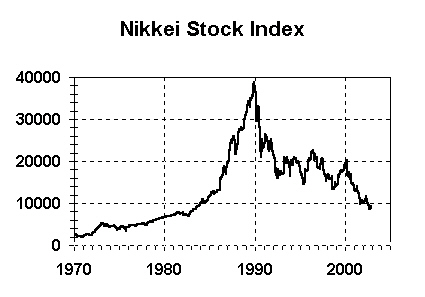
We haven't seen the end of a historically unprecedented low-interest phase yet. Even without a breakdown in nominal terms, at current rates of asset price inflation, a million dollars might not afford you a porty-potty in one of the better areas of the country.
> It's not what you earn, it's how much you have left over after you pay the bills.
Generally speaking, purchasing power in the US is higher and the tax burden is lower. Of course it really depends on where you live. If people earn more, prices will be higher as well. There is cheap housing in the US and expensive housing in Europe. You have to compare "similar" cities, e.g. San Francisco with London:
https://www.numbeo.com/cost-of-living/compare_cities.jsp?cou...
Also, for socialized healthcare, you will generally pay more than 10% of your paycheck, however high that may be.
I haven't done any mathematics.
> If I lose 20% of my wages, for a 10% reduction in the cost of consumer goods, this will put me into a net -14% deficit.
What's the basis for these numbers? First of all, foreign labor isn't 20% cheaper, it's 50-75% cheaper. That's why there's not that much manufacturing left in the US. Secondly, direct and indirect labor cost accounts for far more than fifty percent. Profit margins for consumer goods are usually in the single digits.
Remember, I'm talking about the scenario where everyone has their profession protected. In practice, you are either protected by virtue of not being outsourcable, or by government intervention. You don't see the government artificially keeping a huge domestic garment industry alive, for instance. We leave that labor in East Asia. Still, you can buy domestic garments, but they are massively more expensive.
In practice, assembly work in a car factory is not such a big factor of overall car costs as to raise prices of cars massively. You can argue that only these people should be protected, it just would be unfair.
> Every other country on Earth manages to provide equivalent or better healthcare, for much lower prices.
Every other country? What are you talking about? Most people in the world barely have any access to health care at a level close to that of the US.
Sure, people in Europe on average get a better deal, but again, they also earn less. Of course health care is cheaper if every doctor, every nurse, every clerk earns less. It also helps to not have million dollar malpractice settlements, or not letting pharma companies set their own prices.
It's not all sugar and spice though:
https://www.theguardian.com/commentisfree/2018/apr/06/nhs-fa...
https://www.telegraph.co.uk/news/health/news/6127514/Sentenc...
Your mathematics don't make any sense.
If 60% of my household budget goes towards housing and healthcare, and 40% of it goes towards consumer goods, made by people like me.
If I lose 20% of my wages, for a 10% reduction in the cost of consumer goods, this will put me into a net -16% deficit.
Stop optimizing for the cost of consumer goods. They aren't the problem for a typical household. They haven't been a problem for a typical household since we've figured out mass production in the 70s. They never will be a problem for a typical household, unless we have a complete collapse of civilization.
> Fair enough, let's artificially suppress healthcare compensation in favor of manufacturing compensation. I'm sure it'll do "wonders" for the quality of either.
Every other country on Earth manages to provide equivalent or better healthcare, for much lower prices (Even adjusted for PPP). They don't have parasitic insurance and billing industries, they don't waste healthcare money on marketing spend, and they have reigned in physician salaries. None of those things have any impact on the quality of healthcare (Actually, the first two have a pretty major negative impact on the quality of care), but they do have plenty of impact on the cost of care.
> On the other side of the pond, everyone earns less, especially healthcare workers.
It's not what you earn, it's how much you have left over after you pay the bills.