https://fightthefuture.org/article/returning-to-america-and-...
I have a friend who has been fighting brain cancer for over a year. The small company he was working for let him go (although they wouldn't admit it; it was likely over his condition) and his wife has to constant fight her own company's insurance company/policy to get treatments covered (and she is a lawyer; who literally works for a law firm doing mostly corporate liability cases).
In any EU country, you get a terminal illness, you can take time off and live your life. Will you get the same level of treatment as you would in the US? Who cares. You get treatment, and you can spent time with the people you love and appreciate things until you get better or your friends say goodbye. In America, if you do not have a spouse, you just have to keep working until you can't any more .. and then you die.
Sometimes Compared to what? is the most important question.
I've been driving for a few years. Before this I was making minimum wage with no benefits. Before that I had a difficult stretch of unemployment. One of my least favorite questions passengers ask me is What did you do before this? because I don't really like to talk about it. It is a rough job - you take a lot of risk, have a lot of bad days, and you get little reward in return. But at least it's work.
Of course the bottom rungs of the ladder look terrible to people near the top, but for who have fallen off of it the bottom is the most important part. All of these "worker protections" define the bottom of the ladder as exploitation. Let me decide that, my labor is my own to sell for whatever price I can get somebody to pay for it.
> a guaranteed minimum wage
A min-wage guarantee implies Uber and Lyft will tell you when and where to drive because it would demolish the fundamental mechanism we drivers use to allocate ourselves. Otherwise we would all clump up in a parking lot somewhere trying to insulate ourselves from the costs of driving people around while collecting $10/hr.
> possibility for unemployment benefits
I haven't had this option in a decade or more. If you increase the cost of firing somebody, which is exactly what this is, you increase the cost of hiring as well. See above: this is a bottom rung job, the most important thing is to be on the ladder. If you make the bottom four rungs of the ladder illegal it doesn't mean people can magically start jumping to the fifth rung, they just get left out.
> health care benefits
Life's rough. Hopefully I solve this problem with a better job in the near future.
Don't get me wrong, I really dislike the Uber/Lyft model, I cringe every time somebody says "Oh but Lyft treats drivers so much better than Uber, right?" and I would love to see a better competitor prove the flaws of the Uber/Lyft model in the marketplace. I just don't think that minimum wage, employee status, and benefits packages are going to be that great for drivers or passengers. It's probably a mixed bag for both, but not a very good mixed bag.
As an aside, there's part of me that wants to figure out what a slide-deck is, make one, and be that competitor. So don't think I've been drinking the company Kool-Aid or anything, because I would love to put both of them out of business largely because I don't like how they treat drivers. But I'm still extremely thankful that I've had this job and I don't want to see it taken away from others who may value it in the way I have.
I'm somebody who genuinely thought this was the case. Would you mind elaborating?
Lyft's president once said regarding Uber, "We're not the nice guys. We're a better boyfriend." This statement describes Lyft so much better than I ever could. They don't care about doing the right thing, they probably don't even know what the right thing is anymore, their internal sense of morality is pegged to whether or not they can keep people away from Uber.
As a driver, they have the same business model so the fundamentals of the job are exactly the same. Most of the differences are either window dressing, support quality, or bonus-related.
Uber's just kind of cold. Dealing with support is something you try not to do. It feels like they're cutting costs in their support department and they're not interested in convincing you otherwise. It's kind of like they sent you a picture of a middle finger on your third day of work and from that point on you've known the deal.
Lyft is very touchy-feely, they have events so you can eat donuts and they send a lot of emails talking about how you're a member of a community, etc. They also shame you for doing things detrimental to the community, like if you don't accept a ride. Long-term you start to realize it's all very manipulative, to the extent I've started thinking of their logo as a pink snake.
They kind of move and shift things so it's hard to tell what's going on. Especially with their bonuses, look at this[0], where do these numbers come from? 165 rides a week? That's probably 7 12 hour days. But nobody's hitting that, the middle tier might be doable, but not while driving for Uber, too, so you turn off your Uber app for the week and do 7 10's for Lyft. Next week you'll get different numbers, different goals. It's always shifting, always making you think "well, I might make an extra $50 if I don't drive for Uber this week..." Then after a few months you realize you're driving 30% more and making 20% less. And it just kind of happened while you weren't looking, while you were trying to hit these bonuses.
It also used to be that everybody got the same bonuses, but now they personalize them just for you. Because they care. I have no idea what bonuses other drivers are getting at this point, but for many or most drivers the job doesn't work without them (rental program is $1,000/month) so it ends up being an effective lever for controlling drivers.
Or the treatment of XL drivers, Uber lets the driver turn off regular rides but Lyft says that's just not possible and instead tries to "keep [the driver] busy[1]." The notion of keeping independent contractors busy is a strange one. This seems so clearly anti-competitive I don't know how it's even legal. They don't come out and say they'd rather you didn't drive for UberXL, they just want to keep you busy and if that keeps you off Uber then it's a coincidence that never crossed their mind. Why Uber isn't filing a lawsuit over this is beyond me.
Eventually you get sick of Lyft's games and decide to just drive for Uber full-time and within a day you're shaking your head wondering if Uber is even trying at all. Like, at all. So you drive for both. Then you realize if you just turn off Uber for the rest of the week you can hit this bonus on Lyft....
[0] - https://i2.wp.com/therideshareguy.com/wp-content/uploads/201... [1] - https://help.lyft.com/hc/en-us/articles/115012926367-How-to-...
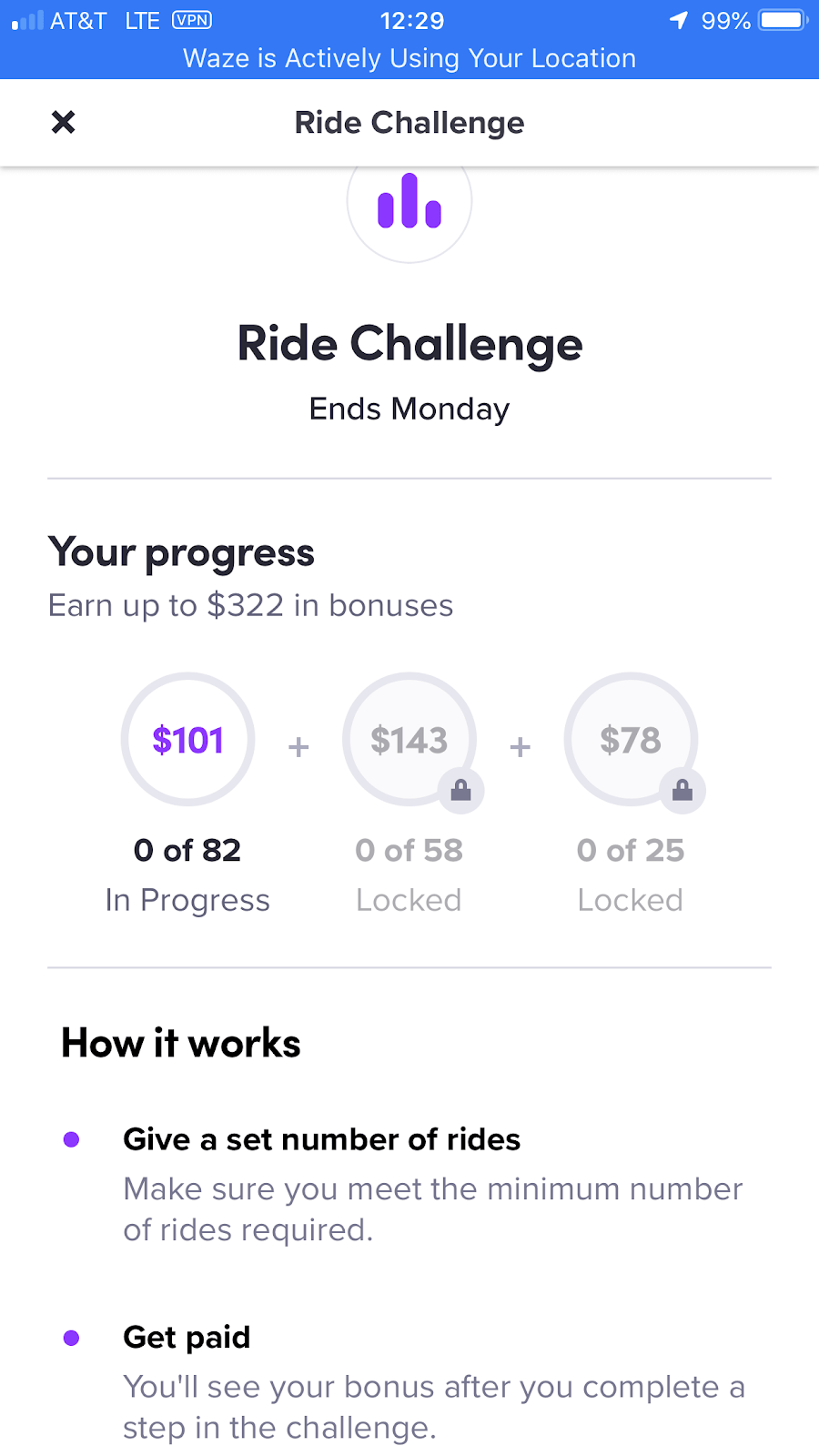
If my company is paying contractors, they generally want them to be busy; I'm not sure what you mean by that
WRT the anti-competitive statement, are you suggesting that lyft is intentionally making it harder to drive XL for both uber and lyft? TBH, I'm not sure that'd hit on any competition laws but I'm willing to be convinced
Thank you for your post, it lets me see a lot of things I would have never put together. It's impressive how much thought lyft put into their platform to monetize guilt, and ensure "stickiness" of their platform / drivers
That is just what I got from the original post, I do not work for either company so it really is hard for me to relate to the pressure OP is feeling.
A nation of temporarily embarrassed millionaires.
I would love to be the health insurance provider getting Uber as a client. I'd be freaking rich on premiums.
The number of rides change as the price of the ride goes up, which happens when you raise the underlying cost to the rider. (aka supply and demand)
The number of drivers change with the overhead cost-per-driver. If each driver has a fixed healthcare overhead, it makes sense to hire only full time drivers as you can pay the overhead once and get the most hours driven from that sunk cost.
The number of drivers that get hired if you bump the salary also declines for all the reasons above.
Obviously it'd be better if all jobs were reasonably-paying and had protections, and you could directly replace all the bad ones with better ones, but that's not the world we live in.
Withdrawing from pre-tax retirement accounts counts as income for ACA purposes. You've now lowered your annual expenses (and thus, your income) and can qualify for subsidies, but all you've really done is shift some of your net worth from investment accounts to housing, in order to reduce annual expenses. This example is likely more applicable to a person in retirement, as well.
I don't doubt that for people with some money, it'll be common to countdown using similar strategies for 5-10 years until you hit the magic 65 age. Given the difficulties in staying employed until full retirement age for programmers, it's quite a gift.
In another couple of decades, a lot of people get to do the pay-down fandango where couples split their assets so that one doesn't pauperize the other (via annuities).
All brought to you by the market warping body called government.
Uber pays them directly for a big commercial contract to cover you when you’re driving for Uber.
Edit: added "for Uber" on the last sentence
"ridesharing drivers operating on the Uber platform in Ontario can now be covered, at no extra cost. All you have to do is call us in order to update your personal auto policy." -- https://www.belairdirect.com/en/partnerships/uber.html
Once you ignore these costs, and only do "income - fuel", Uber pays "really well". And you can do it at any time, as you wish! Little effort! Own boss!
It's not surprising that Uber finds people to drive for them. Not everyone realizes the hidden costs.
Although there are apparently some who seem to understand them, know how to play the optimization game, and (think that they) make enough that it's worth it. I have no way of checking, of course.
Instead we've subsidized all these gig corporations so frequently that one of the biggest ones pays 0 in federal taxes. Something I don't even get the choice to do.
It's about time we stop capitulating to desperation.
which one is this?
It must be nice to sit in air conditioned office on $800 chair, sipping kombucha, looking at 2x 28" 4k monitors pontificating "Why would anyone want to be driving for uber?"
Because for an Uber driver this job could be the best available. One needs to eat and put a roof over one's head.
There are not enough In-and-Out burger places to accomodate all the Uber and Lyft drivers.
There are very few employers of non-skilled labor that provide higher take home pay for the same or smaller number of hours worked than Uber.
You should ask anyone who does unskilled labor if they would take a less paying job.
From my perspective, and I do realize this is relative, people wonder why the middle class is shrinking while failing to realize that a lot of these pro-worker laws are only good for certain types of workers. I'm not saying people poorer than me don't deserve help because I haven't been helped yet, but the issue is precisely that it seems (again, relative to my experience) that no one except the lowest income bracket actually attract political attention right now.
Rideshare insurance is an extra $10/month. Basically nothing.
I have to pay for my own healthcare when I have a regular job too. Buying on the exchange is pretty much the same thing with more choice.
OTOH (or the other other hand), I'll bet that you could make a strong argument for stopping new drug development entirely. Simply sell existing drugs for as little as possible. It wouldn't surprise me if most of that research has insanely high marginal cost with little benefit at this point.
I'll bet you'd have a healthier public, on average, if this happened.
Under this rubric, "cheap" lifesaving drugs are viewed as an arbitrage opportunity. If a lifesaving cancer drug costs $20k per month, then why should a comparable MS treatment be "given away" at $15 per pill?
Also a huge percentage of new drug research is not geared toward creating new and interesting treatments: it's based on making small changes to existing molecules to preserve efficacy while making something "new" enough to be patentable.
It's really not that simple, even if some political talking heads would like you to think so. People travel to the US for some treatments, and people travel from the US for others. It's not even clear if there is a net inflow or net outflow.
All this really shows you is that people with the resources to do so are willing to travel for care, which shouldn't surprise anyone. Either for "the best treatment" (which depending on disease and treatment could be many places in Europe, US, Canada, etc.) or for more affordable treatment (cf US residents traveling to Canada for drug renewals).
That's far from clear. Polling fairly consistently shows that the US public favors at least some degree of it (particularly shifting the healthcare burden from employers to government, other benefits have less political salience), though any particular plan for the detailed mechanism may have trouble gaining majority support.
IMO it's not just hard but impossible for polls to be unbiased, because people that don't like answering polls are never represented. If the subset of people that don't answer polls isn't itself following the same distribution over all possible opinions as the rest of the population the results are biased, and by definition we can't test for these correlations.
Why not? Canada didn't always have their healthcare system. Canadians just agreed on something and suddenly they had it.
The premise was pretty much: take a question that might sensibly appear on a GED test (highschool graduation equivalency, without the class credits), that probably at least 50% of the viewers (so adults that could afford a TV and stay awake until midnight / had just finished watching the news) would probably, if not know, have a good enough idea to say if an answer was obviously wrong. Then go out and film until you got enough bad answers to fill the segment.
I'm under no illusions that the bad examples were cherry picked, but I am also strongly inclined to believe that a "large percent" of the population isn't informed, and doesn't want to be informed, and literally just isn't fit to actually vote.
The US believes everyone should have the right to vote; and I agree with that. However I believe that every voter should be an informed voter that can at least understand the basic impact of their actions and should at least be able to pass an ECON101 test. I would really prefer a local, national, geo-political, basic law, and economics (including some light math) test as a pre-requisite for being able to vote; BUT if the test isn't passed that person would qualify for employment (lit paid) as a student, where attendance in class and academic progress would be part of the pay. If there are medical issues/etc impeding learning that should already be covered by universal health coverage (in a non-broken country).
I get a feeling you think you are one of these voters. But are you, indeed? Are you really sure you can predict the impact of the actions in a system as complex as 300 million people inside trillion dollar economy? Before you answer that, remember that many people with advanced degrees tried and failed to predict things about economy, and even more people with advanced degrees are in constant and complete disagreement about what would be effect of that or this policy and what should be done to achieve this or that effect. And "unintended consequences" appears in virtually every article describing the aftermath of any serious government decision. If all those people aren't really able to figure out how things work, are you confident you are?
> should at least be able to pass an ECON101 test
Why ECON101? That course probably provides very basic knowledge (depending on the curriculum) which is next to useless when dealing with enormous and complex systems because it ignores myriad of details. It's ok for a 101 course, but if after taking this course you think that you know enough to make informed decisions about the whole US economy, then this course actually decreased the amount of your actionable knowledge. And yes, voting is making decisions about the whole US economy, ultimately.
> I would really prefer a local, national, geo-political, basic law, and economics (including some light math) test as a pre-requisite for being able to vote
Are you sure you would pass? What if I will be writing the test and make every effort to make you not pass (you don't think politicians would ignore an opportunity as juicy as disenfranchasing a huge number of their opponents' base?)?
You understand also that making decisions for people that can not vote is the reverse of what representative democracy is, and a just cause for rebellion? If any situation justifies violent overthrowing of a government, it is a situation where the government denies participation in vote to a class of citizens which committed no crime, did nothing wrong but failed to satisfy an arbitrary criteria somebody instituted to not let them vote because they didn't like what they might choose. Who would consider such a government a legitimate one? You probably wouldn't, if you were one of the disenfranchised people. But somehow nobody thinks they will fail the test.
It's really basic stuff, that's why it's a 101 course. However the realities of that kind of course should be remembered and applied to things like "rent control" that acts as an outside influence on where the curves meet, but doesn't actually change the supply or demand directly. Knowledge that would help with assessing the possible intended and unintended results of different laws.
However you miss a points. It's not always or not even often about picking from 2 complex alternatives. It's often a matter of eliminating options that are stupid, illogical, or inconsistent. Doing so often requires basic literacy in the topic involved.
Unfortunately you are right in that disenfranchising a large number of idiots would upend social order even if it was only eliminating those who literally have no idea what is going on.
But how do you know which options are stupid? Because they sound stupid to you? Are you confident enough in your powers of detecting stupid that you would base denying people basic rights on it? What gives you that enormous confidence?
> if it was only eliminating those who literally have no idea what is going on.
The number of people who have an idea what is going on, when we're talking about things like whole US economy, might be surprisingly small. In fact, sometimes I am tempted to think that number is zero. Of course, for me it makes me think maybe we need less government involvement, since a blind giant with a sledgehammer is worse than a blind giant without one, but some people think that means we need to abandon democracy. OK, but unless you are an anarchist, how do you propose to choose the government then? By instituting a series of exams? Chinese tried that, actually. Not sure it worked that spectacularly well. Check it out.
The solution should be to level the playing field (Access to education), not to change the rules of the game from under them.
... "BUT if the test isn't passed that person would qualify for employment (lit paid) as a student, where attendance in class and academic progress would be part of the pay."
Yeah that's right - nobody knows which healthcare programs work. Neither literal idiots, nor uneducated hillbillies, nor ECON101 graduates, nor PHD-bearing professors, nor politicians, nor NYT journalists, nobody has any good information. On a topic as important as which healthcare policies actually work. So what's the point on insisting on ECON101? There's just no information about it, and nobody cares about getting one.
https://data.oecd.org/healthres/health-spending.htm
There are reasons for this; some of them good (the best care in the U.S. is very high quality and leading-edge technology, and consumer protection through litigation tries to minimize errors); some are bad (e.g. because of litigation, legal costs are very high, and the system seems to carry a lot of overheads, and many people still lack coverage).
It seems the so-called Obamacare wasn't a very good approach, because so many people felt it was ripping them off. Clearly it is easier to build an efficient public health care system from nothing (like e.g. my country Finland did in 20th century) than transform an existing system (which the U.S. has and where there are lots of incumbent operators that have "assets" that they protect.
Does this account for confounding factors? Such as the US having the highest obesity rates, which has a massive impact on costs and life expectancy.
I'm for universal healthcare, but "X has these results in Y, therefore it'll be the same in Z" is a poor argument and weakens the overall case.
One thing that is easier to evaluate is the cost of delivering equivalent care - the US system turns out to be quite inefficient that way, which implies the potential for significant cost savings at least.
Actually a majority of Americans support the idea of single payer healthcare [1], and the number goes up depending on how the question is asked. The problem is the political obstacles, which are enormous given the power of the health insurance, pharma, and hospital industries.
https://www.kff.org/slideshow/public-opinion-on-single-payer...
Could you share some data that supports this? Polls I have seen show that a majority of Americans support expanded health care coverage.[1][2][3] There is some division howwever on whether that is best done via Medicare For All or a regular single payer system.
[1] https://www.pewresearch.org/fact-tank/2018/10/03/most-contin...
[2] https://www.kff.org/slideshow/public-opinion-on-single-payer...
[3] https://www.pewresearch.org/fact-tank/2017/01/13/more-americ...
Sure, you might be healthy now but do you really want to take a gamble like this and keep more money in your wallet now, and potentially lose everything due to bad luck later? I guess it's the American way?
I don't think this is true. I think what the US public doesn't want is the higher taxes to pay for it. We are already swimming in debt and wages haven't kept up with inflation. My daughter is making exactly the same wages now that I made when I was her age 25 years ago, in comparable jobs.
You're likely paying something similar whether you realize it or not. When I quit my job the COBRA cost of the insurance was like $600 or $700/month. It's just that your employer is hiding that cost from you and giving you "free" medical insurance. And when you quit your job, you lose your medical insurance after 6 months. That means you lose access to your doctor and you may have to change who you see. Sometimes the new doctor is way worse, and there is a very real cost to you in terms of their standard of care.
So it's pretty disingenuous to argue that this would be a new tax. And making it illegal for employers to offer health insurance while also expanding Medicaid to all Americans would actually remove a major barrier to quitting your job and EG starting a company or working for a small company.
I used to paste links to these posts here but people felt I was spamming, so I don't do that anymore.
Feel free to look at my other comments and posts on Quora as well as reach out to me. We need more people like you to bring prosperity.
The status quo will not bring us prosperity.
I guess what you mostly get is a very expensive military.
This is a gross oversimplification. Two risks that immediately come to mind, increases to the Employer’s Disability Insurance and Unemployment Insurance either through fraud(speaking from experience), or, in the scenario mentioned by gp, when you lay the worker off at the end of the need.
My comment also is a gross oversimplification.
evidence? from 2017 shows more support than not.
https://www.pbs.org/newshour/health/62-percent-u-s-want-fede...
but you must not forget the additional administrative/accounting overhead, the risk from the wide variety of lawsuits one is vulnerable to as an employer, the risks of employee injury on the job, and costs associated with the possibility of laying off employees in the future. surely there are more costs than just wages.
That's still the same problem. If the taxes that fund the health care are paid by employees then a living wage would have to be higher to account for having to pay the taxes. If they're paid by the employer, there goes the money they were going to use to hire the employee, or they have to raise prices and we're back to causing a higher cost of living.
Taxes aren't magic. The money still has to come from somewhere. The actual problem is that housing and health care cost too much. It's necessary to solve that regardless of who is paying for them, at which point there is no longer a pressing need to try to shift the burden somewhere else, because the burden is no longer so onerous.
All that is needed is to undo employers providing health-care. The government could provide it, but it could also work akin to auto or home insurance where you the individual choose the company yourself. (I do think we need other reforms, principally price transparency, in order to manage the current cost problems w/ health care. There is no sane way for any person to evaluate anything about any insurance setup if they cannot gauge what it will cost them!)
Tax-based universal healthcare would accomplish this, but I do not think it is necessarily the only option. It does need to stop being attached to the employer. Losing my job should not cost me my healthcare, too.
Or just disconnect this stuff from the employer. It seems strange that employers are involved in something like health insurance. It creates friction changing jobs, and much of the population isn't employed.
Yes, they do.
This is kind of a pointless question, because the answer is complex and includes things like 'gerrymandering' and 'vote suppression', but it's still a fact that many elected representatives from both parties actively fight public health care.
A majority does, in fact, want this.
https://www.pewresearch.org/fact-tank/2018/10/03/most-contin...
Yes, it's clear that our prosperity hinges on how quickly we decouple health care from our employers.
Employers don't want to be in the business of providing healthcare to their employees and its painfully obvious.
I just don't understand why smart people think it's a good idea for anyone other than me decide what my healthcare needs are!
I would like to have a separate discussion whether the government is the best party to handle this. If you look for my writing here and on Quora, you will see that I have for over a decade being campaigning the government was the best party, but after having really worked on it (thanks to people getting in touch with me from my writing), I no longer believe the government is the best partner.
Instead, I think the government managed marketplace where people choose private insurance is actually a brilliant solution and ACA already provides that, so we already have that in place.
The value the government brings here is extreme negotiating ability with the private insurance providers that individual citizens lack.
> The US public does not want this
I strongly disagree.
I have spoken with far too many (thousands) of people to know that majority of the U.S. hate their employer provided insurance and are worse off for it. I can give you specific instances where an employee was worse off due to the employer provided insurance and had to declare bankruptcy due to medical bills than if they were unemployed to begin with and were on welfare instead!
I seriously believe:
1. the tax incentives to provide employer provided insurance should be abolished. They made sense at a time that's past us now.
2. employers instead should be required to pay a premium for choosing to provide primary insurance to employees instead of letting employees continue with the coverage they have or get one from the marketplace
3. Employers are free to provide secondary and supplementary care insurance if they chose to, not due to regulation.
This leaves behind only those employers who genuinely care about their employees instead of pretending to do something because someone forces them to.
I support the individual mandate in the ACA because it ensures negative self selection in the marketplace.
This will allow people to gain control of their own healthcare, get a benefit package that's more transparent and gain better control of their own lives.
As software engineers, we are in the top tier of employment. We earn in the top tier of the population and handle levels of complexity in the top tier of the population.
Our personal experiences don't reflect that of the general population.
Even then, the engineer making $180k/yr at Microsoft might have a very different healthcare experience compared to the engineer making $180k/yr at Google depending on the choices that the benefits administrators at Microsoft and Google have made!
That's just insane and a level of complexity that's just unnecessary.
This is not good, it distorts the market too much. Look at the negotiating power Spotify and Pandora have over musicians. Pandora negotiates rock-bottom prices with musicians on behalf of its consumers and the consumers think it's great because low prices. Long-term you've decreased compensation for becoming a musician, sound engineer, etc. and harmed the entire music ecosystem.
It's a trade-off between clear short-term gains and diffuse long-term costs.
However, when I see people being unable to afford medication or losing a significant amount of their wealth to afford medication, I start to have second thoughts.
It seems to me, that in a developed and advanced society, one ought to be able to live a quality and comfortable life enabling them to contribute to the good of society as a whole.
Drug prices in the U.S. are at a completely different level compared to any other developed nation.
Because regulations have been put in place to disallow the U.S. government from negotiating with pharma companies on drug pricing.
The regulations were put in with good intentions (and some healthy doses of lobbying) in ensuring pharma companies would have financial incentives to carry out R&D but hindsight is, as they say, 20/20.
Even in the face of these drug price regulations, though, the government still has a much higher negotiating ability than you or I do.
Check the drug prices one pays with Medicare Part D vs. the prices on "free market" Amazon or eBay.
If you have a point to make instead, say it.
I don't know what you're thinking but it feels like you seem to believe that only direct actions have effect.
That's not true. Indirect actions have effect too.
Just because the government's hands are tied in drug pricing does not mean the drug companies can charge the government whatever they want (like they can charge you or I).
For one, it has sheer size and it's pretty powerful overall.
It will take an extremely risk seeking drug company to try and exploit the government and drug companies are extremely risk averse.
Let me give another example - if you interviewed for a front end job this week at either of the coasts and refused to negotiate or name a number, most companies, if not all, would still offer a six figure number because that's the market. I WOULD be surprised if anyone offered you a minimum wage even if you were actually willing to take it!
Another example - say you are driving properly on the freeway following all rules like a perfect citizen and a cop car drives by - in general you're likely to take notice of that and be more careful in the way you drive even if the cop car in no way signalled to you or otherwise expressed any interest. Even if you knew this cop was not allowed to pull you over, you still would modify your behavior. In general for the better.
Compare your change in response to all other cars driving by you - one even might have flashed its lights at you and you showed them your middle finger. You probably wont do that to this specific car though.
Or if you went to an fancy event where the organizers explicitly asked you not to bring any gifts because they knew you were going through a tough time but you saw everyone else bring in expensive gifts, you would probably go out and try and get something reasonable, despite being explicity directed otherwise.
Just because one does not actively signal, or might even be obstructed from signalling, does not mean there is a complete lack of signal.
Drug companies have more to gain from keeping the government happy than making it unhappy.
To that end, they are willing to forgo some profit.
They dont have any reason to do so for you or I.
We are at a natural disadvantage: If you needed drug "GiveLife" to not die tomorrow, you would probably give up a significant amount of your worth or even go into debt to pay for GiveLife.
The government is not a singular entity, but it does exercise some semblance of self-consistent control. The drug/insurance companies have no interest in minimizing their profits aside from following regulations so as to limit potential liability. If the drug companies can successfully lobby for less control then the government's bargaining power is impaired de facto.
Really, say it because I have no idea what your position is and we have been communicating a bit at this point.
You have repeated twice now that the government's bargaining power, is impaired. Yes, that's what I said in my parent comment 2 days ago. Why are you repeating what I said, to me?
No, my previous comment was not ad hominem because I didn't know the position you were taking and I still dont know what position you have on the matter. I noticed tunnel vision on your part that was imparing the quality of the conversation and I suggested a technique I often follow myself. If you want to argue the semantics of an ad hominem, I am out of time.
Is your point that the government's bargaining power, which is impaired, less than the bargaining power citizens like you and I possess?
To clarify: My point, with the tenuous analogies included, is: the government's bargaining power, even after being severly impaired, is still superior to the bargaining power citizens like you and I possess when it comes to negotiating the prices of drugs that we need to get and be better.
Other developed countries recognize this and exploit it to the benefit of their citizens. Perhaps we should think of something similar but outside government.
On a side note, questioning someone's motivation and/or ability to comprehend the relevant information and form opinions based on it is definitely a form of ad hominem, and definitely not the right way to start an attempt to clarify.
Uhhh... nearly every other country other than the US has had some form of national health service for decades and they spend less on healthcare per capita for comparable quality.
What you're spouting is nonsense.
- government projects often have multi-year funding commitments legally bound by legislation; virtually no private enterprises have such guaranteed runways
- goals of government projects are often not "survive then maximize profit at all costs"; in fact, the idea behind infrastructure projects is for extreme long term payoffs, virtually impossible for from-scratch private projects due to lack of capital whereas .gov projects don't have the survival component
- because of things like infrastructure and overhead, there is evidence that public utilities with monopoly-like properties make more sense than rampant theoretical capitalism (imagine 100 sewer companies with 100 sets of pipes, ...)
If anything there is more changing, and stricter controls on (if you don't include departments like defense)
The US public does not want this, though, and the war of words over universal health care has led to incredibly deep entrenchment on the side of those opposed. All this despite the mountain of evidence from other countries, showing the greatly reduced total costs and improved life expectancy as well as a lack of bankruptcy and financial ruin for those caught in an emergency.