Grains are the core of the human diet, and have been since the dawn of civilization. But they are only edible because of civilization - the grinding, fermentation, and cooking breaking them down into something our bodies can use.
In the US and other wealthy countries, we might feed grain to livestock, but it's also often parts of grain that we can't really eat (hulls, etc). And in poorer countries, livestock are often open-grazed on grasses that are inedible for us. And non-grazers like hogs often eat garbage, food waste that we don't consume.
When farming, the questions are even more complex. The livestock generates manure that fertilizes the fields, so much of that "lost" energy is recovered.
The bulk of livestock feed is corn (which has seen tremendous yield improvements since the 1960s through "green revolution" techniques), and for protein content, soyabeans, which have rather pointedly not.
Additional silage provides some but AFAIU considerably less general nutritive content. And you will absolutely find vast acreages of corn and soyabean in the flyover states destined entirely for livestock feed. Not table crops with the leftovers going to livestock. Fully 100% livestock-dedicated.
Integrated farming operations in which cows run loose amongst the corn and wheat fertilising the fields are ... effectively nonexistant.
Theoretical possibilities are not on-the-ground, in-the-dirt, realities.
If you're talking about thermal efficiency.. what you're saying is true but irrelevant. Whether my food is the optimum use of sunlight is not a real concern.
The alternatives to sustainable, integrated, ecological agricultural methods are "cheaper" because the market doesn't price in the 5-million-years-to-one rate at which we're extracting fossil fuels from the Earth over that at which they'd been put there,[1] of the strip-mining of topsoil at rates 100x - 1000x greater than those at which it had formed, of the natural-gas-fed fixing of atmospheric nitrogen (again at a roughly 5 million:1 ratio of inputs), of the mining of phosphorus, another critical fertiliser (potash is, for the moment, relatively abundant), of the impacts of eutrophication of rivers, wetlands, and oceans near ag-land outflows, of the systemic risks posed by monoculture cultivation, of the systemic ecological impacts of pesticide use, of the destruction of virgin ecosystems and biological diversity, and more.[2]
The "economic" costs are actually financialised costs, which include a long, peculiar, historically-contingent, largely malformed and false worldview model origin, which persists for numerous reasons, largely boiling down to being a highly convenient fiction for contemporary beneficiaries of this particular theology. Though the difficulty in moving to a more accurate, realistic, and one might hope sustainable model is severe. The convenience of the modern lie is profound.
Upshot: "cheaper" is based on invalid models heaped on invalid models. There's a vast unbooked debt accumulating.
________________________________
Notes:
1. Jeffrey S. Dukes, "Burning Buried Sunshine" (2003) https://dge.carnegiescience.edu/DGE/Dukes/Dukes_ClimChange1....
2. Lev Tolstoy has an early and fascinating discussion of cost accounting and factors of production in What Shall We Do Then (https://archive.org/details/whatshallwedothe00tolsrich/page/...), finding the standard three-factor model of the time, land, labour, and capital, insufficient.
The economic theory seems to derive directly from cost accounting, dating principally to Alexander Hamilton Church (https://en.wikipedia.org/wiki/Alexander_Hamilton_Church). The problem of defining economic theory to guide accounts based on what accounts tallied to inform economists seems ... problematic.
The legal and economic theory of extractive resources has a long, problematic, and almost entirely unscientific history, specifically the Rule of Capture and its logic, and the principle theory of pricing, which though largely dismissed doesn't seem to have found a replacement: Hotelling's Rule.
Now, it's just a matter of time before fossil fuels are no longer an issue - we are rapidly moving to renewable energy. And that will have a significant impact on farming practice, by altering the cost of tillage and transportation. And as these costs accumulate to the point where they enter the financial equation, farming technology will adjust accordingly. That's what the market does.
So what is "sustainability" here? Are we worried that the agricultural system will break so rapidly that it causes massive famines?
To give a concrete example, Google (well, "Alphabet", but really, Google) launched a project whose entire premise and name were "RE<C": renewable energy cheaper than coal.
It failed.
https://www.greentechmedia.com/articles/read/google-engineer...
The problem, if you subscribe to my view, is that the underlying premise was wrong. It's not that renewables are too expensive. It's that the accounting for coal's costs are entirely flawed.
An interesting implication is that if the underlying accounting, tax, and economic model is changed, fossil fuels will be glued to the ground by a force far stronger than gravity: economic fiscal reality.
What are the odds of that happening? Frankly, low. I'm looking to see how much that particular Overton window might swing, however.
Addressing your ag question: Another of my academic remits (both agriculture and economics). There are any of numerous problems, most revolving around various forms of risk. One of my personal collapse scenarios would involve major, possibly multiple simultaneous, crop failures, whether from weather (most likely drought, floods or freezes might also have impacts), disease, a polination collapse, or something similar. There are some food reserves, but those are decidedly finite and would present severe difficulties at mass scale.
Even through the mid-20th century, massive famines resulting in millions of deaths were seen. The most recent major famine was in Bangladesh in 1974 -- the 1980s Ethiopian famines were comparatively mild, despite the worldwide coverage they drew.
Critics of Communism like to point out the Great Famine of China (1959-1961), in which 15-30 million, of a population of about 660 million, died. Roughly 5%. These same critics ignore the 1920s famine under noncommunist Nationalist China, or the numerous 19th century famines under what was largely British control, or the English-exacerbated Great Irish Famine, which saw a fifty percent reduction in the population of Ireland, from a peak still not matched to this day.
Throughout history, famines in which 10%, 30%, or even 90% of populations have died over wide regions have been fairly commonplace.
In a world of global supply chains, massive monocultures, limited self-sufficiency, and vast inequalities of wealth and military power, a recurrance would be an exceedingly notable event.
Though catastrophic collapse isn't the only possibility. The slow yield decline of overworked lands is another possiblity, and again, soil, water, fertiliser, and pest pressures can build with time. Adjustment to such a gradual erosion should be less severe, but still strongly dislocating.
So what are the odds of something like the Irish potato blight happening on a nationwide or worldwide scale, large enough to disrupt a global food supply? Like the entire US corn crop failing all at once? I'm more concerned about genetic monocrops like Gros Michael bananas or rubber trees than I am about rice or wheat. But one country having a bad year? That's not the problem it was.
Slow yield declines is also a concern, but those are likely to be regional and crop-specific. These things can be managed with modern farming techniques - change crops, or use alternate varieties.
And beyond that, I think we have at least one, maybe a couple more agricultural technical revolutions up our sleeves. The first is already underway - detailed sensors monitoring crop quality down to a plant-by-plant level. When integrated with small, inexpensive crop-tending robots, whole new worlds open up. Who needs "Roundup Ready" when robots that can recognize and pull weeds on sight are roaming the fields? The second is also underway... starting with GMO crops, but I think we will cross over to genetically targeted poisons for common pests. There's a lot of potential there.
On the plus side: crop diversity (three or for major staples), regional production, and major transshippment capabilities.
On the negative side, continued massive global inequality, high birthrates in the poorest (and in some cases least agriculturally productive) lands, and a globally interconnected transport (goods, people) network that's phenomenally effective at spreading disease and pests, changing climates and sea levels, and a continued reliance on unsustainable inputs, as well as major increases in plant productivity largely by offloading native disease resistance with artificial supplementation, and, despite the 3-4 major crop diversity, a very high level of monoculture within those.
The main question will be whether a famine will be localised or globalised. As an example, China is buying up cropland rights in Africa now, much as England once did in Ireland, or the US exported colonial crop cultivation in Latin America. If Africa gets hungry again, who eats what is produced? Africa or China?
In several recent historical famines, money and legal institutions and dynamics starved farmers and fed cities, most especially in the Great Irish Famine, Holdomor, and Dust Bowl.
The general problem is one of building an increasingly complex and optimised system until it starts failing critically at multiple points, stressing resouces and knowledge. Joseph Tainter's The Collapse of Complex Societies (https://www.worldcat.org/title/collapse-of-complex-societies...) gives the general dynamic. Much of the reading on complex systems bolsters his view, as does the study of ancient civilisations. Most of which thought themselves the ultimate pinnacle of progress.
Additional technical means are possible, yes. One of my projects over the past few years has been looking at the mechanisms by which technology works, and the specific capabilities and limitations of these. I've come up with a fairly consistent list of nine:
1. Materials: Substances, minerals, elements, molecules, organics. Provide properties, have associated abundance, cost, and side effects.
2. Fuels: Dispatchable consumable stores of potential energy, largely fossil fuels, biomass, and nuclear. (Stored and kinetic or photovoltaic potential are considered separately: wind, geothermal, hydro, solar.)
3. Process knowlege: Roughly, technology. Domain-specific understanding of how to achieve some ends, independent of other characteristics.
4. Structural knowledge: Roughly, science. Domain-specific understanding of causes and interactions, based on experience, experiment, and observation.
5. Power transmission and transformation: Any communication or conversion of power or energy. Examples: missiles, shafts, rods, gears, electricity, magnetism, beamed energy, batteries.
6. Networks: Structures usefully describable as nodes and links or vertices and edges, whether physical or conceptual, having arity and topology. Examples: transport network, web of knowledge, comms netwok, social netework, land and its varying qualities and capabilities.
7. Systems: Multi-part structures (often networks) with sensing, processing, action, and assessment feedback loops. Roughly, the domains of cybernetics, operations research, or systems theory, in the general, or the topics of most social sciences and management domains.
8. Information: Receiving, parsing, processing, storing, retrieving, and transmitting. Examples: speech, writing, logic, magnetism. Affects focusing activities, managing systems, or disrupting other (or others') systems.
9. Hygiene: Side effects and unintended consequences affecting overall function. Inevitable, often emergent properties, which require mitigation or management.
What this provides is a way of looking at problems (or solutions) and breaking them into components that are not siloed by traditional disciplines (scientific or technological domain silos), hence, they are mechanisms. You get something more useful than "technology is efficiency", or "the power of thought". It's also possible to look at past developments in terms of what contributed to them.
Ag has benefitted hugely from domain-specific knowledge: what plants grow where yielding what requiring what inputs, methods, protections, and processing, and further through hybridisation and now direct genetic manipulation. From energy inputs, especially in supplying water, but also in preparation and transportation. From mechanisation of cultivation -- tractors, combines, and harvesters. From energy- and materials-specific treatments of fertilisers and pesticides.
The biggest changes in 200 years have been the vast reduction in labour inputs (from ~90% of the population to < 2% in most industrialised countries) through mechanisation, and Haber-Bosch ammonia synthesis for fertiliser. Hygiene factors -- management and suppression of disease and pests -- has been another major factor, but produced further hygiene effects consequent of pesticide use. Fertiliser overuse is another hygiene effect.
What automated rather than merely mechanised methods can provide is the ability to further reduce labour, though as that's already low on staples, an Amdahl's Law type dynamic kicks in: parallelisation (of labour inputs) is limited by the nonparallelisable portion of your operation, an example of mechanism-specific limitations. You're also pushing utilisation to ever-more marginal land -- there's more of it, yes, but it's frequently more easily damaged, or more subject to swings in climate, hydration, salt intrusion.
And we're left with the bits we cannot readily change: perennial crops can be sown or left fallow, but vine and tree crops require consistent maintenance across years, if not decades and centuries. Topsoil, literally the top few centimetres or metres across large parts of entire countries, is not a factor which can be meaningfully artificially manufactured, though it can be moved or amended, with tremendous effort. Salinisation, desertification, and innundation are threats that can be managed poorly. As are runoff and ecological disruptions from fertiliser and pesticides, or habitat displacement.
TL;DR: Technology lets us approach limits. It does not let us erase them.
Which is why grassfed > cornfed in pretty much every situation except for the extra fat/flavor you might get from cornfed beef. Having cows that consume grass is a win-win. The grass absorbs sunlight instead of reflecting it back into the atmosphere like a feedlot does, the grass is digested better, and manure fertilizes the grass. And when the cows are moved to different pastures and chickens are brought in, they help to agitate the manure into the soil to help that fertilizing process along.
I wish the grassfed beef industry was embraced more instead of people attempting to swear off beef completely.
Cornfed beef is a result of economics, too - it's cheaper to buy corn than use pasture, and/or it produces meat that can sell for higher prices. We don't just see corfed beef for fancy prime steaks. It's used in cheap fast food hamburgers as well.
Fast food and junk food are the cheapest food. They've applied industrial logic to every link in the food chain. If meat was as expensive as vegans argue, we wouldn't see it as the basis of so much fast food.
https://www.progressiveforage.com/forage-types/silage/what-i... https://beef.unl.edu/cattleproduction/forageconsumed-day
I don't know if it does or doesn't, but you might want to incorporate that into your model.
(NB: I'm not a vegitarian myself. I'm quite familiar with arguments. And have some familiarity with feedlots.)
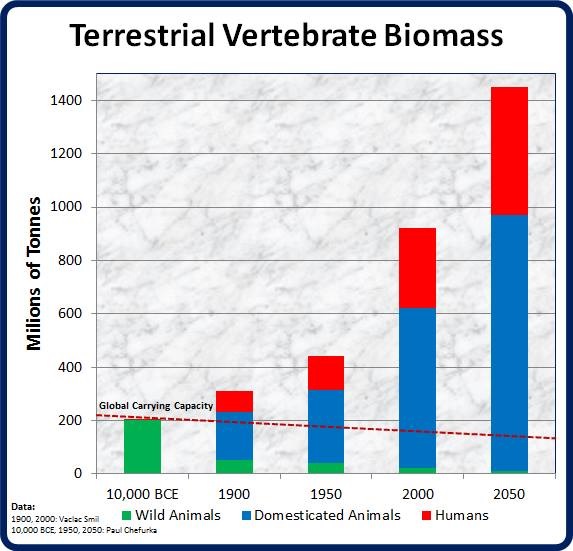
The net terrestrial vertebrate biomass has shifted markedly over the past century (and undoubtedly over the previous 50,000 years of the Human Diaspora). What the pre-Columbian American bison population was I have no idea.
Total pre-industrial wildlife biomass ~10,000 BCE, by estimates, was ~1/7 that of the present, and smaller than humans in total:
http://peakoilbarrel.com/wp-content/uploads/2015/04/Terrestr...
The herds may not have been that big pre-columbus.
This article is false. The Navajo / Clovis Indians never stopped eating meat. They continued to hunt and they raised lamb and goats. Mutton formed a staple of their diet, along with fried bread and goat milk. Clothing was formed from deer skin and yucca fiber. Note, they hunted the deer. And note, they ate the deer. They also ate the yucca, but it wasn't all they ate.
https://navajopeople.org/navajo-food.htm
"The people in this area responded in an interesting way: by focusing much more on gathering, and less on hunting. We know this from their improved tools for processing plants, especially yucca roots."
Just because they improved tools for eating yucca doesn't mean they stopped hunting. Presumably, all of their tools improved, including hunting tools.
They also raised lamb and sheep. I've been to the Taos Pueblo near there, it's 1000 years old and it has a large meat rack centered in the village, for drying meat out for jerky and pemmican.
The caloric density of meat and protein / fat content is much, much higher than found in vegetables...especially wild vegetables.
And no, we don't have the same gut bacteria or digestive tracks as livestock. Sheep, goats, and cows all have four chambered stomachs and are ruminants. They have trillions of microbes in their stomach to process grass and break down cellulose. They also have a digestive tract that is 27 times longer their bodies versus a human's 3 or 4 times length. We couldn't digest grass like them if we tried. Plant foods are much harder to process than animal foods, because of cellulose. The human gut length ratio is similar to an obligate predator like cats.
Plants, in net, capture about 1-3% of available solar energy and convert that to equivalent biomass. Food conversion -- the parts you can eat -- are a small fraction of that.
Herbivores and predators each convert about 10% of the food energy they eat into body mass, for a 90% reduction (approximately) at each trophic level. Grazers lose 90% of the primary plant food energy, first-order predators lose 90% of the herbivore food energy, second-order predators (rare, but they do exist), lose 90% of the first-order predator food energy.
This is known as the trophic or ecological pyramid:
https://www.britannica.com/science/trophic-pyramid
Yes, eating something that can eat what you cannot is a net win. Eating something that eats what you can (most contemporary livestock) is not.