Cornfed beef is a result of economics, too - it's cheaper to buy corn than use pasture, and/or it produces meat that can sell for higher prices. We don't just see corfed beef for fancy prime steaks. It's used in cheap fast food hamburgers as well.
Fast food and junk food are the cheapest food. They've applied industrial logic to every link in the food chain. If meat was as expensive as vegans argue, we wouldn't see it as the basis of so much fast food.
https://www.progressiveforage.com/forage-types/silage/what-i... https://beef.unl.edu/cattleproduction/forageconsumed-day
I don't know if it does or doesn't, but you might want to incorporate that into your model.
(NB: I'm not a vegitarian myself. I'm quite familiar with arguments. And have some familiarity with feedlots.)
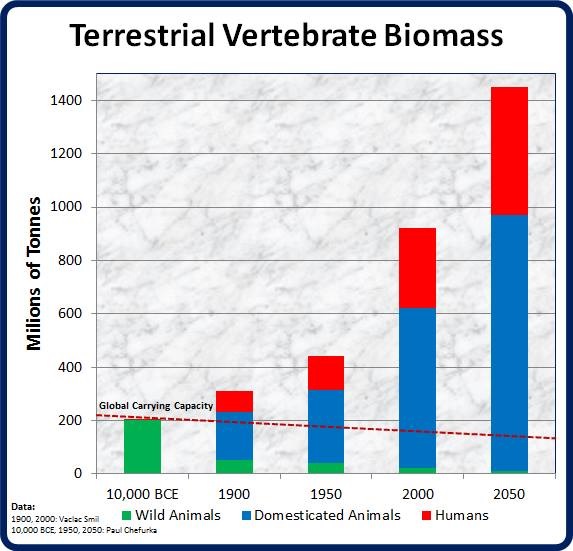
The net terrestrial vertebrate biomass has shifted markedly over the past century (and undoubtedly over the previous 50,000 years of the Human Diaspora). What the pre-Columbian American bison population was I have no idea.
Total pre-industrial wildlife biomass ~10,000 BCE, by estimates, was ~1/7 that of the present, and smaller than humans in total:
http://peakoilbarrel.com/wp-content/uploads/2015/04/Terrestr...
Which is why grassfed > cornfed in pretty much every situation except for the extra fat/flavor you might get from cornfed beef. Having cows that consume grass is a win-win. The grass absorbs sunlight instead of reflecting it back into the atmosphere like a feedlot does, the grass is digested better, and manure fertilizes the grass. And when the cows are moved to different pastures and chickens are brought in, they help to agitate the manure into the soil to help that fertilizing process along.
I wish the grassfed beef industry was embraced more instead of people attempting to swear off beef completely.