I'm not sure the reaction would be all that negative, to be honest.
The problem to me isn't when someone says "we want cheap work and we understand it will not be particularly high-quality," but when they say "we want top-quality work but we're not willing to pay for it."
Voegl's expectations here are honest -- refreshingly so. He's openly paying for artists, but he's paying for art to a budget rather than budgeting to art.
> There is a large grey area between "crap" and "AAA-quality".
I think Voegl addresses that in the middle of the "1." section -- he has had games with "improved" art, but the improved art did not increase sales enough to justify the expense. If an epsilon improvement in art did not improve profits, then it suggests he's near a local optimum.
I think that's the most robust critical takeaway from this Hacker News thread. Vogel feels as if marginal spending on art assets is unprofitable, but if a root problem is instead artistic consistency then more expensive art is not necessarily (much) more effective art.
That said, this also doesn't negate Vogel's business point, that it's always worth examining what's "good enough" to optimize return. Suppose Vogel doesn't have and can't easily develop a good artistic eye for consistency; it's still probably not worth it to hire someone else to do it for him.
If you have an artist with decent technical skills, enough time, and an excellent art director, you can still achieve great results. Eventually that Artist will learn and become better in what they independently produce.
Plus, the art is visible through a camera, and with post-processing and FX - which are easily controlled or influenced by that same art director. Just tweaking colour, camera angle, and FOV can produce incredibly unique results.
I had a very small budget, and no team, and was able to produce something regarded as reasonably good-looking in 3D for Frontline Zed:
Vogel just isn't willing to put in time and money into visuals because it's probably a combination of it 1. not being a priority for him and 2. lacking the skill for visual design (not necessarily implementing it, but just having an eye for it) which is probably also due to the point #1
And to me, I read it as he expects more towards the latter than the former. "Talented, reliable" implies an expectation of a specific level of quality beyond "cheap work, not particularly high-quality".
I don't have such a high reading of "talented," since others in this thread generally complain that Vogel has a poor eye for quality, and Vogel in this blog post notes he's looking for a basic 'good enough'.
I'm inclined to give him the benefit of the doubt, in particular since he understands that not having a reliable cadre of artists is his problem and not that of primadonna artists. The stereotypical out-of-touch manager who asks for "top-quality work on a shoestring budget" also externalizes the blame for failure.
That is: I think many people are responding to this blog post as if it had read "our games look like crap, but that's because we can't find good artists," rather than "... and that's fine by me, we're getting what we want to pay for."
He wants the talent, but he finds talented artists to demand an unreasonable amount of money. To me it's him that comes off as unreasonable.
I think it would be one thing for the author to dig in his heels and make janky looking games because he truly likes them that way, but it sounds from his tone that he'd rather blame external factors for what on some level he knows is his own mediocrity.
Every game you listed, every one, has spends at least one FTE or FTE equivalent, either in sweat equity or in cold hard cash, on their art. (And at least in the case of Steamworld, more than one!) JV's games literally don't make enough money to pay that person. What the heck do you expect him to do?
You're only mentioning the successes, what about all the Steam failures? Your post ignores that, unlike most of those relatively-very-expensive indie games that come out, go "plunk", and their developers go back to a real job, JV has successfully kept doing this for twenty-five years. He's had stinkers and still survived. The machine keeps cranking because of a relentless focus on cost control and making the game that somebody like me wants, even if it means that somebody like you adjusts your pince-nez and waxes on about his "mediocrity".
>his audience values that particular kind of game way more than it does art
Isn't that ridiculously self-selecting? If he's always been making ugly games, then it follows that his current customer base will be limited to people who don't care as much about visuals. This will always be true, regardless of what genre games you're making.
It absolutely does not mean that he wouldn't expand his audience by making good-looking games. In fact, if what he said is true and most of his current customers don't care about looks, it's more likely an indicator that the subpar visuals are indeed costing him customers.
I honestly have a hard time grasping that this even passes as an argument. It's like someone who sells shit sandwiches saying their customers don't mind the shit taste.
I assume that you have read the article and read how JV has tried spending more money to update his graphics in an effort to expand his customer base, to little effect. And since I assume you must understand that one can evaluate marginal returns based on cost outlay, I would think that this line of thinking should make sense, even if you disagree with it.
I've said it elsewhere in this thread but I'll say it again: the goal when running a small business is not to take over the world. The goal is to not fail. Expending scarce resources on bets with a ROI ratio under one is not a good way to avoid failure.
I'm sceptical of this for 2 reasons
1. It assumes cause and effect are linear, which I doubt. People are put off because the games look bad. Making a game that looks better, but still bad, doesn't solve this issue. In order for Jeff to be able to properly evaluate the ROI of making his games look not-bad, he would need to have made a not-bad looking game. This is arguably not the case.
2. It's clear from the article that Jeff doesn't really understand what makes a game looks good. As a result, if he's spending extra resources on making the game look better, they're likely not well spent. The money would need to go into foundational efforts like consistent color palettes to make it visually pleasing, consistent lighting so everything feels like it's part of the same world, proper shading so everything looks grounded, making sure everything looks to scale, balancing out the level of detail between pieces to make sure the right things stand out, etc etc. In the article, he stated that he thinks good art = AAA level, so I'm guessing Jeff just paid artists to add more details to faces and monsters - which really isn't going to solve anything.
> the goal when running a small business is not to take over the world. The goal is to not fail. Expending scarce resources on bets with a ROI ratio under one is not a good way to avoid failure.
I can completely respect this decision. He's trying to run a certain kind of business and that imposes a certain set of constraints.
The irony though is that Jeff is the one who's not respecting those constraints.
It's entirely possible to spend little on art and still have a good looking game. Just pick a simple art style that can be executed fast. Alternatively, if you want to have a good looking game in your personally preferred style - that also happens to be more expensive to produce - that's also entirely possible. It will just cost you more.
Both options are fine.
But Jeff is spending little on art and at the same time asking artists to make highly detailed artworks. There's just no chance of that working out well. The poor results are not imposed by his business constraints, but rather from his failing to respect them.
Vogel should peek over the fence at the adjacent roguelike community and do what they've done: custom tileset support. He's clearly not that invested in his games as aesthetic experiences, and that's his prerogative, but in the year 2019 it's actually not that uncommon for game communities to scratch their own itch in that regard when allowed.
I built a couple full-tileset mods for Blades of Exile back in the day. You can do it with the new Avernum engine too. Of course, he could definitely make it easier.
Now I'm feeling nostalgic. Wonder if I could get BoE running again.
(Are you...the Djur? ;) )
(Guilty as charged, I'm afraid! Been a long time.)
What do you mean by this?
I miss Realmz¹, and until today didn't realize that the developer of Realmz was also the publisher of the Exile series. But I still can't figure out what "the Exile III version of the Realmz" graphics is referring to.
¹My ringtone is actually the Realmz outdoor theme.
http://i10.tinypic.com/2lbkruv.png

New Exile graphics:
https://lparchive.org/Exile-2-Crystal-Souls/Update%2018/1-01...
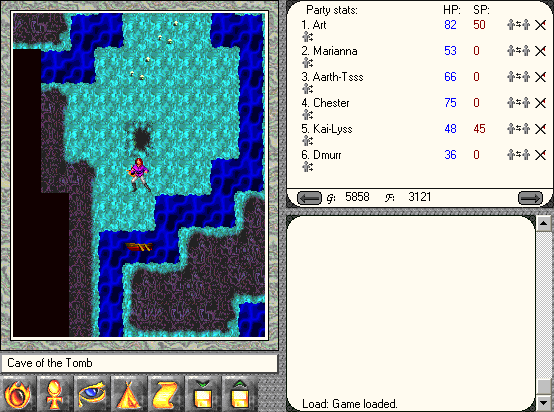
Here's the OG splash screen: http://macintoshgarden.org/games/exile-escape-from-the-pit
And here's the update: http://macintoshgarden.org/sites/macintoshgarden.org/files/s...

There are two sides to this: Can you make better games for cheap? Sure you can, many people have. But the second question is: How large a proportion of those who try that would be able to keep churning out profitable games for 25 years?
Or even produce a single profitable game?
There's nothing mediocre about managing to pump out profitable games for 25 years - very, very few people manage to do that successfully. His games may well be mediocre, or at least look mediocre, but in terms of success he's doing far better than most just by still being there.
I don't doubt the guy is successful, but he doesn't really bring up a convincing argument for his position. He could be potentially be MORE successful if he invested a little more in visual aspects of his games. Reading an article about why it isn't a priority for him isn't that interesting to me.
Covered in the article (and previous blog posts, I think): I have had games where I worked very hard to improve the graphics, spending a lot of time and money, and they really did look better! But when I released those games, the vast majority of people who had said, "Your games look bad." STILL said, "Your games look bad."
Sounds like someone who worked at all the wrong things to "improve" because they don't listen to feedback.
Not sure I can agree with that. Undertale had lo-fi art, but there was a lot of care put into it.
Among other things, there are much higher expectations on graphics and it's a lot harder to make 3D world and assets than it was to make 2D sprites. Cheap games are also facing a fierce competition from a truckload of other cheap games and previous AAA titles. There are more games than people can play and why buy Game 2019 when Game 2015 is just as good and 75% off.
Then he talked about great stories.
Definitely not mediocre.
So, the take away is story can sell to fans of story and game play.
That is not wrong. It has, does, and I suspect, will continue to.
That's an interesting way to look at this article. It seems that many solo entrepreneurs have a hard time evaluating the skills of those outside their own domain.
It feels arrogant to criticize someone profitably running their own company for 25 years, but I wonder if he would be better served by hiring a design/UX firm for a day or two to get some guidance on achieving a consistent look while still spending less money.
There are plenty of entrepreneurs here that hire all kinds of people, and always try to find good bang for the buck. Isn't that normal? I personally have hired artists, developers, marketers, lawyers, managers, you name it... I don't see why I would deal with any profession any different.
> That seems like a pretty big strawman to me. There is a large grey area between "crap" and "AAA-quality".
And even then, you can have low-budget (like what Vogel is doing) with good-looking art, as in good art direction, which he has already done.
I'm one of the players that's on the margin between his graphically "good" games, e.g. the Avernum remakes, which use a vaguely consistent colour palette and are comfortable to play, and his graphically awful games, e.g. the first Geneforge, which has an eye-stabbingly bright green border around the game area that's brighter and higher contrast than the actual content, making playing the game fatiguing and uncomfortable.
Jeff's games don't need 3D art or a big budget or even a totally consistent style, they just need a tiny amount of good UX taste and a few hours of photoshop to mess with HSV. Thankfully, the more recent titles do have better UX.
I guess it's the same case here. The art isn't as if the entire art pipeline was MS Paint so most people who don't mind graphics may at worst just put up with it for the gameplay they expect from Vogels games.
The question he seems to be answering is “why don’t you try and grow your company”, with his answer being “because I’m happy with the way it is”.
Let me add that, in my opinion, there are more chances of a successful game if you're a competent artist with poor coding skills than the opposite. In fact, lots of solo projects succeed because the author is an artist that happens to be a half decent programmer.
Here we have a developer effectively looking to pay below market rates for artists, and then unsurprisingly not finding many good artists willing to do that long term. Not a judgment on my part, just saying that he's looking to keep the art budget to an absolute minimum.
Instead if it was an artist defending his choice to make relatively simple games because he just can't find good developers willing to work for cheap for long enough to complete a project.
The line that stood out me in this context:
I can't stress this enough: Finding talented, reliable, reasonably priced freelancers is HARD. Cherish them when you find them.
If the context of the discussion was about developers instead of artists, how would HackerNews feel about someone lamenting the fact that they can't get any "affordable" developers to work on their projects?
Also, as an aside:
The key problem here is that, when most people say, "Your art looks bad," what they mean is, "I want art that is good." They mean, "I want AAA-quality art." And I can't make that. Not even close.
That seems like a pretty big strawman to me. There is a large grey area between "crap" and "AAA-quality".