Countries that pegged their currency to the euro, or outright started using it got measurably better than the one that didn’t.
Counties that had “troubles because of the euro” would have most definitely had them even without, but the problem would have surfaced much later, when the damage would have been done.
It’s just so easy to solve economy problems with devaluing a currency and most, especially populist governments just can’t help themselves but do it, ending in huge nation wide catastrophes - see a lot of latin america, pre-euro ex-ussr countries etc.
Having a stable currency is just vital to the long term health of a country, and the euro has certainly helped with that immensely. It does remove a tool from a government’s toolbox, but a dangerous one that I wouldn’t trust most of them to use anyway.
As for Africa, with the amount of financial education the populace has at large, I would presume a stable currency would do wonders to their economies long term, at least for several generations ahead.
A bit oversimplified but very accessible source of info for geopolitical economic stuff like this would be VisualPolitik youtube channel.
So does the EU though. This doesn't seem like an especially great plus point for the Euro, given the QE (money printing) on a truly vast scale carried out by Mario "whatever it takes to save the euro" Draghi and likely to be continued by his successor.
Basically the eurozone stays unified by having local governments borrow money from the ECB, which is willing to engage in apparently unlimited bond purchases to ensure yields stay low and pro-EU governments stay in power. This amounts to massive wealth transfers from (primarily) Germany to the rest of the eurozone for purely political reasons. Germany is willing to tolerate this because of its past: German national pride has been transferred nearly wholesale to the EU's desired future nation of "Europe". Would African nations tolerate the same? Seems very dubious.
Maybe Africa will show us what a more equitable power distribution looks like? I’d love for them to try. But I would predict that it would be vastly beneficial for capital flowing into that African union to have a stable currency. People with money usually don’t want their capital to evaporate for frivolous reasons.
GDP is an iffy measure for Ireland though.
And it has been just a couple of decades. Over the long run, stable currencies usually outperform their capricious rivals. Mostly because investors want stability, and so they flock to places where it is present.
There are numerous examples of countries with their own currency doing well, or doing very very poorly. But there are few examples of countries doing very badly _because_ they adopted a union currency.
Imagine Alabama stating they’ll quit the US dollar and get their own alabamians or something - it might go great, it might go badly, but you sure know it would be risky. And investors by and large wouldn’t like that.
I understand that many eurozone countries could be helped by currency tools like devaluing, but I'm not sure if anyone can really know how the tradeoffs vs. smoother commerce pan out and conclude authoritatively that the whole thing is a net negative.
Also the state can scam buyers of state bonds by inflating the currency, which also has the sideeffect of meddling with it's own economy.
It's not a silver bullet, it's just different cancer.
With a free-floating currency, prices for foreign buyers can change overnight. This can allow quick responses to shocks. In contrast, internal devaluation (deflation) is a very slow process (how do you coordinate everyone in a country to reduce their prices).
e.g. for the UK circa 2008 the economy had problems (more reliant on finance sector than most other countries) and the currency dropped, making UK exporters more competitive. Italy or Greece a few years later would have also seen their currencies fall, had they not been locked into the same currency as Germany. Instead, their exporters have problems with competitiveness which take many years to equilibrate (they must have lower inflation or deflation relative to Germany).
There is a subject called 'Optimum Currency Areas'. As always, there are tradeoffs, more homogeneous economic areas face this particular problem less and so are more likely to benefit from a single currency.
[1]: http://cepr.net/publications/reports/latvias-internal-devalu...
When I read economics textbooks, I see a marked contrast to physics textbooks. e.g. in physics, they might explain about a pendulum using equations etc, but then they show you real experimental data, to show that your equations about period vs pendulum length are correct. I have not found economics textbooks that do that.
The more basic thing that economics gives me is akin to this: when iron ships were first proposed, sceptics might say 'iron sinks, so iron ships are impossible, you are crazy'. You can answer this by putting an iron saucepan in the kitchen sink, and showing that it floats.
So (macro) economics can tell me some basic things about 'which way is up'. But putting even half-accurate numbers on things is difficult. imo economics is often done best when you view it using historical case studies + theory to know which way each effect acts.
This is not to say that what you ask is impossible, but when that is done (by experts, not me), it is not convincing enough to convince others that it is right.
Then why don't they lower their prices? Why do they need to rely on a devaluating currency (which might come automatically from the market, or from the central bank actively buying foreign currency at high price)?
Internal devaluation can be done, it is just a slow and painful process (usually including higher unemployment).
Anyway the takeaway is that there is an upper bound to how much Greece can borrow from Germany before local industry becomes more cost effective. The goal is to trade as much as possible but to also support the local economy.
Now the same scenario with the Euro results in no appreciation or devaluation. Greece borrows money from Germany. The exchange rate doesn't change because it's the same currency. Greece's ability to repay the loan did not change but there is now no economic pressure to not lend money. Greece can lend as much as it wants and since German products are always more cost effective it will use that borrowed money to always buy German products. The local economy languishes and eventually Greece has borrowed so much that it can't pay off it's debt. Then all you need to do to finish off Greece is to launch some kind of austerity policy that decimates what little local economy has managed to survive.
There is no working solution for the problems a unified currency causes. The best thing that one could possibly do is to have transfer payments to cancel the surplus but there is no way to force people to spend that money in the local economy and there is still the perverse incentive to increase the surplus to get more transfer payments.
Not just, but it is.
E.g. Switzerland has actively tried for years to peg 1.20 CHF to 1 EUR, to ensure that exports would not be hurt by a strong CHF. ... Until it suddenly didn't anymore.
https://www.ineteconomics.org/perspectives/blog/how-to-ruin-...
This is painting just one side of the story. Look up the graphs for debt as % of GDP in the same years.
https://tradingeconomics.com/italy/government-debt-to-gdp
https://2.bp.blogspot.com/-rj28mXbk6V8/TsEC58hZftI/AAAAAAAAA...
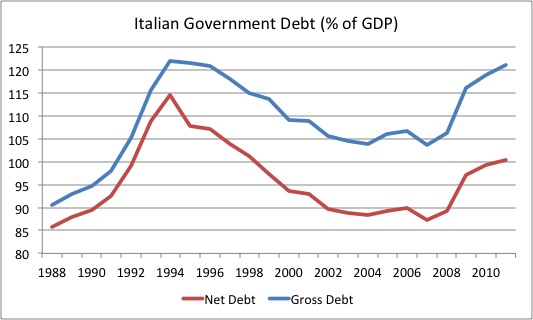
Sure, we were growing, but more than that we were growing our public debt. I'm no economist, but this doesn't seem the sign of a healthy economy to me.
I do not claim to know the aggregate effects, but I would guess it is not as simple as convenience vs. sovereignity.
Because the Euro solved a problem that did not exist in the EU. Every nation that joined was able to convert their currency to other EU currencies at reasonably low cost, and because each currency was relatively stable, at a low risk too. Africans do actually have high currency conversion costs, and some of the currencies are risky.
To put it in Krugman's terms, the African nations have mostly committed the 'original sin' anyway, and this is a way of making a bad situation better. Italy was free of the original sin and was making a good situation worse by joining the EU.