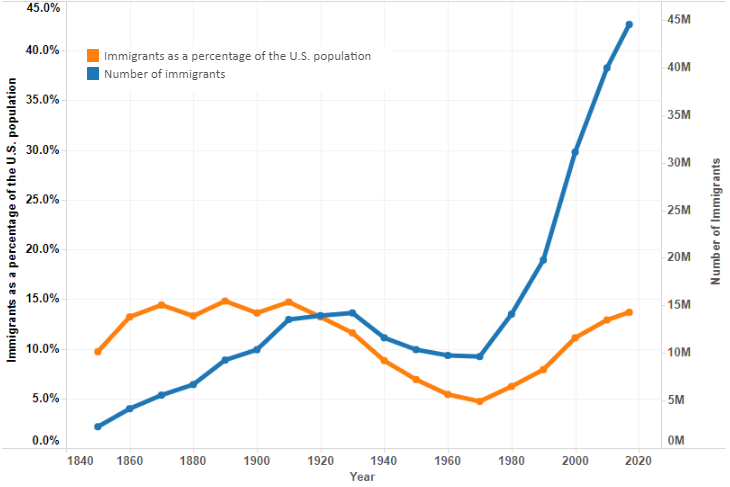
But demographics have changed dramatically since 1970. For example, immigrants make up almost 3x as large a fraction of the population (from 5% to almost 15%) than in 1970. Obviously, if you add a large number of (typically) economically disadvantaged people to the population, income inequality is going to go up, even if there is no change in incomes for everyone else: https://www.migrationpolicy.org/sites/default/files/source_i....
Likewise, peoples’ incomes increase with age. The population overall has grayed significantly. Again, even if wealth inequality wasn’t increasing for people of any given age, changing the age distribution of the population will affect income inequality.
Finally, a larger fraction of the population now comprises historically disadvantaged minorities. While the income gap between races in the US is a huge problem, it’s a different problem than “income inequality” genetically, deserving more targeted solutions. (And even that income gap is hard to analyze, because the ages of people of different races in the US differ quite dramatically). The median age of non-Hispanic whites is 42. The median age of Hispanic people is 28. The median age of African Americans is 33: https://www.pewresearch.org/fact-tank/2016/07/07/biggest-sha...).
Income inequality probably is going up. But I’ve never seen a study that actually holds demographic changes constant so the result reflects peoples’ perception of what income inequality means.
Take note of how often you hear/read something like "incomes haven't risen in 30 years, but prices have gone up over 50% over that period". [Almost?] Inevitably, the income will be real income [inflation adjusted] and the prices nominal prices.
I worry that the public / workers / voters / policy makers are being misled/confused/misdirected.
The public is being misled, by whenever someone complains about stagnant wages the response is "you have smartphones now", but we can't afford houses or healthcare how is this okay? So your argument seems to be that all economists are in on this together to do what?
And your thankful your favorite youtube news personality has cracked the case (without publishing any research and has an opportunity to make money from getting views). Good thing he /she is looking out for you.
The bottom line is you sound incredibly foolish to me if you can't supply any sources of people trying to do this trick. Even if you do find one or two examples, there are plenty of sound statistics that say people have it harder now finicailly then 50 years ago.
[0] https://www.investopedia.com/ask/answers/101314/what-does-cu...
[1] https://www.pewresearch.org/fact-tank/2018/08/07/for-most-us...
Even things that are true are often reported in a way that obscures causal factors. For example, wages are stagnating, but total compensation (wages plus benefits) is not. Now, from an employee’s perspective, they might not care that their total compensation is growing because health insurance premiums are increasing but paychecks are staying the same size. But the employer has the exact opposite perspective: the employee is costing more money whether that money is going to to paychecks or benefits. Failure to articulate that distinction moreover leads you to the wrong conclusions. When you’re told about wage stagnation but growing corporate profits, you’re supposed to think employees are getting a smaller piece of the pie. That’s not true: https://www.nber.org/digest/oct08/w13953.html
> Total employee compensation was 66 percent of national income in 1970 and 64 percent in 2006. This measure of the labor compensation share has been remarkably stable since the 1970s. It rose from an average of 62 percent in the 1960s to 66 percent in the 1970s and 1980s, and then declined to 65 percent in the 1990s where it has remained from 2000 until the end of 2007.
Here is the conspiracy theory presented with no examples: >Inevitably, the income will be real income [inflation adjusted] and the prices nominal prices.
This is what I take issue with and I don't think that a comparison between real nominal prices happens in order to trick people. This seems like something high school student wouldn't get away with.
https://www.nytimes.com/2019/05/02/business/economy/wage-gro...
Then look at the article: nominal wages rose every year (as indicated in the chart), but the breathless headline suggests the opposite to the average American. Do you believe that the omission of the word "real" in the headline was purely accidental or intended to drive outrage clicks?
They don't specify which in the title, but they do in the article. The biggest thing is there is no comparison between nominal and real prices. Acting like the nominal cost of things is not keeping up with real wages.
If you don't want to get tricked maybe read the whole article instead of just the title. It is a somewhat complex topic and takes some thought to put into it if you want to know what is going on.
I'll reply on thread next time I see one, which is likely to not happen in the next 24 hours. Hopefully, you'll take an open minded read to see where social and mainstream media accounts are biased for outrage and clicks over information content and will notice these on your own as well.
On a per square foot basis, you don't really see an increase.
http://www.aei.org/publication/new-us-homes-today-are-1000-s...
One of the commenters on the article you linked makes a good point:
"new single family homes are a very small part of the real estate market.
most of the big price moves have been in urban areas where single family dwellings uncommon and new homes extremely rare."
Initially John's chances of getting a job: 1/N
Now, with the arrival of new immigrant, John's chances: 1/(N+1) i.e. he's worse off.
Sure it turned out better for the new immigrant and he can earn way more than his original country and thus this is better for humanity and the globe but it is of little relief to John who is worse off now.
My assumptions in this:
- John is a low skilled worker who will not be easily able to switch to another line of work like a software developer
- John does not have significant savings to fall back on.
Another fun fact:
- The will to let the low skilled immigrant in, in today's environment does not stem necessarily from a position of goodwill, rather it is a calculated position to keep the numbers of a voting bloc which consistently votes for a given party, constant. This can be easily explained by seeing where the opposition to limiting immigration comes from.
So keeping in mind the above 2 points, it becomes readily apparent that what politics has gotten good at is winning elections and not betterment of people. One of the parties has discovered that one of the easiest "hacks" or "optimizations" is to keep importing poor people and that way you will have a steady stream of voters, otherwise you might actually have to start improving the stock of existing population.
This is somewhat analogous to how simply being good at a written test for a position does not necessarily mean you're a good fit for that position but you've simply optimized for the selection process.
All of this to say that as far as a hypothetical John is concerned, it is of no merit to him that the world is a bit more efficient because a person from Bangladesh is able to work with a little more efficiency, indeed whatever small gains from that are outright eclipse by an increased competition in the local pool of jobs and resources.
Economists used to believe that many things were zero sum, (ie if England allows French cheese imports it will be at the expense of British cheese producers. Yet often allowing imports and increased trade leaves both France and England richer as consumers in both places value the additional selection and the competition lowers prices or foreign items can charge a premium for their novelty). Immigration is similar; it’s not zero sum.
Blaming this on a cynical political motive to create a voting block is contrary to the history of commerce and global trade and also contrary to your own analysis. It seems to me that the party most opposed to immigration is also the party that had been driving inequality by 1. Promoting globalization while also decimating the social safety net that would ease the transition, 2. Shifting to regressive taxation on sales while drastically lowering taxes on capital and its accumulation i.e. inheritance taxes. 3. Destroying any bargaining power for workers and employees and resisting minimum wage increases. I could go on and on.
Probably made worse by the vastly higher amount of dual income household, so someone with just 1 income is proportionally worse off.
A single unskilled worker vs a couple of high skill workers, competing for supply & demand against each other...yeah, the former's not gonna have fun.
http://www.levyinstitute.org/publications/can-redistribution...
Like anything else redistribution falls on it's face if you go too crazy with it.
But sure, the problem was the system because that’s easy to believe, as it requires just accepting the standard American narrative.
China and the rest of Asia are magnitudes more competitive compared to 50 years ago. And prior to that US industry was unmatched thanks to the massive effects world war 2 had on the other, western industrialized nations.
We’ve also had a combination of tax and regulatory policy that has encouraged capital formation and increasing returns to capital, so labor’s share of returns has decreased.
To add to that, capital is exponentially more portable than labor. With globalization, capital in the form of investments can move wherever it needs to to grow, it's borderless. Labor however, in order to grow wealth has to physically move. Remote jobs for basic labor doesn't exist - that's almost exclusively knowledge work.
So if you're a coal miner, your ability to create wealth is extremely limited to certain physical places. If you're a remote Java dev, you can code from anywhere and grow wealth much easier, but there is a serious time cost to switching work. If you're an investor and just need to drop money into an account, not only can you do it from anywhere, you can move things around more or less immediately with little (relative) cost.
It's about portability of the thing that is growing the wealth. Labor = slow, Capital = fast.
If the rest of the world becoming more productive results in US workers being worse off, then something is severely wrong with US trade policy. For one, it contradicts the dogma that more trade is strictly beneficial.
It is strictly beneficial, in aggregate. But in any situation, there are winners and there are losers. There are no decisions you can make where everybody wins. If you live in a first world country and your skill set is worse than somebody in the developing world, you’re going to have a bad time.
The usually trotted-out theory of comparative advantage claims there are only winners.
I would argue anyone who says otherwise is either being disingenuous or doesn't actually understand economics.
That is not to say that is not trotted out frequently.
Also, to be fair, during my economics education they had this whole focus on modeling policies and finding optimizations where no one is worse off.
Of course, in the real world, that practically never happens... and there is an argument that the focus on efficient/competitive markets/ equilibria/rational agents is also a bit "wouldn't it be nice if the world was actually like this...", whereas in the real world only the most trivial goods/markets can vaguely be described as such...
Even if your skill set is greater, your cost of living is higher. So you'd have to be more than marginally better.
Also, the logical conclusion of where this seems to be headed is that if you're a low-skill person living in a first-world county, voting for protectionist, isolationist policies/politicians is a rational choice.
Perhaps if society used the increased wealth to benefit everyone the value of global interconnected trade could be felt by everyone. This is an easy fix, return to the post World War Two tax policy that built the middle class. Return to a well respected government that drives large scale work like highways, scientific research, the space program. Think about how much technology is a direct result of military research (GPS, the Internet, rocketry, etc) imagine if we mobilized on the same scale for exploring space, basic research and innovation and entrepreneurial activity.
So, yes, they are crabs at the bottom of the pot seeing other crabs moving up, and they cannot abide by that.
Instead, I’ll just suggest that you find a good Freshman-level Economics textbook and read carefully. You may find it illuminating to understand the concepts behind complex policy decisions.
Given that none of the most successful economies developed without protectionism [1,2], you'll have a difficult time explaining that indeed. That pesky reality, always getting in the way of "good Freshman-level Economics textbooks".
[1] https://en.wikipedia.org/wiki/Comparative_advantage#Criticis...
But yeah, it's still trade, so there will be lows and highs, and ebbs and flows.
Ricardo's original idea was applicable with a narrow set of assumptions/conditions and didn't have much to say about who'd end up with the greater net wealth. I'm not sure how/why it was turned into a magical improve-any-economy law of nature.
I agree with your point that populations can change over time. Fifty years ago, many people didn't get degrees and made good money. Today, people without degrees (and some with) don't make good money.
So instead of trying to segment in groups (the college educated vs. everyone else), let's just look at everyone. This removes the concern of our shifting populations.
One metric to look at is median income. Adjusted for inflation, it hasn't budged much in decades. In the past 42 years, it's increased about 32 percent.
In a world where everyone has a college degree, well, some people with college degrees will have to be the ditch diggers so to speak.
I don't know how you solve that problem? It's just math.
It's not "math" that humans have to engage in undesirable labor, under brutal conditions. We have thousands of years of developing tools that are contrary to that statement.
It is a collective social decision to say that an hour of someone's time is worth less than building a robot. That's the only reason why cashiers still exist.
People who don’t want to waste time reading hotel reviews and deal-hunting on travel sites.
If you go that route, then the people who build and program the robots will necessarily be paid less. Today that is likely a top 10% job. (More likely a top 5% job if we're being honest.) In a world where everyone has a college degree and there are 30 times the number of people who can program those things because the tools have gotten just that easy...
well, you do the math.
At the extreme, you can't just pay 100% of the labor market more money because they have a college degree. It just doesn't work like that.
Put in more base terms, there is only room for 1% of the people, in the top 1%. You may be able to, through the magic of increased production, decrease the price of everything in your economy. So that the other 99% of people can afford access to everything to which people in the top 1% have access. But even that is difficult in the extreme. It'd just be easier, over time, than is paying everyone in your economy more over time.
That... seems to be a total misunderstanding of why people are concerned about income inequality. The fact that the sizes of the percentile buckets are fixes does not mean that the distribution between the buckets is zero sum.
There's no "just math" reason for why we pay some jobs more than others. It's not even a "just market" reason. There are elaborate regulations on income (c.f. tax brackets, minimum wage, investment taxes, mortgage deductions...) all across the board. And those aren't working well, as evidenced by the numbers in the linked article.
None of that stuff is "math". It's policy.
It's not a zero sum game. Imagine it this way. Everyone today is making more than hunt from a cave money. Why is that? Because a single human can produce more than the bare minimum for survival.
- who gets to buy prime location property
- who ends up in best schools
- who gets to own mines and infrastructure
- who gets to truly rule (too big governments are slow)
- every instance of packing problem where supply is limited by real scarcity or scaling by communication
Actually this is exactly what should happen. Maybe the increase in wages isn't as extreme as 100% but it should be at least 2% per year. The problem is that it didn't happen during the last decade.
How about we pay the ditch diggers enough to live on? In fact, what the numbers are showing is that ditch diggers are poorer now than they were! Even if you refuse to share any of your tech industry gains, can't we at least keep ditch diggers at parity?
How much of this effect is the vastly higher percentage of people who now go to college? If you line up 100 people by vague estimation of their likely earning potential in 1970 and do the same today, but now 2.5 times as many people attend college, the population remaining with "no college" in 2020 isn't really the same population as it was in 1970.