Revolut's CEO[1] is the son of the top bureaucrat of Russian Gazprom, which has been implicated as the main channel of - you guessed it[2], money laundering for Russian oligarchs [3].
[1] https://en.wikipedia.org/wiki/Nikolay_Storonsky
[2] https://panamapapers.sueddeutsche.de/articles/56fec05fa1bb8d...
[3] https://www.ft.com/content/2ebff9ee-38f6-11e9-b856-5404d3811...
Also, Gazprom Promgaz != Gazprom. It's "a research institute for Gazprom" [1].
but the premise is correct - a unicorn who raised 5m for an online bank startup is hardly a serious option.
That has become one of my red flag. I want to deal with people and companies focused on the quality of their products and businesses, not on doing "shit" (taking their motto literally).
Another example of a field that I'm personally aware of and in which this kind of attitude should not be acceptable is cybersecurity. If your job is to protect people, then EVERYTHING you release has to be bulletproof.
Analysis Paralysis is a real thing. Sometimes you just have to do it.
The "move fast and break things" crowd are generally the same people that will choose to open things up in the name of "getting shit done". They'll drop firewalls, expose services publicly, and generally go out of their way to avoid security because they see it as a hurdle to achieving their primary goal. In my experience, this lack of foresight almost always causes cascading problems in the future that grow exponentially worse the longer they're left unchecked.
That's normally a red flag, for a banking business a mortal sin.
"Well at Google, they'd use a global distributed fault tolerant Hadoop cluster for their data store." "Dude??? We're building a Wordpress site. We're gonna run MySQL on the same shared server as the php code."
They had a big sign on the wall "Don't fuck the customer."
That's a much better ethos that "move fast and break things", or "Get shit done" in my mind... (Even if it is just performative customer facing propaganda, at least it shows that management understands that's a key requirement customers want to be told they'll meet...)
Don't move fast and break things. Move productively and build things.
it was a great place to work - engineering was pretty lax, most of us were there only from 10-4.
As in, spend your time making something you'd be proud to sign your name to.
That could easily be a way to say that he got threatened to leave that anti-money laundering system switched off 'or else'. Keep in mind that as soon as you create a way for organized crime to do their thing on your service and you are making money of them that they will happily consider you to be in their debt. It happens in the movies, and sometimes it happens in real life.
Someone I know peripherally had something like that happen to him because of a series of movie theaters. Not good, even if you are not aware that such things are happening.
This is why casinos, online gambling, bitcoin related stuff and payment systems as well as two-sided market places always require extra care, before you know it you have a bunch of criminal coat tail riders on board.
Meaning, despite their London HQ, Revolut is Russian owned and Russian managed pseudo-bank.
Giving them more money might not be great idea.
We use Revolut around the office to split bills for lunches, etc, but I wouldn't keep more than few bucks in there.
They have a banking license from Lithuania (but customers are not switched to it) which might be revoked by Lithuania and they are trying for another license in Ireland.
Thanks to comment below - edited this make more sense.
[1] https://www.theguardian.com/money/2018/dec/22/lithuania-icel...
They're only covered against bankruptcy though - if someone steals your phone and drains your account, you're SOL.
I don't use Venmo myself - I'm at a point where I'd rather just pick up the check that try to split it (using any method). And let me friends pick up the next meal.
Just to clarify: The Russian Laundromat mostly relied on the banks from Latvia and Estonia[1], the two EU countries with the largest Russian population. The only banks which participated in the scheme from Lithuania – Danske and Nordea – were actually Scandinavian, and have either left the country (Danske), or merged with others (Nordea) afterwards.
[1] https://www.occrp.org/assets/laundromat/BarChartBank-big.png
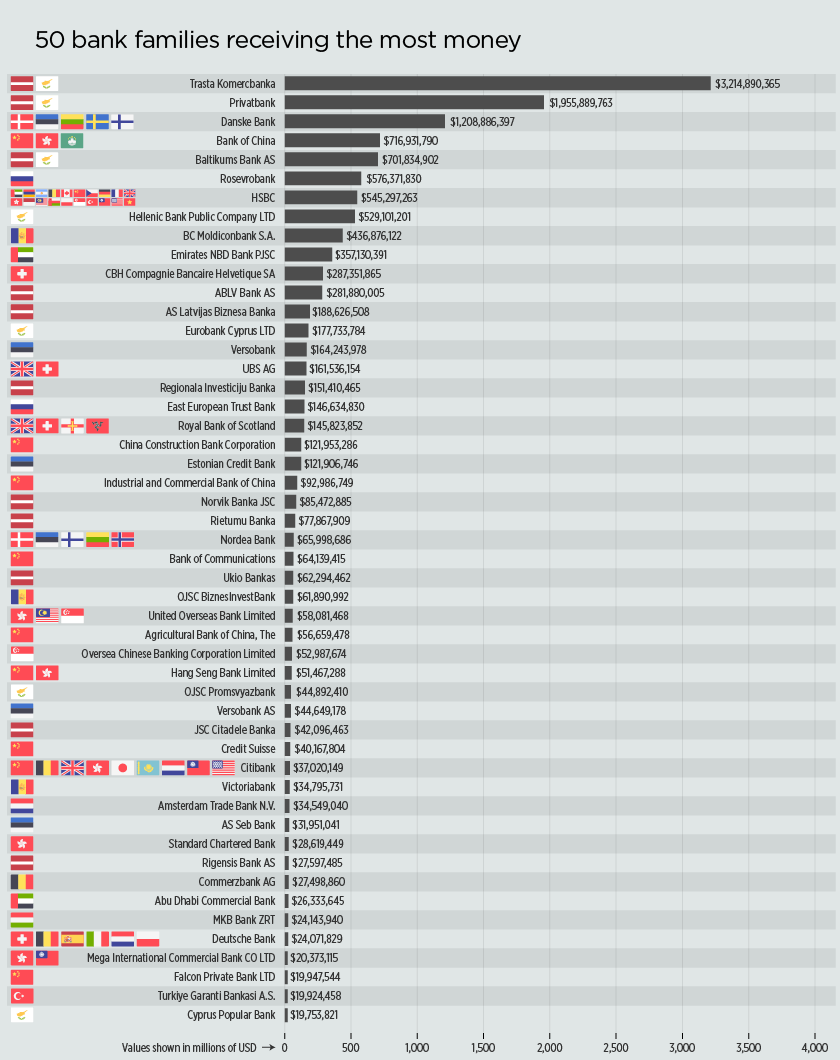
It doesn't raise issues per se. But Lithuania has a sizable Russian population [1]. It's also a small country.
The latter means it has less experience supervising novel and complex financial systems. It also makes its regulators easier to unduly influence, either through bribery or threats (e.g. Revolut failing would probably deplete Lithuania's national deposit system).
> But Lithuania has a sizable Russian population [1]. It's also a small country.
The Russian population (5%) is a tiny minority here, not represented by any political party in the parlament. It's much bigger (25%) in Latvia and Estonia, as Russians tend to live in the cities near the Russian border[1].
> The latter means it has less experience supervising novel and complex financial systems. It also makes its regulators easier to unduly influence, either through bribery or threats
In this case, there is a common view in Lithuania, that as a tiny economy we should focus on IT sector and follow Estonia's example, trying to be the most modern and innovative state in the EU.
Therefore, there is an entire goverment program for attracting and supporting fintech companies[2], hoping that they will open offices in Lithuania and employ recent graduates, preventing them from fleeing to Western Europe for better job opportunities.
Of course, it makes no financial sense to give a banking license to a foreign startup for such a small economy, but Revolut is extremely popular in Lithuania and the general population sees it as an alternative to Scandinavian banks which have occupied the local market.
As a result, those policitians who have tried to oppose giving the license to Revolut were publicly attacked from all sides as "working on behalf of Scandinavian banks".
[1] https://en.wikipedia.org/wiki/Russians_in_the_Baltic_states
I rest my case. That such financial regulation is being politically decided gives Revolut more leeway in Lithuania than it would have in e.g. the U.K.
It's not being politically decided, but multiple senior members of the parlament in the committee on Budget and Finance have publicly expressed their concerns.
I agree that there is a lot of general inexperience in the entire system, and I don't believe that Lithuania would be able to regulate Revolut properly, as it's based in the UK.
The point was, that Revolut was more than welcome in Lithuania, and they didn't need to try to influence anyone. The politicians and regulators were even proud that one of the biggest fintech startups in Europe chose to set foot here.
They also saw that N26 was successfully granted a license in Germany, Monzo in the UK, and Bunq in Netherlands. Therefore, it wasn't seen as such a big risk.
I would guess that regulation in the UK is better, but I'm not really up on my Eastern European/pan European banking regulation to definitively say.
So does Facebook, DoorDash, FlipKart and hundred+ other Silicon Valley companies. Revolut also has money from Seedcamp, Balderton, Index and tons of other VCs.
> Revolut is Russian owned and Russian managed pseudo-bank
Since when being a Russian is a crime? Besides if a company is London based it is regulated by UK authorities.
You make it sound like the guy being Russian, DST being Russian (and allegedly having "ties" to Kremlin) is somewhat a red flag. I would like to hear more on the reasoning behind how all that is negative?
Don't Silicon Valley CEOs have ties to White House? Should I not use their products? :)
There is outsized demand for money laundering from Russia, in large part owing to its endemic and unchecked corruption. This is why most recent European money laundering scandals have involved Russian money [1][2][3].
So when you see an AML deficient operation with multiple Russian ties based out of Lithuania, it raises legitimate questions.
[1] https://www.reuters.com/article/uk-danske-bank-eu-regulator/...
[2] https://www.cnbc.com/2019/04/18/deutsche-bank-shares-slip-am...
[3] https://www.insurancejournal.com/news/international/2019/03/...
https://www.nytimes.com/2019/06/02/us/politics/elaine-chao-c...
Chao is being investigated by the House [1]. Worst case, we’re talking single-digit millions of suspected malfeasance versus billions in Russia of cut-and-dry graft.
And most importantly, a wrong here doesn’t excuse a wrong there.
[1] https://www.politico.com/story/2019/06/24/house-chao-rules-t...
And Revolut is a non-Russian service. Hence the comparison.
(Money laundering has three steps [1]. Dirty Russian money is typically placed with Russian banks. It is then layered between Russian and non-Russian banks before being integrated by a non-Russian bank, thereby masking its origins. Given the amount of dirty money flowing out of Russia, a Russian account tends to gather more scrutiny than e.g. a Danish one in the same way a Colombian account garners more scrutiny than a Miami one.)
The problem is that that entity is a de-facto dictatorship that is well known for being corrupt.
Most shareholders and the regulator in control are western based and run by people whose parents aren't employed in Russia's public sector, as far as I know.
Show me a government that's not known to be corrupt.
Giving any Russian oligarchs more money is always a bad idea.
Just waited for the golden parachute check to be cashed in.
[1] https://www.telegraph.co.uk/technology/2019/02/28/revolut-fa...
What are you talking about, that's completely reasonable.
CFOs of financial services companies are typically senior AML officers. All AML actions are their actions, and AML liability for AML officers is almost strict liability. If something happens and if best practice wasn’t followed, the AML officer(s) are personally and criminally liable.
If someone could turn off the entire AML scanning system with the CFO’s prior knowledge, sign-off, and ex post facto notification, that’s a deficient AML policy.
For example, the rules stopped large numbers of women who had bank accounts or their passports in maiden names from transferring money to themselves. Revolut would see an incoming payment from supposedly the same person, but with a different name, and lock the whole account down until documents could be provided proving why that happened.
That means if you top up your Revolut account on saturday to buy some McDonalds, you are now going to be locked out of all financial services for probably 1+ week while you get official documents proving the name change. A marriage certificate isn't enough. If your salary is paid into Revolut, you might default on loan payments, loose your house/car, etc.
All that to stop only the stupidest of money launderers. Smart money launderers know to use business accounts where the name of the account holder isn't checked by any bank.
I don't quite follow - can you elaborate and explain the scenario?
If a business does the same, and claims they're moving their own money about, the name checks aren't applied, so they can work around many of the checks.
Business accounts however are not checked as tightly as people often enough either outright mis-spell the company name, use outdated company names, specify departments in the name and not the comment field, ...
To be honest, fuck Revolut, so use them with little money.
Something is not right with these freaks.
Can you expand on this? I'm not sure what the reference is to.
Revolut cited 'personal and health reasons' for the CFO's resignation. Whatever those personal and health reasons really were, they clearly passed quite quickly as within the space of a few weeks, said CFO has joined another FinTech company as their new CFO.
The company quite literally has the words "get sh*t done" in giant neon letters on their office wall. They live by the mantra of move fast and break things. That mantra is inevitably going to cause problems when your entire business is dealing with real money owned by real people in one of the most heavily regulated industries in the world.