News for hackers. Stuff that matters.
Re:Boeing Believed a 737 Max Warning Light Was Standard by ErikVandeWater on Sunday May 05, 2019 @07:43PM (#19835792)
> But months after the planes were flying, company engineers realized that the warning light worked only on planes whose customers had bought a different, optional indicator.

If I am to read this correctly, the angle-of-attack disagree light is installed on all Boeing 737-MAX aircraft. For customers who did not buy on optional additional indicator, the angle-of-attack disagree light was always off, even if there is a disagreement between to sensors of the angle of attack of the aircraft.

Doesn't this seem dangerous in-and-of itself? If a pilot assumes that the light is off because there is not a disagreement, instead of because there is no information available, she is acting on incorrect information, and might try to address problems unrelated to the actual problem.

Also, pilot may switch aircraft and expect the same functionality of safety features and may make incorrect assumptions about the functioning of this light.

Re:Boeing Believed a 737 Max Warning Light Was Standard by AnssiH on Sunday May 05, 2019 @07:45PM (#19835802)
The "light" is just a warning text that appears on the flight display, so the "no light installed" and "light installed but off" states are not distinguishable (as far as I have understood it).

http://www.boeing.com/resources/boeingdotcom/commercial/737m...
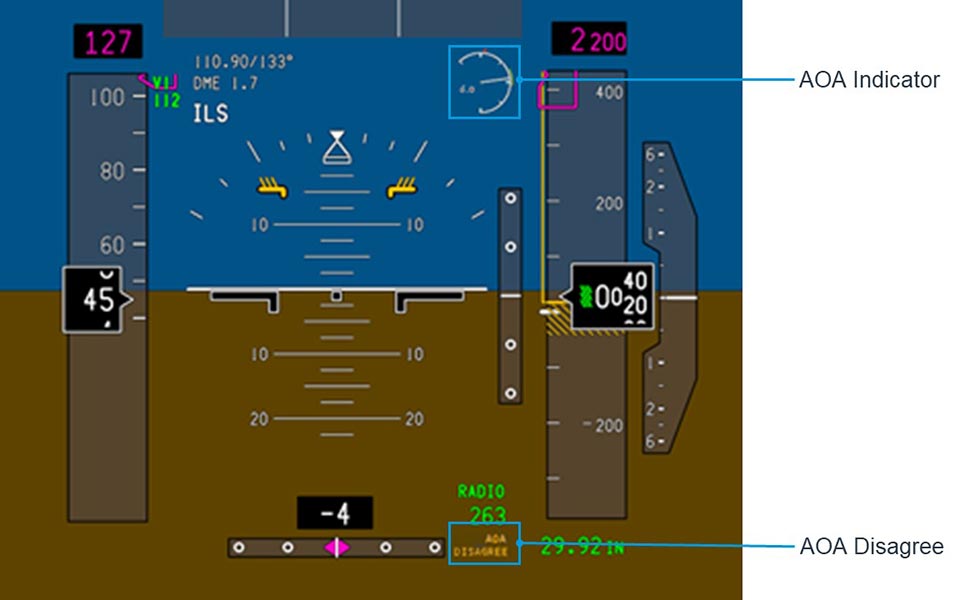
Re:Boeing Believed a 737 Max Warning Light Was Standard by inferiorhuman on Sunday May 05, 2019 @07:48PM (#19835810)
The "light" is just a warning text that appears on the flight display, so the "no light installed" and "light installed but off" states are not distinguishable (as far as I have understood it).

They're absolutely different. If you're a pilot and you expect to see an error message when the two alpha vanes disagree, you'll be lulled into a false sense of security when that text never appears even in the case of a failure.

A pilot needs to be able to trust all of the instruments in the plane.

Re:Boeing Believed a 737 Max Warning Light Was Standard by spectre256 on Monday May 06, 2019 @07:54AM (#19838543)
I'm a pilot, and absolutely this is a crucial difference.

It also reminds me of a time years ago when a team I was on had to extend a Memcache client library, as it couldn't differentiate between the following two conditions:

- "I tried to retrieve a key from cache but was unsuccessful (due to connection error, etc)"

- "I tried to retrieve a key from cache but determined conclusively that key does not exist in the cache"

If it was important for a caching layer on our silly social game, the same thing is clearly important in aviation.

Re:Boeing Believed a 737 Max Warning Light Was Standard by segmondy on Monday May 06, 2019 @09:36AM (#19839249)
Most people experience the same when using DB, NULL in a database is hard to distinguish from, data never stored or data don't exist.
Re:Boeing Believed a 737 Max Warning Light Was Standard by kbenson on Monday May 06, 2019 @11:06AM (#19840087)
Do you mind explaining what you mean? To my knowledge, inspecting the number of rows returned eliminates this problem.
Re:Boeing Believed a 737 Max Warning Light Was Standard by RHSeeger on Monday May 06, 2019 @12:20PM (#19840851)
I think he's referring to something like a row with First, Middle, and Last name fields. If the Middle name field is null, does it mean "we don't known this value" or "this value is <nothing> (the person doesn't have a middle name)". For most database schemas, there is no way to tell the difference between the two states.
Re:Boeing Believed a 737 Max Warning Light Was Standard by nradov on Tuesday May 07, 2019 @10:01AM (#19849379)
While this is overkill for most applications, the HL7 V3 data types used in healthcare even have multiple different "flavors" of null. So you can distinguish between "no information", "unknown", "not asked", etc.

https://www.hl7.org/implement/standards/product_brief.cfm?pr...

Re:Boeing Believed a 737 Max Warning Light Was Standard by fegu on Tuesday May 07, 2019 @09:11AM (#19849003)
The latter case, no middle name, should be stored as an empty string. In practice, not enough care is devoted to the difference between Null and empty string for text fields.
Re:Boeing Believed a 737 Max Warning Light Was Standard by no-s on Tuesday May 07, 2019 @07:39PM (#19854498)
"First not null, Middle null, Last not null" represents an a priori assumption that everyone has a First, Middle, and Last - but sometimes we don't know what the Middle is. Allowing a zero length string in any of those attributes implies that some rows in a table have First, Middle, or Last represented by a zero length string. What a zero-length string actually means is subject to interpretation and thus beyond the data model.

in the real world it turns out not to be useful to require that people have names just in order to keep data about them...nor does a name particularly distinguish one person from another.

Re:Boeing Believed a 737 Max Warning Light Was Standard by cryptonector on Monday May 06, 2019 @01:26AM (#19837067)
Reminds me of that Red Dwarf episode where Rimmer wants to go to red alert and Kryten asks "are you SURE sir? it does mean changing the bulb!".
Re:Boeing Believed a 737 Max Warning Light Was Standard by MaxBarraclough on Monday May 06, 2019 @04:00PM (#19843186)
Reminds me of a different Red Dwarf moment. Any damage? I don't know, the damage-report machine's been damaged. Apparently they played the same gag twice:

https://youtu.be/1KEHSOPSvhc

https://youtu.be/R49IKBWznOM?t=19

Re:Boeing Believed a 737 Max Warning Light Was Standard by cryptonector on Monday May 06, 2019 @05:34PM (#19844127)
Good one!
Re:Boeing Believed a 737 Max Warning Light Was Standard by lostlogin on Monday May 06, 2019 @04:03AM (#19837595)
I think you’re misinterpreting. The parent means that by design the plane makes the states indistinguishable.
Re:Boeing Believed a 737 Max Warning Light Was Standard by blackflame7000 on Sunday May 05, 2019 @08:12PM (#19835898)
If you see two AoA sensors that aren't in agreement then you can safely assume either one sensor has failed or physics itself has.
Re:Boeing Believed a 737 Max Warning Light Was Standard by phire on Sunday May 05, 2019 @10:43PM (#19836431)
The 737 has AoA sensors by default, the autopilot uses them and the flight computer corrects the flight speed based on the AoA and issues stalling warnings based on the values.

But the display which displays raw AoA readings to the pilots is an optional extra, only 20% of 737 maxes ship with it enabled. Normally pilots (or at least commercial pilots) are trained to fly without referencing the AoA by staying well within the safety margins.

So, if the AoA isn't shown anywhere in the default configuration, there is no way for the pilots to crosscheck them and see the fault. Which is why you need the AoA disagree warning message.

Unfortunately, Boeing messed up and the AoA disagree warning was only enabled on the planes with the AoA display option enabled.

Re:Boeing Believed a 737 Max Warning Light Was Standard by acqq on Monday May 06, 2019 @01:29AM (#19837077)
> if the AoA isn't shown anywhere in the default configuration, there is no way for the pilots to crosscheck them and see the fault. Which is why you need the AoA disagree warning message.

But the article buried the lede!

There is much bigger problem reported now in this article:

The warning wouldn't have helped even when flying with those companies that paid extra for it!

Note:

"“We were told that if the A.O.A. vane, like on Lion Air, was in a massive difference, we would receive an alert on the ground and therefore not even take off,” said Dennis Tajer, a spokesman for the union representing American Airlines pilots. “That gave us additional confidence in continuing to fly that aircraft.”

But in the last several weeks, Boeing has been saying something different. Mr. Tajer said the company recently told American pilots that the system would not alert pilots about any sensor disagreement until the aircraft is 400 feet above the ground."

Note what happens then: at the moment you are above the ground, and the MCAS activates, we already know that if you "just follow the procedure" the forces against pilot corrections could be too big to do anything. That's what can be concluded from the analysis of the Ethiopian crash.

That means the plane from the "20%" with "paid option" would still eventually crash as soon as AoA vanes fail, just there would be one more of many alerts in the cockpit for some short time before everybody dies.

The sense of "security" Boeing gave the American pilots flying for the companies who paid for that additional feature was completely false. They would have been doomed too as soon as a single AoA vane that the MCAS depended on failed: The warning worked only at the moment it was completely useless.

The U.S. MAX planes were grounded the last, yet they were in the same danger as the other planes.

Re:Boeing Believed a 737 Max Warning Light Was Standard by dmix on Monday May 06, 2019 @01:53AM (#19837155)
That's certainly not how the information is presented. But if you read closely you can see how they set it up carefully in the first half.

This is about adding to the narrative of Boeing's "general mismanagement" of the aircraft. Not about adding to the particular 737-800 crash investigation story (directly).

Re:Boeing Believed a 737 Max Warning Light Was Standard by phire on Monday May 06, 2019 @02:06AM (#19837193)
On both the Lion Air and Ethiopian Air crashes, the AoA sensor had failed before takeoff.

So the warning message could have potentially prevented both crashes and anything like it (assuming it activated during the takeoff roll, before V1 and the pilots were trained to abort take off when it happened)

Though you are right, if the AoA sensor had failed halfway though a flight, they still would have had problems.

Re:Boeing Believed a 737 Max Warning Light Was Standard by FabHK on Monday May 06, 2019 @02:33AM (#19837279)
> On both the Lion Air and Ethiopian Air crashes, the AoA sensor had failed before takeoff.

Are you sure? The AvHerald narrative for the Ethiopian Airlines flight:

"The takeoff run was entirely normal, both AoA sensors were in agreement. Shortly after becoming airborne the left AoA sensor however began to deviate and reached a position of about 85 degrees nose up, which obviously triggered the left hand stick shaker motor (and provides a very noisy and distracting cockpit environment), which in turn, different to the 737 NG behaviour (where the AoA does NOT correct the pitot data), also caused the IAS and ALT data to differ from the right hand system, in particular the left IAS became 12 knots higher than the right hand IAS (the preliminary report does not mention that the IAS DISAGREE warning activated however, which would invoke the unreliable airspeed procedures). The captain was pilot flying and focussed to keep the aircraft on track (via the flight director) due to terrain around while at the same time trying to understand why the stick shaker activated. Several required callouts by the first officer did not occur (e.g. speed, ...), as result the crew lost speed as well as thrust control completely out of sight."

As I said somewhere below, I don't think the AoA disagree indication would have made much of a difference here.

http://avherald.com/h?article=4c534c4a/0052&opt=0

Re:Boeing Believed a 737 Max Warning Light Was Standard by acqq on Monday May 06, 2019 @02:29AM (#19837267)
The new information in the article (buried in the last part of it!) is that apparently the warning message just didn't work on the ground at all, even with the already non-functioning sensors, and even if that option was paid for; read it again:

"We were told that if the A.O.A. vane, like on Lion Air, was in a massive difference, we would receive an alert on the ground" ...

"But in the last several weeks, Boeing has been saying something different. Mr. Tajer said the company recently told American pilots that the system would not alert pilots about any sensor disagreement until the aircraft is 400 feet above the ground."

Re:Boeing Believed a 737 Max Warning Light Was Standard by cs02rm0 on Monday May 06, 2019 @02:59AM (#19837366)
Knowing nothing about these things, are the AoA sensors accurate on the ground? I assume they depend on predictable airflow, of which there's initially none and Boeing have to draw the line somewhere as to when they become reliable?
Re:Boeing Believed a 737 Max Warning Light Was Standard by lagadu on Monday May 06, 2019 @05:37AM (#19837961)
Even if they're accurate, due to the ground effect[0] when an airplane is close to the ground it can have significantly higher AoAs without stalling because the stalling speed is so low at those heights.

[0] https://en.wikipedia.org/wiki/Ground_effect_(aerodynamics)

Re:Boeing Believed a 737 Max Warning Light Was Standard by sokoloff on Monday May 06, 2019 @07:34AM (#19838426)
> when an airplane is close to the ground it can have significantly higher AoAs without stalling

No. A wing will stall at a consistent critical angle of attack. Ground effect works by increasing the lift available for a given angle of attack, not by allowing a larger angle of attack to develop.

Parent comment was asking about the need for minimum airspeed to set the AoA sensors into a reliable state such that they could be checked at the gate, though, which is unrelated to ground effect.

Re:Boeing Believed a 737 Max Warning Light Was Standard by FabHK on Monday May 06, 2019 @09:32AM (#19839214)
Not necessarily at the gate, but possibly during taxi and definitely during the takeoff roll (ideally before V_1).

Granted, btw, that AoA readings on the ground may be unreliable - the question remains whether AoA disagree could be detected reliably before takeoff.

Re:Boeing Believed a 737 Max Warning Light Was Standard by sokoloff on Monday May 06, 2019 @10:00AM (#19839444)
If the issue you're worried about is only MCAS related, it seems like the takeoff roll might be a poor place to want to detect it.

An abort just prior to V1 is a no-joke exercise from a safety standpoint. MCAS operation is suppressed with any flaps deployed, so taking an airplane with a failed AoA sensor into the air and troubleshooting/returning to the departure airport if needed or simply flying with an INOP MCAS may very well be safer than a high-speed abort.

Re:Boeing Believed a 737 Max Warning Light Was Standard by FabHK on Monday May 06, 2019 @12:38PM (#19841066)
Good point. Instead of aborting take-off, either do a circuit back WITHOUT retracting flaps, or set Stab Trim switch to CUTOUT and fly to destination trimming manually with the trim wheel? Wonder what pilots are briefed to do currently (well, if MAXes were flying).
Re:Boeing Believed a 737 Max Warning Light Was Standard by FabHK on Sunday May 05, 2019 @08:23PM (#19835953)
Sure. Problem is, if you can see the two disagreeing AoA indications, then you will get the "AoA disagreement" warning light/message, even though you don't need it.

Conversely, if your airline has not ordered the optional AoA indicators, and you'd really want the "AoA disagreement" warning light/message, you don't get it.

Re:Boeing Believed a 737 Max Warning Light Was Standard by bitexploder on Sunday May 05, 2019 @08:18PM (#19835931)
Serious tangent, but the idea of physics failing amuses me. One night we had an Earthquake in an area that basically almost never has them. Gentle shaking. It woke me and my wife up. I remember looking out my window for some sign of nuclear weapons going off or something. Nothing. I blurted out “Earthquake” all in about 10 seconds of processing. Rolled over. Went back to sleep. My wife was anxious the rest of the night and could not sleep from “what if” scenarios. One of her concerns was “what if physics was broken”?!
Re:Boeing Believed a 737 Max Warning Light Was Standard by bobsil1 on Sunday May 05, 2019 @10:18PM (#19836361)
What if the moon’s too bright? https://en.wikipedia.org/wiki/Inconstant_Moon
Re:Boeing Believed a 737 Max Warning Light Was Standard by selimthegrim on Sunday May 05, 2019 @10:45PM (#19836440)
What if it’s only there when someone looks?

https://www.quora.com/Is-the-moon-there-when-nobody-looks-If...

Re:Boeing Believed a 737 Max Warning Light Was Standard by vidanay on Sunday May 05, 2019 @10:40PM (#19836423)
Damn...I read that link as "Incontinent Moon"
Re:Boeing Believed a 737 Max Warning Light Was Standard by mikorym on Monday May 06, 2019 @05:46AM (#19838000)
> One of her concerns was “what if physics was broken”?!

I think this is the wish of very a many physicist as they drink their morning tea and contemplate the day.

Re:Boeing Believed a 737 Max Warning Light Was Standard by magduf on Tuesday May 07, 2019 @06:19PM (#19853977)
No place on the planet is immune to earthquakes, it's just that they're much more common in some places than others (i.e., near fault lines). The continental plates are always under stress and can move at any time.
Re:Boeing Believed a 737 Max Warning Light Was Standard by touisteur on Monday May 06, 2019 @01:02AM (#19836995)
That's kind of the plot of 'Ravages' (https://en.m.wikipedia.org/wiki/Ashes,_Ashes) a French SF novel by Barjavel.

Electricity suddenly stops working.

Re:Boeing Believed a 737 Max Warning Light Was Standard by sgt101 on Monday May 06, 2019 @04:03AM (#19837600)
Re:Boeing Believed a 737 Max Warning Light Was Standard by Haga on Monday May 06, 2019 @02:55AM (#19837348)
So neurons stop working?
Re:Boeing Believed a 737 Max Warning Light Was Standard by jerf on Monday May 06, 2019 @09:04AM (#19839007)
I've seen stories that address that by positing that it turns out that our intuitive understanding of ourselves as fundamentally "simple" entities is in fact correct, and the electricity our neurons used was just an epiphenomenon based on our local conditions. If you physically move your body into another location, suddenly those rules will work on you, and lo, you really will be running on the 4 humors, or whatever other theory is in play.
Re:Boeing Believed a 737 Max Warning Light Was Standard by sowbug on Sunday May 05, 2019 @08:25PM (#19835963)
If they're on either side of the fuselage and you're slipping, it seems like they'd give different readings. Pitots can give misleading readings if you slip away from the side they're on. I've never flown a plane with an angle of attack indicator.
Re:Boeing Believed a 737 Max Warning Light Was Standard by inferiorhuman on Sunday May 05, 2019 @09:18PM (#19836155)
If they're on either side of the fuselage and you're slipping, it seems like they'd give different readings.

Which is why there's a threshold that much be crossed (IIRC ten degrees) before the disagree warning appears.

Re:Boeing Believed a 737 Max Warning Light Was Standard by dreamcompiler on Monday May 06, 2019 @12:02AM (#19836766)
Most of the time when you're slipping close to the ground you're going to also have flaps deployed, in which case the MCAS is inoperative. Your AOA sensors will definitely disagree, but at least the MCAS won't act on them because it doesn't act when flaps are deployed.

If you're slipping without flaps I guess it could still be a problem if the disagreement is outside the epsilon spec. I'm not sure if [normal] slip could ever cause that much disagreement.

Re:Boeing Believed a 737 Max Warning Light Was Standard by bigiain on Sunday May 05, 2019 @08:53PM (#19836069)
I'm now imagining a 737MAX8 in a flat spin...

(I've had the controls of a 172 and a Tiger Moth briefly, but have never _really_ flown a "real plane". I have flat spinned many many rc planes, mostly recovered fine, but also to their occasional doom...)

Re:Boeing Believed a 737 Max Warning Light Was Standard by pdonis on Sunday May 05, 2019 @08:57PM (#19836085)
Or the sensors are on different sides of the plane and the plane is slipping or banking. Which happens routinely during normal flight.
Re:Boeing Believed a 737 Max Warning Light Was Standard by rosser on Sunday May 05, 2019 @08:36PM (#19835997)
While that's (partly) true, it's also pretty irrelevant to whether one can reasonably infer "AoA sensors agree" from the lack of an error notification indicating they don't, when the system that should be providing that notification is, in fact, disabled, because the airline one works for opted not to purchase some premium feature.
Re:Boeing Believed a 737 Max Warning Light Was Standard by SomeHacker44 on Monday May 06, 2019 @08:35AM (#19838804)
Looking at the mechanism of a vaned AoA sensor, I am guessing a fast enough roll would induce disagreement. Probably insufficient in degree to be material, though.
Re:Boeing Believed a 737 Max Warning Light Was Standard by sgustard on Monday May 06, 2019 @12:58AM (#19836976)
Thank you for sharing that image. Now the UX question is: would that small bit of yellow text in a cockpit with hundreds of visible UI elements make any difference?
Re:Boeing Believed a 737 Max Warning Light Was Standard by radiorental on Monday May 06, 2019 @07:39AM (#19838440)
It would imho. If the plane is in a failure mode, the user would search the UI specifically for error messages.

As a UXer I would _assume_ error messages would be in a consistent section of UI real estate. However, even if this is not the case I would expect both experience and training to mitigate the "can't find the error message among all das blinkenlights"

Re:Boeing Believed a 737 Max Warning Light Was Standard by t0mas88 on Tuesday May 07, 2019 @07:57AM (#19848588)
Yes absolutely, all failures are announced in that same place on the PFD.

The pilot flying has eyes on the PFD continuously, only looking away for a few seconds at a time if handling other systems. Essentially when flying instruments you "scan" the 4 primary pieces of information in the middle of that screen every few seconds.

On top of that there is an audible reminder when a new failure annunciator appears, so even if they were on autopilot and not paying attention (rare so early after takeoff) they would hear it and look.

Re:Boeing Believed a 737 Max Warning Light Was Standard by ErikVandeWater on Sunday May 05, 2019 @07:52PM (#19835825)
I see. It is still the same problem where the pilot does not have an indication as to whether the safety feature is telling them that there is not a problem or if the safety feature is not telling them anything about the existence of a problem.
Re:Boeing Believed a 737 Max Warning Light Was Standard by azhenley on Sunday May 05, 2019 @07:51PM (#19835820)
Does a pilot know whether the particular plane has it installed or not?
Re:Boeing Believed a 737 Max Warning Light Was Standard by inferiorhuman on Sunday May 05, 2019 @08:03PM (#19835862)
No, that's the point. All 737 MAX planes were supposed to have an angle of attack disagree annunciator. Boeing thought all 737 MAX planes were sold with a working angle of attack annunciator. Turns out only some of them had working warnings. Boeing discovered that the annunciator would only work under certain configurations but decided that this wasn't serious enough to notify airlines or the FAA. And then Lion Air crashed one of these managerial marvels.
Re:Boeing Believed a 737 Max Warning Light Was Standard by sundvor on Monday May 06, 2019 @06:20AM (#19838129)
The more that comes out of this, the more my opinion solidifies that they just have no effing clue about what the heck they are doing.

I'd expect building safe, efficient, high quality planes to be the answer. Whereas in their minds it's probably generate record profits by maximising ROI on past investments, protecting profit margin at all times having priority over things that might improve quality. Oh and with a complete spaghetti monster of responsibility layers.

I just keep getting more and more disgusted they are getting away with manslaughter.

Re:Boeing Believed a 737 Max Warning Light Was Standard by PedroBatista on Monday May 06, 2019 @05:53AM (#19838028)
Indeed, the 737 MAX is a dangerous bastardized old design but a managerial marvel.
Re:Boeing Believed a 737 Max Warning Light Was Standard by FabHK on Monday May 06, 2019 @09:41AM (#19839281)
- "We thought the 'AoA disagree' warning was functional in all jets we delivered, but turns out it works only if this other paid upgrade has been installed."

- "We planned for, and certified, an MCAS operating within certain boundaries, but then delivered a plane that exceeds these limitations multiple times."

- "To save money, we built a plane whose handling characteristics are so crappy that we could not certify it, unless we put in an extra system interfering with primary flight controls, but let's not tell anyone about it."

- "We've added this powerful system interfering with primary flight controls, and it depends crucially on AoA data, which we receive from two sensors. Well, let's just pick one of them and ignore the other one. It'll be fine."

Managerial marvel? I assume you're not sarcastic, so what do you mean?

Re:Boeing Believed a 737 Max Warning Light Was Standard by PedroBatista on Monday May 06, 2019 @10:48AM (#19839901)
You assumed wrong, or at least half-wrong.

It's a managerial "marvel" because they managed to certify and deliver that mutant flying turd adding billions to their bottom-line, earning their bonus while spending Boeing's good name and capitalize their decades-long "investment" on FAA.

That's top-notch management right there...

Re:Boeing Believed a 737 Max Warning Light Was Standard by magduf on Tuesday May 07, 2019 @06:25PM (#19854007)
That's just typical management for American corporations these days. If you want a company you can really trust with human lives, you buy from a company that isn't run by Americans. Of course, that's no guarantee (see: VW Dieselgate), but American management these days is all about next-quarter profits over all else. Japanese-run companies are probably the most trustworthy ones; people there care more about the long term and personal honor. Too bad they don't make planes, but that's changing, as Mitsubishi is now getting back into the airplane business.
Re:Boeing Believed a 737 Max Warning Light Was Standard by FabHK on Monday May 06, 2019 @11:47AM (#19840465)
> You assumed wrong

Glad to hear :-)

Re:Boeing Believed a 737 Max Warning Light Was Standard by OJFord on Monday May 06, 2019 @09:03AM (#19839002)
It is the point, because if the pilot doesn't know whether or not it's installed, then absence of warning does not imply absence of problem.

If a pilot knows or believes it's installed, then they might discount a theory because the instrument appears to disagree.

Re:Boeing Believed a 737 Max Warning Light Was Standard by peteretep on Sunday May 05, 2019 @10:22PM (#19836376)
> Doesn't this seem dangerous in-and-of itself?

To me, more dangerous, is that some safety systems are considered optional. Surely the plane either needs a safety feature or not, and it shouldn't be down to someone at an airline to make a decision on?

Re:Boeing Believed a 737 Max Warning Light Was Standard by mikekchar on Monday May 06, 2019 @03:39AM (#19837516)
There is usually no such thing as "safe" or "not safe". It's more like "X% chance to happen". X might be really, really small, but not zero. Usually you can make X arbitrarily small, but the amount of money needed grows non-linearly. Do you pay 10x the price of an aircraft to reduce the chances a problem so that it goes from happening once every 100 years to once every 1000 years?

Who should make the decision whether an airplane is "safe enough"? Should it be the buyer who wants the safest plane? If you did that then rich airlines could keep out new competition by specifying safety features that make airplanes more expensive than they need to be. Should it be the country where the airline is based? But different airlines are based in different countries. Should there be options so that one country can specify higher standards than others?

Basically, that's how you get where we are I think. I'm not sure how you avoid that.

Re:Boeing Believed a 737 Max Warning Light Was Standard by onion2k on Monday May 06, 2019 @04:41AM (#19837763)
Who should make the decision whether an airplane is "safe enough"?

How about these guys? https://en.wikipedia.org/wiki/International_Aviation_Safety_...

Re:Boeing Believed a 737 Max Warning Light Was Standard by jrochkind1 on Monday May 06, 2019 @01:17PM (#19841574)
it's worth pointing out, however, that it was a software-only feature that they turned on or off depending on whether the customer had paid. If I understand right?

I think that changes the calculus of "Do you pay 10x the price of an aircraft to reduce the chances a problem so that it goes from happening once every 100 years to once every 1000 years"

They had already invested the money to develop the feature. Delivering a plane with or without it to a customer had the same cost. If the customer paid more, they got the safety feature turned on, the end.

Re:Boeing Believed a 737 Max Warning Light Was Standard by grkvlt on Thursday May 09, 2019 @11:03PM (#19874700)
> Delivering a plane with or without it to a customer had the same cost

Not exactly, surely. The ongoing/recurring costs to Boeing would be increased with the feature enabled - it's another thing that can go wrong and must be monitored, it changes support requirements and the overall software runtime complexity. I assume that would get factored in, somehow...

Re:Boeing Believed a 737 Max Warning Light Was Standard by firethief on Sunday May 05, 2019 @11:01PM (#19836522)
Different countries have different standards of safety, and different budgets. Boeing got more $$$ from airlines in the US by making planes in Ethiopia and Indonesia less safe. Yay capitalism.
Re:Boeing Believed a 737 Max Warning Light Was Standard by Haga on Monday May 06, 2019 @02:57AM (#19837361)
Maybe should have run adds in the cockpit
Re:Boeing Believed a 737 Max Warning Light Was Standard by briandear on Monday May 06, 2019 @03:03AM (#19837380)
That’s weird to say. Lion Air is a sloppy, cheapskate airline — look at their horrible maintenance and crash history for evidence of that. That they didn’t want to pay slightly extra for additional options on the plane was their choice. And Ethiopian is a flag carrier: they could have easily gotten the extra option, but likely some accountant thought it wasn’t necessary. Who spends over $100 million on an airplane and then declines a $1 million safety option?
Re:Boeing Believed a 737 Max Warning Light Was Standard by boudin on Monday May 06, 2019 @04:32AM (#19837719)
Yeah, blaming the airlines and not the obvious flaws in the plane and the way it got its security certifications is the way to go...

People should have paid for the "warning when auto-crash enabled" option and I'm sure Boeing advertised their plane as absolutly unsafe without it...

Re:Boeing Believed a 737 Max Warning Light Was Standard by thaumasiotes on Monday May 06, 2019 @04:36AM (#19837739)
> Who spends over $100 million on an airplane and then declines a $1 million safety option?

Someone being pitched 30 different $1 million safety options?

Re:Boeing Believed a 737 Max Warning Light Was Standard by grkvlt on Thursday May 09, 2019 @11:10PM (#19874725)
Someone who wants to buy 100 of those airplanes, but knows that the safety option reduces the risk of incurring a $100 million total hull loss by less than one percent, thus saving less than the $100 million extra cost for the option? Obviously the numbers are different, but see the oft-quoted 'Fight Club' line about product recalls for similar logic.
Re:Boeing Believed a 737 Max Warning Light Was Standard by caf on Monday May 06, 2019 @08:12AM (#19838646)
Southwest didn't buy the option either until after the Lion Air crash:

In manuals that Boeing gave to Southwest Airlines — the biggest operator of both the MAX and 737s in general — the warning light was depicted as a standard feature just as it is on older 737s, according to Southwest spokeswoman Brandy King.

After the Lion Air crash, Ms King said, Boeing notified Southwest that it had discovered the lights did not work without the optional angle-of-attack indicators, so Southwest began adding the optional feature too.

(quotes from https://www.abc.net.au/news/2019-05-06/boeing-knew-737-probl... )

Re:Boeing Believed a 737 Max Warning Light Was Standard by marksweston on Monday May 06, 2019 @07:02AM (#19838298)
Who ships safety-critical features as an optional extra?
Re:Boeing Believed a 737 Max Warning Light Was Standard by bumby on Monday May 06, 2019 @10:43AM (#19839852)
There's levels to safety-criticality so these aren't binary decisions. Often they are based on severity/probability/detectability measures.

For example, airbags on your car may be mandatory but automatic emergency braking not so much.

Re:Boeing Believed a 737 Max Warning Light Was Standard by marksweston on Monday May 06, 2019 @11:59AM (#19840599)
I agree, but was responding to a post that was heavily criticising Lion Air for not paying for the option and implicitly laying the blame for the crash at their door. Either the option was safety critical, in which case Boeing had no business making it optional, or it wasn’t, in which case blaming Lion Air is unreasonable.

Given that thanks to Boeing, the Lion Air crew didn’t even know the MCAS subsystem existed, and that MCAS would continue to rely on the single faulty sensor however many extra redundancies were installed, the decision not to buy seems kind of irrelevant.

Re:Boeing Believed a 737 Max Warning Light Was Standard by bumby on Monday May 06, 2019 @01:25PM (#19841667)
> Either the option was safety critical, in which case Boeing had no business making it optional

This is the part I was trying to clarify. I don't know Boeing's internal processes, but there certainly could be options that are safety-critical but still optional because they are ranked low enough on the severity/probability/detectability scale.

I agree that it's wrong to blame Lion Air as the consumer. The fault seems to be in Boeing misapplying the risk categorization.

Re:Boeing Believed a 737 Max Warning Light Was Standard by Arnt on Monday May 06, 2019 @03:19AM (#19837443)
You appear to assume that the 20% of aircraft with the optional feature are in the US. That's possible, but... Citation needed.
Re:Boeing Believed a 737 Max Warning Light Was Standard by firethief on Monday May 06, 2019 @05:09PM (#19843906)
It's not a random assumption. I read in some recent article that the airlines in the US have the feature--sorry I don't remember which, but you can look it up as easily as I.
Re:Boeing Believed a 737 Max Warning Light Was Standard by Arnt on Tuesday May 07, 2019 @03:21AM (#19847262)
How can I look that up?

You're the one who made the factual statement. I'm not the one that's obliged to back that up.

Wikipedia lists the customers, and the number of aircraft delivered to US airlines is a good match for the 20% of aircraft that are said to have that feature. However, that assumption implies that 0% of leasing companies ordered it, that 0% of Canadian customers did, that the American airlines bought all their aircraft and didn't lease any, etc. Might all be true but you can see why I asked for a citation.

https://en.wikipedia.org/wiki/List_of_Boeing_737_MAX_orders_...

Re:Boeing Believed a 737 Max Warning Light Was Standard by ddalex on Monday May 06, 2019 @02:23AM (#19837245)
Not less safe. Perhaps not as safe at others. Such as of those where the front doesn't fell off.
Re:Boeing Believed a 737 Max Warning Light Was Standard by FabHK on Monday May 06, 2019 @09:44AM (#19839309)
Well, it's not built of cardboard and rubber...

Does everyone know this delicious skit? "Clarke and Dawe - The Front Fell Off"

https://www.youtube.com/watch?v=3m5qxZm_JqM

Re:Boeing Believed a 737 Max Warning Light Was Standard by firethief on Monday May 06, 2019 @05:13PM (#19843942)
I mean less safe relative to shipping the same hardware with the warning feature enabled, which they could have done at no cost except the loss of loss of price discrimination (which I'm sure was substantial, but probably not enough that they don't now regret it)
Re:Boeing Believed a 737 Max Warning Light Was Standard by fit2rule on Monday May 06, 2019 @02:33AM (#19837278)
Since the 737 MAX also has military customers, it may be more likely that Boeing's design of the modular components was compromised by the need to accommodate military specs, which often leave off 'unnecessary consumer safety options' ..
Re:Boeing Believed a 737 Max Warning Light Was Standard by bumby on Monday May 06, 2019 @10:38AM (#19839787)
It has to do with the classification during the system safety analysis (SSA). IIRC, the MCAS was classified as 'hazardous' if failed but not 'catastrophic'. If it were classified as a higher hazard level, it presumably would levy additional requirements. It's a risk-based approach, which sounds like they failed to appropriately classify the risk.

https://www.seattletimes.com/business/boeing-aerospace/faile...

Re:Boeing Believed a 737 Max Warning Light Was Standard by edelans on Monday May 06, 2019 @04:15AM (#19837650)
Did you buy all the optional safety features of your car model ?
Re:Boeing Believed a 737 Max Warning Light Was Standard by pcl on Monday May 06, 2019 @05:34AM (#19837949)
Last time I bought a new car, this was actually a pretty important factor for me -- one car was nominally cheaper, but had a number of optional safety features (like rear passenger pillar airbags, IIRC), and they brought the price to parity with the other car I was considering. I figured I'd hate myself if I declined to buy some optional safety features and ended up with an injured passenger as a result, so ended up including all of them in the purchase price, and eventually went with the higher-base-price car.
Re:Boeing Believed a 737 Max Warning Light Was Standard by Nasrudith on Monday May 06, 2019 @08:01AM (#19838583)
The really sociopathic part is the upselling of it as a separate feature when the actual marginal costs are nill. It is one thing if they have to retrofit it but the 737 is newer - just doing it the most expensive option seems like it should give the most logistical savings and be the best for long term profit. I mean people look at the safety record and a crash makes them look bad even if it was pilot error.
Re:Boeing Believed a 737 Max Warning Light Was Standard by FabHK on Monday May 06, 2019 @09:47AM (#19839337)
Yeah, that's jarring - it's not even that Boeing has to put in extra parts or even extra software. It's just flipping a switch in the software.
Re:Boeing Believed a 737 Max Warning Light Was Standard by lwhi on Monday May 06, 2019 @05:18AM (#19837895)
It's a tool. Without the warning you can add up the approximate weight of passengers and luggage, and check it's below the maximum. I'd like to think this is done as a matter of course.
Re:Boeing Believed a 737 Max Warning Light Was Standard by chaboud on Monday May 06, 2019 @06:39AM (#19838200)
I'm not sure what you're responding to, but AoA indicators have very little to do with weight and balance.

Fuel loads, critical airspeeds, and maneuvering characteristics are indeed governed by weight and balance. That has nothing to do with AoA reading mismatch indicators.

Was there a separate question about automatic weight and balance measurement as a feature?

Re:Boeing Believed a 737 Max Warning Light Was Standard by _pmf_ on Monday May 06, 2019 @05:31AM (#19837938)
> Surely the plane either needs a safety feature or not, and it shouldn't be down to someone at an airline to make a decision on?

To you own the safest car that is available?

Re:Boeing Believed a 737 Max Warning Light Was Standard by magduf on Tuesday May 07, 2019 @06:29PM (#19854028)
Actually, when I bought my last car, I did get the trim level that had all the extra safety features.

However, I'm not transporting passengers for money and accepting liability for passengers' lives; airlines do, so their financial calculation should be very different from Joe Blow private car buyer.

Finally, if I understand correctly, these extra safety features were software only, meaning they don't cost the manufacturer anything to add on, so there's no excuse to not make them standard. On cars, the extra safety features require expensive sensors, so they really do add to the BOM cost of the car, and putting them on an economy car really could push the price too high for buyers to afford, so carmakers put them in higher-cost models to help make them more commonplace and then move them into lower-cost models as the volumes increase and economies of scale make costs lower.

Re:Boeing Believed a 737 Max Warning Light Was Standard by droithomme on Sunday May 05, 2019 @11:45PM (#19836696)
> Doesn't this seem dangerous in-and-of itself?

I would describe it as extreme criminal negligence with wanton disregard for human life.

Re:Boeing Believed a 737 Max Warning Light Was Standard by sgt101 on Monday May 06, 2019 @04:27AM (#19837697)
I'll see that, and raise with "I would describe it as extreme criminal negligence with wanton disregard for human life that has resulted in more than 300 deaths."
Re:Boeing Believed a 737 Max Warning Light Was Standard by gordon_freeman on Sunday May 05, 2019 @10:31PM (#19836398)
My question is if this ON-OFF switch was really a safety feature (and I believe it was and is) then why FAA turned the blind eye during the aircraft certification process and did not ask Boeing to make it Standard on every MAX plane they ship? Shouldn't the blame for those 2 air disasters be equally then shared by FAA along with Boeing because every air regulation agency in the world looks at FAA as a leading org among them all.

Edit (as seeing downvote due to the possible tone of the comment): What I am saying is basically this should have been flagged by the FAA during the certification process. Maybe that was not part of the process but making sure to check which optional features offered are safety related could be absolutely critical for air safety.

Edit 2: I meant ON-OFF Light here

Re:Boeing Believed a 737 Max Warning Light Was Standard by cjbprime on Sunday May 05, 2019 @10:50PM (#19836468)
I have no idea what you mean. Which ON-OFF switch? No-one was talking about an ON-OFF switch. There is no optional ON-OFF switch. The article is about an optional warning. Not an optional switch.
Re:Boeing Believed a 737 Max Warning Light Was Standard by gordon_freeman on Monday May 06, 2019 @12:01AM (#19836759)
I meant the ON-OFF Light -- the AoA disagree light that turns on when both sensors have different readings (during a possible malfunction of the sensor with bad data) and keeps off when both sensors have same reading on the angle of attack.
Re:Boeing Believed a 737 Max Warning Light Was Standard by cjbprime on Monday May 06, 2019 @01:09AM (#19837014)
Oh. Then the answer appears to be that Boeing misled the FAA into thinking that MCAS didn't have the capability to cause a catastrophic failure, by understating the degree of control authority it was capable of, and therefore AoA sensor failure (and the disagree light) wasn't tied to any airworthiness issue.

I don't think a light (rather than annunciator) can be a very serious safety feature in any case, simply because in an emergency pilots aren't going to be looking at random places throughout the cockpit to see which small lights are on. They're going to be looking at the central EICAS display, which is what they're trained to do.

Re:Boeing Believed a 737 Max Warning Light Was Standard by jrochkind1 on Monday May 06, 2019 @01:13PM (#19841514)
I hadn't realized planes were sold with software-only features that were only turned on if you paid more. Which is what sounds like happened, right?

I guess I shouldn't be surprised, this makes sense as a money-maker, and is how software is (necessarily) sold. When you have to pay extra for certain software features, whether or not they were actually included in the binary you have as a lesser-payer, it could have been, software is intangible and has no extra per-unit cost to include the "mechanism" once developed. This makes sense as a business model for selling software, in that that's how software works.

But yeah, I hadn't realized planes were sold that way. When we're talking about "features" that are pilot dashboard indicators... it really doesn't seem wise. Are there any pilot dashboard indicators that would be sold as add-ons that wouldn't increase safety were they there? I mean, what's a dashboard indicator for if not making it easier for the pilot to fly the plane? If you have to pay extra for some actual physical device, that's one thing, the physical device has to be installed. But when they're just holding back safety features with no extra per-unit cost that could simply be switched on if you paid... does not make me feel great about flying.

Re:Boeing Believed a 737 Max Warning Light Was Standard by sonnyblarney on Monday May 06, 2019 @01:22AM (#19837051)
The bigger issue is that there should be no price discrimination on safety gear unless it's complex and expensive.
Re:Boeing Believed a 737 Max Warning Light Was Standard by sokoloff on Monday May 06, 2019 @07:41AM (#19838459)
Set the rules that way and you're likely to get a lot of safety gear that meets the "is complex and expensive" test.
Re:Boeing Believed a 737 Max Warning Light Was Standard by chopin on Monday May 06, 2019 @05:28AM (#19837931)
This disagree doesn't help anything if you don't know that MCAS exists and is coupled to the sensors. Afaik only Brazil regulators insisted of telling pilots of MCAS existence (though I don't know whether the implications where clear to pilots).
Re:Boeing Believed a 737 Max Warning Light Was Standard by raxxorrax on Monday May 06, 2019 @10:19AM (#19839615)
I am surprised these mechanisms come in optional packages. What else do I have to order separately? Wings, engines, ruder?

Is this some kind of airplane DLC and can I get the season pass for less money?