News for hackers. Stuff that matters.
Re:Quake II RTX: Re-Engineering a Classic with Ray Tracing E... by narrator on Friday March 22, 2019 @06:19AM (#19461071)
This is great to see. Quake and Doom were all about elaborate fake 3d and elaborate fake raytracing to run fast and look amazing on slow hardware. As technology improved, first we got a real 3d engine and now we finally have a real raytracing engine.
Re:Quake II RTX: Re-Engineering a Classic with Ray Tracing E... by dexen on Friday March 22, 2019 @06:46AM (#19461209)
>Quake and Doom were all about elaborate fake 3d

A nitpick: DooM (1 and 2), just as well as Duke Nukem 3D were indeed "2.5D" elaborate fakery of 3D. One of examples of the ruse: a level was basically a (floor, ceiling) height map, and there could be no two overlapping rooms one above the other.

On the other hand, Quake (1) was an early pioneer [1] of real, actual 3D, including an OpenGL backend and all that. That's one of the reasons it required significantly beefier hardware: needing a Pentium for smooth gameplay, while DooM would run perfectly fine on a mid-end 486, which is a generation older.

[1] cf. Marathon

Re:Quake II RTX: Re-Engineering a Classic with Ray Tracing E... by taneq on Friday March 22, 2019 @08:14AM (#19461762)
> On the other hand, Quake (1) was an early pioneer [1] of real, actual 3D

The Quake rasterizer with its overlapped divide for perspective correction is a thing of beauty and possibly my favourite piece of code ever. If there's anyone out there who loves optimisation and hasn't read Abrash's "black book", it's well worth a read.

Re:Quake II RTX: Re-Engineering a Classic with Ray Tracing E... by int_19h on Friday March 22, 2019 @11:09PM (#19468822)
One interesting thing about Quake is that not only it was 3D, but it was excessively 3D in many ways. For example, they have rendered all flames as 3D models, even though sprites and/or procedurally generated 2D flame (as used in e.g. Unreal two years later) would look much better given the very low poly counts.

https://media.moddb.com/images/members/1/240/239733/qv1.gif
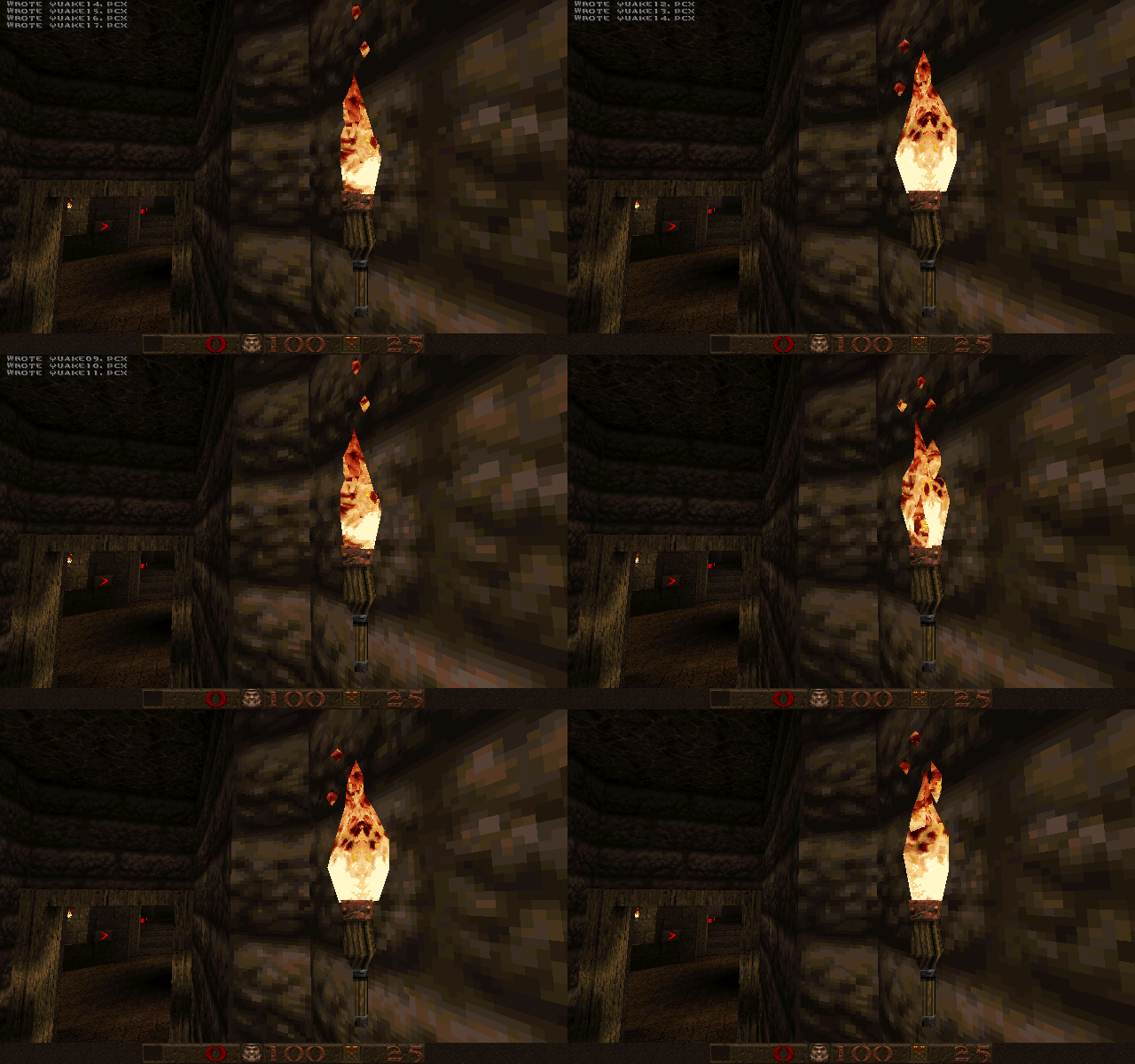
Curiously, explosions were still sprite + particles. But I can't remember anything else outside of UI that was using a sprite.

Q2 took it even further - it has 3D models for explosions, and even puffs of smoke when bullets hit walls (these were simple particle effects in Q1). IIRC the only thing that was a sprite was the BFG10K plasma ball?

Back then, I just found it strange. In retrospect, I wonder if it was an attempt to associate some kind of "uncompromising real 3D" branding with id engines. It's interesting that Q3 - which was the first engine id released after they got serious competitors in that space (Unreal, Source) - switched back to sprites for fire, smoke and explosions. And Unreal especially made it a point that it wasn't just 3D, but it was shiny:

https://www.youtube.com/watch?v=zqdeyseQAP4

Re:Quake II RTX: Re-Engineering a Classic with Ray Tracing E... by josteink on Friday March 22, 2019 @08:26AM (#19461847)
> A nitpick: DooM (1 and 2), just as well as Duke Nukem 3D were indeed "2.5D"

Double nitpick: Duke Nukem could actually have stacked floors and bridges over other playable areas.

As such, if it didn’t use “real” 3D, its 2.5D scheme were considerately more elaborate than Doom or Wolfenstein.

Re:Quake II RTX: Re-Engineering a Classic with Ray Tracing E... by fb03 on Friday March 22, 2019 @09:02AM (#19462109)
Yes, but I remember you still had to use a really contrived way of explaining that 3d 'geometry' on the editor (BUILD.exe).

Basically you still drew in 2d but you could overlap rooms with other lines that wouldn't intersect with any already existing lines, and that would configure 'a room above/below the current room'. Then you had to slope the floor until it actually connected with the newer room.

It was pretty strange but yeah, some people built insanely detailed things with Duke3D :-)

Re:Quake II RTX: Re-Engineering a Classic with Ray Tracing E... by TomBombadildoze on Friday March 22, 2019 @11:17AM (#19463352)
> Basically you still drew in 2d but you could overlap rooms with other lines that wouldn't intersect with any already existing lines, and that would configure 'a room above/below the current room'.

Elaborating a bit -- the Build engine had a feature called "sector effectors" that, when triggered, would teleport the player to a completely different sector in the map. The transition was seamless and permitted interesting effects like the illusion of having stacked floors.

The designers used this feature to most profound effect in the level Lunatic Fringe. In order to complete a full circuit of the central ring room, the player had to move through a 720-degree circle to return to the entrance. It was _extremely_ confusing playing that level for the first time.

https://dukenukem.fandom.com/wiki/Lunatic_Fringe

Fabian Sanglard wrote an excellent series about the engine here: https://fabiensanglard.net/duke3d/

Re:Quake II RTX: Re-Engineering a Classic with Ray Tracing E... by estebank on Friday March 22, 2019 @02:20PM (#19465350)
Interestingly enough the Portal games leverage similar level design given to the Source engine, not only for the obvious user controlled portals but also to stitch levels together seamlessly, including impossible architecture (the long bridge leading to the glados confrontation in the first Portal shows the room you're about to enter, but its actually too small and shaped differently to hold the room.
Re:Quake II RTX: Re-Engineering a Classic with Ray Tracing E... by dexen on Friday March 22, 2019 @08:28AM (#19461857)
Thank you a lot, josteink; I mixed up map format's with renderer's limitation.
Re:Quake II RTX: Re-Engineering a Classic with Ray Tracing E... by mbel on Friday March 22, 2019 @06:39AM (#19461167)
What do you mean "fake 3d"? They are as 3D as any other computer generated images with linear perspective. Quake is even using a rasterizer like nearly all games today.
Re:Quake II RTX: Re-Engineering a Classic with Ray Tracing E... by anc84 on Friday March 22, 2019 @06:59AM (#19461288)
I'd take the benefit of the doubt and consider the poster oblivious to the vast difference between Doom and Quake, they probably just threw them both into the "early 90s 2.5D FPS" bucket.
Re:Quake II RTX: Re-Engineering a Classic with Ray Tracing E... by dahart on Friday March 22, 2019 @11:37AM (#19463574)
The word fake doesn’t bother me, but maybe “limited 3d” would be a better term for it. The 3d it had was still correct 3d, sure, it was just limited in what kinds of 3d it could render, unlike the full 3d games that came soon after.
Re:Quake II RTX: Re-Engineering a Classic with Ray Tracing E... by PavlikPaja on Friday March 22, 2019 @11:54AM (#19463747)
It wasn't really 3D, you couldn't look up or down at all in the original doom I think and in the later games you could, but it got all horribly distorted, as the engine couldn't actually show the scene from different perspective.
Re:Quake II RTX: Re-Engineering a Classic with Ray Tracing E... by kkapelon on Friday March 22, 2019 @06:49AM (#19461231)
Doom used 2D sprites, so "fake 3d" if you ask me.
Re:Quake II RTX: Re-Engineering a Classic with Ray Tracing E... by morganvachon on Friday March 22, 2019 @07:49AM (#19461616)
The terms "fake 3D" and "2.5D" in reference to Doom and similar games has nothing to do with sprite based mobs, it's about not having a truly 3D map. Doom's maps were drawn in 2D top-down with a height variable for any wall or platform. You couldn't have one room above another, which is why elevators in the game were solid (you couldn't stand under the floor). The various level editors for Doom based games looked like primitive 2D CAD programs.

Quake was a whole new paradigm, it was based on a true 3D engine and its maps were generated in three dimensions. You could stand under stairs, under the room above, and underneath lifts.

Re:Quake II RTX: Re-Engineering a Classic with Ray Tracing E... by leoc on Friday March 22, 2019 @08:07AM (#19461720)
It's surely both the sprite-based monsters and the "2.5D" world that justify DOOM's "2.5D/fake 3D" label, though indeed more the latter. (System Shock was a transitional example of sprite monsters in an otherwise full-3D world: https://youtu.be/CGKidgwcalM?list=PLqqLcEJ9bUtNedMdW64WioyV9... )
Re:Quake II RTX: Re-Engineering a Classic with Ray Tracing E... by mbel on Friday March 22, 2019 @07:22AM (#19461453)
So does plethora of today's AAA titles for subtle details like particle effects, grass and others.
Re:Quake II RTX: Re-Engineering a Classic with Ray Tracing E... by kkapelon on Friday March 22, 2019 @10:02AM (#19462563)
yes. but sprites (i.e. enemies and weapons) are the primary method of interaction with Doom.

Grass and particle effects are secondary....

How many FPS AAA titles today use sprites for enemies and weapons?

Re:Quake II RTX: Re-Engineering a Classic with Ray Tracing E... by jandrese on Friday March 22, 2019 @10:57AM (#19463104)
Funnily enough the sprite based enemies were a real strength for Doom compared to many of the fully 3D games that came out in the next generation, including Quake. Because rendering full 3D enemies was taxing for the hardware you couldn't put too many of them on the screen at once. In some games more than 2 or 3 would cause it to chug. So you only ever run across one or two enemies at once in the games, unlike Doom that wasn't afraid to throw a swarm of pinkies at you because you just picked up the chainsaw.
Re:Quake II RTX: Re-Engineering a Classic with Ray Tracing E... by kkapelon on Friday March 22, 2019 @12:33PM (#19464192)
Agreed. I think "Painkiller" is one of the few games that actually managed (much later) to put a healthy amount of enemies against you just like Doom did..
Re:Quake II RTX: Re-Engineering a Classic with Ray Tracing E... by sneakernets on Friday March 22, 2019 @12:27PM (#19464135)
Doesn't matter, to the Doom engine they are tall cubes , albeit with increasingly awful collision detection as the cubes increase in size.
Re:Quake II RTX: Re-Engineering a Classic with Ray Tracing E... by kkapelon on Friday March 22, 2019 @12:32PM (#19464182)
So according to your definition Doom is a full 3d game, even though as a player I actually see 2D weapons and 2d enemies?
Re:Quake II RTX: Re-Engineering a Classic with Ray Tracing E... by sneakernets on Friday March 22, 2019 @04:52PM (#19466817)
Of course it is in the "game" sense. It handles X, Y, and Z axes in game on mobs and the player, although it is selective in which mobs get the "Z treatment". Monsters are infinitely tall, projectiles aren't. It's not a limitation of the engine as much as it was a design choice, as Y-shearing was too ugly in Carmack's opinion, so it was removed in favor of a very forgiving auto-aim.

Nothing's stopping someone from adding code to render 3D models or "portals" in the game, and in fact it has already been done, with no 3D acceleration needed.

Re:Quake II RTX: Re-Engineering a Classic with Ray Tracing E... by anc84 on Friday March 22, 2019 @06:50AM (#19461234)
We had Q3RT 15 years ago: http://www.q3rt.de/
Re:Quake II RTX: Re-Engineering a Classic with Ray Tracing E... by _Microft on Friday March 22, 2019 @06:45AM (#19461199)
Do you maybe mean "raycasting" as used in Wolfenstein or Doom compared to a proper 3D engine like the Quake games were using?