US spending is over 18%, almost double the cost in France. Even the oh-so-expensive Switzerland spends ~12% of its GDP on healthcare.
https://www.statista.com/statistics/184968/us-health-expendi...
https://www.reuters.com/article/us-health-spending/u-s-healt...
I have family here and I love the United States, I'm staying, and I hope we can make some more progress, but I totally understand why some people don't want to wait that long.
My main reason for wanting to leave right now is the state of healthcare. I already have one "preexisting condition" out of my hands, it's called sleep apnea. I'm in shape, it's just a matter of my anatomy. My costs are relatively affordable (aside from never bothering with another sleep study since that's seen as not covered), a couple hundred dollars a year. Maybe a large purchase of a new machine every 5 to 10 years.
But I realize that even though I'm saving large chunks of money thanks to America paying more, I'm one terrible illness away from having it wiped out. I'm not a gambler by nature, so it doesn't really appeal to me. Pay me less, give me subsidized healthcare, real time off, etc. Basically, treat me more humanely.
I could care less about money I may lose due to tragedy at any moment. Especially when that crazy inner state minority will simple lambast me for not planning appropriately for my illness regardless of how much of my savings I pour into it (why didn't you save a million dollars for your ongoing cancer treatment you bum?).
When I was in my 30s I had a blood test come back with what the doc said was moderately high cholesterol (185?). From that point on all of my policies excluded illnesses, diseases, treatments and medicines that were in any way connected with high cholesterol.
Honest questions:
Weren't pre-existing condition exclusions only relevant if the condition was diagnosed when the person was uninsured and only when that person was buying an individual policy (so you could still get coverage through an employer group policy)?
Also, even if the condition was diagnosed while the person was uninsured, what would happen if they subsequently spent a long period of time insured under a group policy? When the person went back to the individual market, they'd have a long paper trail of being insured from the group policy. Would a new individual insurer really be able to figure out that, years ago, the person was uninsured years ago when they were diagnosed?
I can't speak for anyone other than my Floridian self but my hypercholesterol diagnosis was while insured on a group policy and became a pre-existing excludable condition when I set up shop on my own and bought an individual policy.
> so you could still get coverage through an employer group policy
There was no employer to offer me group coverage. It was my way or the highway.
> Also, even if the condition was diagnosed while the person was uninsured, what would happen if they subsequently spent a long period of time insured under a group policy? When the person went back to the individual market, they'd have a long paper trail of being insured from the group policy. Would a new individual insurer really be able to figure out that, years ago, the person was uninsured years ago when they were diagnosed?
I hear you, but really all it takes is a question on the insurance application to find out the info. If I'm asked I answer honestly not only because it's a felony to do otherwise but because false answers on insurance policy questionairres is an easy win for the insurance company that wants to avoid claim payment. If I were to lie though it wouldn't be a walk in the park but finding out the adverse info is definitely do-able and so long as preexisting conditions can be excluded there's a tremendous monetary incentive to find this stuff out. They can tap into the place that tracks health issues for life insurance companies (the Medical Info Bureau) to find out even more or simply write all of my physicians and ask them directly.
My wife is in the same boat. She has a thyroid issue and her policy came with an exclusion for everything associated with hyperthyroid. This is pretty much the entire book of morbid cardiovascular conditions.
At this point I'm job locked: If I leave (or am laid off) the individual market will exclude the hell out of both of us.
Having my illness would cause the rates for health insurance to sky rocket for my company the following year. I wouldn't blame them for letting me go since that would cause hardship for the rest of my coworkers.
Different people have different definitions of "progress". Your definition of progress might not align with mine. That doesn't mean I am not interested in progress, just that I believe we should be progressing in a different (possibly even diametrical) direction than you believe we should be progressing.
Maybe Progress(B) is a lovely thing for you. The rest of us, however, don't like it very much, and didn't vote for it.
Hold on, let me check something...
"The Congress shall have power to lay and collect taxes on incomes, from whatever source derived, without apportionment among the several States, and without regard to any census or enumeration."
I rather think we do have that right. Human rights for minorities are indeed a thing, but they aren't a thing that gives you (or anyone else) a fully general right to rule over the majority, nor a fully general right to treat the government as illegitimate when it uses its constitutionally enumerated powers to go against your ideas.
So let me clarify your position a bit: you do support immigration law enforcement, correct?
Also where did you get the idea that the majority of people in the US gets to decide the policy?
Yes, of course. If enforcing the law as written involves doing Bad Things, the law should be changed, but if we aren't democratically deciding to change it, then it's on us what it involves.
Mind, there's been plenty of support for the DREAM Act for quite a while now, so...
>Also where did you get the idea that the majority of people in the US gets to decide the policy?
The basic ethical grounds for representative democracy, without which the US government has no legitimacy, no matter how many pieces of paper anyone waves around.
Yes, it very much is.
>US was set up as a constitutional republic specifically to limit the simple majority mob rule.
The US was set up to preserve the power of the rural landowner class. It wasn't intended to be a representative democracy initially, and has only moved imperfectly towards representative democracy over time, with great struggle.
Rule by a minority elite claiming the mantle of national authenticity as its exclusive possession is, ethically speaking, far less legitimate than that of plain, old-fashioned majorities.
Anything contrary to his agenda is not progress, but going backwards. "around half" is a veiled hit on people who voted for President Trump.
Has it crossed your mind that this half might not see what you want as progress but instead destructive?
I'd also say that if anybody really did end up with more expensive policies with worse coverage, that's a continuing fault with our insurance companies. If they were functioning correctly, then an increase in policy premium after ACA would indicate that the consumer was not accurately assessing their own risk previously and thought their coverage was far more extensive than in reality. I haven't yet found an actual example of someone who really did get less coverage that cost more. Inevitably they are comparing an old plan that had basically no actual, effective coverage to one with far fewer loopholes.
Nope, it means that the risk pools changed and now everyone has to pay significantly more because they are paying for people with existing conditions. The only people that didn’t end up paying more are the ones who receive subsidies they didn’t previously.
The old plans were better if you didn’t have a condition because you were pooled with cheaper people to care for. Loophole reduction only plays a small part in that.
ACA changed health insurance from being insurance into a country-wide health program for already sick people. Insurance is a terrible vehicle for that. It was a horrible compromise and single payer would have been worlds better once you’re already down the path of that level of government intervention.
This view is directly at odds with the “progressive party” in the US that is convinced the only way forward is prayers that we will come up with an energy storage solution to make up for the instability of wind/solar while continuing to allow nat gas and coal in the interim while climate change marches on.
In my views, every time the government increases taxes and starts more individual and corporate welfare programs, that is the opposite of progress because it’s very rare that the government executes something effectively with self sustaining income.
Cap and trade is progress. Random bans on industries are not. And on and on.
So yes, we can certainly agree on facts, but I don’t think many people can agree on what the definition of better is because that’s definitely subjective.
Cortez and Sanders were elected on socialist platforms and they want nothing but massive government expansion of welfare programs that they see as “progress” and “better”. Their proposals so far have massive funding flaws and/or are ripe to fail in a short period of time (in my view) so I don’t see them pushing progress or anything better.
Ironic as American expats are still taxed, unless they give up citizenship.
https://www.nolo.com/legal-encyclopedia/when-us-citizens-liv...
https://www.americansabroad.org/us-taxes-abroad-for-dummies-...
As far as I'm aware, its the only nation that taxes its citizens in that way.
I’m not American so it’s not my problem, but it’s what I hear from other tax exiles.
My parents are American but given the choice for me to become American I declined due to the whole tax issue.
there is a "physical presence test" where you need to be resident outside the USA for 330 days or more a year.
https://www.irs.gov/individuals/international-taxpayers/fore...
1. https://www.healthsystemtracker.org/chart-collection/u-s-spe...
Things like cost controls and universal coverage are synergistic. People with coverage will seek earlier, cheaper remedies over waiting to the last minute expensive emergency care.
Republicans and conservative Democrats have allied to sabotage the ability for universal service to control cost. From the abandonment of the Public Option in the ACA marketplace, to disallowing Medicare Part D from negotiating with drug manufacturers for lower prices. We've been effectively hamstrung, but that means there's plenty of low-hanging fruit.
If the US got its obesity rate under control, we could save a lot of money (less hypertension, less diabetes).
I pay $6000+/year in health insurance in the US + deductibles + co-pays + + + and I don't even know if they'll cover me when shit really hits the fan - but hey, I'll get a flu shot "for free".
Check profit margins for companies in the health care space, they're pretty good.
As you can see, obesity is a leading risk for all these problems.
We need to fix obesity.
Based on the data it's age that determines whether or not to leave the US, which makes sense since there'd be shallower roots to leave behind.
We can have both the most advanced military and a solid social system if we can figure out how to get our social spending return on investment close to other western nation. Universal Health care would be a big step. Other stuff to look at is collapsing the number of social services agencies down to a more reasonable numbers, not removing the benefits. Actually auditing our system to figure out what is and what is not working rather then allocating money based on political appearances.
Well, it depends on what your goal is.
If it's to improve population-wide health care outcomes, then yes, we do a worse job than many other first world nations.
If it's to allow for a, ah, "vibrant" set of industries who can benefit from capturing social spending while providing mixed outcomes which we justify by enshrining the fundamental attribution error under the banner of "meritocracy" then perhaps we're being efficient after all.
You get this in Canada as well, they just don’t pay for it - US taxpayers do.
You keep the military for the times, or at least most countries outside of the United States and its absolutely outrageous military spend does. If you think the US went to Iraq or Afghanistan or Vietnam for Canada (or countless exercises throughout the rest of the world, usually to prop up whatever the favored dictator was, and to promote US interests), or that Canada owes US taxpayers for that, you're profoundly mistaken (though Canada went heavily into Afghanistan for the United States, the single time NATO was actually invoked for defense).
Don't think for a second the US military hasn't planned for having to wage war against a country that it's outfitted with it's own technology. Many exported items have reduced capabilities, and lack the communications systems that allow information sharing between all military assets. Information at the front line is what wins battles.
We pay 4-10x the price of comparable first world countries for basic infrastructure like water, roads, and transit. We already pay more per capita for Medicare than most countries spend on universal health care. 15% of my earnings immediately go into a social welfare system that will be insolvent before I'm 50 years old. And even though our military has the best technology and funding in the world, we can't win wars against AK47s, IEDs, and Toyota Hiluxes. Paying taxes in the US is like throwing cash into a dumpster fire.
The sad thing is that due to tax rules on expat earnings, I can't just vote with my feet, I have to vote with my citizenship. That may not be the end of the world (I'm already on the path to dual citizenship with an EU country), but its a bit like getting a divorce because your husband spends too much on beer: it has to get really bad before it gets to the point of divorce. And for me, it's almost there.
https://media.nationalpriorities.org/uploads/total_spending_...
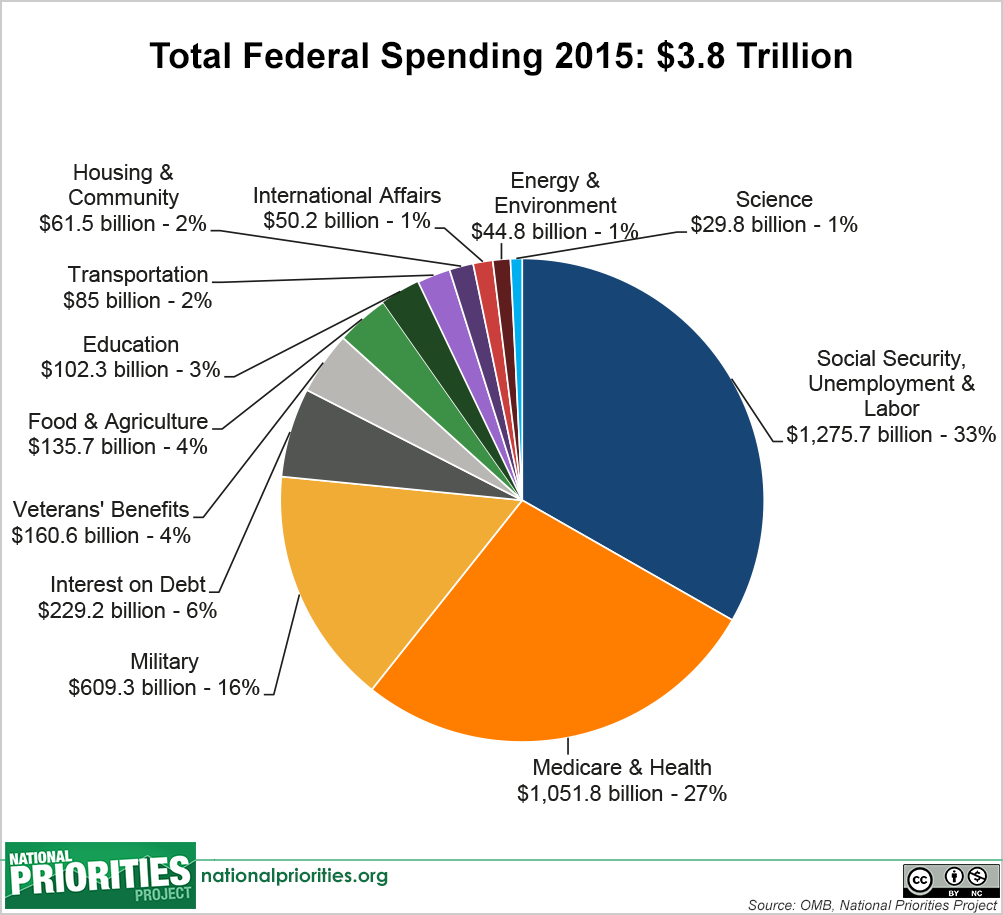
(from https://www.nationalpriorities.org/budget-basics/federal-bud... )
It's unfortunate the chart includes social security, which isn't quite tax and spend the way most of the rest of the federal budget is.
The same for Medicare; everyone pays the payroll tax but most don't get to use it. We'd have more personal sense of investment in our social programs if they helped people more widely, e.g. everyone of every age can use the healthcare they're being taxed for in countries that have nationalized it.
Social security doesn't do that. The rich get back everything they put in. Or more when you were forced to put money into social security and then couldn't use it for healthcare, then receive nothing because you don't live long enough, while the rich people who outlive you get the money you paid.
That is the same thing once you account for where the tax money goes, which it is unreasonable not to do.
For example, if you have a 25% tax that pays for a $10,000 UBI, there is a single marginal rate but the tax system is progressive because the effective rate is a curve. Someone at $20,000 pays $5000 and receives $10,000, net $5000, an effective tax rate of -25%. The effective tax rate is 5% at $50,000, 12.5% at $80,000, increasing asymptotically to 25% with higher incomes.
Compare this with a version of social security that charged higher marginal rates for higher income people, but all benefits are still paid out in proportion to what each person paid in multiplied by their lifespan. There is nothing progressive about this -- if everyone lived the same amount of time it would be exactly breakeven, and since in practice the rich live longer it thereby becomes regressive.
Source?
No, not at all. In the US, it's not uncommon for partisans to threaten to "move to Canada" if the party they oppose wins the election. Here's are some examples (http://fortune.com/2016/11/08/election-move-canada-trump/).
All this indicates is that some people are dissatisfied with the results of an election and the party and politicians who are in power.
Dissatisfaction with the govt does not necessarily mean dissatisfaction with the return on the investment of taxes. I want kids to be educated, people to be healthy, and that desire doesn't change if my tax rate is 0% or 80%. Sure, there's a point at which I think that taxes aren't the answer, but the root desire is not about taxes, they are merely a means to an end.
Many of the libertarian-leaning folks here will have a very different view of the above, but I think that would be apples and oranges - they view govt as either inefficient or unjust, but the issues in this article are different, about effectiveness and functioning.
The issue is about efficiency. If you pay $2000 in taxes, you want to be getting >=$2000 in value for it. If you have to pay $5000, the value needs to be >=$5000.
The problem in the US is that government efficiency is a disgrace. We spend more on the military than most other countries combined and get... what, oil? We already have oil. And we need less of it, not more.
Our healthcare costs are outrageous and rather than do anything at all to actually address the cost, we just keep increasing the amount of tax money that gets thrown at it -- which only raises the costs further.
Social security is designed to sound progressive when it's really a transfer of wealth from poor to rich (because the rich live longer), and which deprives the poor of money during their working years that they could have used to send their children to college and other investments in the future, intentionally making the choice to retire later or rely on that investment they could (and now can't) make in their children to support them in their old age. Or for that matter have just invested the same money in a major index ETF, which has always had better long-term returns than social security to begin with.
If we were getting what we're getting now and paying half the taxes then everything would be fine, because then you don't have free healthcare but you do have the amount of money it costs to buy healthcare. It would also be fine if we were paying what we are now but getting twice as much. But we're not.
This is the statement I disagree with. Me having a few thousand extra $ at the end of the year does not give the homeless homes, does not allow me to comparison shop for healthcare, does not tell me if the drug at the store is actually real, does not ensure the schools are safe and effective. And I can't buy those by myself for that extra cash. This is how the people under discussion in this article are feeling.
We won't resolve libertarian principles and divides here, but WITHIN THE SCOPE OF THIS ARTICLE, my argument is that the dissatisfied people would not be content if the tax rate is zero, because they aren't dissatisfied about the tax rate. That there is a separate group of people that ARE dissatisfied about the tax rate can be true without being relevant to the first group.
Why not? If you had thousands of dollars a year in extra cash, you could donate to homeless shelters, pay the higher healthcare premiums, subscribe to a service that would independently validate pharmacies, pay for good private schools or donate to scholarship funds, etc.
More to the point, you wouldn't need to pay for them to the extent that they already exist. There currently are homeless shelters and multiple health insurance companies and an FDA and mostly reasonable public schools. But they cost twice as much as they ought to or more. The healthcare market in the US is completely broken, but it's completely broken by inefficient regulations. Some of the costs of the inefficiency are paid in private health insurance premiums rather than tax dollars, but the problem is still the inefficiency.
Drifting off-topic, but the short version is that "subscribe to a service that would independently validate pharmacies" (meaning everything on the shelf at the pharmacy), validating schools, etc all comes down to recreating work that the govt does and then making sure that it's more cost-effective to provide good value than it is to be deceptive about providing good value. I suppose I should get a few degrees to make sure I know how to evaluate these different areas. Hopefully I know which schools will teach me for real and not deliver empty bombastic lies. There's a reason that everywhere that does a good job at these (IMHO) have plenty of taxes.
Ultimately it's a war between where you want efficiency (private market) and reliability (govt).
All of which is mostly unrelated to the point I made above: The people under discussion are upset about results, not taxation. Even if you are 100% correct that giving them their tax money will allow them to fix the issues they are upset about, that's not the same as actually fixing them. And I, for one, pay taxes so that people with the right knowledge, authority, and economies of scale CAN fix those things. Giving me a tax refund is no different than refunding me for a product not delivered - it's better than losing the money, but I wanted the product.
That's kind of the point. If the government is doing a crappy job and you can get your money back, go take it to someone else who can do a better job. Maybe even your state or local government instead of the feds.
> and then making sure that it's more cost-effective to provide good value than it is to be deceptive about providing good value.
This is the exact problem we already have with the government. It isn't inefficient because nobody wants it that way, it's because of regulatory capture and corruption. The only way out of that is for the real party in interest (i.e. the citizens) to be paying attention.
But that doesn't work at the scale of the federal government, because a billion dollars in graft is a rounding error but it's still a billion dollars, so you get a billion dollars of incentive for corruption and the taxpayers only care about that specific thing as much as they care about 0.03% of their tax dollars. But the same is true for every other individual program, so corruption and waste is rampant.
The problem is that we keep comparing the US government to the governments of other countries when it's the individual US states that are at the scale of most other countries. The national healthcare systems in Europe aren't administered by the EU. They don't have a single military or school system. If they did they would have all the problems we have by trying to do it here -- that much centralization is too big a target for corruption and too easy to hide inefficiency in the complexity and scale. There is a point at which more scale no longer yields more efficiency and instead yields bureaucracy and inefficiency.
Do you really want to have to shop around for a service that tells you which drugs are safe? You can't pick the cheapest because they probably cut corners or took industry kickbacks, but are you throwing away money if you pick the most expensive one? Do you just pick the average-priced option and hope they are trustworthy?
That would imply that these "essential services" are worth less to people than the cost it takes to provide them. Especially when the primary customers for such a service would be doctors, so the typical patient wouldn't even have it as an independent cost separate from the doctor's visit.
> At best, we'll end up with the same thing because corporations are greedy and there's not really a good reason to have competition in pharmaceutical oversight.
Why would you not expect competition? We don't have a monopoly provider for credit reporting or product reviews.
> Do you really want to have to shop around for a service that tells you which drugs are safe?
Do you really want to not be able to? What happens when the FDA approves Vioxx or the dozens of other drugs they've approved, often on the market for decades, that will give you a heart attack or liver damage or cancer or birth defects?
Or even worse (since you can't opt-out), when they fail the other way and don't approve the only drug that would save your life?
The issue is not that I trust the government, it's that I trust companies less. Governments have done a lot of bad things, and have done a lot of deception, but ultimately I trust their model of accountability more than I do companies. I'm not against being persuaded...but I don't see a lot of (any?) real world examples of this free-market utopia you describe, nor signs that it would come about. Instead, whenever govt reduces regulation too far, companies form monopolies, perform deceptive trade practices, and break the fundamental concepts of capitalism. That govt can over-regulate does not mean that (1) it must, nor (2) that it is.
All of which is irrelevant (again) to this article, which is stating that people are unhappy with the results. They aren't demanding tax cuts, they want the results. The primary obstacle to results in recent decades has not been the govt being bad at it's job, but people demanding the govt stop doing these things and cutting their funding to do so, then complaining about the govt's inability to fix things. These are the same people demanding bigger military funding and focus on oil, so the govt seems to be doing a decent job of doing what it's asked...it's just not what I and many others are asking for.
The common examples are invisible because nobody talks about things that are working. For example, ever have to buy a box of screws, or a hammer, or a piece of rope? Sold in any hardware store at low, transparent prices with minimal regulation and good quality.
> Instead, whenever govt reduces regulation too far, companies form monopolies, perform deceptive trade practices, and break the fundamental concepts of capitalism.
This is the trap of ideological purism. You can argue about "less regulation is better" or "more regulation is better" as an abstract principle but that's not a way to evaluate an individual regulation. Applying either principle blindly and universally would require either total anarchy or total authoritarianism, which isn't what anybody actually wants.
It's possible to eliminate necessary regulations while still having too many (or the wrong) other regulations -- this is in fact what commonly happens in Washington, because the people who win there are the people with the best lobbyists, whether they want to pass/preserve bad competition-destroying regulations or eliminate good competition-protecting ones.
The advantage of a general principle of less regulation, especially at the national level in an environment known to be wasteful and corrupt, is that you can find alternatives for the national government not doing something -- whether it's markets or citizen organizations or local government. But if they waste your resources on corruption and bureaucracy, you can't recover them to use for something better, which interferes with anybody doing something better.
> All of which is irrelevant (again) to this article, which is stating that people are unhappy with the results. They aren't demanding tax cuts, they want the results.
You keep saying this, but the article doesn't say that at all. It says that people are dissatisfied, not why. And given the demographics of the most dissatisfied groups, it wouldn't be the least bit surprising to learn that they would e.g. prefer to reduce military spending.
And if you do want the results, wasting tax money still interferes with that.
For example, you mention homelessness, but that is inherently a local issue. There is a major homelessness problem in San Francisco but not so much in Kansas. And you also can't solve it in SF by building shelters in Kansas. You can't even solve it in SF by building shelters in Bakersfield. The relationship it has with inefficient military spending is that they come from the same tax base -- if the people of San Francisco are paying taxes to fund the military, those dollars can't be used (by the local government or the people themselves) to address homelessness there. Resources are scarce. When the government wastes them, you no longer have them.
> The primary obstacle to results in recent decades has not been the govt being bad at it's job, but people demanding the govt stop doing these things and cutting their funding to do so, then complaining about the govt's inability to fix things.
Only the federal budget hasn't declined. It has been ~20% of GDP since the end of WWII and still is. Which means it has been growing over time, since real GDP per capita is up. If they're providing worse or fewer services than they used to, it's because they're doing less with more, not because they have less in total.
> These are the same people demanding bigger military funding and focus on oil, so the govt seems to be doing a decent job of doing what it's asked...it's just not what I and many others are asking for.
That is the corruption and inefficiency. The people asking for that are defense contractors and oil companies and their workers, who have tons of (taxpayer-sourced) money to lobby with are not a small voting block because the scope of the expenditures is so massive that it employs a large number of people. It's exactly the sort of thing we could reduce in order to lower taxes without impacting the level of actual services provided.
1) So that we can have consistent, reliable, and widely-available services. 2) So the financial cost of society is spread fairly across everyone.
These are not guarantees the free market provides, because the market doesn't care about outcomes. Giving people tax breaks and hoping they donate it to homeless shelters will probably not help all the homeless people in the country. Switching the FDA to an opt-in subscription service will not prevent unsafe drugs from reaching consumers.
Sure I'd prefer government to run be as efficient as possible, but the goal isn't efficiency, it's better outcomes.
Paid for by the US taxpayer of course.
I had this, err, debate on Reddit recently. I am against the actions Israel is taking against Palestine. I view it as an atrocity in its own right. (There, I said my part. Please hear the rest out.)
From that, I said I was against the actions of violence. However I was attacked and called an antisemite. And it wasn't one person. It was quite a few. Something is going on, in that criticizing bad actions makes me construed as some sort of a hater (read: racist, sexist, ageist, nationalist, etc).
Obviously this also has other broad implications. If I disagree with practices of X, means I somehow hate X, even if I don't. I also see that similar viewpoint bandied here at HN, primarily with the once-a-month article about women and tech (which devolves into flamewars and large swaths of comments being disconnected by dang).
What's going on here? It's certainly a phenomenon which I'm seeing accelerated. Is this the growing pains of having hypercommunication across the world? Is this the problem of having up-to-the-second news?
God fucking damnit I hate these conversations. No, we don't manipulate the bloody government! We're less than 2% of the population. You know who passes all those laws "outlying" criticism of Israel, none of which have stood up in court, ever? Evangelical Christian Republicans.
Not American Jews or Israeli exiles, who, again, mostly vote Democratic and make up an insignificantly small fraction of the total population.
Nuclear armed submarines are probably their most important defensive asset.
So is Israel smart for not wasting money on a huge naval fleet?
Also, destroyers and cruisers are primarily used as missile-firing platforms anyway. And good luck countering enemy submarines without destroyers of your own.
And I think you are overestimating how large destroyers are. They're basically the minimum size necessary to have a warship that can sail the world's oceans independently.
Agreed, and currently a modern Navy and it's ability to "projct power" is unmatched.
I just see a lot of commentary about how these large boats would be sitting ducks for modern missile systems. I'm not arguing that they are, just that it's been suggested and I'm wondering if Israel's decisions regarding defense are effected by this (probably not)
Your other two points were good as well - thanks for contributing.
Israel doesn’t need to worry about an invasion because it can fall back on the US.
I generally agree. When I've debated this topic with others they basically say the carrier groups will be the first to go, but the response from nuclear submarines, and hidden fixed launch sites would be overwhelming.
Again, I'm not arguing this point, just suggesting that some may argue a strong Navy is antiquated.
From my experience some of the reasons people in my circle have left / wish to leave the US are the following:
- Race relations have become more divisive. If you speak spanish in certain parts of the country you are outright asked to provide proof of citizenship as though you are a second class citizenship. BLM has also made counter movements more bold with my black friends being harassed more by the police over trivial things.
-Gun Violence. I live in Florida and have had two close calls with gun massacres in Parkland and Orlando. I am reaching the age where if I were to have kids I would have to make a cost/benefit analysis of their chances getting shot down in cold blood.
- Politics have become more divisive than ever. I have friends on both sides of the political spectrum and it is becoming unbearable if you are anything but a left/right wing radical. Either way every election ensures that 50% of the population is outright mad at all times.
-General Cultural Differences. In the US you need to have a car to get anywhere and opportunities for employment feel very limited outside the mega city centers which tend to be very car centric and have no real culture outside of a few museums.
Obviously it would help if the government was better organized but I don't see how the points I raised would be solved outside of a huge shift in culture.
- Health Care. Before a few years ago, it was possible to be completely rejected by all carriers and not be able to buy it at any price. Even with insurance, a major illness or chronic condition can cost hundreds of thousands or even millions and wipe out a lifetime of savings.
We spend on military force so they don't have to. The money they save is used for the services you listed.
We could renegotiate, which is what President Trump is doing, yet Id guess Americans want to have the worlds largest and most advanced military. "He with the biggest stick" mentality.
EDIT: I’m not complaining about the level of military spending or healthcare spending. I’m pointing out that from my perspective our return on taxation is a great military and a crappy healthcare system. Hence I’m not happy about the returns on taxation.