Maybe you can explain what you are referring to here?
Ancient Greeks and Romans simply did not do arithmetic with pen and paper. They used a counting board with counters or pebbles (“calculi”), or for simpler problems used their fingers or did the work in their heads.
Doing computation was literally called “placing pebbles”, and to settle accounts with someone you would “call them to the pebbles”.
Roman numerals were not a tool for computation. They were a tool for recording data or results. The purpose of Roman numerals was to faithfully record in writing the placement of counters on a counting board. The position of the counting board (or perhaps in some contexts a pile of coins of various denominations) was the primary representation of numbers, and Roman numerals were secondary.
https://upload.wikimedia.org/wikipedia/commons/1/13/Houghton...
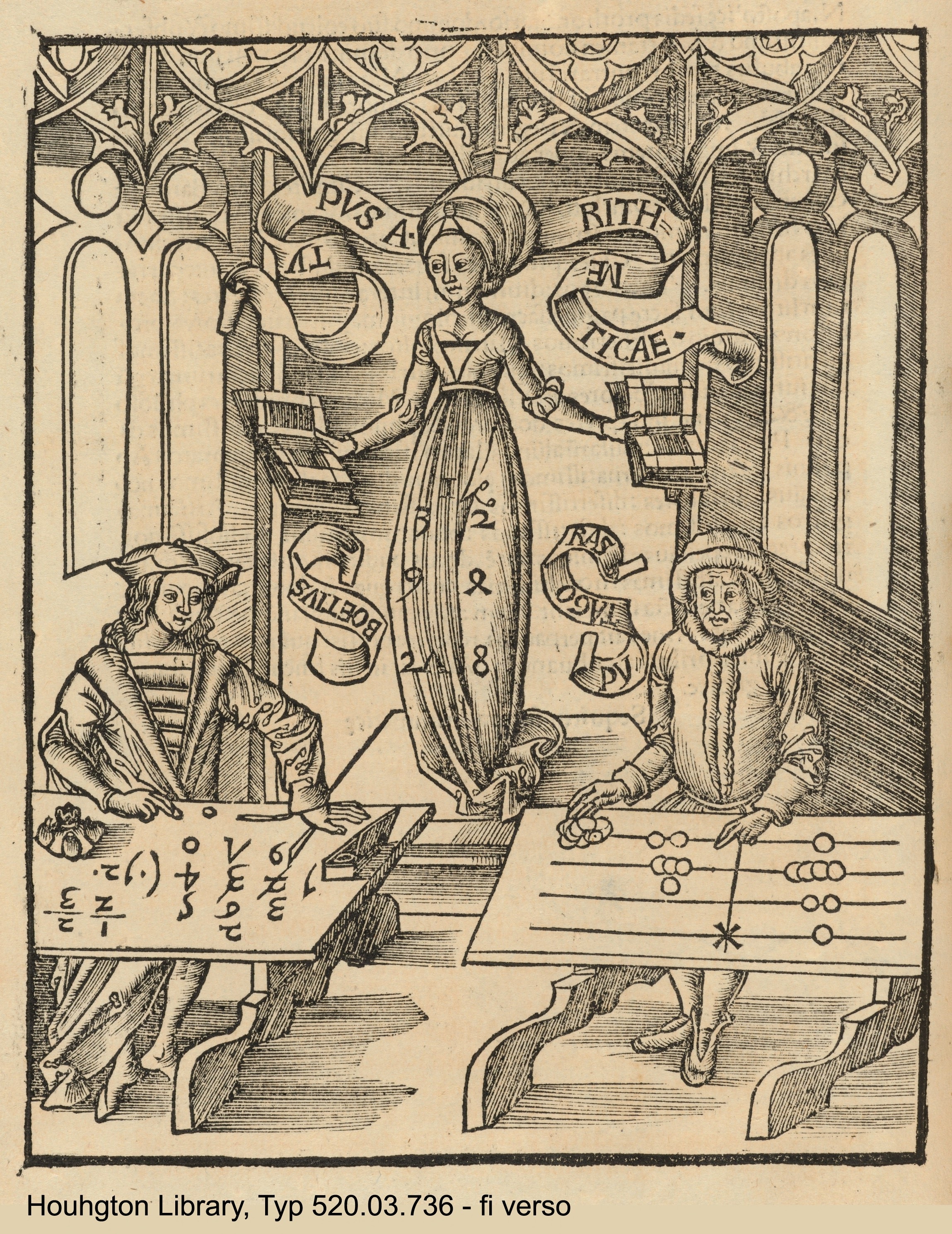
But we care about both representing numbers and computing with them. So I don't think it makes sense to say its not fair to point out the drawbacks of a system that can't do both.
If people simply said “paper is good, we should use paper instead of counting boards” that would be fine. But instead they always make up nonsense about how pen and paper long division is stupidly cumbersome if your only tool is pen and paper and you write your numbers as Roman numerals, or whatever.
Or perhaps you are saying it nonsense to start the discussion with the implicit assumption that the available tool is pen and paper, and not a counting board.
Yes, that is right. Roman numerals do not make much sense in a paper-centric context where we have ditched counting boards. Any algorithms you might invent for working with Roman numerals on paper are anachronistic. Comparing invented straw-man uses of Roman numerals against real uses of Hindu–Arabic numerals is not fair or useful.
It’s like making an argument that Lassie and Perry Mason are “better” than Verdi operas on the basis that the opera set designs are too elaborate and colorful, the action is too spread out, and the commercial breaks don’t flow with the story when you try to show the opera on small black and white TVs from the 1950s.
MCMDCVII is just wrong. D is 500, X is ten.
Edit: I never used an abakus or the like, but maybe that's what roman numerals are the analogy to, and it got overcome with long division and the like.
A symbolic positional system saves space on the page. It makes recorded numbers more difficult to falsify later. Doing scratch work on paper leaves a better record of calculations (the position of a counting board is inherently ephemeral) which potentially makes it easier to spot errors. It is easier to describe pen and paper arithmetic in printed books which helps spread knowledge more easily than an oral tradition. It extends more easily to larger or (after the advent of decimal fractions) smaller numbers without needing an inordinately large number of different symbols. It is more easily extended by the use of pre-computed tables of function values, and especially by slide rules and similar devices. Once we start decimalizing our metrical system it becomes very regular to work with many different measurements in a consistent way. Perhaps most importantly the use of writing leads naturally to the development of symbolic algebra and ultimately simpler formulations of higher mathematics.
But we can carefully describe the advantages and historical process of replacement etc. without unfairly disparaging the more direct representation.
Nevertheless, high level representation might be an advantage. Maybe an interesting parallel viz. cognition is the 19.95 pricing scheme that's apparently proven to be confusing to the consumer. I'm just not sure which numeral system suffers more from that.
[1] which marks an isogloss between east and west germany, the latter saying "dreiviertel vier" - three quarters four; German also has a weird order for decimal place reading: 121=hundred-one-twenty
MDCCCC is absolutely a more direct representation of the counters on a counting board than 1900. Each letter precisely represents one counter and its position.
But if you want, you can make a counting board with a line down the middle and use one side for negative values, in which case MCM would be a pretty direct representation of that. (It is unclear whether this was the origin of such numerals; we don’t have a whole lot of evidence about how calculation on ancient counting boards was done, because it was largely part of oral culture.)
Why was 1997 easier for us to read than MCMDCVII?
Duh... because we all have decades of experience working with the former representation and almost no experience at all working with the latter one.
If you wrote a number using arbitrary different symbols and (say) base 14 instead of base 10, but still a positional number system, we would still find it incredibly difficult to interpret written numbers, because we wouldn’t be used to it.
Indeed we find exactly this happens when people who are not experienced programmers try to read hexadecimal numbers written using digits 0123456789ABCDE, and that’s even in a case where we are deeply familiar with all of the symbols and their order, and in a very straightforward power-of-2 base.
Romans or medieval Europeans had absolutely no problem reading numbers written like the latter example. Indeed, this is a much more straight-forward and intuitive representation, and is very easy to interpret for anyone used to working with a counting board, since it is a direct translation of the positions of counters on the counting board to symbols written on paper. [Edit to add: Note that Roman numerals were not a system for practical arithmetic – people didn’t use writing for this, instead calculating by moving counters around on a counting board — but only a written record of input data and calculated outputs.]
I really hate how much people bash on Roman numerals without any significant experience working with them, and without any discussion or even acknowledgement of the historical or practical context.
I would recommend anyone interested in this topic start by reading Netz’s paper “Counter Culture” about Greece 2500 years ago, http://worrydream.com/refs/Netz%20-%20Counter%20Culture%20-%...