News for hackers. Stuff that matters.
Re:Math and Analogies by jacobolus on Wednesday November 28, 2018 @03:36PM (#18555398)
People never used Roman numerals for performing written arithmetic, so that is not a fair comparison. Calculations were done mentally, with fingers, or for anything complicated or serious on a counting board.
Re:Math and Analogies by JoeAltmaier on Wednesday November 28, 2018 @03:39PM (#18555430)
I believe the ancient Romans would disagree? They had complicated rules for borrowing and simplifying, but of course it had to be done or they had nothing.
Re:Math and Analogies by jacobolus on Wednesday November 28, 2018 @08:10PM (#18557304)
> complicated rules for borrowing and simplifying [..] or they had nothing

Maybe you can explain what you are referring to here?

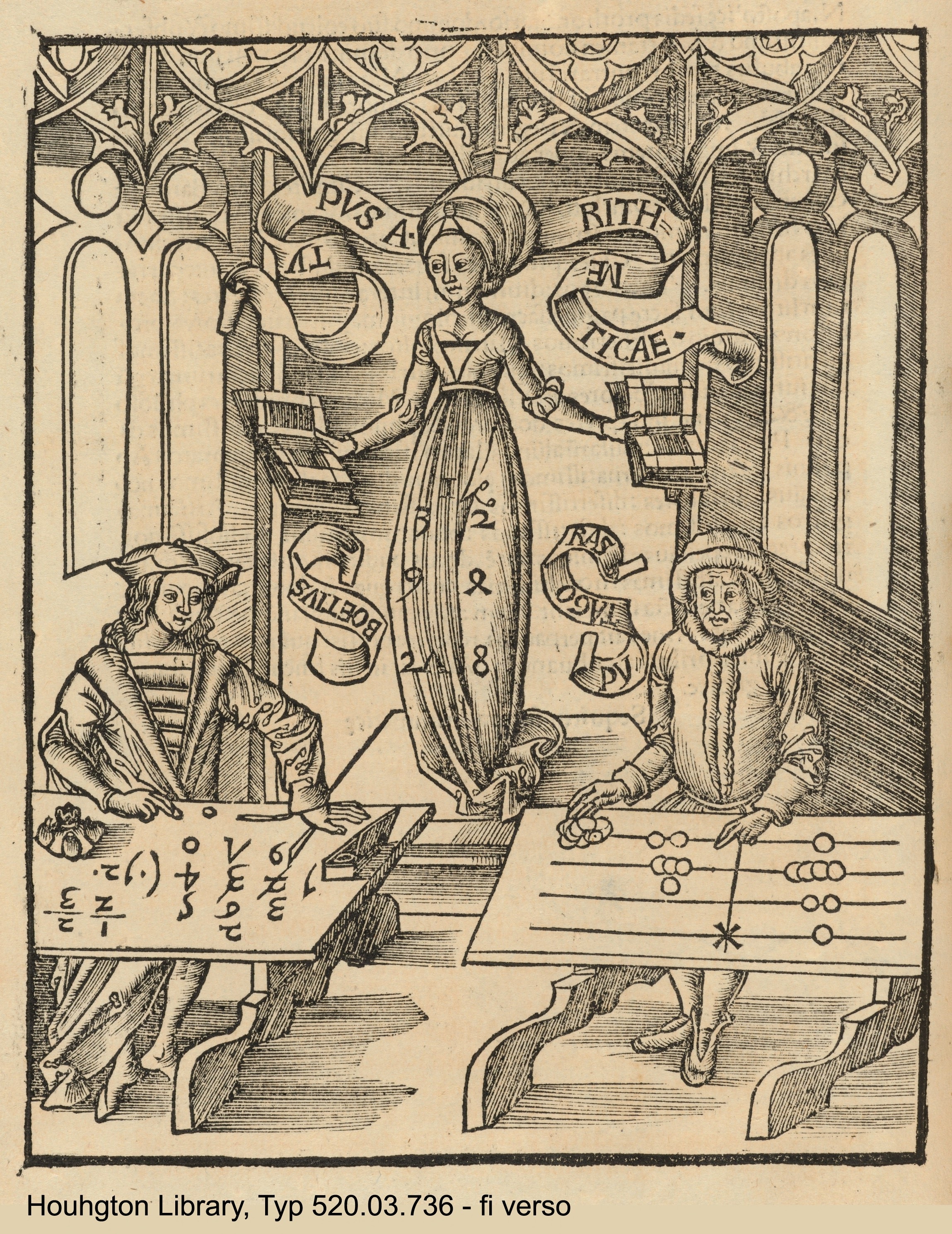
Ancient Greeks and Romans simply did not do arithmetic with pen and paper. They used a counting board with counters or pebbles (“calculi”), or for simpler problems used their fingers or did the work in their heads.

Doing computation was literally called “placing pebbles”, and to settle accounts with someone you would “call them to the pebbles”.

Roman numerals were not a tool for computation. They were a tool for recording data or results. The purpose of Roman numerals was to faithfully record in writing the placement of counters on a counting board. The position of the counting board (or perhaps in some contexts a pile of coins of various denominations) was the primary representation of numbers, and Roman numerals were secondary.

Re:Math and Analogies by Koshkin on Wednesday November 28, 2018 @04:50PM (#18556016)
The Romans heavily relied on the abacus. It used the 10-based positional representation of numbers.
Re:Math and Analogies by gugagore on Wednesday November 28, 2018 @03:49PM (#18555535)
I'm not sure what your position is. What would be a fair comparison?
Re:Math and Analogies by jacobolus on Wednesday November 28, 2018 @08:26PM (#18557369)
The fair comparison would be a written arithmetic with Hindu–Arabic numerals vs. a counting board.

https://upload.wikimedia.org/wikipedia/commons/1/13/Houghton...
Re:Math and Analogies by gugagore on Wednesday November 28, 2018 @09:53PM (#18557652)
That would be fair if all you cared about was calculation. Comparing our numbers with Roman numerals is fair, I believe you're saying, if all you care about is representation. They both require practice to read and write.

But we care about both representing numbers and computing with them. So I don't think it makes sense to say its not fair to point out the drawbacks of a system that can't do both.

Re:Math and Analogies by jacobolus on Wednesday November 28, 2018 @11:22PM (#18558088)
Doing pen and paper arithmetic is not part of the “system” of Roman numerals.

If people simply said “paper is good, we should use paper instead of counting boards” that would be fine. But instead they always make up nonsense about how pen and paper long division is stupidly cumbersome if your only tool is pen and paper and you write your numbers as Roman numerals, or whatever.

Re:Math and Analogies by gugagore on Thursday November 29, 2018 @07:45AM (#18559784)
How is that nonsense? Is it not cumbersome to do long division with Roman numerals if your only tool indeed is a pen and paper?

Or perhaps you are saying it nonsense to start the discussion with the implicit assumption that the available tool is pen and paper, and not a counting board.

Re:Math and Analogies by jacobolus on Thursday November 29, 2018 @06:14PM (#18565085)
> nonsense to start the discussion with the implicit assumption that the available tool is pen and paper

Yes, that is right. Roman numerals do not make much sense in a paper-centric context where we have ditched counting boards. Any algorithms you might invent for working with Roman numerals on paper are anachronistic. Comparing invented straw-man uses of Roman numerals against real uses of Hindu–Arabic numerals is not fair or useful.

It’s like making an argument that Lassie and Perry Mason are “better” than Verdi operas on the basis that the opera set designs are too elaborate and colorful, the action is too spread out, and the commercial breaks don’t flow with the story when you try to show the opera on small black and white TVs from the 1950s.