Because when the tide goes out—and it will—the Fed needs to be in a position to reinvigorate the economy. It's standard mainstream economic theory.
We're already in a precarious position, with the Tax Cuts and Jobs Act doing precisely the opposite of what we should be doing. Thank goodness the Fed has so far managed to remain sensible. I would be far more worried if they were not continuing to raise rates.
And the money created during QE is still not causing any significant inflation (that people harked about). And if it were, the Fed can raise rates, reserve requirements and so on.
I hate to sound gloomy, but the more I look around, the more I see the swindle, the bezzle, and the veneer rather than real value and real wealth creation. I also see a lot of cheapening of formerly great products--Macbook Pro newer models come immediately to mind. But of course, hardly the only example!
The Fed operates on a razor thin ledge and is right to be putting rates back to normal levels vs. the 0.01% or whatever we dropped to--they were even working on how to operate at negative rates, and some bonds (Swiss?) actually paid negative coupons for awhile. Maybe they still do?
Anyhow, I am in favor of reasonable interest rates because that is a major lever that controls price inflation. People think very one-dimensionally about interest rates, as in, how much they are paying to maintain their ridiculous debt loads. Me, on the other hand, I have no such debts to pay off. Freedom is not being a debt slave, being able to walk away from any job at any moment and not suffer a bit for it.
I would like to see banks pay savings interest rates again. They cranked them down very fast, but have never restored them to anywhere close to where they should be right now. My checking account pays a paltry .25%, my bank acct, maybe .7%. Meanwhile, even 3-months CDs are in the 2-2.5% range right now and longer term CD rates are halfway decent again. Long term T-Bonds are up around 3%. You can find Munis and other riskier bonds with decent coupons as wells.
It's all the debt. Wages are going to paying interest instead of driving price growth. And as the Fed raises rates, the amount of cash going to pay interest increases in proportion to the outstanding debt, which means a little increase currently goes a long way against inflation. Especially because it's a double effect -- as interest rates increase, money goes from buying things to paying interest, but it also encourages people to take money they would have bought something with and use it to pay down principal to avoid paying the higher interest rates.
This is a good thing in the right amount -- it should encourage a reduction in the total outstanding debt -- but they need to go slow because of the proportionally large effect of a small interest rate hike against the unusually large amount of existing debt.
Suppose you have an existing $500K variable rate mortgage. Interest rates increase by 0.5%, you have to transfer $2500/year from buying stuff to paying interest, reducing inflation. If you had had a $200K mortgage it would only have been $1000/year for the same rate increase.
The high level of existing debt has made the rate increases unusually powerful at fighting inflation.
Then there's another question, if someone is paying more, it means someone else is getting paid more. So, while some have less disposable income, others have more. The overall net effect on spending can still be negative, but it's not an automatic conclusion that one can simply jump to.
But the someone else is the bank. From there it typically goes into government bonds or some such thing with an equally tenuous connection to consumer prices. Banks don't have a large desire for fresh fish or motor fuel that goes unmet only for a previous lack of funds.
What they'd like to do is find someone new to loan the money to, but higher interest rates make people want to borrow less money, so the bank will often just use the money to reduce the amount it itself has to borrow from the Fed.
The economy is booming. Go find a new job. You will be able to and you'll get a pay raise.
People don't choose cities the way they choose a home. This isn't like someone thinking they have to live in a nice apartment when all they can afford is a nice apartment.
Cities are places where people can choose to live, but more likely than not they are where they haven't chosen to live. Their choice to stay is a choice to be with family that they need or that needs them. Or a choice to advance a career that they are unlikely to find elsewhere. Or to stay in a place that is culturally important to them.
We can afford to give people the possibility of not having to leave a place that they love, or comfortably afford a city they can't leave for whatever reason. It may mean that some people don't get rich off of rent-seeking housing markets, but it is entirely possible, and we should do it. It isn't any more entitled to want to do so than it was for our entire nation to want Life, Liberty, and the Pursuit of Happiness when we didn't have it.
Cities are inherently expensive. The more people you have wanting to bid up the limited amount of real estate in a city, the more expensive it will get. This pressure could be alleviated with higher density housing, but no one has a right to that.
Property owners have actual rights...they are listed explicitly on the deed or easement. Buying a property does not and never will confer the right to restrict other people's decisions of what can and can't be done on their property.
Society may decide on those restrictions together. But it is a bad precedent to give some parts of society more power than others when deciding on those restrictions, and it is in no way "entitled" for a member of society to complain about the results of this trend or want to fix it.
Same with GDP. A 50 car pileup will increase GDP!
Why would a 50 car pile up “increase GDP”? I’ve heard similar criticism of how we measure GDP, but don’t understand precisely what the problem is.
2. A 50 car pileup will employ EMS personnel, hospital staff, tow truck drivers, road cleanup crews, etc. Then later, new car assembly, transportation, DMV workers, and car salesmen.
Myself and many of my peers have had a decidedly opposite experience during the last 2-3 years and are enjoying a thriving economy. I'd suggest you're kidding yourself that it's -not- booming, and are suffering the results of choices made despite the state of the economy.
Whatever you may suspect to be the cause of my circumstance, I am positive the good things you are experiencing are a result of good timing and luck(I'm sincerely happy for you, don't get me wrong but please stop patronizing me - the world is filled with real people) Forgive me for wanting a future where those things aren't necessary for housing or family-raising.
The price of education will only decrease when more people take up manual labor jobs. You can get paid 24$ here in Florida if you’re willing to work on a ladder.
I knew another man that started working at a shipyard out of high school as a rigger (guy that lifts stuff, doesn't get much more blue collar), and in a couple years was supervising the assembly of Warships making thousands of dollars a week - SV eat your heart out.
This is something Mike Rowe has been advocating for years. Not only is college not cheap, even if it was free it's a worse option in every way for a lot of people.
https://www.forbes.com/sites/kathycaprino/2018/08/30/dirties...
[0] https://www.statista.com/statistics/183481/united-states-pop...
https://moneymaven.io/economonitor/emerging-markets/deconstr...
What was the last bull cycle that delivered life changing jobs to those who were low/mis-matched skilled and how sustainable was that? The tail end of most expansionary cycles I've seen are just speculative blow-offs.
Also where's the inflation ? Equity Markets are up over 130% since 2010, while earnings are up ~ 50%. These are some of the most expensive markets we have seen (barring the dot-com boom which was more large cap centric)
QE and the various central bank interventions I'd argue have elevated equity market prices (asset inflation) while increasing income disparity and delivering disproportionate gains to those invested in stock markets -- (not saying there were better alternatives in the years following the 2008 crash, but here we are).
Because "inflation" only exists in the sense that someone has arbitrarily decided what to measure, how to measure it, how to add or remove items from lists, and how to weight everything...and the cranky codger economists that decided to create the index as it is are obviously not experiencing price inflation.
It is not uncommon for an older person who is 30 years into his career and 25 years into a mortgage to be paying less than 5% of his income in housing costs. Recent college grads in this economy have faced what could probably be called hyperinflation...my own rent prices have increased 3x from less than a decade ago, and while I'm relatively well off, rent is still 30% of my income. For some of my peers, it's closer to 50%. If rent goes up 4 percent again, some of those people will have outpaced the CPI on just their housing alone!
Young people have seen their health care expenses skyrocket as well. Old people, thanks to various legislative ways to spread costs around, haven't. Same goes for education: older people don't need it anymore, young people are breaking their backs trying to get it.
I think it would be fair to say that in terms of what the working population is experiencing, our official inflation figures are severely understated. Inflation is legitimately hard to measure. The fact that we take a handful of metrics that only a few people can barely understand, and we base our entire monetary policy off of it should be alarming to everyone. But it's not, and it won't change until long after it has broken an entire generation of voters.
There's unfortunately a simple reason why costs like housing and education can explode without triggering inflation - if everyone reallocates their spending to these two areas, they are buying less in other areas. Less demand = lower prices. That is, a rise in prices in some areas does not imply inflation goes up even if those areas are very important.
That said I do think the "mystery" of where the inflation went is easier explained in other ways. It's not housing or education necessarily. It's debt and stocks. The bulk of the money poured into investment assets that aren't counted in inflation stats at all.
Even optimistic / supporters of the stimulus / spending way back then were sure we'd see some inflation we could tie to that whole thing, and others predicted lots of inflation, as far as I know they never did see much.
I think the lack of inflation has been a mystery for a long while now.
As well, have you noticed that the size of food products has been cut by 10% or more? A "pint" of ice cream is actually 14 oz now. That's a decrease of 12.5%, but same price. Same goes for orange juice, packages of bacon are 375g instead of 500g, etc.
Gas has been at multi-year lows (until recently) and yet in CA the price of gas was still almost $4. Now, as oil rises, gas will rush towards $5/gallon and we are like the boiled frog because it happened so slowly we didn't notice.
Rather than inflation, this is because of the Baumol cost disease. American labor is too expensive to cost-effectively spend it manufacturing jeans anymore.
> As well, have you noticed that the size of food products has been cut by 10% or more? A "pint" of ice cream is actually 14 oz now. That's a decrease of 12.5%, but same price. Same goes for orange juice, packages of bacon are 375g instead of 500g, etc
There are also clear cut examples of food portion sizes rising over time. Most pints of ice cream are still full pints; Haagen-Dazs is the main brand that shortchanges their pints.
Are you saying the measurement is just for say a gallon of milk isn't for a gallon anymore or something?
I'm not sure that makes sense....
http://content.time.com/time/nation/article/0,8599,1818761,0...
This is common knowledge. Just because you think "it doesn't make any sense" doesn't mean it's not happening. A gallon of milk may or may not be exactly a gallon depending on where you buy it from, just like OJ. It's gone from 64 oz to 52 oz this year.
Raising rates in good times means more of a lever to pull in bad times. Letting the credit bubble continue to inflate, while keeping rates arbitrarily low to let a bull market run for benefiting the wealthiest, makes little sense historically.
But regardless of the money multiplier, raising rates does still have a negative impact on market outlook and optimism. Not too much to worry about probably. unless you are looking to buy or sell a house with a low down payment.
Probably because of the methodical changes that have happened to how employment is calculated post 2009 compared to before…
As a semantic aside, the index call to the single reference was unnecessary, lol. Just trying to help.
For those of you who have other mindless things you would prefer to spend hours on in your life and have no interest outside of wanting a quick fix: ~17,000,000 million disappeared[0] from the numerator since there is a lot of flexibility in ("People are classified as unemployed if they do not have a job, have actively looked for work in the prior 4 weeks, and are currently available for work."). People are fooling themselves if they think the employment rate is relevant signal anymore for determining the strength of the economy, it hasn't been in 10 years.
[0] https://www.alhambrapartners.com/wp-content/uploads/2018/09/...
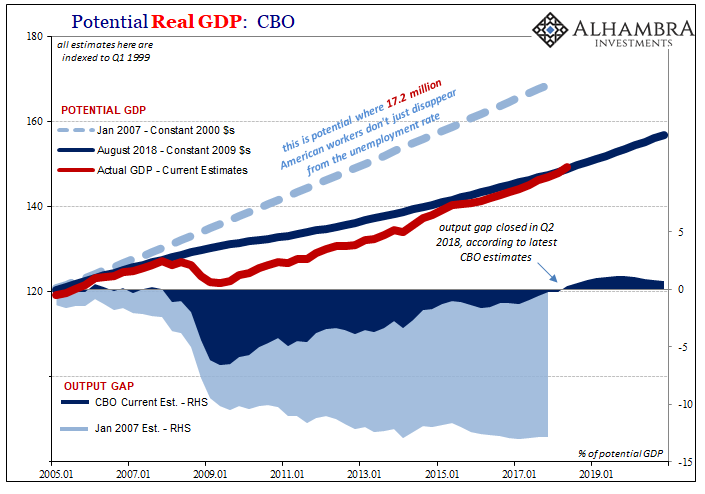
Much easier for me to see that volatility didn't have much further down to go, swing in and out of it taking profits and building a better position before it blows, and here we are people finally noticing that things aren't what they seem…
I'm much more likely to be able to push the dirt on this glorified ant hill we call earth through the outcomes of my actions, than anything that I could ever say with words.
People can’t seem to figure out why inflation is so low with employment so high. The Fed is doing what they do when unemployment drops this low, despite the fact that inflation isn’t knocking at the door.
It seems like the best assessment is that as long as the macro indicators stay strong, we might as well dry out some powder for a rainy day.
But I personally worry about knocking the legs out from under the strongest bull cycle we’ve ever seen when the next few years seem poised to deliver very strong gains, particularly to disadvantaged populations which are the hardest to bring into full employment, and for whom better paying jobs are life changing.