https://www.timeanddate.com/astronomy/spain/ponferrada
https://www.timeanddate.com/astronomy/republic-of-macedonia/...
With this new regulation, Spain can adopt a time zone that makes more sense for them while not having to change clocks twice a year.
The CET timezone has that property for the town of Goerlitz or, to a slightly less extend, Vienna. That means almost all of Germany, France, and Spain doesn't already have that property.
[1] http://blog.poormansmath.net/images/SolarTimeVsStandardTimeV...
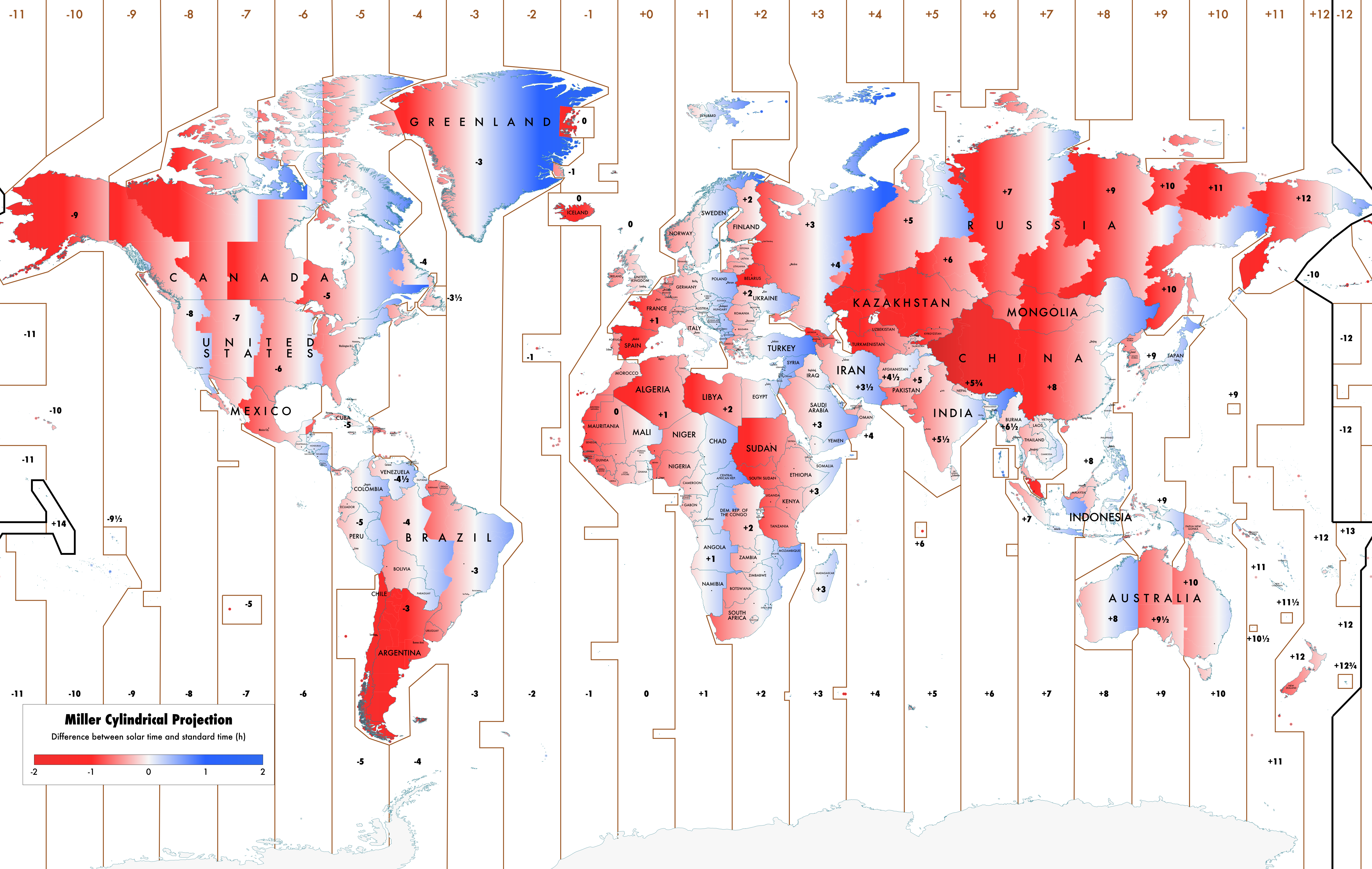
That said, it would only be a very few people who experience this, even on the "correct" time. Time zones are what disconnected time from the sun, not daylight savings.
This has never really been the case to begin as a wide (geographical) range of countries is part of the same time zone, meaning for instance that noon in Spain is not really noon.
You'll never resolve individual preferences though. Some won't want sun at 4AM in the summer; others won't want dark at 4PM in the winter [ADDED: or kids waiting around for school buses in pitch dark]. Get far enough north (and much of Europe is much further north) and there isn't enough light to go around at some times of the year.
I used to care more. Now my schedule is mostly flexible enough that I can largely choose when in the day I want it to be light.
The argument against permanent DST in Boston is how dark it would be when kids go to school.
Of course the counterarguments are "Alaskans do it" and "you can just adjust school schedules (and the work schedules of all the affected parents...)". In theory, those are both options, but are less desirable for many than the status quo
You work 9-11 hour days? Doesn't france have a legally defined 35 hour work week and other, fairly stringent laws re max hours / day?
For example, I have a legal 35 hour per week contract with 38h30 of work per week, the difference being compensated by about 15 additional days off and the rest paid in overtime.
Where I work (large private company) working from 9 to 18/19 with a good hour of lunch break is quite standard (with administrative people tending to work more form 8 to 17).
But the EU also thinks that the metric system is the bee's knees, even though it's just as arbitrary as the imperial system.
At least lengths in the imperial system are based on natural averages, and not some bureaucrat that decided to use a distance to Pairs. The equator, I could understand. But using Paris just proves that it's all about political control, and not actually improving a system of measurement.
The metric system is decimal and the orders of magnitude are intuitively consistent (1, 10, 100, 1000, 10000...). If the hang up is that they first chose the distance between Paris and the North Pole for the length of a meter, then that hang up is no more significant than the yard originally being defined as the length of a man's belt (something many people would now consider way too small).
Nobody in those times had the technology, insight, and awareness of the world that we currently do, so it was all defined in terms of what they knew. Nothing wrong with that; in the metric system they've all been adjusted to more scientific measurements (e.g. the precise weight of a precious metal, or some calculation on the speed of light)
Metric system is worldwide not an EU thing and while it was initially just as arbitrary picked as the imperial one it scales linearly in base 10 so you can do conversions mentally without breaking a sweat.
I'm curious if you could just as easily convert inches-feet-yards off the top of your head?
For me that's a relatively easy case, because I regularly do that. When it comes to ounces/quarts/pints/gallons though, I'm completely baffled.
Give me microliters please: even if I have no idea how to conceive of that now, I know how to convert it trivially.
Also, the original definition of the metre did use exactly the distance from the north pole to the equator. It's just that the earth is not completely round, so you need to define this length along a meridian. The Paris meridian may be as good as any.
The metre was originally defined in 1793 as one ten-millionth of the distance from the equator to the North Pole.
I don't know where you got the "distance to Paris" idea. From what?
I once looked up (probably pre-Wikipedia) the standard for the length of a kilometer and saw that it was 1/1000th of the distance from Paris to the North Pole.
That's what I get for believing the internet.
I rescind my bureaucratic criticism of the metric system.
But I still like using easy-to-remember natural conventions like inch=thumb, foot=forearm, yard=arm's length.
Mile still seems arbitrary, though. I'l have to look into that one.
But I'd love to see the end of Daylight Saving Time. I hate the biannual screwing of my body clock.