It's not a good measure, but it's not a case of politicians picking a convenient metric, it's just a case of a bad metric being optimized for.
Those who are interested can read the report to the 13th International Conference of Labour Statisticians (yes, there are conferences for everything) in which the unemployment definition which U-3 is based on was adpoted: http://www.ilo.org/public/libdoc/ilo/1982/82B09_438_engl.pdf
https://www.bls.gov/opub/ted/2018/u-3-unemployment-rate-was-...
But U3 is fine for year-to-year readings of employment temperature for lay people like most of us.
1) equal pay for equal work
2) equal represenatation among (higher paying) jobs
I routinely see these two issues conflated, and occasionally the purported resolution of #1 for gender being trotted as evidence of no more "gap".
Although I can see how that could be characterized as "cherry-picking" a statistic, it doesn't make the statistic any less valid, and it detracts from the real problem of conflation. If it's true, then additional effort at #1 would, indeed, be wasted. It would be better to criticize the notion of just one "gap" rather than any cherry-picking.
How does this relate to the topic at hand? The original commentor suggested a problem of conflation, between "unemployed" and "jobless".
Elsewhere in the thread, it's been discussed whether workforce participation is a more meaningful metric.
Even that risks conflating "employed" with "fully employed" (as opposed to "underemployed", such as part time or working for a lower wage). Real wage growth comes up repeatedly, presumably because of that confounding factor.
As for equal pay for equal work - I'd be very surprised if women aren't getting that, because that's illegal and you'd expect that to show up in the form of many many lawsuits.
Yes there does seem to be an issue of some workplaces that have a boys club type environment and fail to promote women - but I don't know if that's big enough to explain the dramatic wage gaps that are touted by some people.
Negotiating a higher salary requires a bit more drive/aggressiveness than the average person has. Making up numbers here, if you say that only 20% of the population has that personality trait, men seem more likely to have that trait (perhaps 15% of men have it and 5% of women), which would contribute to the equal pay for equal work gap.
To rephrase my above statement, the current job market rewards certain personality types with higher positions & salaries, and men seem to have a higher chance of having that personality.
A completely separate question is: Is the above an acceptable situation? I would say no.
For example, more men are three times more likely to be psychopaths than women [1], and CEOs have a much higher chance of being psychopaths than the general population [2]. There's a strong chance that certain psychopathic tendencies are rewarded in the current corporate structure.
Similarly, there are other stories you hear of there being a lot of backstabbing in certain companies at the higher levels. Personality types that are disinclined to engage in that will be unlikely to climb the corporate ladder there.
It's probably in the best interest of all companies and society in general that these kind of personality traits are not rewarded unless they are actually beneficial.
By fixing the problem at this level we'll not only be solving the gender/pay gap between men and women but also the gender pay/gap between differing personalities within a given gender as well.
[1](https://health.howstuffworks.com/mental-health/mental-disord...) [2](http://www.businessinsider.com/ceos-often-have-psychopathic-...)
I have another theory. Some people are so incompetent that they end up as C-level execs. Incompetent people tend to promote equally or more incompetent people.
Second, when you do that you're sort of controlling the problem away. Women don't seek more work/life balance because they're not as crazy as men. They do it because they're expected to carry more of the burden of raising a child. The literature is clear that the wage gap is relatively small until children enter the picture. After that the gap skyrockets.
This is why the main practical goal of every wage gap activist is equalizing the burden of having a child. It's why the number one policy issue is universal mandatory parental leave for both genders.
There certainly is sexism in the workplace, although the court ruled different I think Ellen Pao was a victim of this. That said, I don't know if it as prevalent and widespread so as to lead to meaningful and statistically significant wage gaps when all the factors are considered. Certainly the evidence for this sort of widespread institutionalized sexism is lacking in my mind.
Still I think the conversation here is more that the wage gap numbers are not as significant as they are often presented in discourse about gender equality
Saying you need to control for things that have already been controlled for doesn't leave a particularly good impression.
To me it seems like an uninteresting tautology. Like these others:
“False statements about immigration numbers are often presented in discourse about naturalization policies”
“Misleading financial figures are often presented in discourse about what stocks to buy.”
It’s like... yah. So?
All discourse is full of garbage. If you are interested in the truth, you weed through that and evaluate the numbers and, according to best practices, find a good estimate.
When you do that, you find there is a substantial gender-attributable pay gap in many countries in many industries.
Why that is and how we change it seems like a worthy discussion.
I am curious to why you think the existence of people with a poor understanding of the facts is a worthy topic of conversation.
There will always be people in “the discourse” saying wrong things. If that’s all it takes to halt the important conversation about how women get pay equity, then you have yourself a surefire tool to ensure that conversation never happens. Or at least that you never have to participate.
(And as a side note, the existence of a raw 77% gap is factually true. Media would have to argue that it’s entirely due to sexism for them to step into territory you object to)
"Female Uber drivers make 7% less per hour than their male counterparts—even though the algorithms that determine pay for the ride-hailing service are gender blind, according to a multi-year study."
If their conclusion is accurate, I am puzzled as to what solution can be proposed. Should we lower speed limits or cut mens’ hours?
Apologies if I don’t understand the uber cost structure. Is there not a time component in the service charge similar to cabs?
Taxis often take this even farther and make the time component only include time where the taxi is going less than fixed, fairly low speed (in NYC it is 12 mph), so slowing down from 25 mph to 20 mph wouldn't gain them any extra money on the fare but would cost them extra time.
The studies do not "control for everything". For example I have never seen
1. Control for the much higher levels of sick days taken by women.
2. Control for the product of hours worked and years worked. Women work fewer hours and spend more years out of the work-force. This has a multiplicative effect on "hours of work experience"
Additionally the power of "controlling for X" is vastly overstated. In reality it is only reliable when the different factors are close to orthogonal, have linear relationships and are not causally related. Typically none of the above are true.
Almost impossible to make any progress in it without appeal to emotion and in-group/out-group dynamics.
https://www.forbes.com/sites/karinagness/2016/06/30/new-repo...
Women tend to choose more fulfilling lower paying careers (last point on fortune and second last on time)
http://fortune.com/2018/04/10/gender-pay-gap-myths/
http://time.com/5230911/equal-pay-day-2018-wage-gap-myths/
I don't have the original studies but I think the news sources here are fairly reliable
Perhaps you can find the citation yourself and use it to counter the point you are replying to.
The burden of proof is on the person making the claims. What is freely asserted is freely dismissed. How would the user you replied to even go about searching for the citation, given so little information to go off of?
The link you provided seems to allude to someone announcing their personal preference, which should not have to be defended. Assertions of what scientific literature have established as accepted wisdom are free game for questioning. That's what gives theories their fundamental efficacy, being able to withstand reasonable criticism.
Then kindly leave it at that. It is, after all, the nature of friendly and disagreeable conversation. Crying to me about it certainly isn't productive.
If simple enumeration of the fallacies contained your arguments is seen as a personal attack, You don't have a lot of ground to stand on when you accuse other people of being trolls.
If you want a citation then go find it. Don't expect other people to do YOUR work for YOU. For more information on trolling: https://github.com/prettydiff/wisdom/blob/troll/Avoiding_Tro...
Anybody who anticipates a conversation is a thing that can be won, as in a contest or battle, is probably a troll.
https://upload.wikimedia.org/wikipedia/commons/thumb/9/9b/US...
It persistently fell from 83.3% in January 2008, to September 2015, where it bottomed out around 80.6%. It has been climbing since then, and is now up to 81.8%. Getting that back up near 83% would be a big win for the economy.
The highest that has ever hit, is 84.5% in 1999/2000. Healthy has historically (in the last 30 years) been anything around or above 83%. I think it's plausible the US can return to that figure in the next year.
We've struggled with the prime age unemployment due in part to the big loss in production jobs since ~2000. The continued recent (curved upward again at the end of 2016 [1]) boom in manufacturing jobs (exports are at an all-time high) should pull a lot of blue-collar workers back into the labor market. The manufacturing sector unemployment rate is incredibly low at 3.1% (lowest since June 2000, other than the 2.6% it hit before Christmas 2017).
Trump, were he wiser on macro strategy, would resolve NAFTA, close out the trade conflict with Canada & Mexico soon, come to a deal with the EU, and then focus all the trade war on China. US manufacturing will continue to boom, cheap energy and improved margins will largely ensure that. The only serious threat is some really bad trade moves with the non-China trading world.
Female participation rates have been rising historically and it's completely recovered to pre-2008 levels https://fred.stlouisfed.org/series/LREM25FEUSM156N
Whereas, male participation rates are declining and did not recovered completely yet. https://fred.stlouisfed.org/series/LREM25MAUSM156N
https://www.nytimes.com/2018/06/01/upshot/we-ran-out-of-word...
I wonder if you actually only counted white and asian men, would the statistics look any better?
EDIT: I just realized how terrible that may have sounded. I'm genuinely only curious about what's causing this apparent disparity. (A disparity that must be a bit severe mathematically speaking.) So my "off the cuff" guess would be that large sections of black, hispanic, and native american men are not really able to participate in the employment markets. And that's maybe how the numbers get so high for men in general?
Men in that age range are actually employed at a higher rate than most other demographics. He is making a point about men in that age range being employed at a relatively low rate compared to historic rates for that same demographic, not their employment rate compared to other demographics now. Men age 25-54 have at times had rates getting close to 5%[3].
However, this can't entirely be blamed on a poor job market because it has become much more acceptable for men to take the role of a stay-at-home parent or caretaker than it would have when their employment rate peaked in the late 1960s. There are almost far more students in that age range than there would have been in the 60s.
[0] https://scholar.harvard.edu/files/glaeser/files/jobs_for_the...
[1] http://www.multpl.com/us-employment-population-ratio
[2] https://fred.stlouisfed.org/series/LREM25TTUSM156S?utm_sourc...
https://www.investopedia.com/articles/investing/080415/true-...
This morning, the Labor Department announced that the national unemployment rate ticked up to 4 percent in June for good reasons, as hundreds of thousands more Americans sought work.
It’s great to see our workers in neglected sectors of the economy have a chance to get back in.
Sure some workers of neglected sectors got a boost (coal), but at what cost? Funny how there is little talk of the solar workers that got laid off following those change in policies.. https://www.cnbc.com/2018/02/07/us-solar-industry-lost-nearl...
"Yet the experience of towns like Ames and Des Moines show that such “labor shortages” might be due to insufficient wages and crummy working conditions — not an unwillingness of workers to switch industries or improve their skills for a job. The trucking industry is instructive here: Trade groups have argued that it is facing a shortfall of 51,000 workers, yet businesses have not yet shown much willingness to cut hours, boost pay, and improve conditions to lure workers in. Indeed, across the economy, companies have shown a remarkable unwillingness to boost wages, with growth barely keeping pace with inflation even as the unemployment rate has dropped to 4 percent"
This isn't progress
Who works in fast food and why? Mostly people who are either don't have any skills to work anywhere else or people who can't work anywhere else.
When there is high unemployment, high skill workers will be more willing to take a less desirable job in order to survive. As unemployment drops, the high skill workers leave the undesirable job and find better work(more pay, better hours, etc.). Fast food places then have to either raise wages or higher less skilled workers to replace those who have left.
This is progress.
"Yet the experience of towns like Ames and Des Moines show that such “labor shortages” might be due to insufficient wages and crummy working conditions — not an unwillingness of workers to switch industries or improve their skills for a job. The trucking industry is instructive here: Trade groups have argued that it is facing a shortfall of 51,000 workers, yet businesses have not yet shown much willingness to cut hours, boost pay, and improve conditions to lure workers in. Indeed, across the economy, companies have shown a remarkable unwillingness to boost wages, with growth barely keeping pace with inflation even as the unemployment rate has dropped to 4 percent"
The easiest way of doing /that/ is to make social benefits (retirement, vacation time, healthcare) public pools and 'single payer' (but with competition for benefits that provide services like healthcare).
When all of society is willing to say "they don't deserve more pay, the machines are doing all the work" including the workers themselves, and 'being employed' is seen as some sort of moral imperative that is more meaningful than a paycheck and totally detached from actually producing value... things can get bad. We should always remember history, and that those people were not fundamentally different from us. They were willing to bear it. We will be too. And while they didn't have a century of fighting against 'socialist' policies so were willing to discuss the New Deal, we are in a different situation on that count. Such a solution would not be discussed seriously, much less attempted.
(But, I don't fear this too much. The fact is technology is cheap and has made people so productive that its far more likely they will realize that companies no longer provide any tangible benefit compared to working directly for customers online, especially once the software is there to facilitate it.)
> In total, 6,899,000 adults were under correctional supervision (probation, parole, jail, or prison) in 2013 – about 2.8% of adults (1 in 35) in the U.S. resident population.
It's very difficult to find work with a criminal record in the US.
We've got to get rid of the mindset that we need to "protect ourselves", both corporately and individually, from "dangerous people" (i.e. former criminals) by excluding them from our lives and our companies. "Love your neighbor as yourself" applies to them also. Love always involves risk. A noble society values redemption more than safety. Work itself is ennobling, especially when trust and responsibility can be earned.
That's not to say we should ignore background check results. But a crime (or crimes) in the past shouldn't mean they're automatically excluded.
However, if you got caught stealing a bunch of electronics from a past employer, you'll have a seriously hard time find a job anywhere where they have to trust you with money or property.
Honestly, people who commit crimes against their employers do this to themselves. How could you ever be trusted again when your strategy at the beginning was to shit where you sleep?
I don't feel that's really relevant, and the person who is trying to get back on their feet likely doesn't care. They just want a damn job.
"Honestly, people who commit crimes against their employers do this to themselves"
Not many do. In fact, I'd say far more employers commit crimes against their employees than the other way around. And yet, they don't have to worry.
If most people were to look at safety only a bit differently, their world outlook would change substantially. If they realized that it is stupendously easy and simple for any of the multitudes of people they come into contact with on a daily basis to kill them, and that no police force in the world could possibly stop such a thing from happening if the person were to decide to do it with no warning, the initial response would probably be fear. But, upon further reflection, they might realize that despite the tremendous ease, despite what others might have gained at any point, it simply has never happened to them. What could possibly explain that? There are ex-convicts, unpleasant people, people with disturbed worldviews, psychopaths, and other 'bad people' everywhere and you've certainly been in contact with them quite regularly. And... you've been, and continue to be, safe.
While it is challenging to keep a human being alive, what with them having all sorts of needs, it is very easy to kill one. Someone walks up to you and pulls out a knife with a 2 inch tiny blade and simply presses it into your jugular and you will most likely die in a minute. Or you could get hit with a car, or something could be put into your food, or your house could be set on fire with you in it, there are innumerable methods that are all easy and entirely within the capability of any normal person. But, killing a human requires something else. It requires the willingness to kill. Almost no one has that. Military training is arduous and difficult because even giving this willingness to the average person is insanely hard to do (and they settle for simply ingraining killing as a reflex response since they have never actually accomplished manufacturing the actual will, so soldiers typically kill before their conscious mind can decide what to do, taking their will out of the equation, resulting in neurological damage that manifests as PTSD but that's another topic). To presume that even a "bad person" runs around with this willingness constantly within them is quite ludicrous once you've faced the reality of how rare it is for such violence to occur.
And then when you look at the violence which does occur, and try to understand it, what makes those situations so different, you quickly notice that essentially all occur in situations of desperation. You might be led to suspect that perhaps the desperation is more the problem rather than the persons involved. Perhaps the 'bad people' who didn't kill anybody the day before or the day after aren't simply murder machines who will always be a threat.
This all, however, requires a great deal of thinking. And thinking about emotionally arousing topics at that. Life, death, the uncertainty of strangers, the fragility of ones own situation, etc. Before you can begin down the road of thinking about these things, you have to know how to think. And you have to be willing to think. Both of those factors are in substantially short supply in modern society. The knowing how to think because we don't teach it in schools (the Republican Party in Texas actually had opposition to the teaching of critical thinking skills as a primary plank in their official party platform not long ago) save in college philosophy courses. The willingness due to a total reliance upon intuition as a guide to truth. Intuition can not deal with these topics at all. It arises from the 'default behavior' of our brains which arises from their structure that evolved to keep us alive (just) in small tribes on the African savannah. It is prone to obsession with fear, and fearing the unknown, and fleeing from threats rather than facing or dealing with them. Until a person can turn their back on intuition and use reason instead, the monstrous 'bad people' will be a constant bugaboo.
With enough demand, we may begin to see employers willing to retrain these workers and bring them back into the fold.
https://www.reuters.com/article/us-trump-effect-coal-retrain...
That's the first sentence of the article. You're telling me that in a list of over one hundred course, covering everything from computer programming to nursing, there's nothing with pay and benefits comparable to coal mining?
When NAFTA was being negotiated, there was similar talk of retraining all the blue collars. There were blue jean factories in Western NC, once they left there were no jobs to move into. Training or not.
Now it is easy to say, "Move to where the jobs are" but for someone who owns a house in an area but has little to no other assets, this is not a solution.
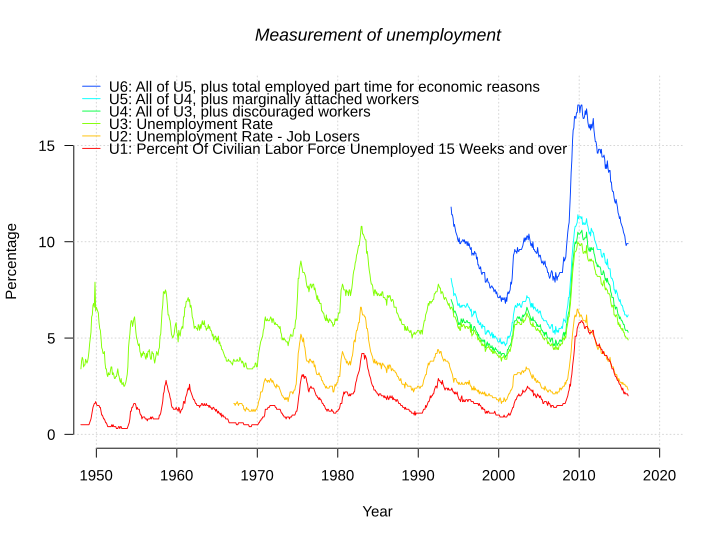
The official employment stats cover both. U3 is the unemployment rate, which correctly covers only the labor force, while U6 covers the labor participation rate, which covers the population.
People who stop searching for jobs (eg. due to despondence or poor health) are excluded from the official unemployment rate, yet they are jobless.
On a recent EconTalk, Edward Glaeser, the Fred and Eleanor Glimp Professor of Economics at Harvard, said, in their recent sample, 11.9% of U.S. men aged 25-55 have been jobless for over 12 months.
From quick googling, 11.9% of U.S. men aged 25-55 is about 7.5 million people.
http://www.econtalk.org/archives/2018/03/edward_glaeser.html