For us the cost of living of a city and state were game-changers.
One of us was doing software/web development and another was financial accounting (CPA). This was not a small town, it was a suburb of the Dallas/Fort Worth metroplex. The farther out you move from the city, the lower the cost of living, but we had a 30-40 minute commute.
Neither of us wanted to pay for cable so we saved like $8K over a number of years skipping out on that.
I guess outlying suburbs of somewhat-but-but-wildly-bustling metros are viable as low-cost / high-employment places to live, though I'm not sure requiring long commutes that aren't well suited to mass transit is a great solution for most people.
Most people with tons of college debt that I know worked the entire time, so YMMV on that one. The people I know without debt are actually more likely to have not worked (because their parents were paying).
Another option for keeping college costs down is to start out at a community college and then transfer. With teachers there interested in teaching the material, the education can sometimes be better than entry level classes at a 4-year school.
You may want to look into deferring or forbearing your student loans [1], at least until you're back on your feet.
> my $100k tech job didn't come with retirement benefits
Next time around, consider a SEP-IRA [2]. In the meantime, contact a local NGO about subsidized healthcare, food, education and job-training and placement programs.
Also, don't be embarrassed asking for charity. When I started my first company, I took a gamble and skipped out on health insurance. A few months of sleep deprivation later, I'm in the hospital with pneumonia. Huge bill. Wrote a letter to the hospital board asking for a deferral; they wrote down the bill to pennies on the dollar.
[1] https://studentaid.ed.gov/sa/repay-loans/deferment-forbearan...
[2] https://www.irs.gov/retirement-plans/plan-sponsor/simplified...
Politely, no, do not do that. Instead look at enrolling in an "income-driven repayment plan."[1] With this, even if your required payment is $0, you will receive credit toward the total # of payments required for your loan term.
https://studentaid.ed.gov/sa/repay-loans/understand/plans/in...
I advise couples w/ debt to rethink formal marriage because of how tax laws are structured. Same goes for those who are married; strategic divorce is a real and sometimes necessary option.
Did you mean Roth or traditional IRA instead?
Alas, all I have to offer is a measly upvote, the currency of Millennials' bright shining future.
There is something that millennials together can do differently, though -- vote.
Millenial turnout is terribly low in the US. https://media.npr.org/assets/img/2016/05/16/pew2ft_16.05.13_... (So, yes, one party has made it a mission to suppress turnout; yes, Election Day is a work day, which makes it harder for working people to vote; etc. -- we can change all that, but first we have to work in the system as it is today.) And that means that boomers and the wealthy have had a much larger influence over society than young people. (The Piketty theory is that the West went through a few decades of stability after the 1970s and that made many people complacent, especially the young, allowing the wealthy and corporations to acquire power. Given the last two years, the time for complacency is ending.)
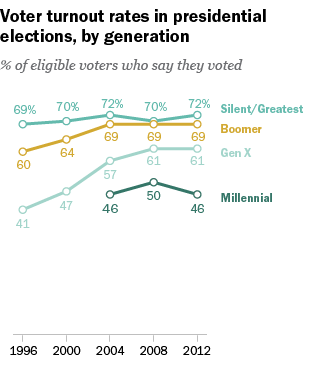
In particular, a better social safety net and a better education cost and education loan system would make for a fairer playing field for all. The only way you and I in America are going to get that is if we all vote - especially young people.
And in your particular case, the biggest travesty is the non-dischargeability of educational debt. That's a hard problem - both universities and the loan companies are at fault for lobbying for and setting up this system. But we need to fix it.
Again sorry for your current situation and I hope it looks up soon.
Point here, before voting you need figure out actual solution. Not sure if anyone you can vote for now has actual solution.
Here's a solution: Make sure that everyone who cannot cut it in college does not go in the first place. Start by not letting people who cannot complete basic requirements graduate from high school.
This starts to turn off the money tap, instead of turning it on full blast by hooking it up to even more public funds, so it will never happen. It also prevents lots of people who can barely read from taking on debt only to drop out 2 years later after doing a few "remedial" years.
https://medium.com/@simon.sarris/higher-education-erodes-a7c...
Then, make college more difficult until the credentialism becomes less pointless. It is insane that we have baristas 100k in debt after being in school from age 5 to 22. There are more ways to solve that than just redirecting the debt.
Hi, unfortunately, yes. I, like many others, wrote to him [and a few notable Democrat and Republican Senators who publicly champion(ed)] SL reform. My letter actually had supporting facts, and practical actionable policy suggestions. I heard back (directly) only from one Senator, a Republican, whose form letter was unrelated to SLs.
Though I didn't receive a direct response from anyone in Obama's administration, shortly after I'd sent my letter, the administration suggested cutting the SL interest deduction, which was polar opposite of what I'd suggested. And as you probably know, during last year's tax reform debates, the Republicans picked up, but ultimately dropped, that very same idea of removing said deduction.
There were some other policy changes that I saw effected after my letter that makes me certain that it was read and understood. Unfortunately, those changes, harmful to borrowers, were again the opposite of what I'd suggested.
Given what I am reading in Ron Suskind's Confidence Men, and have read/heard elsewhere, I'm not all that surprised.[1]
Young people will continue to be politically and financially expendable until they learn from history, organize themselves into strong blocks and directly involve themselves in the political process. Voting is merely a small part of participation. And I say that having been on the inside of the political machine.
There's no doubt that non-dischargeable student can be really rough for a lot of people. I'm not in insurance or anything, but it seems like if we just implemented the simplest fix, i.e. let people declare bankrupcy to forgive student loans, the math might just not pencil out to make it feasible to grant any student loans.
For instance I couldn't take out an $80k loan to start a business with instead of getting a student loan, no bank would give it to me. So there's definitely something special about student loans and the way in which they're so easy to get without needing good credit or any collateral behind them.
And if they could be forgiven by declaring bankruptcy, what would stop lots of people from doing that right after they graduate? For a lot of young people (including myself at that age), your total cumulative assets are worth approximately nothing when you graduate. And it's not like you're gonna be able to buy a house within 7 years of graduating anyway so the hit to your credit score of a bankruptcy might not be that bad.
It really doesn't seem like there's a silver bullet solution to help people finance the massive cost of college easily. What's the best solution here? Is it possible to reduce the underlying cost structure of higher education enough to make a big enough difference?
Let lenders vary interest rates by institution and major. Also, give lenders a choice: (a) loans dischargeable in court like any debt or (b) non-dischargeable loans where total payments in a calendar year are capped as a fraction of AGI.
This combination incentivises lenders to communicate employment and wage information from the labor market to students deciding where to go for school and what to study.
Perhaps letting rates vary across institutions might be the simplest improvement. That would help Stanford students and make it hard to attend lower tier colleges. So we’d also need a way to advantage community colleges with a service mission. The big losers would be lower-tier, high-cost private schools and for-profits. But that’s a good thing- those are the schools that are breaking the American educational system and loading up students with low-value degrees and high debt.
The median price of houses sold in the US is around $200,000. If you have a good job you can afford a house in 99% of America. And, indeed, there are more homeowners than renters.
99% of Americans live somewhere where buying a house is affordable for most people. That's cold hard facts backed up by the average house price and ownership statistics. Most Americans don't live in New York City or San Francisco.
More people own (~65% IIRC) than rent and mortgages are stupid easy to get as long as you're employed; you don't even need a sizable down payment OR a good credit score. The requirements for a FHA loan is 3.5% down and 580 credit score - that's it! There's also plenty of other government subsidized programs for buying a house, my State has one that's available to almost everyone - the income limits are stupid high, more than six figures IIRC. I know people who are in a financial mess and have no business owning a house but they do own because it's so easy to get a mortgage. My friend makes only $30,000/year working for the government and owns a house because she qualified for a mortgage.
If it was so impossible to buy a house then it wouldn't be possible for 67% of the population to own a house.
Good jobs doesn't need scare quotes.
And I don't live in the Midwest either - I live on the east coast. I have friends all over the east coast and don't live in the city where I grew up, so it's not like my experience is hyper localized.
This is why non-compulsory voting hasn't ever made sense to me; it effectively biases the system towards those who care the most and enables those same people to influence the system further by making it difficult enough for others that they won't bother.
When it's compulsory to vote, things like weekday voting stop happening because laws will be introduced making it illegal to prevent your employees from taking time off work to go vote, so naturally both employers and employees alike want weekend voting.
Additionally, it incentivises the government to make voting accessible, because it is unreasonable for them to enforce voting via fines etc if it's not really possible for people to vote.
When I moved to the US from Australia I heard stories from my new colleagues about people in poor neighbourhoods lining up literally all day just to maybe get to vote before the booth closed, while those in richer neighbourhoods had practically no line at their voting booths. This is not how democracy should work. Your "freedom to choose not to vote" only serves to hurt any other freedoms you may have had.
That doesn't sound unreasonable on the face of it, to be honest.
As someone who is over 50, I feel the current system is stupid. I vote from home using a mail in ballot but the ballot is several pages, often six pages long, and takes me an hour to fill out while I do research online, so someone doing it in person has to make a lot of time before or after work (polling places near their home).
None of what you cite - affordable education, a better social safety net would directly benefit the GP at this point. Indeed, he would be the one paying for it.
Subsidized student loans produced many quality graduates. They also spun off reams of communication majors.
I'd actually argue part of the problem is lenders are totally immunized from the risk of their loans; if loans were priced to each institution and each major and each individual's academic record, that might pull wage and labor demand information from the labor market to undergraduate campuses.
About the student debt: That's a lot of debt. I suspect you and many other millenials were lied to when you were told that getting that much student debt is normal and necessary, when it is in fact neither. For example it takes longer to graduate when the student alternates semesters of school and work, but it does get them through (especially if the school has a strong co-op program), without nearly as severe a crushing debt load. Second, the overall benefit of an education goes way beyond the differences between schools, i.e. for many careers an inexpensive school is just as good as an expensive one. (Counterpoint: if you want to be on the Supreme Court someday, you apparently have to go to Harvard Law School...)
I confess that I'm puzzled when I hear about such high debt numbers from new grads, and the main explanation I can think of for what's different now from when I came up is that people are systematically being told that any college debt is a good investment (and loans are freely granted on that basis), when it plainly is not (and they should not be).
2) Please see my comment below about getting yourself on an "income-based repayment plan," if you aren't already on one.
3) Believe it or not, student loan debt is dischargable, though not easily so. See [1] & [2] for a 'success'(?) story not involving a fraudulent institution. IMO this decision was the impetus for Sallie Mae (SM) restructuring itself into SM and Navient.
[1] https://abovethelaw.com/2013/05/in-showing-undue-hardship-co...
[2] https://cdn.ca9.uscourts.gov/datastore/opinions/2013/05/22/1...
I don't really know how student loans work in the US, but I've heard that federal loans payements were indexed on income. For that reason, they are more akin to taxation than to a regular debt. Is that correct?
The government cant really afford to forgive everyones loans. The repaid interest goes to federal programs and the principal goes to giving new loans to the younger generation.
However, there is currently at least one lawsuit pending because the gov't is trying to talk its way out of providing the forgiveness. Essentially telling the group that they were mistakenly approved for the program.
Also people should read the program's fine print (in the FAQs). There is no guarantee that the program will remain or that the commitment will be honored.
Yes there are predators that take advantage of others using said tool. Its been known to cause "indentured servitude". But lets not criticize the tool here. This is an issue of governance, and societal scale.
I hope things turn up for you soon.
Anyone who takes on debt like that is increasing the risk to their lives. Sure, if everything follows the mean - good job, good health, good relationships - people on average come out ahead after an expensive education. But the downside risk is amplified. Get sick, and there's nowhere to turn and you're stuck servicing that debt for the rest of your life.
It's a problem that crosses party lines. Both finance firms and universities have played a role in setting this system up. But millenials have to vote in numbers and advocate for making student debt dischargeable in bankruptcy -- this is the whole social point of bankruptcy law dating back centuries, to reduce crazy downside risk to individuals.
Income-based repayment plans already exist, limiting your payments to 10% of discretionary income, with full forgiveness after 20-25 years if any balance remains. "Servicing that debt for the rest of your life" is not a thing.
No doubt about it if student loans were bankruptable then it would be ripe with fraud.
Houses, cars, businesses, etc. can all be surrendered. Knowledge cannot. A degree cannot. Why should it be dischargeable if the recipient cannot discharge the benefits?
Ethics has little to do with it. The lender has money you want, and you pay them for the privilege of using that money for a while. Supply and demand.
One can't collateralize a mind aside from claiming a fraction of the attached body's output.
(Full disclosure: I am an unemployed millennial as well, and too naive to understand what's keeping you from getting another job. Hence the question.)
(I spent two years working for a home care company.)
There might be some tax deduction when it's medical reasons, but I'm not sure about that.
Married with $100k in student loans between the two of us. Her first job out of college paid $30k with no benefits. No matter, I had the money making tech degree, we'd be fine. My first job out of college was $100k, so I didn't see a problem there.
Three year later I'm facing mounting healthcare costs incurred even with top notch gold plated tech insurance. Most of my salary the last 3 years went to my landlord and the government. The remainder went to student loans and medical costs, so I don't have much in the way of savings even after earning $300k. And somehow I still owe $100k in student loans.
And my $100k tech job didn't come with retirement benefits so I don't have any retirement savings yet. It did however come with a generous stock grant. But then again, the company folded and now I don't have a job or insurance.
And now I'm a full time caregiver for my wife, with no health insurance, trying to get a job, with $100k in non-dischargable debt, looking to get on welfare, but at the same time reading about how our government wants to take even that away.
So that's what I'm doing this weekend.