Re:Macbook Pro frying USB peripherals
by _wiv7 on Tuesday May 01, 2018 @05:45PM
(#16972013)
Actually, it's not SMD components in particular. The failure mode for many MOSFETs and other semiconductor devices tends to be a short. They only tend to fail open if there was enough energy at hand to blow the short clear.
[ Parent
| on HN ]
Ah yes, I remember from lab, you'd get a fail open right after you managed to manufacture a temporarily light emitting diode from things that are not normally light emitting diodes (or maybe not even diodes).
We call those "Light Emitting Resistors".
They result when you attempt to violate Ohm's Law.
You can generally diagnose those olfactorily as well as visually. :)
Re:Macbook Pro frying USB peripherals
by morganvachon on Tuesday May 01, 2018 @07:34PM
(#16972740)
> You can generally diagnose those olfactorily as well as visually. :)
Indeed, my electronics engineering mentor described it as "letting the magic smoke escape". Once the smoke is gone, so is the magic.
Now if only you could capture the smoke and get it back inside the chip.
It would work again!
There was this guy called Edison who once made quite a healthy business out of selling LERs. They seem to have lost some of their sheen nowadays but I suspect they'll make a come-back one day in miniaturised form, something like 'nano-LERs'.
Or alternatively, SEDs (smoke emitting diodes).
> exercise Ohm's Law.
FTFY ;-)
Old bad electrolytic capacitors often smell like bad fish. Not sure why.
Everything's a fuse, it's just a question of how much current it takes to blow.
Re:Macbook Pro frying USB peripherals
by crankylinuxuser on Tuesday May 01, 2018 @08:02PM
(#16972908)
Indeed! Reminds me of this joke image https://i.imgur.com/TtFotWu.jpg
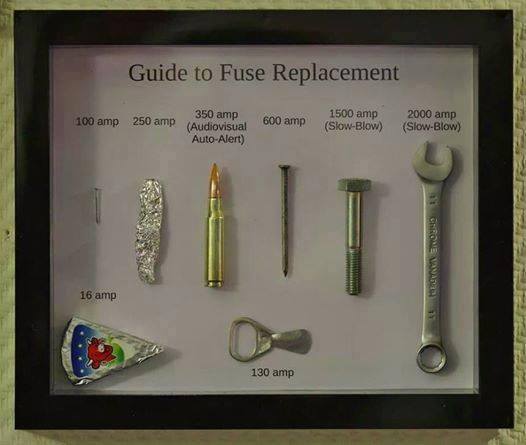
Unfortunately, in really old houses, I have seen pennies used. Shudder
I had a friend that would fix bad PCBs that had a short in a middle layer by hooking up a car battery and burning up the short. It actually worked.
It worked without unwanted side-effects? Wow.
These days I bet a thermal camera would be great for finding those.
Rossman (see link above) shows how to use 91% isopropyl alcohol to find these more effectively. It evaporates more rapidly at the heat source, so there's your short. I don't know how well this would work to find shorts in middle layers of circuit boards; I am still learning to identify the broken active components on the surface.