b)Large automakers know this but simpler for them translates into less maintenance which means lower profits. Automakers therefore will pay lip service to electrics, drag their feet and kill off any real electric competition if they can. The world's environment is not a shareholder in the large automakers.
So his "master plan", (the Truth but not the whole truth) he published in 2006. What he left out was that he knew as he moved to a high volume model that's when the large automakers would try to cut Tesla off at the knees and then go back to resting on their laurels.
If his high volume model was mediocre and expensive to build Tesla would be dead in the water. He needed an excellent car but even more than that he needed Tesla's cost to be much lower than the majors could match so they couldn't low ball the market long enough to cut off Tesla's oxygen.
When Tesla got 400k Model3 pre-orders that's when he decided to double down on the 'low unit cost/large production investment' strategy for the model3. Making this work is critical to Tesla's strategy. You can be sure Musk and his team put a lot of effort into the production tech knowing it was make or break for Tesla.
The Economist is under estimating Musk and they should give him a little more credit given his track record. Telsa is not a slam dunk but it's also nowhere near as fragile as they make out. Musk also has a bit of equity in SpaceX he could lean on if the markets demur at the end of 2019.
https://static.seekingalpha.com/uploads/2018/3/1/37229846-15...
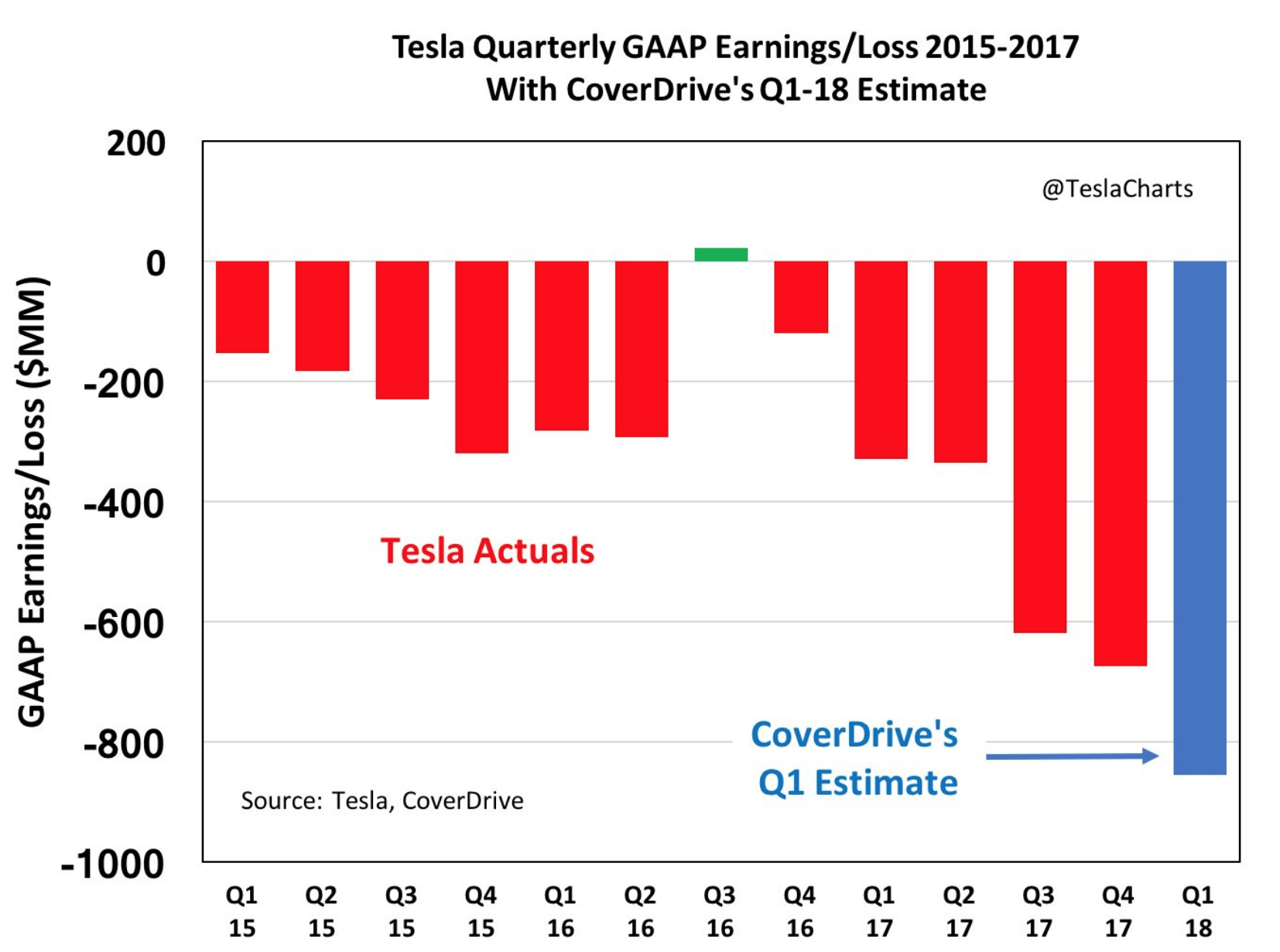
Tesla is going to run into issues in 2019 if they are unable to ramp up the Model 3. Tesla lost $1.6 Billion last year, and they only have $3 millionish in cash. Furthermore, Tesla has debt that is due in 2018 (~$300 million or so) and early 2019 (~$900 million).
Over the next year, Tesla needs to pay off $1.2 Billion in debt, AND needs to increase revenue by ~$1.6 Billion or so to stay even. They're not exactly in a good situation.
I'm relatively confident that Mr. Musk can raise another $3 billion in capital through stock offerings or rolling over their debt in the short term, but those options have some risks involved. Furthermore, people will not want to lend money to Tesla if they think that the company is sinking.
-----------
All the while, Tesla has bought SolarCity and also inherited all of its debt and issues. Tesla was having enough issues ramping up Model 3, but now they ALSO have to make the solar company profitable too. It was a bad time to buy SolarCity.
Except you need a whole lot fo heavy battery. The model S is not a light car.
You can make anything sound amazing is you ignore every drawback.
And that heavy battery concentrated at a very low point makes Teslas (or, for that matter, most E vehicles) excellent in handling.
If I'm not mistaken, maintenance translates to profits for dealers which are completely different from manufacturers (unless you're talking about Tesla). From the standpoint of the manufacturers, it's in their interest to force people to buy new cars instead of buying them, so they should be making cars that fall apart quickly--except the evidence is that car quality has dramatically improved over the past 40 years.
That might have been the original plan, but nowadays it would be suicidal. That is because the Chinese government is totally committed to EV's. I am sure the mainstream auto execs are totally aware of that.
Most of the problems in my modern car come from failures in the electrical / electronic subsystems.
Meanwhile my grandpas no bs 1980's Honda Accord is still going with just some lube and gasoline.
When you make a motherboard that works properly for more than 5 years, let us know.
2. One anecdote does not a rule make.
3. "When you make a motherboard that works properly for more than 5 years, let us know." Maybe you should stop buying bottom-shelf. I've seen 10-year-old Thinkpads work like they did on the first day. And my current Asus notebook is already 6 years old and shows no sign of old age at all. Even the battery still holds over 80% charge.
On the flip side these cars are filled with electronics. Just look at the dash... I don’t trust those to last more than the warranty period. However, I feel the same about most modern cars, especially luxury cars.
SpaceX cannot replace NASA, at least not yet. SpaceX is a component supplier to NASA like Boeing, United Launch Alliance, etc. There's a whole lot of other stuff that NASA does that SpaceX is not even trying to do.
So here's a company (or two if you count spacex) that is taking huge financial and organisational risks and running at the edge of their capacity to expand all the time and all the industry observers just shit their pants in fear about it and try to shoot it all down.
I like how "taking risk" is talked about as if it meant "statically you will gain out of it". That is not what risking means. Risking means that you can either loose or win and that plenty of people really loose. Risk does not entitle you to reward.
That's not what I said or meant. I have added a (potentially) to what I wrote. My point still stands imho.
The capitalism is supposed to be about rational decisions in competition and environment of reasonable transparency. Which may mean taking risk or not taking risk depending on how likely the reward part is to happen and how much punishment there would be.
No, capitalism is about owning capital and getting rewarded. That's why it was called “capitalism”, and not “riskism”. That's why, while all actors in the system take risks, the lions share of the rewards go the holders of capital.
But, anyhow...
> So here's a company (or two if you count spacex) that is taking huge financial and organisational risks and running at the edge of their capacity to expand all the time and all the industry observers just shit their pants in fear about it and try to shoot it all down.
SpaceX coverage is fairly positive, so let's not count them in this criticism. The financial press is frequently negative on Tesla because they repeatedly keep failing to meet what Tesla management announces they are going to do (with production targets for the Model 3, they've repeatedly failed to meet them, adjusted then downward, and failed to meet the adjusted targets.) Even to the extent that it's defenders characterize capitalism as being about rewarding risk taking, they don't say it's about rewarding blind risk taking.
I think SpaceX will provide services to NASA, but replace it? Not a freaking chance.
I think you meant assist / boost / "lend a hand to" NASA, by delivering some payloads to ISS and collaborating on other missions.
The slide from $310 to $250 happened in the 10 days prior to April 1, after it became clear autopilot was turned on in the recent California Model X accident, which is exactly what the author says.
Presumably banks have propped the stock back up to the current $298 and are running PR cover in an attempt to make back some of what are inevitable losses. I can't imagine anyone on r/teslamotors buying more right now. The general consensus is AP is not up to snuff. Only people investing other people's money would try to save TSLA right now.
I think Tesla would've been fine with robotic manufacturing and electric vehicles. With autopilot, they've entered risky territory in order to earn investment dollars. It's not clear whether or not that risk will pay off. It seems clear now that full self-driving isn't happening any time soon without lidar.
EDIT: Please explain your downvotes, thanks!
I like how this whole argument hinges on the idea that companies like Toyota don't know how to Automate.
Not like they are the world standard in manufacturing efficiency or anything.
Musk is trying to beat the standard.
It's because in this temple of lean manufacturing, Tesla uses far more workers than NUMMI employed to build far fewer cars. In 1985, its first full year of production, NUMMI had 2,470 employees and produced 64,764 vehicles — about 26 vehicles per worker per year. By 1997, it had 4,844 workers and produced 357,809 vehicles — about 74 vehicles per worker per year.
Tesla, on the other hand, had between 6,000 and 10,000 workers in 2016 and manufactured 83,922 vehicles. That puts its vehicle-per-worker number between 8 and 14, about one-seventh the efficiency of NUMMI at its peak.
Tesla isn’t pushing the standards, they’re not even playing in the same league as Toyota and other established manufacturers. But they sure are good at hyping their flawed methodology.
What's surprising is that Tesla is also having trouble with battery pack manufacturing. That's far simpler than building a car. It's a good job for robots, building identical units made of a large number of the same components.
And I would not be surprised if part of this will be a massive simplification of the current "cable trees" with cables from each component to the central fuse board to something like 2 24V power rails and 2 high speed data buses (one for safety critical stuff, the rest for everything else), with plugs every 20-30cm or so, fuses inside the components themselves and everything controlled with intelligent boards in the components.
Installing the cabling tree is inarguably one of the most complex parts in building (or, for what it's worth, servicing/maintaining/extending) a car and also the part where you right now need humans in the loop. By including the power rails e.g. directly in the car's composite frame and only running a tiny strand of wire for the bus you save a boatload of money.
I think what's Elon is trying with the automation is very similar to difficulties that SpaceX had initially with reusable rockets. At first people doubted SpaceX can replace NASA, then that it was possible to do have rockets to return back, later when it started looking reasonable but SpaceX rockets were still crashing, company like Blue Origin were making fun of them by posting video that they can already land (omitting that just getting 100km up and back was far less challenging than what SpaceX was trying to do).
Eventually SpaceX succeeded and this resulted with much cheaper cost to send satellites to space.
To me it looks like Tesla is going through same thing, they try to automate all manufacturing instead of doing what everyone else is doing, this might make things bad at first, but once they succeed it will be very easy to scale the production and the only limitation will be the supply.
I believe in Tesla primarily because of Elon, he is kind of a guy who doesn't have word "failure" in his dictionary, if Tesla doesn't succeed then most likely what they were trying to accomplish was impossible.