"Lisp" has two meanings: (1) ANSI Common Lisp; and (2) the family of programming languages to which ANSI Common Lisp belongs, and which was called "Lisp" many years before ANSI Common Lisp was conceived; that family includes many other languages with quite a bit of variety, including Scheme, Clojure, INTERLISP, T, kernel, picolisp, *Lisp, (the early versions of) Dylan, and many others.
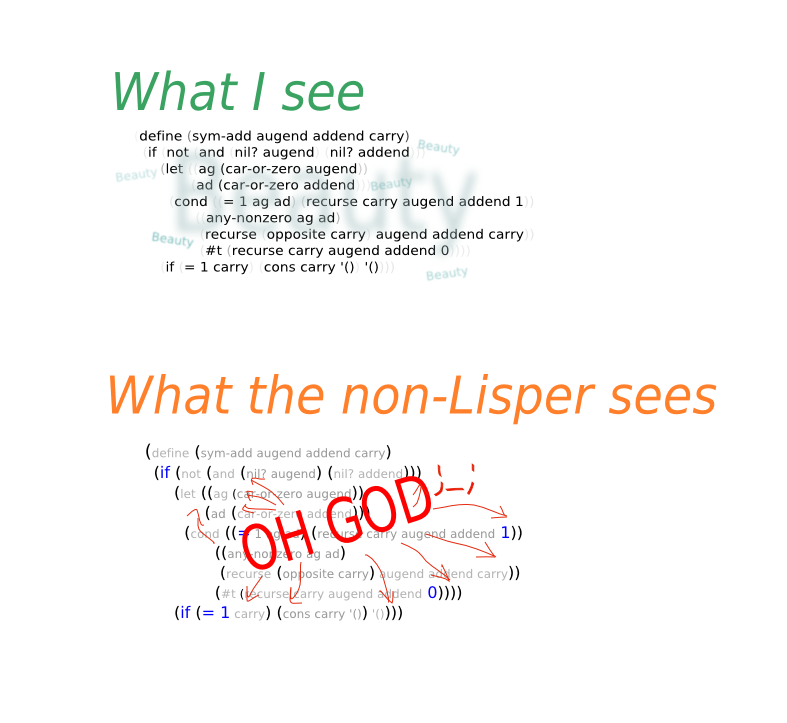
The main direction I was coming from though was that ~10 years ago I was just like the OP, I had read some of SICP and PG's essays and thought I knew Lisp, but no, I just knew a minimal subset of Scheme. Very pretty (https://www.thejach.com/imgs/lisp_parens.png), learned some neat things, but didn't pursue it in favor of practical workhorses like Python et al. I went with the "learn Lisp for the side effects of learning it but don't ever use it" crowd, but I never learned Lisp. It wasn't until much later that I found out Common Lisp was way more than just an ugly syntax change on Scheme that required #' in front of function names. So the features I listed in my comment are really a subset (but a strong one) of the features that would have convinced me ~10 years ago to take a much closer look into actually using Lisp and recognizing I learned something very different.
Lisp is an old family of languages, though. It's been around a long time, and it's explored a broad range of language ideas and a lot of nooks and crannies. There are a lot of Lisps that are pretty different from each other. There's a pretty good list at Wikipedia (https://en.wikipedia.org/wiki/List_of_Lisp-family_programmin...), but it still omits some interesting variants (for example, *Lisp, Kernel, Lispkit Lisp, Connection Machine Lisp, and others). There are greater differences between, for example, Common Lisp and kernel than between Common Lisp and Scheme, but all of them are still recognizably Lisp.
So you're right: you don't want to be fooled into thinking that Scheme is all there is to Lisp. But Common Lisp also isn't all there is to Lisp. Scheme plus Common Lisp plus Clojure isn't all there is to Lisp, either. It's a big space, and there's room for it to grow bigger still without losing its essential Lispiness.
"APL is like a beautiful diamond – flawless, beautifully symmetrical. But you can't add anything to it. If you try to glue on another diamond, you don't get a bigger diamond. Lisp is like a ball of mud. Add more and it's still a ball of mud – it still looks like Lisp."
-- attributed to MIT Professor Joel Moses
For all practical purposes CL, Scheme, Clojure and Elisp are all lisps.
Since only CL and Emacs Lisp can and do share actual Lisp code, I call only them Lisp for practical purposes.
For 'unpractical' purposes - they share no source code but are influenced by practical Lisp - , Logo, Javascript, Ruby, Clojure ... are also Lisp.
But what exactly is 'actual lisp'. I mean what is this strict definition?
Forgive me, I understand calling Scheme and CL as same might feel like saying Java and C++ as same. But one would be right in saying Java and C++ both come from a C based paradigm.
On the same lines one could say CL and Scheme come from lisp paradigm. At this point in time both communities compared to any major language community are so small that one could refer to both as Lisp.
For practical purposes Lisp dialects are those directly inheriting back to Lisp I from McCarthy. You can run programs from 1960 in Common Lisp with very little changes (unless it uses machine interfaces). To port them to Scheme is possible. To port them to Logo, Clojure, Javascript or other languages considered to be dialects in a wider sense mostly means a rewrite.
Thus for me Lisp means the dialects of Lisp and their respective communities which can share code, libraries, applications by relatively simple ports. For example Emacs Lisp has Common Lisp enhancements, which are semantically very similar. ISLISP could be directly integrated into a Common Lisp - Kent Pitman mentioned that he actually did that to see that they are culturally compatible.
Languages who don't directly share code are maybe part of an abstract family, which has no agreed on definition - thus this is for practical purposes relatively useless.
At first I thought this was absurd, but after some time learning Lisp this was more obvious.
Scheme and Common Lisp are built around totally different philosophies, and thus not only the languages diverge, but also the way you program in them.
    DEFINE ((
    (LENGTH (LAMBDA (L)
    (PROG (U V)
        (SETQ V 0)
        (SETQ U L)
    A   (COND ((NULL U) (RETURN V)))
        (SETQ U (CDR U))
        (SETQ V (ADD1 V))
        (GO A) ))) ))
    LENGTH (((X . Y) A CAR (N B) (X Y Z))) ; ---> 5
    (defparameter length-cl (lambda (l)
        (prog (u v)
            (setq v 0)
            (setq u l)
        A   (cond ((null u) (return v)))
            (setq u (cdr u))
            (setq v (1+ v))
            (go a))))
    (length-cl '((x . y) a car (n b) (x y z))) ; ---> 5
To me, a "dialect" implies that you're in the same language but some users of that language just say things a bit differently to each other. "Howdy" vs "Yo". So "add1" and "1+" might be an instance of a dialect change from 1960. For Common Lisp, "sb-ext:run-program" would be the SBCL "dialect" / implementation's way of running an external program while "run-shell-command" might be Allegro CL's. Is Scheme's call/cc a dialect of Lisp60's prog and go? Clojure doesn't have goto at all.. Racket is much cooler than standard Scheme and has nice packages like https://docs.racket-lang.org/control-manual/index.html but is that a dialect equivalent? At what point does the C equivalent of all the above just become another dialect on the way Lisp says it? (And if you're using Common Lisp as the basis Lisp... do Clojure and Scheme have regional dialects that let them say what CLOS says, or what the condition system says, with minor changes?)
As I said at the top I don't think it matters that much, when people talk about "a Lisp" I just assume they mean something with an s-exp syntax and macros, when people talk about "implementing Lisp" I assume they mean "implementing [a] Lisp" but I kinda wish they meant Common Lisp. Such a loose definition raises the question why other langs are described as Algol-like or C-like and never "an Algol" or "a C", or a dialect of either, but whatever.
Lisp can have almost zero syntax, so can last a long time and be picked back up quickly, I've found.
This doesn't necessarily mean lines-of-code is the most productive immediately; as much as there is resistance to it from current (i.e., 2018March17) mainstream programmers, hyperdimensional programming (i.e., 2D+, and higher in VR) like with Unreal Engine 4's Blueprint, are likely going to win out with pure advancement of results, perhaps (that is, creating effective art quickly).
Imagine finessing functions of different shapes in VR, rather than lines of text code.
Could you explain this for a non-Lisp person? (I have some understanding of macros already.)
Instead of unwinding the stack when a condition is signaled, handler code is invoked in the dynamic context of the signal and thus has much more information available to decide how to recover.
If a decision on how to recover can't be made programmatically, the system kicks out to the user where they are presented with the choices you have given them.
See: http://www.nhplace.com/kent/Papers/Condition-Handling-2001.h... for more.
* Multi-paradigm programming (functional programming in the immutable sense is not dominant, the Lisp OOP system is top class, mutable state can be everywhere)
* Rich looping mechanisms that don't require tail call contortions
* Explicit typing that leads to optimized code and compile time warnings! (https://news.ycombinator.com/item?id=13389287)
* Warnings at compile time (not run time!) about things like undefined functions/vars/wrong args/unused vars (https://news.ycombinator.com/item?id=14780381)
* A pretty good set of libraries et al that (once you set up quicklisp) are just a function call away from trying out (https://notabug.org/CodyReichert/awesome-cl)
* (edit: one more since I like it a lot) Out of the box the Lisp system contains features you have to get from IDEs in other languages like breakpoints, tracing, inspection, code location questions like "who calls foo"... of course working with that system via emacs or something is nicer but it's basically all there in the base system (http://malisper.me/debugging-lisp-part-1-recompilation/)