The feeling I got when learning scheme was that of liberation. People have that epiphany all the time, but with different languages and techniques. For me it was scheme.
And of course, I could never be bothered with syntax. If something becomes too verbose in scheme, I write a macro to simplify it. The only thing I need to know is whether something is a function or a macro. After 3 years of writing python on and off, I still manage to mess up syntax unless I think very hard before writing.
I am however not a programmer, and of average intelligence. In fact I am on the very top of the bell curve, looking down on the rest of you.
List comprehensions, to me, are what makes Python a productive (or the most productive) prototyping language. It allows me to think and program in mathematical relations without much fuss. Add to that nice sets and dicts (needed for asymptotic efficiency), and I can easily forgive it that it is built on an everything-is-an-object paradigm (there are few things I detest more than OOP).
I've never truly understood why you need the meta-capabilities of LISP. I much more need a syntax that does not hide what happens (procedure call, list indexing or at least "indexing"). Macros amount to code generation. Code generation is mostly bad, it typically means the problem wasn't thought through, and that there is a lack of clearly defined building blocks. So far I've only ever generated a few C structs and enums, but I'm not sure it was an entirely good idea. It was super easy to generate from Python, anyway.
No, you need to structure your data in a way that there is almost no boilerplate, and only very little glue code (which effectively amounts to "the macro code", with the difference that it's only executed once per data object).
> Do you think those are bad because those are code generation that don't look the way you think they ought to?
Good point, but I have a strong belief that the abstractions offered by C (function calls and good syntax for arrays and records) are sufficient and going up is detrimental for larger systems. I don't code in assembler because typically there is too much redundancy (function call convention) and it's too specific (architecture dependent) and probably too verbose. That said, I'm not strongly against it, but haven't really tried.
Macros allow us to extend the language. It is not just C-like code generation. The loop constructs of common lisp, or the for loops of racket (or my own reimplementation for guile scheme) are macros.
With lisp macros we can express zero cost abstractions that in other languages would have a lot of overhead, and make them feel like a regular language construct (CLOS started like that)
My own racket-like loops for guile generate code that the optimizer can then turn into optimal code: https://bitbucket.org/bjoli/guile-for-loops/overview
The downside being that macro expansion slows down compilation. My workstation can expand about 1000 loop macros/s with guile and a couple of orders of magnitude more using my chez scheme prototype (somewhere above 100k)
To be precise, it will generate something like 'JUMP_IF_FALSE' which is not exactly a shitload. Not saying the execution will be fast. After all, it's an interpreted language.
> Macros allow us to extend the language.
We're on the same page. What I was saying is: if you need more than function calls and records, chances are you're doing something wrong... the program architecture becomes intransparent. Macros and other conveniences allow for hacks put on other hacks, until you don't understand your program anymore and development eventually stalls.
I once added cooperative multithreading by switching stacks in a C program. It was very easy to do and helpful for that project, but small hacks like this are rarely needed. (And in that instance it could have possibly been avoided, but I wasn't in a position to change the dataflow architecture).
You can of course provide libraries that "extend" the language, but sometimes you will never be able to lose the feeling of it being bolted on, because the semantics of the la guage doesn't lend itself to that certain way of doing it.
Lisp macros solve that, at least for me. We use them like regular procedures and as long as you keep the simple rule that you sbouldnt make a macro of something you want to compose with procedures, there really isnt much that gets in the way of understanding a program, because most of the time whether something is a macro or not does not matter.
I added some basic ones to common lisp in a couple of minutes.
  (defun read-comprehension (stream char)
    (declare (ignore char))
    (destructuring-bind (expr for var in list &optional if filter-exp)
        (read-delimited-list #\] stream)
      `(loop ,for ,var ,in ,list
          ,@(when filter-exp `(,if ,filter-exp))
          collect ,expr)))

  (set-macro-character #\[ #'read-comprehension)

  (eval (read-from-string "[(+ x 1) for x in '(1 2 3) if (> x 2)]"))
;; => (4)A "real" implementation would do more processing of the forms in the list read by read-delimited-list and perform appropriate checks. This is more to just give you a sense of how trivial it is to extend the language.
I don't actually know python well enough (I had to look up "list comprehension") to say, but I would estimate that it would only take a page or so of code to give you something fully-featured and robust.
In practice, I would never abuse the reader like this when typical "loop" expressions are enough to do these kind of things (and more).
Implementation of a "Lisp comprehension" macro by Guy Lapalme http://rali.iro.umontreal.ca/rali/sites/default/files/publis...
Simple and Efficient Compilation of List Comprehension in Common Lisp by Mario Latendresse http://www.ai.sri.com/~latendre/listCompFinal.pdf
Yes sir!
> (procedure call,
   80febf0:	08
   80febf1:	c7 44 24 04 01 00 00 	movl   $0x1,0x4(%esp)
   80febf8:	00
   80febf9:	89 3c 24             	mov    %edi,(%esp)
   80febfc:	89 44 24 0c          	mov    %eax,0xc(%esp)
   80fec00:	e8 cb c8 f4 ff       	call   804b4d0 <__fprintf_chk@plt>
Gotcha covered there too!
80fd7eb: 8d 7c 0e ff lea -0x1(%esi,%ecx,1),%ediEach of those is actually hiding what really happens. E.g. for a procedure call the runtime compares the arity of the call and the called function, inserts each argument into a data structure of some sort, perhaps grafts together environments or does other things on a language-specific basis, performs a jump of some sort, then the called function takes over, and finally stashes its return value(s) in a data structure of some sort and performs another jump.
Even list indexing in a language like Python is relatively complex, involving a lookup of the list length, bounds-checking &c.
> Code generation is mostly bad, it typically means the problem wasn't thought through, and that there is a lack of clearly defined building blocks.
Proper syntactic abstraction is all about building the right blocks for the problem at hand. At the end of the day, all we have are bits of silicon transferring electron: everything above that is an abstraction. A sufficiently-powerful programming language enables the programmer to develop the abstractions he needs for the problem he has.
It's nice when these important properties are indicated by a visual clue (square brackets).
> A sufficiently-powerful programming language enables the programmer to develop the abstractions he needs for the problem he has.
Sure. And that programming language still happens to be C for many, many purposes.
C macros (or "C code generation" if you prefer) is very, very different from Lisp macros.
Lisp macros are built into the language, the whole language itself is designed around this capability.
  S = {x² : x in {0 ... 9}}
  V = (1, 2, 4, 8, ..., 2¹²)
  M = {x | x in S and x even}
  S = [x**2 for x in range(10)]
  V = [2**i for i in range(13)]
  M = [x for x in S if x % 2 == 0]
Perl 6 closest syntax to original
  my \S = ($_² for 0 ... 9);
  my \V = (1, 2, 4, 8 ... 2¹²); # almost identical
  my \M = ($_ if $_ %% 2 for S);
  my \S = [-> \x { x**2 } for ^10];
  my \V = [-> \i { 2**i } for ^13];
  my \M = [-> \x { x if x % 2 == 0 } for S];
  my \S = (0..9)»²;
  my \V = 1, 2, 4 ... 2¹²;
  my \M = S.grep: * %% 2;
  my \S = (0..*).map: *²;
  my \V = 1, 2, 4 ... *;
  my \M = S.grep: * %% 2;
Python
  string = 'The quick brown fox jumps over the lazy dog'
  words = string.split()
  stuff = [[w.upper(), w.lower(), len(w)] for w in words]
  my \string = 'The quick brown fox jumps over the lazy dog';
  my \words = string.words;
  my \stuff = [[.uc, .lc, .chars] for words]
  noprimes = [j for i in range(2, 8) for j in range(i*2, 50, i)]
                         range(2, 8)
                for i in
                                              range(i*2, 50, i)
                                     for j in
              j
             [                                                 ]
  my \noprimes = (2..^8).map: { |($^i*2, $i*3 ...^ 50).map: { $^j }}
                 (2..^8)
                        .map:
                              { |($^i*2, $i*3 ...^ 50)             }
                                                      .map:
{ $^j } my \noprimes = ({ $^j } for ({ |($^i*2, $i*3 ...^ 50) } for 2..^8))
2..^8
for
{ |($^i*2, $i*3 ...^ 50) }
( )
for
{ $^j }
( )
  primes = [x for x in range(2, 50) if x not in noprimes]

  my \primes = (2..^50).grep: * ∉ noprimes;

  my \prime-set = 2..^50 (-) noprimes; # a Set object
  my \primes = prime-set.keys.sort;
  # create a prime supply and act on it in the background
  Supply.interval(1).grep(*.is-prime).act: &say;

  say 'main thread still running';
  # says 'main thread still running' immediately

  # deadlock main thread,
  # otherwise the program would terminate
  await Promise.new;

  # waits 2 seconds from the .act call, says 2
  # waits 1 second , says 3
  # waits 2 seconds, says 5
  # waits 2 seconds, says 7
  # waits 4 seconds, says 11
  # and so on until it is terminated
I'm not a mathematician.
To me it seems a bit verbose and clunky. It probably also only works as a single line, which seems odd in a line oriented programming language. Basically it seems like a little DSL for list generation, sort of like Perl's regexes are a DSL for string operations.
Perhaps you may want to reread the last paragraph from the original article. Maybe in a few years the world will have passed you by. Then again maybe not.
* Multi-paradigm programming (functional programming in the immutable sense is not dominant, the Lisp OOP system is top class, mutable state can be everywhere)
* Rich looping mechanisms that don't require tail call contortions
* Explicit typing that leads to optimized code and compile time warnings! (https://news.ycombinator.com/item?id=13389287)
* Warnings at compile time (not run time!) about things like undefined functions/vars/wrong args/unused vars (https://news.ycombinator.com/item?id=14780381)
* A pretty good set of libraries et al that (once you set up quicklisp) are just a function call away from trying out (https://notabug.org/CodyReichert/awesome-cl)
* (edit: one more since I like it a lot) Out of the box the Lisp system contains features you have to get from IDEs in other languages like breakpoints, tracing, inspection, code location questions like "who calls foo"... of course working with that system via emacs or something is nicer but it's basically all there in the base system (http://malisper.me/debugging-lisp-part-1-recompilation/)
"Lisp" has two meanings: (1) ANSI Common Lisp; and (2) the family of programming languages to which ANSI Common Lisp belongs, and which was called "Lisp" many years before ANSI Common Lisp was conceived; that family includes many other languages with quite a bit of variety, including Scheme, Clojure, INTERLISP, T, kernel, picolisp, *Lisp, (the early versions of) Dylan, and many others.
The main direction I was coming from though was that ~10 years ago I was just like the OP, I had read some of SICP and PG's essays and thought I knew Lisp, but no, I just knew a minimal subset of Scheme. Very pretty (https://www.thejach.com/imgs/lisp_parens.png), learned some neat things, but didn't pursue it in favor of practical workhorses like Python et al. I went with the "learn Lisp for the side effects of learning it but don't ever use it" crowd, but I never learned Lisp. It wasn't until much later that I found out Common Lisp was way more than just an ugly syntax change on Scheme that required #' in front of function names. So the features I listed in my comment are really a subset (but a strong one) of the features that would have convinced me ~10 years ago to take a much closer look into actually using Lisp and recognizing I learned something very different.
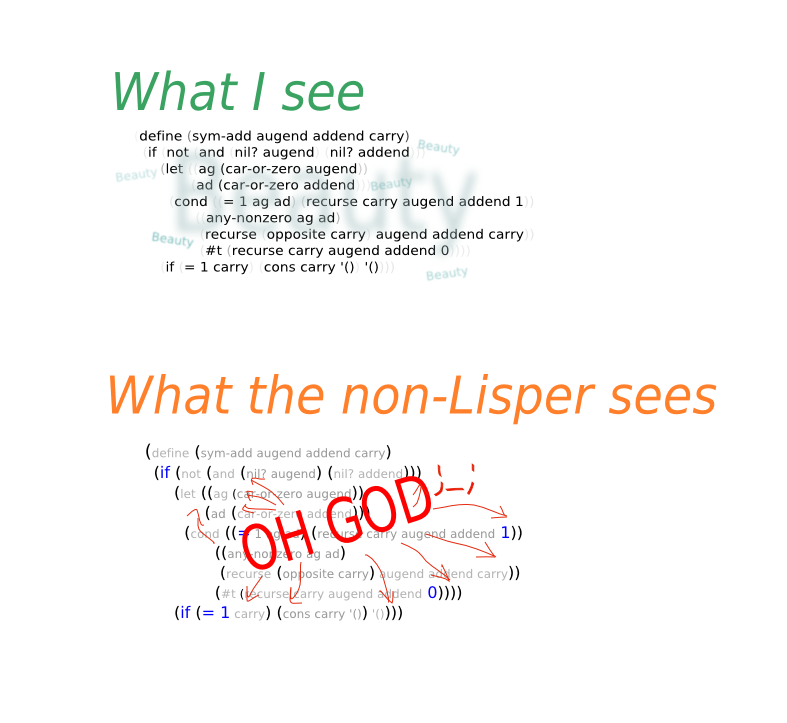
Lisp is an old family of languages, though. It's been around a long time, and it's explored a broad range of language ideas and a lot of nooks and crannies. There are a lot of Lisps that are pretty different from each other. There's a pretty good list at Wikipedia (https://en.wikipedia.org/wiki/List_of_Lisp-family_programmin...), but it still omits some interesting variants (for example, *Lisp, Kernel, Lispkit Lisp, Connection Machine Lisp, and others). There are greater differences between, for example, Common Lisp and kernel than between Common Lisp and Scheme, but all of them are still recognizably Lisp.
So you're right: you don't want to be fooled into thinking that Scheme is all there is to Lisp. But Common Lisp also isn't all there is to Lisp. Scheme plus Common Lisp plus Clojure isn't all there is to Lisp, either. It's a big space, and there's room for it to grow bigger still without losing its essential Lispiness.
"APL is like a beautiful diamond – flawless, beautifully symmetrical. But you can't add anything to it. If you try to glue on another diamond, you don't get a bigger diamond. Lisp is like a ball of mud. Add more and it's still a ball of mud – it still looks like Lisp."
-- attributed to MIT Professor Joel Moses
For all practical purposes CL, Scheme, Clojure and Elisp are all lisps.
Since only CL and Emacs Lisp can and do share actual Lisp code, I call only them Lisp for practical purposes.
For 'unpractical' purposes - they share no source code but are influenced by practical Lisp - , Logo, Javascript, Ruby, Clojure ... are also Lisp.
But what exactly is 'actual lisp'. I mean what is this strict definition?
Forgive me, I understand calling Scheme and CL as same might feel like saying Java and C++ as same. But one would be right in saying Java and C++ both come from a C based paradigm.
On the same lines one could say CL and Scheme come from lisp paradigm. At this point in time both communities compared to any major language community are so small that one could refer to both as Lisp.
For practical purposes Lisp dialects are those directly inheriting back to Lisp I from McCarthy. You can run programs from 1960 in Common Lisp with very little changes (unless it uses machine interfaces). To port them to Scheme is possible. To port them to Logo, Clojure, Javascript or other languages considered to be dialects in a wider sense mostly means a rewrite.
Thus for me Lisp means the dialects of Lisp and their respective communities which can share code, libraries, applications by relatively simple ports. For example Emacs Lisp has Common Lisp enhancements, which are semantically very similar. ISLISP could be directly integrated into a Common Lisp - Kent Pitman mentioned that he actually did that to see that they are culturally compatible.
Languages who don't directly share code are maybe part of an abstract family, which has no agreed on definition - thus this is for practical purposes relatively useless.
At first I thought this was absurd, but after some time learning Lisp this was more obvious.
Scheme and Common Lisp are built around totally different philosophies, and thus not only the languages diverge, but also the way you program in them.
    DEFINE ((
    (LENGTH (LAMBDA (L)
    (PROG (U V)
        (SETQ V 0)
        (SETQ U L)
    A   (COND ((NULL U) (RETURN V)))
        (SETQ U (CDR U))
        (SETQ V (ADD1 V))
        (GO A) ))) ))
    LENGTH (((X . Y) A CAR (N B) (X Y Z))) ; ---> 5
    (defparameter length-cl (lambda (l)
        (prog (u v)
            (setq v 0)
            (setq u l)
        A   (cond ((null u) (return v)))
            (setq u (cdr u))
            (setq v (1+ v))
            (go a))))
    (length-cl '((x . y) a car (n b) (x y z))) ; ---> 5
To me, a "dialect" implies that you're in the same language but some users of that language just say things a bit differently to each other. "Howdy" vs "Yo". So "add1" and "1+" might be an instance of a dialect change from 1960. For Common Lisp, "sb-ext:run-program" would be the SBCL "dialect" / implementation's way of running an external program while "run-shell-command" might be Allegro CL's. Is Scheme's call/cc a dialect of Lisp60's prog and go? Clojure doesn't have goto at all.. Racket is much cooler than standard Scheme and has nice packages like https://docs.racket-lang.org/control-manual/index.html but is that a dialect equivalent? At what point does the C equivalent of all the above just become another dialect on the way Lisp says it? (And if you're using Common Lisp as the basis Lisp... do Clojure and Scheme have regional dialects that let them say what CLOS says, or what the condition system says, with minor changes?)
As I said at the top I don't think it matters that much, when people talk about "a Lisp" I just assume they mean something with an s-exp syntax and macros, when people talk about "implementing Lisp" I assume they mean "implementing [a] Lisp" but I kinda wish they meant Common Lisp. Such a loose definition raises the question why other langs are described as Algol-like or C-like and never "an Algol" or "a C", or a dialect of either, but whatever.
Lisp can have almost zero syntax, so can last a long time and be picked back up quickly, I've found.
This doesn't necessarily mean lines-of-code is the most productive immediately; as much as there is resistance to it from current (i.e., 2018March17) mainstream programmers, hyperdimensional programming (i.e., 2D+, and higher in VR) like with Unreal Engine 4's Blueprint, are likely going to win out with pure advancement of results, perhaps (that is, creating effective art quickly).
Imagine finessing functions of different shapes in VR, rather than lines of text code.
Could you explain this for a non-Lisp person? (I have some understanding of macros already.)
Instead of unwinding the stack when a condition is signaled, handler code is invoked in the dynamic context of the signal and thus has much more information available to decide how to recover.
If a decision on how to recover can't be made programmatically, the system kicks out to the user where they are presented with the choices you have given them.
See: http://www.nhplace.com/kent/Papers/Condition-Handling-2001.h... for more.
Paul Graham and Robert Tappan Morris, two of the founders of YCombinator, love Lisp/Scheme. They got rich by selling their company Viaweb to Yahoo. You guessed it: Viaweb was written in LISP and Paul Graham believes that this was their secret weapon:
> http://www.paulgraham.com/avg.html
Also the software that drives Hacker News is written in Arc, a Lisp dialect that was invented by Paul Graham.
So Hacker News and YCombinator are indeed at least historically very attached to Lisp/Scheme.
EDIT: From the years being here, and having played with LISP myself, it's a language that appeals to a certain type of programmer, who claim to find it very productive compared to other languages.
And everyone else hates it.
So you pick a LISP language you're severely limiting your hire pool.
I'd rather have 5 very good Lisp programmers than 50 code monkeys.
One is macros. Being able to transform code before it is run using the language's built-in data structures provides a solution when the language just doesn't have the abstraction you need. Used properly, this can be invaluable. Used improperly, of course, it can make a mess.
The other is REPL-driven development. Most languages have a REPL, but they don't really embrace it the way Lisp does. I find this frustrating. Why is my editor on my PC not talking to the app running on my Android phone and letting me see its state and make changes in real time?
All my opinion, of course: The time (cost) required to create such easily available introspection is too high for the comparatively small gains. REPLs in modern languages (when even implemented) are just so often a completely separate mode of operation.
But a person designing and implementing programming-language tools has to deliberately choose to provide the needed features because implementing them after the fact raises the costs and lowers the benefits. That means such a person must believe that the gains are worth the cost. The only people likely to believe that are people already familiar with those kinds of systems.
I actually like to use the 'repl' module in nodejs. With a little bit of effort, you can make the dev experience much easier.
That basic assumption is a giant knife-switch that pervasively affects everything in the language and environment. Consider, for example, the generic functions CHANGE-CLASS and UPDATE-INSTANCE-FOR-CHANGED-CLASS. Those functions are in the Common Lisp language standard. That makes no sense unless the standard assumes that a Common Lisp system can modify a program while it runs.
Only a minority of programmers want such systems, but to be fair, only a minority of programmers have worked with them enough to understand them.
Not everyone prefers that style of programming, but most programmers will probably never have the opportunity to find out whether they prefer it. I did have the opportunity, and I learned that I did prefer it. I still prefer it thirty years later.
Get back to me with a Clojure or JS environment that does what I miss from a great Lisp or Smalltalk environment. Let me trigger an error and walk the call stack to inspect parameters and intermediate results. Give me a keystroke to get a list of every other piece of code that calls the function with the error--don't make me wait more than about a second for the list. Let me interactively edit the values on the stack in the suspended computation or, better yet, change their types (and have them properly reinitialized), then resume the computation. Let me redefine a function that's on the call stack and then restart the call using the new definition. Let me serialize the entire dynamic state of the program to disk, copy it to a colleague's machine, and start it up to show my colleague the same error in the same dynamic environment. Let me do all of that interactively without needing to leave the original break loop triggered by the original error. Oh, and package the tools as a single modest-sized executable that I can run with a simple command line or a double-click, that launches in a couple seconds or less.
I don't know of such a Clojure or JS environment. If you do, I would be grateful to learn of it.
Besides the previously-mentioned features, I could build a windowing UI by dragging pieces together. I could build the resulting native-code app for delivery by choosing "Save" from a menu. I could write WDEFs (the code resources that defined window shape and behavior) and other low-level stuff interactively in Lisp. I could patch arbitrary calls with assembly code written and debugged interactively in the Lisp environment (one of the SK8 authors was previously an assembly-language video-game programmer; he was ecstatic about this feature of CCL).
Comparing my current daily-driver development machine to the one on which I was using Coral Common Lisp in 1988, the new machine has twice the word size, 400 times the clock speed, 16,000 times as much RAM, and 400,000 times as much disk space.
Meanwhile, the development tools are in many ways worse, rather than better.
There's a general belief in the tech community that better tech wins. When something works better, hackers will start using it, and if there are incidental barriers, they get solved. None of the explanations I've seen have been satisfactory; I reject the both the idea that Lisp isn't really that big an advantage and that the average hacker isn't smart enough to see it.
I don't think the proposition that better tech wins passes the laugh test. You could argue that I'm a cynical old curmudgeon, though. I've been writing software for a living for thirty years now.
It's not about hackers being smart enough to see Lisp's advantages. It's about them (1) being the sort of programmer who prefers programming-as-teaching over programming-as-carpentry, and (2) getting enough exposure to live-programming environments to see what the deal is. The important advantages are not immediately obvious. They're whole system synergies, and it takes time and experience to grasp the nature of stuff like that, regardless of how smart you are.
Plus, maybe there are just more carpenters than teachers.
I have a Discord bot written in CL. If I want to add a new command or feature, I write it, hit a few buttons, and it seamlessly integrates with my bot without interrupting anything it's doing.
If I have a problem with a macro, I can hit a button to have it expand right there in my code, and when I see the problem I hit a button to unexpand it.
The editor will even catch errors and ask what you want to do, without interfering with other threads, which has been very useful while developing my bot.
It's strange from my perspective to see REPLs as a separate mode of operation. Yes, there's a little overhead, and it's something you might want to strip or disable from a production build, but the overhead is small in the context of a modern application language. Contrast with something like Electron.
This style of development makes the feedback loop between the programmer's mental model of how things work and a reality check extremely tight. It's one of those things like TDD that often changes what kind of programs you write.
The fundamental structures underlying Lisp are quite solid. I like the distinction Phil Wadler makes: Lisp was discovered while languages like Python were invented. Everything in Lisp fits well together. Other languages in this vein are Haskell, SML, OCaml, etc. You can spot these languages because all of their features are usually built from the primitives of the language. An invented language forces the inventor to try and remember how a new feature may interact with all of the others... and sometimes it doesn't work out.
Also Perl 6 is written in itself.
They still haven't caught up. I don't find any other language that gives at least 3 of these features
- Fully interactive development -- i can recompile/redefine a function while the code is running
- Fully interactive OOP development -- i can recompile/redefine a class while the code is running
- OOP system based on multiple dispatch/multimethods
- true metaprogramming done using the same language's syntax, not a special, cumbersome lib.
- execution speed on par with the JVM and sometimes approaching C speed.
Reaching for a "safe and familiar" procedural/imperative language is like most people reaching for a claw hammer when they wish to hammer and nail something in. To most people, it's the same, they are just hitting something.
To a pro, they know when they reach for their claw hammer, a sledge hammer, a mallet, a ball pein, club hammer or cross and straight pein.
If you have a text file that you just need to slice and dice. The tool to use is awk/sed/tr/cut, or perl. Got rules? prolog. Got massive array data? APL. Got multiple massive array data that you wish to combine and separate in various ways? SQL. Surely, you can use python for all those things. But should you?
Arguably, yes, most especially when several of them apply to the same process, rather than to separate pieces of data.
We have so many great, specialized tools. But the act of development often bifurcates into "problems that don't have to scale, or even present a great interface" and "problems that need extensive customization at every layer and support millions of users" and our stacks reflect that.
So tooling choice is often more dependent on maximizing leverage while setting appropriate cutoff points for scalability - in almost all production scenarios you are better off simply to design the system down to the featureset of available off-the-shelf tooling and anticipate a hard break where it migrates upwards, versus thinking you have to boil the oceans immediately so that all facets can be transitioned smoothly and all features are possible right now.
Lisp is quite practical for solving day-to-day problems, as long as you are a knowledgeable Lisper.
> Honestly curious why Lisp has so much admiration and praise on HN.
So my point is that Paul Graham says Lisp was important in his success. His success was important in the creation of Y Combinator and therefore of Hacker News. So we should not be particularly surprised that readers of Hacker News include many that are favorably disposed toward Lisp.
submeta also said:
>But I would not think of Lisp when it comes to solving day to day problems.
...so I mentioned that Lisp is quite practical for day-to-day programming, if you know it well. For what it's worth, I've been using it for day-to-day programming for thirty years.
I don't believe PG's claim that Lisp made a significant difference in productivity for them.
Just consider that, while being a very beautiful language, Scheme is different to Common Lisp.
If you are faced with doing a production system, you'll feel the benefits of Common Lisp, particularly now in 2018 where the tooling and libs are much better.
Scheme can do everything that CL can do IF you add a ton of extensions and libraries and stick to a particular scheme implementation. So you would have a "custom" platform. Where as with plain-vanilla Common Lisp you would have all these features but in a totally standardized way.
At ILC 2002 former Lisp giant now Python advocate Peter Norvig was for some reason allowed to give the keynote address like Martin Luther leading Easter Sunday mass at the Vatican and pitching Protestantism because in his talk Peter bravely repeated his claim that Python is a Lisp.
When he finished Peter took questions and to my surprise called first on the rumpled old guy who had wandered in just before the talk began and eased himself into a chair just across the aisle from me and a few rows up.
This guy had wild white hair and a scraggly white beard and looked hopelessly lost as if he had gotten separated from the tour group and wandered in mostly to rest his feet and just a little to see what we were all up to. My first thought was that he would be terribly disappointed by our bizarre topic and my second thought was that he would be about the right age, Stanford is just down the road, I think he is still at Stanford -- could it be?
"Yes, John?" Peter said.
I won't pretend to remember Lisp inventor John McCarthy's exact words which is odd because there were only about ten but he simply asked if Python could gracefully manipulate Python code as data.
"No, John, it can't," said Peter and nothing more, graciously assenting to the professor's critique, and McCarthy said no more though Peter waited a moment to see if he would and in the silence a thousand words were said.
0: http://smuglispweeny.blogspot.com/2008/02/ooh-ooh-my-turn-wh...
If you also look at the pseudocode or the python code, it's not very Lispy. Python more or less is used on a level of an object-oriented BASIC.
In the above answer to a question in Quora, he seems to suggest that most of the features in lisp eventually got adopted in most other mainstream languages. Or in other words the concept of 'acceptable lisp'.
I get what you are saying, and I feel the same way. But I think what people try to imply here- If you are using Lisp for a certain set of features, most of them are now available else where.
But not in the same language and/or less well integrated.
Example: mostly no popular language has flexible macros as tightly integrated in the language as Lisp has. Those who have macros, either have a different view on macros and/or have them as preprocessing steps.
You find very few languages with generic functions. There are lots of attempts to add them to languages like Java, but they are mostly experiments and not used.
Similar for Common Lisp exception handling mechanism. Very few language have that.
More direct influence languages like PERL6, Julia, R etc. look and feel very different from Common Lisp.
Even if you think language have features like Clojure has a REPL - but it lacks the Lisp interpreter, the integrated error handling, the break loops, ...
It's not the number of components, it's the integration. You can bolt wings to a ship, but the thing won't fly well.
Also we tend to prefer Perl 6 to be spelled with a non-breaking space before the 6. [U+A0]
Perl 6 has features from many sources, so it is indeed a departure from Lisp.
You can program in teams with ten or in companies with hundred Lisp developers. Usually the team size does not need to be that large.
Lucent for example developed a Lisp based network switch (similar to what Ericsson did later with Erlang) and they had around 100 developers. It was competing with a much larger team developing a similar product in C++.
ITA had around 100 developers for their flight search in Lisp.
Symbolics had at its height around 1000 employees and my guess would be that 40% were Lisp programmers.
Personally I'd say there would be little problem working in a team with ten Lisp developers - you just have to find or educate them.
Ultimately, what I really love are expression oriented languages, and the ALGOL/C and APL families have alternatives with a more succinct and expressive syntax (Perl, K).
One might also argue that Scheme is a poor man's Forth.
If you work in a complex or rapidly evolving domain, I cannot think of a better choice than Lisp. If you are doing a lot of text processing or writing CRUD apps, then you will probably not get much benefit.