It's hard to compare the US to other developed countries, because the systems that exist in other developed countries could not exist as they do today without the US. While there are high barriers to trade (both artificial and natural - you can't fly across the Atlantic for emergency treatment, for example), you have to look at the global market to get a sense of how it works.
For example: today, companies that engage in medical and pharmaceutical R&D receive most of their revenues from the US. This is true even of pharmaceutical companies based in Europe: the US is their primary source of funding for R&D. (Similarly, 50% of all R&D in the entire world takes place in the US).
Any attempt to bring costs down in the US - whether single-payer or market-based - would result in higher costs for drugs and other supplies to the rest of the developed world[0]. Put another way, countries like Denmark and Canada and the UK have the appearance of negotiating leverage only because they're such a tiny market[1] compared to the US - and, crucially, a completely segregated market as well. So even if pharmaceutical companies end up selling drugs at very low rates there, they can easily make up the difference in revenue by increasing prices in the US[2].
The US doesn't even have to impose its own price controls to bring costs down - all they have to do is permit drug reimportation from other countries which honor US drug patents (like Canada). This would immediately cause drug prices in the US to drop (and, at equilibrium, drug prices in other countries to rise). There actually was a bill introduced in the Senate last year to do this, but it was voted down.
[0] It wouldn't affect countries like India or China, because they already don't honor most relevant pharmaceutical patents.
[1] Again, by revenue, not necessarily by population
[2] This doesn't actually affect their sales much, because sales are relatively inelastic, thanks to insurance - the costs are borne collectively by the population.
That's what the US covers. Not quite so noble sounding that you're covering the cost of advertising though, is it?
I usually avoid responding to comments that are this snarky, because it's generally a strong indicator that the person isn't actually having a discussion in good faith. But I'll bend my own rule to say:
1) EU sales of pharmaceuticals are nowhere near enough to sustain the level of R&D we see globally.
2) Direct-to-consumer advertising is only one part of "marketing". Even in the US, it's not the majority of money spent on marketing. Marketing absolutely does happen in the EU, and it's a necessary part of the entire R&D lifecycle.
Pharmaceutical R&D spending in 2015: USA $47B, Europe: $33B.
Total drug sales Europe 2015: $190B
It's worth noting that most technology companies spend more on sales and overhead than R&D. For 2014-2015, the ratio between R&D spending and SG&A spending was 0.59 at Pfizer, 0.75 at Google, 0.56 at AstraZeneca, 0.43 at Apple, and 0.58 at Microsoft. Apple wouldn't be able to sell cheaper iPhones by reducing its advertising expenditures...
If all companies reduced their marketing spend equally by 50%, nothing of value will be lost.
That's why I said "mostly". The first 10% of marketing spend may well be useful. The last 10% is the case of being louder than competitors, and is zero sum. Where the line is in a particular market varies and is subjective.
Obviously there are abusive cases where pharma companies are spending marketing dollars to promote products that aren't even marginally better than the alternatives. But it seems to me like there are broad cases in the industry where --- whatever other criticism you might want to level about marketing spending --- marketing simply isn't ever zero-sum.
You're probably aware of the egregious cases of Daraprim[0], Acthar[1] (there are at least 5 cases from the last 10 years that I've read about, these two come to mind). They are only unique in the sense that there was no "slow boiling process", but rather an immediate extreme hike. Many other out-of-patent medicines experienced slower but significant hikes, such as the Epipen[2] are happening all over the place.
You should also read the Epipen article paragraph about the public-facing marketing, which is deceiving and life endangering, and about the policy-facing marketing, which is also not in any way compatible with your description.
It is my impression that your first paragraph is fantasy.
[0] https://www.washingtonpost.com/news/wonk/wp/2017/08/01/what-...
[1] http://www.nytimes.com/2012/12/30/business/questcor-finds-pr...
[2] https://www.nytimes.com/2017/06/04/business/angry-about-epip...
My point is that marketing expenses are far from just informative - e.g., in the case of Acthar and Epipen, they go towards convincing doctors and policy makers that a specific brand is superior or magical, when no such evidence exists; and it is my opinion (which would take me forever to find the facts for, I admit) is that a significant part of the marketing budget, perhaps upward of 50%, goes to such deceitful practices; another one that comes to mind is Oxycontin[0], which was marketed deceitfully, and is a major contributor to the opioid epidemic.
[0] https://www.theverge.com/2018/2/11/17001926/oxycontin-purdue...
I just have a very simple point to make about pharma marketing costs. It was not my argument that there aren't abusive pharma companies; clearly, there are.
In fact, oxycontins claim to fame is its uniqueness in how long it acts for and therefore reduced addiction potential, which does not actually work this way.
The “non competition” belief is itself a marketed reality for many drugs.
It amuses me how in the ostensibly capitalist US nobody cares about efficiency. You would think that the insurance companies in the US would care about profits, instead billions are being wasted every year. It wouldn't even be so bad if healthcare was actually the best in the world so people would get what they pay for but it is not even close...
Prescribing costs for the NHS are only about 10% of total costs, I don't think the effect is as big as your post implies.
You're saying that like it contradicts my point, but it actually corroborates what I'm saying. The US spends two and a half times as much per capita as the UK does, in addition to being five times larger.
As I said, this is just one example - pharmaceuticals aren't the only way that the effects of a global market are visible, but it's a good example because it's one that's very easy for people to grasp.
What point are you trying to make? It's not really relevant how much is spent on marketing in the US, because:
1) European sales are nowhere close to sufficient to sustain the levels of R&D conducted in the US or funded by the US market.
2) The US still funds the outright majority of R&D in the entire world, including R&D for pharmaceutical companies based in Europe.
https://www.ncbi.nlm.nih.gov/pmc/articles/PMC1261198/
"It is widely claimed that research to discover and develop new pharmaceuticals entails high costs and high risks. High research and development (R&D) costs influence many decisions and policy discussions about how to reduce global health disparities, how much companies can afford to discount prices for lower- and middle-income countries, and how to design innovative incentives to advance research on diseases of the poor. High estimated costs also affect strategies for getting new medicines to the world’s poor, such as the advanced market commitment, which built high estimates into its inflated size and prices. This article takes apart the most detailed and authoritative study of R&D costs in order to show how high estimates have been constructed by industry-supported economists, and to show how much lower actual costs may be. Besides serving as an object lesson in the construction of ‘facts’, this analysis provides reason to believe that R&D costs need not be such an insuperable obstacle to the development of better medicines. The deeper problem is that current incentives reward companies to develop mainly new medicines of little advantage and compete for market share at high prices, rather than to develop clinically superior medicines with public funding so that prices could be much lower and risks to companies lower as well."
"The deeper problem is that current incentives reward companies for developing mainly new medicines of little advantage, and then competing for market share at high prices; rather than rewarding development of clinically superior medicines with public funding, so that prices could be much lower. One or two out of every 20 newly approved medicines offer real advances, and over time they have accumulated into a highly beneficial medicine chest for humanity. Approving new medicines using non-inferiority or superiority trials against a placebo, and using substitute or surrogate end points, has resulted for years in about 85 per cent of new drugs being little or no better than existing ones. These then become the medicines the rest of the world wants, because the rich have them and presumably benefit from them. But in fact, they have spawned an epidemic of serious adverse reactions that rank behind stroke as a leading cause of death and cause about 4.4 million avoidable hospitalizations worldwide. Thus the mythic costs of R&D are but one part of a larger, dysfunctional system that supports a wealthy, high-tech industry, gives us mostly new medicines with few or no advantages (and serious adverse reactions that have become a leading cause of hospitalization and death), and then persuades doctors that we need these new medicines. It compromises science in the process, and consumes a growing proportion of our money."
Can you share additional info on this or some keywords so I can do my lookup? I'd like to learn more about this, and why it was voted down.
It was an amendment, not a bill, but either way, it was voted down last January. I believe it only would have applied to reimporting drugs from Canada, which limits how effective it would have been, but it would have been a start.
Booker's excuse for voting against it was to allude to FUD about "safety standards". It's probably effective at inspiring fear, uncertainty, and doubt in people's minds, but it's a really weak excuse, because we're talking about brand-name drugs that are already sold to the US and Canada from the same manufacturer, just at different prices, and so we already have established processes for tracking batches and issuing recalls when needed.
I see this economic fallacy so often and crop up in so many different places that I'm thinking that it might actually need a name - maybe the "fallacy of immutable profits". For example, elsewhere:
* If you raise the minimum wage, the inevitable outcome is that people will be fired and prices will rise so that the "natural" state of the company's profit remains unchanged.
* If you raise land taxes then landlords will just raise rents so that their return on investment remains static.
As a profit making entity, this is naturally what you'd want to bluff people into thinking would happen. It's not what actually would happen though, except in one very specific scenario (the profit making entity has all the power and the other parties have no leverage).
The reality is that if you put economic pressure on one valve and there are three potential exit points, the pressure will be distributed across them relative to the leverage on each side. Has Walmart employed way more people than they need or are they barely getting by with what they have? The answer to that determines whether how much their profits get cut and whether employees get fired. Can customers just get their stuff off Amazon if walmart raises prices? If yes, then Walmart has to eat a shit sandwich of lower profits.
If the power of the drug companies relative to the power of Denmark is very high then Denmark will eat the losses. If the reverse is true, well, then Pfizer will eat shit.
Pfizer, of course, hate negotiating with large parties - especially whole countries because their relative leverage is much lower. They will lobby furiously to try and break the country down so that they can lobby on a more local level. This is also partly why Congress barred medicaid from negotiating with drug companies - it was hitting drug companies in the profit margins. Can't have that.
And, I think Pfizer's power on the global drug market is consistently overestimated, though most proposed "free trade" deals coming out of the US (e.g. TPP) seem focused on increasing the leverage of companies like Pfizer - e.g. with the ISDS and stronger intellectual property provisions.
I'm struggling to see what's so bad about reduced drug prices and reduced profits for a large corporation which doesn't, to put it lightly, always play fair.
> Of course drug companies "hate negotiating with large parties"--because countries can exercise monopsony power: https://en.wikipedia.org/wiki/Monopsony.
Monopsony means single customer - hence mono. As in 1. If Pfizer wants to not sell to Denmark and sell to every other country in the world - of which there are several - it is completely free to do that.
Edit: psychometry above phrased it much nicer than I did. I was responding to retric's defeatist sounding reply. Yes, I'm easily triggered by concern trolling.
https://drkevincampbellmd.wordpress.com/2015/04/16/the-rise-...
https://drkevincampbellmd.files.wordpress.com/2015/04/growth...
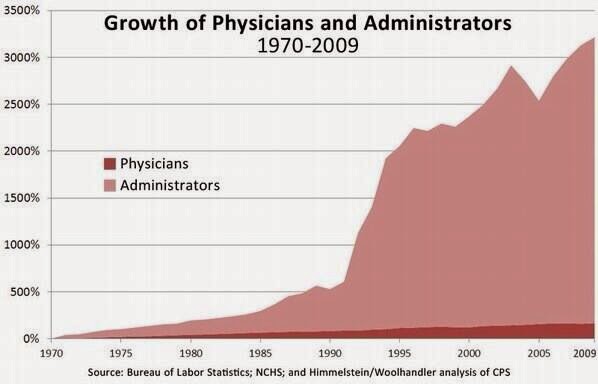
https://duckduckgo.com/?q=growth+of+physicians+and+administr...
I believe, but cannot prove, runaway administrative costs are caused by insurance company driven blame shifting and profiteering. Though I am open to the notion that insurers may just be amoral bureaucratic beasts feeding on people.
The Utopia of Rules: On Technology, Stupidity, and the Secret Joys of Bureaucracy by David Graeber http://a.co/6olvPDM
Source: Healthcare IT. Everyone inside the beast knows single payer is the correct answer.
352,200 "Medical and Health Services Managers" at a median pay of $96,540 per year [0].
713,800 "Physicians and Surgeons" at a median pay of $208,000 per year [1].
Now, I'm totally ready to concede that managers are adding less value to the healthcare system than doctors, but that chart is pretty much a textbook example of lying with statistics. Sure, growth has been huge. But it's also pretty obvious that the base number was small and that there's lots of compensation going elsewhere.
[0] https://www.bls.gov/ooh/management/medical-and-health-servic...
[1] https://www.bls.gov/ooh/healthcare/physicians-and-surgeons.h...
---
Expanding on my prior statement of the obvious...
Value add vs overhead. I'm sure you've been in situations where some people are anti-productive. In this story, that's the private insurers. My go to example of frivolous make work is ICD-10 (and the transition from ICD-9). More data gathered, huge increase in cost, less value, no impact whatsoever on patient outcomes.
Lately I've been wondering if there's a migration path between our current fee-for-service to the capitation model (aka The Correct Answer, a technology unlocked by the singer payer achievement).
The defenders of our current system of private insurance focus on improving cost transparency (as a way to postpone the inevitable). Okay. Sure. Pretending for a moment that patients can go bargain hunting...
Why are rates negotiated per procedure? As though healthcare is Taylorism reducible assembly line work. Even more absurdly, different patients are charged differently for supposedly the same work, totally invalidating the premise that the work is so easily quantifiable. (This unfair practice just hides the cost shifting.)
Why aren't we billed for time and materials, plus overhead, plus profit? Why all the fuss with medical coding? I think this is called cost based accounting. https://en.wikipedia.org/wiki/Cost_accounting
I truly want to know.
Cost of Hepatitis A vaccine at doctors office, 2 shots @ ~$115 each, plus $150 to $300 each time for just visiting the doctor. Total cost $550 to $800. There are so many things doctors aren't needed for, but due to the prescribing power they have they can really take advantage of the moat they have.
It's been my own experience as well. My dear friend in Australia who otherwise praises her system has had to wait over a year for some very important foot surgery. I was able to schedule a not-very-critical knee surgery in a matter of days, and I have the lowest-cost insurance plan my company offers.
Even while unemployed and on government insurance, my daughter was able to have open heart surgery when she was six months old. She waited a few weeks for an opening. I shudder to think how long she might have had to wait in Canada.
I can't see the article because my free views are up; Do they discuss what I view as the two most heavy flaws of United States healthcare? The increased regulations and the ability of doctors and hospitals to charge exorbitant prices due to insurance itself.
Regulations (in my observation) consistently bring heavy cost burdens to every industry they are applied to.
And insurance permits cost hiding: It doesn't trouble me terribly that a saline bag costs $70 if 3 million of those on my plan pay less than a penny each to pay for my saline. Doctors and hospitals have jacked prices sky high since insurance has become the norm. Whereas stories abound of cash payers getting their hospital bills slashed by significant margins. Only because they bypassed insurance.
I've also lived in Australia and when I needed a eye operation, it wasn't even life threatening or dangerous (probably in 30 years it might have blinded me). I got surgery scheduled on the same day.
So really the wait all depends and of course it's on a triage system. I would say if your daughter needed her surgery in a socialised healthcare system it would have been triaged and made a priority.
i was also born prematurely, and as a result of that had to have some pretty major surgery done as a child. All of these surgeries where done rapidly aswell to keep the impact to a minimum.
Compared to a couple of months ago, where i needed to get some surgery done in my hand, in which i had to wait a couple of months. The issue with my hand was annoying and slightly painful at times, but nothing life threatening or "serious" compared to my premature birth surgeries.
Sure, the wait time sucks, but healthcare is (in my opinion) something collective that should be done by society as a group.
if i have to wait a couple of months to get my hand fixed. While at the same time it allows a premature child to get fixed up and get's a proper chance to live, so be it.
But the problem here, as you pointed out, is that to implement this idea in America, people would have be less selfish and more responsible for their own health. Neither of which is a core tenant of our modern society. 50-70 years ago is when we should have done this.
A related tweet from the woman in the article: https://twitter.com/aliranger29/status/878429522533777410?s=...
> I'll save you some math; without insurance we would owe $231,115 for 10 hours in the OR, 1 week in the CICU and 1 week on the cardiac floor.
Of course, I could be wrong too. I’ve been very lucky with my health. My grandfather spent four days in the hospital last year and it was $35,000...
I’m glad your daughter was able to get the care she needed.
The people that are fucked over are the working and lower-middle class people who make too much money for the free programs, and so have to purchase exorbitant, yet often very terrible, insurance plans, which typically have high deductibles, so that they pay thousands of dollars a year for their terrible coverage, plus $3k-$5k more if they are unlucky enough to actual need to use the insurance they're paying through the nose for.
Some examples:
My mother cut her finger quite badly making dinner a few years ago. She wrapped it up in a towel, grabbed a book since she knew she was in for a wait and headed to the ER. Triage nurse confirmed she wasn't in danger of bleeding out and added her name to the list. My mom waited 3 or 4 hours and then someone stitched her up. Many people in much worse shape were wheeled through while she waited.
My father was peering out a window with security bars, slipped and caught his wedding ring on a bar which partially degloved his ring finger. We rushed him to the ER where the triage nurse raced him into an OR to have the ring removed (it was embedded) and his hand stitched up. He was home within an hour or so with his mangled wedding ring in a urine sample jar. Followup care recommended plastic surgery in combination with physiotherapy to restore finger movement. My Dad had to wait several months for a plastic surgery opening since it wasn't life threatening. Plus based on his telling the other people in the plastic surgery waiting room has crazy gruesome disfiguring traumas and he was happy to let them go first.
A friend got stung by a bee and thought nothing of it. The next day we were playing soccer and he got hit with the ball where the sting had been. He had a delayed allergic reaction of some kind since his leg swelled up to about triple size and turned a really crazy colour. We drove him to the ER and I've never seen a triage nurse move so fast in my life. My buddy was on an IV with doctors prodding him within 30 seconds of walking through the door. He needed to have a full IV bag of a concoction of drugs I couldn't pronounce twice a day for a week, but he was fine.
I have seen no evidence that in Canada it wouldn’t have been the same or faster than the USA. There is plenty of rightist propaganda in the USA that claims otherwise, but it has mostly been exposed as...propaganda.
Cash payers pay much more than those with insurance at American hospitals, mainly because the collection rates for cash payers are much lower so they are associated with more risk.
There is, also, a more subtle game at play here. At the end of the day, if the public system is good or not is a political decision.
There is a strategy that is happening now in some (many?) places in Europe where the public health system is defunded and then there are public claims of how bad the system is.
Sure, because it is a very nice piece of cake for the private sector. What better business than something that people cannot live without?. There is a lot of money in play.
All healthcare systems have to ration care. The U.S. rations care in an immoral way.
But there is more to the morality of it than what you state: Our system, for all its faults, naturally favors those who choose to excel in their field. By contrast, those who choose to steal from their neighbors by taking an easy route, whether by doing mediocre work, or by not studying, or by not working at all, will find themselves left out.
DON'T HEAR WHAT I'M NOT SAYING. I'm not saying everyone who is poor is lazy! My Texan friend is a hard worker. Where they might have gone wrong is the choice of career path and education. But many do indeed choose the easy route. Earlier this year I was seeking to help a poor family move, get a job, get education. I could see them consistently choosing the easy route, and they suffer because of it. Their daughter suffered most because of it.
My dear Texan friend likely could pay for her rotator cuff surgery if she or her husband had a startup in which they poured their lives and passions into. (I am hoping to help them do just that.) The United States is in the top 10 countries for ease of starting a business.[1] (To be fair, New Zealand is single payer and is first. I'm not saying the system is perfect.)
Rewarding career excellence it seems to me has a broader impact on the culture around. Better workers pay more into insurance to help others. And better workers improve the systems and products that they touch.
Don't hear me say however that I think the system is perfect. I am a Christian and my command from Jesus is to help the needy, and we don't do that as well as I'd like. That's why I am aiming to bring better healthcare and careers to people in the poorest of nations. I have a side project I'm working on for the people of Haiti, and I don't see any reason it would fail to help many dozens or thousands (or millions?) of needy.[2] I have high hopes that in 20 years many more people in Haiti will be able to afford health care, and not because their government made it much more affordable or available. There is little hope of that in a corrupt nation like Haiti.
So I'm hoping to take the skills I have excelled in to help others to help themselves to improve their own skills, so that they too may be able to enjoy the same benefits I have.
TL;DR: There is more to morality than helping those who cannot pay. Our system seems to be, whether knowingly or unknowingly, guided by the "if a man will not work, he shall not eat" principle, and the moral response for those living under such a system is to both work hard to better one's own life and the lives of everyone who uses the products of one's skills; and to lend a hand to one's neighbor on an individual level, to help them to help themselves.
We all are guided by some form of absolute morality; please ensure yours takes into account all factors.
Yeaaah, I remember you having very odd, non reality based objections to geology yesterday, too. Now I know why.
I would suggest that you re-evalute your ideas, they seem utterly crazy to me. We aren't all born with the same skills, even if we all work as hard and smart as we can we aren't all going to make six figure salaries so that we can afford medicine. Someone has to dig the ditches and take out the garbage, and you should not be using twisted religious logic to condemn your garbage man to death.
I repeat: We are all guided by absolute morality.* Ensure yours takes into account ALL factors.
Now if you’ll excuse me, I’ve got to get my business off the ground. Can’t spend my whole day here chatting. People in Texas and in Haiti lack healthcare and I’m aiming to do something positive about that.
* Edited to add exhibit A, the statement above by yequalsx: "The U.S. rations care [does so] in an immoral way."[1] That is a statement of absolute morality on the part of yequalsx. I didn't bring up morality, they did. Their belief is absolute; it is not relative. They do not believe that what is good for them is only good for them, but that this morality must be obeyed by the entire world. That is an absolute standard.
The hole in this absolute moral standard is it seems to fail to take into account those who either steal or who miss out on opportunities due to a lack of awareness. See my carefully-worded comments above.[2]
According to your first paragraph you realize there is not a dichotomy. It is not the case that everyone falls into the "excels in their field" and "steal from their neighbors" camps. Indeed your example demonstrates this. So our system is immoral in how it rations care. That is all I said.
You said the phrase, "steals from their neighbors". I guess this refers to welfare recipients and some sort of belief that taxation used to help loafers is theft. This is most disturbing to me. The one you follow has it written in his book that the love of money is the root of all evil. He said with regard to taxes pay unto Caesar what is Caesar's. He said to his disciples that at judgment he will divide people into his left and right and say to the one group you fed me when I was hungry, clothed me when I was naked and that they did this when they fed and clothed the least of their brethren. He mentioned the parable of the Good Samaritan.
You mention a brief passage in 2 Thessalonians 3:10. A passage clearly taken out of context. Yes the phrase, "if a man will not work, he shall not eat" is in the Bible. You should realize though that it was said to believers in Thessalonica. Your usage of the phrase and it's use by right wing Christians in the U.S. is completely out of context.
Given what Jesus said with regard to helping others vs. a passage taken out of context written by Paul I think you have your priorities wrong. I will paraphrase what H.L. Mencken said. The modern right leaning version of Christianity as practiced in the U.S. can best be described as people who have the haunting fear that someone, somewhere is getting something they don't deserve. This is quite ironic since the whole premise of Christianity is that some will be saved even though none deserve it.
I choose not to focus on possibility that someone will get healthcare even though they don't deserve it. I choose to focus on the possibility that everyone has value and is worthy of being cared for. I choose to focus on this because in my view it is the moral thing to do. I'm not a Christian.
No it doesn’t, as a more careful reading of my words would reveal. I’m not interested in discussing this with someone who won’t carefully read, so I wish you good day and God bless.
Choice of parents and zip code are the prime factors.
Yes your insurance plan may cost you a little but how much is your company paying on your behalf?
I had this same argument with some of my coworkers who didn't want to pay extra taxes for government healthcare. The company list how much they are paying on your behalf for insurance as part of the ACA it was $12000 a year for the family. Assuming a $120,000 developer salary (reasonable but low for a senior dev in our market). That's 10% of our total compensation. That money comes from somewhere.
They were paying the same $12,000 for the help desk support staff that was probably making $40K at the most - about 25% of their total compensation.
This is a symptom of provisioning, not single payer vs profiteering.
That is, you don't have to look for solutions for how to find enough money to pay for health care for those who can't afford it right now, you need solutions for how to bring the price down.
Can't do it, to much focus of power in DC. The Democrats were supposed to achieve this and they couldn't. In fact even their attempt at it made things worse.
The only decent solution is to be healthy yourself as much as possible and get catastrophic coverage. Or perhaps get state supported insurance? (state level politics is easier to deal with, but the fights with the feds backed by the multinational corps. often times doesn't go well.)
Yeah, but if the US had a single-payer healthcare system, the government would also have an incentive to ensure that doesn't happen as much - so it would take a much better and stricter look at what "food vendors" are allowed to sell in the US and what they can put in their foods or even how transparent they are about it.
Right now it has very little incentive to do that because Americans being fat and sick is "not the government's problem". It's the people's and insurance companies' problem, which is why insurance companies fight to be responsible for treating as few conditions as possible.
If the US had a single-payer healthcare system, it also wouldn't be the only country in the world that "doesn't believe" in climate change and "wants to save coal jobs" or even fracking jobs (in case you thought I was only referring to Trump's policies).
I wonder, does the US goverment (state, local or federal) insitute programs for physical excerise/sports?
my goverment does this, especially with children and teenagers/young adults (the first two also have mandatory P.E Classes in school, and outside of school, sports is usually subsidized for the poor).
Getting people to live healthy at a young age results in people living healthy when they are adults.
Medicare's billing is incredibly complicated and convoluted - and moreover, most of the complications in billing for private insurers ultimately stem from the rules that Medicare itself puts in place.
Even under a single-payer system, you'd still have all the complexities of billing, and Medicare is quite possibly the single most complicated payer on the market, from a billing perspective.
For instance, giving someone who is poor benefits so they can afford healthy food (or even better, taxing unhealthy foods and using that money to subsidize healthy food) will actually reduce healthcare costs down the line. A healthy lifestyle goes a long way in regards to sick preventions.
I wonder if physical activity also has to do with this? the U.S is a very car oriented nations, which means people walk less?
I visited Japan, and I saw 1 single fat guy. He also was the only homeless man I saw in Tokyo... (it's illegal to pan-handle in Japan, so he did the universal thumb/fist-to-the-mouth-head-back motion to ask for a drink.)
And yes, everyone walks a ton there. There's no reason people can't walk here, they just don't. To quote the movie L.A. Story "Go for a walk? In L.A.? Hahahahah."
You really think there is no reason? I mean you chose Japan as your example - I walked everywhere every single day I spent in Japan as well. Because the cities (heck, entire country) are set up with human pedestrians in mind as first class citizens, and are laid out in a manner which makes everywhere from small villages to Tokyo very walkable. For any trip under a mile or two, walking was always clearly the best option.
The US? It's effectively a giant suburb except for an exceedingly tiny number of dense urban cores built prior to to the invention of the automobile. Walking in those areas is dangerous (many times done on purpose by city planners to discourage pedestrian "riff raffs"), typically pointless (e.g. you have to walk to walk as it's square miles of nothing but single family homes), and honestly utterly boring and socially disconnecting. Walking 4 blocks in my suburban neighborhood in Minneapolis is a soul crushing tour of how disconnected the community is (you likely won't even talk to a single person) - walking 4 blocks in my dense Chicago neighborhood is interesting and helps build community as the density and walking/transit focus forces the community to interact on a daily basis.
I am quite convinced the suburbification of the US after WWII is the primary cause for the breakdown in social cohesion we're starting to see.
Then there is the simple notion, take the time to go somewhere to walk. I have relatives that do this, I know it's not impossible based on your living location. If you want to bring economics into this, then there's a vastly more complicated topic.
Yes, it's way easier to walk in Tokyo (any different than New York?), but I was also in rural Japan, and there was no more unique motivation to walk there than in rural USA.
I think social cohesion can be broken with just the introduction of smartphones and social media, so sure, it's possible suburbification made some things worse. But it's now socially acceptable to discuss and display on public media what used to be considered perverted and depraved, did suburbs cause this?
What society can be decent when being decent isn't valued by society?
How are these people saying that direct awareness leads to more efficient pricing? It's not like most people can shop around for reasonable alternatives.
[0] https://www.statista.com/statistics/237043/us-health-care-sp...
Yes the USA is quite insane in that you already have mostly socialised medicine with Medicare and Medicaid. You even have a version of the British NHS system in the VA. The only people who don’t seem to have coverage are the people you actually want in any universal insurance scheme; the young and healthy.
Private health exist in countries with public health.
Right now medicare can't lobby for drug prices. How that level of blatant corruption could be enshrined in law is hard to fathom.
Honestly I'm not sure we need obamacare or any of it and I feel like it is all a circus. All we need is a law that no medical service or drug can cost more than the average price of a basket of oecd countries. The prices would hit the floor and all the other problems would mostly just disappear.
> There were two areas where the United States really was quite different:
> We pay substantially higher prices for medical services, including hospitalization, doctors’ visits and prescription drugs.
> And our complex payment system causes us to spend far more on administrative costs.
> The United States also has a higher rate of poverty and more obesity than any of the other countries, possible contributors to lower life expectancy that may not be explained by differences in health care delivery systems.
Which is amusing, because people who argue against single-payer tend to argue that a) single-payer would lead to an inefficient government bureaucracy handling billing and administration, rather than the status quo of "efficient" hospitals and insurance companies; and b) private health insurance that requires everyone (or their employers) to pay for their own healthcare encourages more healthy living and more efficient pricing due to a more direct awareness of the costs.