http://www.dwa.gov.za/Documents/Policies/nwpwp.pdf
But as it says in that document - it's National Policy. The government will need to make the call. There may well be provision for disaster areas, but the government doesn't think CPT qualifies.
On the second point 4, there's a already a health concern with regards to our current water supply. Cracks in pipes in the existing infrastructure allow impurities to enter our water supply. When the pipes are at full pressure this doesn't happen. However, when the pressure is dropped (as what is currently happening in various suburbs), the pressure is not enough to keep these impurities out, and you end up with a contaminated supply in some areas.
https://www.timeslive.co.za/news/south-africa/2018-01-18-de-...
The apartheid government may have been morally reprehensible, but at least it knew how to run a country. Either option is kind of shitty…
So, by the standard you imply with your comparison, the apartheid government—even more certainly than the present regime—did not know how to run a country.
That's fine, but that's also completely orthogonal to the point, which is that:
1/ By most standards, the effectiveness of government has plummetted since the end of apartheid. Crime is up; corruption has increased; resources are running out (nation-wide electricity blackouts last decade, now water); etc.
2/ Open government-sponsored racism still exists today, but most of it is considered to be commendable under the banner of affirmative action.
If we were to take race entirely out of the picture, the apartheid regime would be considered far more effective than the ANC regime. That, of course, is neither realistic nor fair… But we should aspire to a post-racial world where we race is no longer relevant, where both apartheid and affirmative action are considered revolting abominations, but also where we judge governments based on their net effectiveness.
My point is that comparing government effectiveness is not as easy as looking at results. This was exemplified by many of the communist satellite states to the USSR, which it sponsored for political gain to its own economic detriment. The satellite states flourished under communism, and as soon as the regime collapsed they suffered - was it the newly-elected democratic government's fault that industry had collapsed and there was rampant inflation, or was it just a long-term effect of previous government policy?
The government had an initial plan to redirect overcapacity in many areas (not just electricity) to rolling out services to those neglected by the Apartheid govt, and then after that to start building infrastructure again (not sure of specifics, maybe 5 years on?). The problem is that in most cases, this never happened. Hence the limits of most infrastructure are gradually being hit, with a knock-on effect for the economy.
Hear, hear. While "the better angels of our nature" should inform our aspirations, the political, social and economic facts-on-the-ground should inform what action should be taken in order to bring us closer to the ideal.
Affirmative-action is a symptomatic treatment (that could be argued as being punitive) which achieves little-to-nothing in solving the root-problem, while creating a whole new set of problems. Successful integration of former-colonial and indigenous peoples in ZA would have been an unprecedented achievement, but adopting policies that are so obviously regressive will not bring that into reality.
This is sadly a travesty coming.
Why?
In already deployed networks, decreased usage means the cost per client, or the cost per unit used will go up.
This is a problem with any network that charges for delivery based on usage and cannot easily cut off unused parts of the network.
More likely, it takes a flat-ish $x to maintain the infrastructure, and the reduced usage means they can't reach that minimum $x threshold.
It’s not a policy issue, it’s an education issue.
It doesn't sound like things are trending in a good directly and water supply scarcity seems likely to cause instability and other issues.
Why stay there?
Of course there is a political dimension.
The SA national government (ANC) is from a different party to the Cape Town local government (Democratic Alliance, the main opposition party).
So there is tension between local and national governments. They try to make each other look bad.
Hard to prove, it it does look like the National government is either just neglecting Cape Town or deliberately encouraging it to fail.
And they are corrupt, particularly the national government, yes.
https://www.biznews.com/undictated/2017/12/15/cape-town-wate...
https://www.biznews.com/thought-leaders/2016/12/05/sa-water-...
http://ewn.co.za/2017/02/12/report-water-and-sanitation-depa...
You could even have progressive rates
That would also prompt people to install water saving devices
When flying into Cape Town, you still see a large number of pools that look well-maintained, which is scary. I'm convinced that some residents just quietly pay excessive water penalties, and are let off the hook.
Given the Listeria breakout that's happening, and the "falling" or unprepared public health sector, it's a matter of weeks till we deal with a huge crisis.
Disclaimer: I have been working in CT for a few months, fly in and out every week.
Your description point to infrastructure decay.
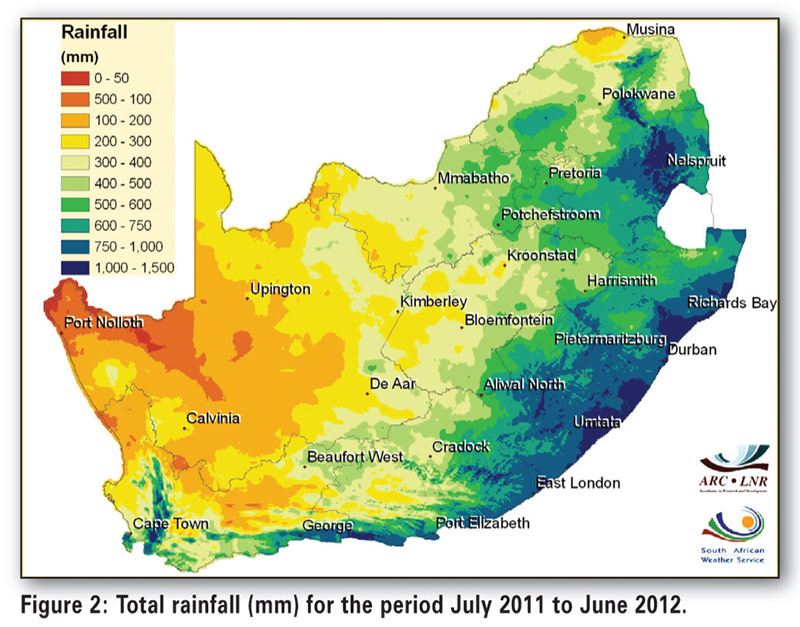
Cape Town is at the bottom of Africa, but at 33.9° S it is roughly as far south as Tunisia and the Mediterranean, or Los Angeles, California are north. To pick other coastal places.
The climate is "Mediterranean" with rain in winter sweeping in over the sea from the west, and hot dry summers. (1)
But the area to the north of Cape Town, towards the equator is dryer, even along the coast. In fact it becomes harsh desert by the time you reach Namibia (2).
So it only takes a small shift of the weather systems away from the equator to impact the winter rainfall that reaches Cape Town.
1)
https://en.wikipedia.org/wiki/Cape_Town#Climate
http://www.capewatersolutions.co.za/rainwater-harvesting/cap...
2)
http://www.grainsa.co.za/images/Articles/2012-08/reenval_fig...
Yes, we should probably power those plants from some renewable/sustainable source, but that's a different discussion for another day.
It's sad and crazy that this is still not changing. SA is a very sunny country.
Desalination is expensive in many ways. If it was a viable way of acquiring water (which it is in some places, like literal deserts) then these places would have already done it. Hence rising sea levels provide no additional access drinkable water.
"It's got what plants crave" is a line from his movie Idiocracy. It is directly relevant the discussion at hand, but it's also a zero-effort joke that contributes nothing new.
> low-effort jokes. It doesn't add information.
And then
> God forbid somebody makes a joke!
You're misreading what is being said.
That's why the explanation as if it was facetious gets the downvote.
Especially since it's not at all baseless. Outside of the subtropics rainfall is expected to increase. But drought length can also increase. It's complicated.
One part of me is disgusted at someone profiting from bad planning and misery of others, the other thinks that this is something that really needs investing.
"Newly discovered tapes have revealed how the energy corporation Enron shut down at least one power plant on false pretences, deliberately aggravating California's crippling 2001 blackouts with the aim of raising prices."
[0] https://www.theguardian.com/business/2005/feb/05/enron.usnew...
And businesses aren't really motivated to provide cheap water or more than bare-minimum health standards.
There are obvious pros and cons on both sides of that debate.
Neither are governments (see Flint).
https://youtu.be/Bu2wNKlVRzE?t=4m40s
(recommend this film if you haven't seen it)
Edit: it gets more depressing the more you look...
... https://youtu.be/2sWhvOaavTQ?t=44s M.Burry on his investments (2010)
... https://www.youtube.com/watch?v=meXnifcAwN8 Morningstar: Why invest in water? (2015)
1. "Day 0" has been moved forward - we're now expected to run out of water 21 April.
2. The daily limit of water per person is 87l but only ~50% of consumers meet this target
3. This is considered a 1/1000 year event (in contrast to 1/100 experienced elsewhere in the country recently). However due to increased population this is being called "the new normal".
4. Water allocation between residential/agriculture was done at some national level, meaning the province wasn't able to manage the supplies correctly.
5. 6/7 water relief projects are behind schedule - these include desalination plants and aquifer pumps.
6. We lose 15% of our water through leaks - much lower than the world average but not as good as the best (around 10% in Australia and New Zealand)
Some other personal notes: 1. There has been talk of tapping the aquifers for decades - the studies haven't been prioritised and we still don't know how much we can safely take. The outlying areas of Cape Town are essentially marshes and during normal rainfall seasons are prone to flooding, so there is definitely some space but noone knows how much.
2. The city has lost R1.6b ($130m) in water fees due to reduced usage, so now we're facing a "drought tax". To me this is bullshit but thats a whole other post.
3. The restrictions should not be eased once the dams are full - with climate change and increasing population its only a matter of time until we run out of water and no amount of rainfall is going to help
4. When we run out of water there will be water trucks and collections points, but there has been no talk of sanitation - I suspect a lot of people are going to get really sick.