News for hackers. Stuff that matters.
Re:Hockney–Falco thesis by krrrh on Tuesday December 26, 2017 @05:46PM (#16011539)
The film Tim’s Vermeer has a nice exposition of this theory, including a few good scenes with David Hockney himself. Great Look the intersections of art, technology, and personal obsession.

http://www.sonyclassics.com/timsvermeer/

Re:Hockney–Falco thesis by greglindahl on Tuesday December 26, 2017 @07:48PM (#16012039)
I wish people would be a lot more focused on Tim's experiment than Hockney's theory. Great documentary, and Tim is a great hacker and a participant in the community.
Re:Hockney–Falco thesis by StavrosK on Tuesday December 26, 2017 @08:00PM (#16012078)
Tim's experiment was very convincing for me, a layman. Especially the fact that it reproduced details that the brain can't really process well enough to draw (e.g. the subtle changes of color of the wall) and the fact that the paintings exhibit optical defects such as lens blur, aberration, vignetting, etc, is pretty stong evidence to this theory.
Re:Hockney–Falco thesis by greglindahl on Tuesday December 26, 2017 @08:08PM (#16012101)
Yeah, the problem with it is that while it's proof that you can do that with Vermeer's technology, there's no proof that Vermeer did it that way. And there are no artifacts like those lenses and mirrors found in illustrations of painting workshops or artifact collections, and no books or other documents that talk about that technique.

It would be awesome an art historian would look at a bunch of paintings for those defects, or if someone could work out how many portraits are 1:1 scale, like Tim's second "Claire with a Pearl Earring" experiment.

Re:Hockney–Falco thesis by StavrosK on Tuesday December 26, 2017 @08:14PM (#16012126)
Yeah, very true. However, isn't the color aberrations in the paintings a dead giveaway that a lens was used? You can't really get aberrations any other way!
Re:Hockney–Falco thesis by greglindahl on Tuesday December 26, 2017 @08:19PM (#16012144)
Yeah, I like that one. I also like the argument about the brightness gradient in the white wall being super accurate. But these sorts of arguments aren't considered strong by critics.

Now imagine that we found a half-burned-down painter's workshop in the countryside, with a bunch of artifacts. Or a woodcut or drawing of a painter's workshop with these devices in use. Those would be very convincing to a critic. But we don't have those.

Re:Hockney–Falco thesis by StavrosK on Tuesday December 26, 2017 @08:26PM (#16012164)
Yeah, fair enough, I guess I just disagree with critics there because chromatic aberration is a very specific defect, and not just "random colors gone wrong". Art critics will know more than me on this, though, so they must have their reasons.

Hopefully we will find a workshop somewhere with a bunch of photographic equipment and crack this puzzle.

Re:Hockney–Falco thesis by igravious on Tuesday December 26, 2017 @11:12PM (#16012766)
Re:Hockney–Falco thesis by mysterypie on Wednesday December 27, 2017 @12:44AM (#16013131)
What's with the spam link? You have a really good comment history, so I'm thinking either your account has been penetrated or somehow your "yeah" was autocorrected to a bogus hyperlink, or you meant to link something else.
Re:Hockney–Falco thesis by igravious on Wednesday December 27, 2017 @05:51AM (#16014052)
Thank you for the compliment about my comment history. There is an alternative explanation. A surfeit of eggnog. Luckily I didn't post this link: http://flaminglips.com/history/songs/the-yeah-yeah-yeah-song...
Re:Hockney–Falco thesis by fatbird on Tuesday December 26, 2017 @11:01PM (#16012730)
But we do have such images:

https://i.pinimg.com/originals/b0/53/42/b053425982ecb933ca4c...

https://www.easy-drawing-lessons.com/images/xpainter-using-a...
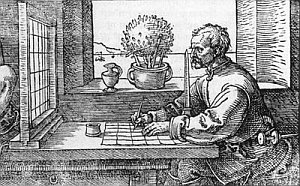
And their existence is part of critic's arguments against the Hockney thesis: many tools have been used in various ways at various times, and there's been little or no shame in acknowledging and documenting it.

To accept Hockney-Falco, you'd have to accept the opposite: that such devices were widespread amongst artists but kept secret or never mentioned. I think Occam's razor suggests that if such devices were commonly used, it wouldn't be so hard to find evidence of it.

Re:Hockney–Falco thesis by greglindahl on Tuesday December 26, 2017 @11:42PM (#16012877)
Those aren't images of the tools that Tim used. And I totally agree that the tools used by Tim aren't found in middens or descriptions or drawings. Occam's Razor does apply, but, it leaves me wondering why The Music Lesson is so great. Or why the Girl with a Pearl Earring is 1:1.
Re:Hockney–Falco thesis by klenwell on Tuesday December 26, 2017 @10:54PM (#16012713)
I was first introduced to Hockney's theory in a New Yorker article from 2000. The full article isn't available online unless you have a subscription but you can find a summary of sorts here:

https://www.newyorker.com/magazine/2000/01/31/the-looking-gl...

It looks like the article preceded publication of Hockney's book and originated at a time when he was still rehearsing and refining his argument.

His main antagonists in the article are the art historians who come off a bit like stuffy reactionaries. I was firmly in Hockney's camp by the time I had finished the article. It was one of those ideas that changed the way I look at the world slightly.

Never read the book. Tim's Vermeer was the coup de grace for me and I was gratified to see Hockney make a cameo in it.

Re:Hockney–Falco thesis by anigbrowl on Tuesday December 26, 2017 @08:09PM (#16012106)
It's a cupser-cool project, but it's sad that it only half-engages with its subject. Tim builds himself a replica of Vermeer's studio and then painstakingly commits a visual record of it to canvas using optical tools.

There's virtually no discussion of the design of Vermeer's paintings, which was elaborate to say the very least. I was so hopeful that time would apply his technique to some other subject, but it stays almost myopically focused on the rendering process.