Now imagine that we found a half-burned-down painter's workshop in the countryside, with a bunch of artifacts. Or a woodcut or drawing of a painter's workshop with these devices in use. Those would be very convincing to a critic. But we don't have those.
Hopefully we will find a workshop somewhere with a bunch of photographic equipment and crack this puzzle.
https://i.pinimg.com/originals/b0/53/42/b053425982ecb933ca4c...

https://www.easy-drawing-lessons.com/images/xpainter-using-a...
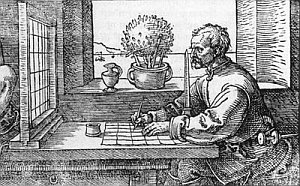
And their existence is part of critic's arguments against the Hockney thesis: many tools have been used in various ways at various times, and there's been little or no shame in acknowledging and documenting it.
To accept Hockney-Falco, you'd have to accept the opposite: that such devices were widespread amongst artists but kept secret or never mentioned. I think Occam's razor suggests that if such devices were commonly used, it wouldn't be so hard to find evidence of it.
It would be awesome an art historian would look at a bunch of paintings for those defects, or if someone could work out how many portraits are 1:1 scale, like Tim's second "Claire with a Pearl Earring" experiment.