1) That's really not a countrywide thing
2) It's not specifically the landlords, it's whoever was already there. A landlord who bought in just recently is not rolling in dough. The people who capture the gains are the people who got in fifty years ago and sold & moved, or the landlords who got in fifty years ago and are still renting the property.
3) But, yes, from the worker's perspective his salary increases will tend to go towards housing/land. This is a natural state in a competitive housing market. He must compete in the market for the space to live so that he can live near his job. The power of the market will continually optimize for those who make the most money (i.e. hypothetically produce the most economic value) to live in the most desirable housing (e.g. the closest to work)
Yes. Silicon Valley's land baron is John Arrillaga, who bought Silicon Valley farmland in the 1960s. He owns about a square kilometer of office space.
This doesn't happen in Germany for instance. Rent in Berlin and Hamburg (1st and 2nd largest cities) is quite reasonable. Reason is economic activity in Germany is quite decentralized.
Edit: Added links
> For homeowners in Chicago, the average increase is 10 percent. https://rebootillinois.com/2017/06/13/big-property-tax-hike-...
> Summary over past couple of decades
https://d2dv7hze646xr.cloudfront.net/wp-content/uploads/2015...
This is how we want it. The three blocks in every direction surrounding a middle school shouldn’t be populated by 80 year old retirees.
Chicago used hike this year to fund pensions
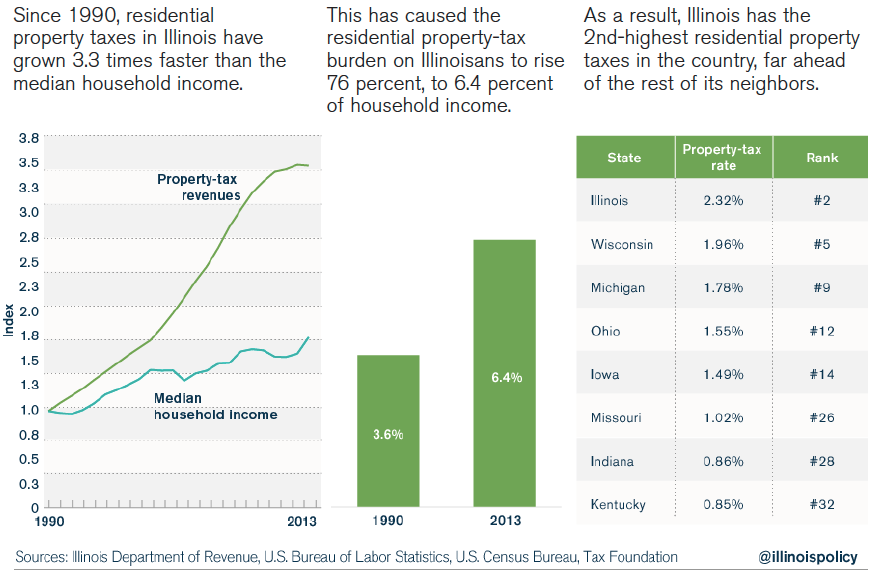
This graph is a good summary
https://d2dv7hze646xr.cloudfront.net/wp-content/uploads/2015...
> Illinoisans’ residential property-tax burden – as a percentage of median household income – has risen 76 percent.
https://www.illinoispolicy.org/reports/growing-out-of-contro...
Other factors should have a bigger effect. For instance if crime halved overnight, the city could reduce its policing budget and lower property taxes, regardless of property value changes.
Housing costs are directly related to the area per person and the location. If people expect to live in much larger flats or houses compared to e.g. the 19th century and in expensive urban areas, they will have to pay the price.
Your comment could only make sense if you believed housing prices were dictated by construction costs. They aren't. Prices are set based on what is the highest price tag sellers are able to force upon the customers. Buyers also wanto to push the value down but sellers, due to the nature of real estate properties and taxes, profit more by simply sitting on their investment and waiting out for someone opening fheir wallet and offering the asking price.
Buying a house has always been the preferred investment. When you make that easier, it's only natural prices will rise.
IMO, the only feasible way to minimize this trend is economic decentralization.
Many people now are spending almost 50% of their pre-tax income on housing, and most of that is the price of land and goes to landlords. It seems that landlords inevitably capture a big chunk of people's salary increases.
Additionally in the US your health insurance is generally tied to your job; even after Obamacare you probably have to work to pay for your monthly insurance.
If housing costs went way down and health insurance were universal, I suspect many people would feel much less need to work so many hours.