We all know what would happen to bus stops, stations, and generally to public places if people on buses actually had anywhere near the density "made possible" by public transport. It just won't work.
While for instance, adding roads in the sky (ie. very long bridges) scales exponentially, for obvious reasons. As does just flying (flying, incidentally, is a lot more efficient than people think). People don't want this, for obvious reasons, but there comes a point in cities where we have no choice. Frankly, cities like depicted in "the fifth element" and "star wars" are the future. Probably more rails, less floating, but the general idea is where we'll be going.
Doesn't even really matter if they have public or private transport. Given how fast public transport upgrades (even when absolutely required by the numbers of people they just refuse to upgrade for decades. Yes. Decades) and how comfortable it is, and add of course the fact that they just don't support the use cases cars enable (some of which, like an elderly or disabled person doing groceries, are absolute requirements) and you get to the point : private transport is far preferable to public transport.
Then how do cities like Singapore, with a population density of nearly 8k people per square km, have far less traffic than pretty much any major US city? They make public transportation work, and if you've ever been there, you'd know it works really well.
Just because western countries haven't figured it out yet doesn't mean that it can't work at all. Public transportation in the US sucks because the US, as a whole, wants it to suck.
Rather, public transportation sucks, so everyone who can afford a car (and some who can't) buy a car and use it, so they don't care very much that public transportation sucks; they instead are annoyed that private transportation sucks and want that to improve (e.g. by having an AI deal with driving). They don't see public transportation as a solution to the problem they experience, even if it would solve the problem that brought them into that situation.
FWIW, I have always relied on public transportation in any western country I have been to and while it could have been better sometimes (e.g. rural bus schedules requiring you to plan around them) I don't think it's too bad either. I don't know how Singapore compares, but usable public transportation is definitely also common elsewhere.
(and let's not forget things like Amazon just don't work unless they exploit delivery men if you do choose to answer this question)
EDIT: I don't really understand the Amazon question. Maybe I didn't understand the original question either.
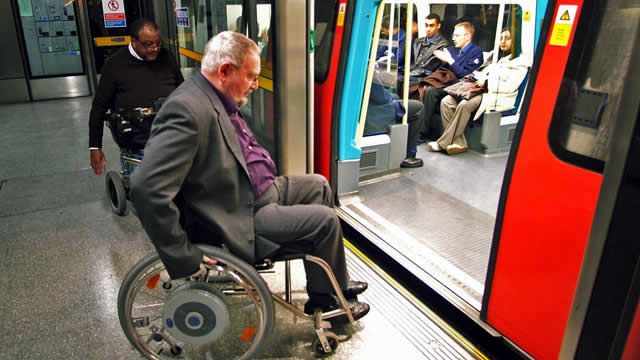
2) public transport is not wheelchair accessible. We have trains from the 70s on the track, and aside from multiple steps and a gap, there are no places for wheelchairs. Buses are a little better, but not really usable either. When push comes to shove, this requires people to lift the wheelchair and put it on the train/bus, then help you on the bus as well. If bystanders don't do this, I guarantee out here the driver won't either. For trains, you are supremely unlikely to find anyone of the public transport companies in the station, and nobody helping wheelchair bound people on the bus. Plus, you never, ever see wheelchairs on the train.
Note that if you look at the videos below you see that in most cases, disabled people need (much) more time to get aboard a vehicle. This is not available in public transport and is available in private cars.
Furthermore, wheelchair users (as visible in the second video) (and obviously only up to a certain level of disability) are not just able to use cars, but are able to carry and move heavy loads using them, like groceries.
So once again, an argument in favor of cars once a good look at reality is added to it.
[1] https://www.youtube.com/watch?v=R0usQ1LksSA
> We have trains from the 70s on the track, and aside from multiple steps and a gap, there are no places for wheelchairs
you’re wrong. The only 1970s train still in widespread use is the HST. These have generally been refitted with wheelchair spaces: it’s in carriage C on a GWR HST, for example.
Besides, HSTs are being either replaced or hugely refurbished (power doors etc.) by 2020 - because really serious accessibility regulations come into force then (RVAR). Entire fleets of 80s trains (Pacers) are being scrapped because of this. The British railways are already good for accessibility, and getting much better.
[1] https://cdn.londonandpartners.com/visit/london-organisations...
[2] http://1.bp.blogspot.com/-1TZlXmiSe3I/UTcdowZY8hI/AAAAAAAAH3...

Dutch train: https://www.seat61.com/images/Russia-austrian-ext.jpg
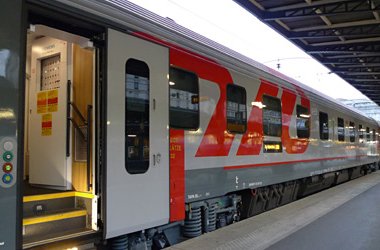
Swiss train: http://citytransport.info/Digi/3253.jpg

British train: https://www.angeltrains.co.uk/Products-Services/Regional-Pas...
Eurostar: http://i.dailymail.co.uk/i/pix/2015/09/14/15/2C4DBFB70000057...

(I've used these Eurostar trains. If you have to get on with a wheelchair ... good luck. It's frankly too hard for perfectly normal people and pretty much all young kids have a lot of trouble)
Oh and as for London buses: https://www.standard.co.uk/news/transport/driver-in-angry-co...
I will generally agree that London is a positive exception. Mostly because everything else in Europe is utterly inaccessible for wheelchair users. Unfortunately, even with that there isn't all that much that is accessible.
Let's just all sanely agree that obviously cars are a lot more wheelchair accessible than public transport, with a few small and limited exceptions. And even within those exceptions, public transport does not provide the services a car can give.
Here in the US, all public transportation is required by law to be wheelchair accessible. Perhaps Europe is different, but that is a decision that they have made, it is not an inherent limitation of public transportation.
Cars are not inherently wheelchair friendly; they must be designed to accommodate them. Trains and buses are exactly the same. Here at least, public transport is much more accessible than private vehicles because all public transportation must be wheelchair accessible, but there is no such requirement for private vehicles.
Netherlands:
http://www.accessibletravelnl.com/blogs/Trains-in-the-Nether...
Switzerland:
https://www.sbb.ch/en/station-services/passengers-with-reduc...
Britain:
http://www.britrail.com/plan-your-trip/passengers-needing-as...
Eurostar:
https://wheelchairtravel.org/review-eurostar-train-london-to...
I especially encourage you to look at the picture of the ramp in the last article. The Eurostar may be difficult to board for normal people, but if someone in a wheelchair calls in advance, they get all the assistance they need.
The article you linked for London buses is just people being inconsiderate and needing to be told to behave. That could have happened just as well with someone blocking a parking lot reserved for disabled people.
So to put it bluntly: I see your articles ... they paint a completely unrealistic picture, and frankly I refuse to believe that things practically work this way.
A lot of details are unspecified. They essentially say "call 3 hours in advance and we'll provide". I called "sorry we don't work at this time, call back during working hours ... blah blah blah", but of course there are (a lot of) trains riding around at the moment. So ... not during weekends ? I hope it's not that bad. Somehow this isn't mentioned on that page. It also seems to be limited to large stations and is not generally available on either all trains or all stations.
I also refuse to believe that this can work for 10-15 wheelchair users on one train. Picturing such a situation raises all sorts of practical issues (for one, I seriously doubt that you can fit more than 5-6 wheelchairs in the biggest NS wheelchair section in a train that I've ever seen) that I'm thinking they just don't deal with.
Just no.
Additionally I'm ignoring the fact that for wheelchair users and other accessibility-challenged users the other problems of the train (such as a potentially large walking distance between the station and your house and/or your actual destination) that cars don't have as much are much worse than for normal people.
I will agree that the trains in Holland are much more usable than the trains in the Bay Area. That's certainly true. But practical for wheelchair users ? No way. Anywhere even remotely as good as having a car ? No way. (but yes, if you're rich (cars are cheaper), and live in inner city of the Hague, they're certainly more practical)
Of course, there's coordination problem here: ceteris paribus car users benefit from other people shifting to public transport, as long as they themselves don't have to switch. This is why it is important to make public transport a genuinely attractive option, and to put a price on the negative externalities caused by private cars, for example by means of congestion charges.
High-density neighborhoods make grocery shopping much easier for everyone. Here in San Francisco, I have one grocery store 1 block away, another grocery store 2 blocks away, and 3 more grocery stores within 5 blocks. I can do all of my grocery shopping on foot, and I can pick up what I need in a small batch on my way home on any arbitrary trip. If I were disabled or elderly I would probably additionally need a cart of some sort, instead of carrying groceries myself.
-Tax cars really highly.
-Have car quotas
-Suppress dissent and in practice a one party system
-Build out public transit
-Pop Density.
-No land for sprawl available.
It has sprawl but it's far less auto-oriented than the US.
Some major factors are: -expressways are almost all tolled -carbuyers are required to demonstrate that they own/rent a parking space, rather than policy than mandates every new housing unit and business have enough parking that demand is more than sated even at zero cost -zoning that allows sufficiently-dense land use such that most residences are within a short walk of a rail station— this station usually has groceries and other necessities nearby, as well as schools within walking distance
Just a wild guess, the "vast majority of your adult life" are the experience you imagine the whole world has, yet they were spent unattached, without children or supporting so much as a cat, never mind children in a rich area of a huge city (and yes, San Francisco counts as huge) ...
Clearly we should design the entire planet around the frustrations extremely rich Californians experience ($100k per year is almost 2 TIMES the median income, and makes you part, as an unattached person, of the top 7% income earners in the US. Let's just stop pretending and point out the obvious: to fix income inequality in the US, these incomes are what needs to be taxed MUCH more, without, of course, providing any more government services for that extra tax for you. You do not need it. Plenty of other people, 93% when not even counting those outside the US, do need it)
Sorry for the derision, but you were doing it to me.
The majority of it was spent attached, with a child, and several years of it taking buggies on public transport.
And no, San Francisco is not huge - San Francisco isn't much bigger than my suburb.
You also seem to think I'm in the US, for no good reason.
So that's wrong on every count.
San Francisco Muni has a daily ridership of 658k. Do you really think it would be better if all of those rides were done via car?
And yet it works perfectly well all around the world.
Besides, is Manhattan not American? The seem to do well (though, of course, they could spend more and improve their neglected since the 70s or so subway).
No one is saying get rid of cars, simply improve traffic by adding mass transit
If I look at paris, it already has a very dense subway system. The main drawback is that it closes between midnight and early morning and that it could be even denser.
Close the roads to cars (except emergencies and buses), promote bikes and electric longboards (along with other transportation systems that are easy to carry under your arm when you are done) and you have a solution for megalopolis.
even though musk might seem short-sighted in his approach, his vision and determination are admirable. let's have more of that, especially in the public transportation space.
(i agree that automated cars is not going to be a panacea, at least not in the next 30 years, but it's an meaningful step forward in transportation tech)
And I'd definitely enjoy owning a car or campervan for hiking/biking trips and other adventures — or paying $.75 a mile for a robocar to pick me up for similar trips.
I just hate the way that nearly all American cities make car ownership mandatory for full citizenship, and American land use laws mean almost all new development is almost purely auto-oriented (this is somewhat less the case in a subset of post-2008 development, but these developments are generally islands of sorta-walkability in an inhumane hellscape of high-speed arterials).
A modest improvement in road throughput from automation is nothing but a short-term solution, and might well make congestion worse because of the reduced time/attention cost of driving— potentially much worse, since people many more people could move into RVs occupying the only free land in coastal California, its roads.
Elon Musk does not look like a smart guy when he rejects what clever outsiders who have been paying attention to these issues for years have to say and by calling them idiots— after all, he supposedly got into rocketry by devouring textbooks, not by getting angry during his commute.
This graphic makes the point about why cars can never be a solution for mass urban mobility better than pretty much anything else: https://i.imgur.com/sCvRIEd.gif