Or in other words, for every man there is a paragraph (in criminal law). If not, one will be invented.
I'm not saying that your quote doesn't have power - it does. But the important aspect of it is that the targets were people the subject knows were being unfairly treated. So yes, if they start locking up homosexuals or Muslims or jews I'll refer to that parable and think "shit - I'd best do something".
As things stand I'm not getting out of bed to help a nazi.
Let's not kid ourselves. If these guys took over, they'd kill people, and they're not shy about admitting it.
It's really a bad slippery slope to start finding new exceptions where censorship is ok. It just shows that you don't understand how free speech works. Until crimes are committed, I don't care if your ideology is universal destruction. You should be left alone.
Second, the slippery slope is a fallacy. Literally. The "slippery slope fallacy" is a textbook fallacy. In this instance, many countries make it illegal to espouse Nazi ideology today, yet Germany and France haven't become dystopian dictatorships.
"If we outlaw gun ownership for the mentally ill, that's a slippery slope to outlawing all firearms."
"If we outlaw same sex marriage, that's a slippery slope to outlawing all marriage."
"If we outlaw cocaine, that's a slippery slope to outlawing beer."
All of those make just as much sense as a slippery slope of outlawing Nazis.
Now we have factions of the public literally asking for censorship. What a field day and marketed success for Government Relations. Is it really 'thought censorship' if the public is asking for the Government's mighty purifying hand of social ideology? Is the government banning Mein Kampf? Is it banning Hitler's transcripts? Is it just flexing its muscles to see if censoring the living, breathing electorate can be made acceptable by the public?
Furthermore, there is nothing in our legal system that bans Nazis. Fuck Nazis, and fuck their ideology, but free speech is more important. The US legal system bans crimes, not thought systems. If you don't like that, then push for constitutional amendments, but as it stands now, they are exercising free speech.
Yes it is. There are lots of things it's already illegal to say.
In fact, banning some forms of speech can increase the freedom of speech on the whole, such as when you suppress the speech of groups threatening violence on minorities, thus keeping them silent and cowed.
And don't forget we are talking about censorship here. We don't have a two-step legal system, i.e. let's censor people who have abstract ideas of murder, then arrest them once they start to carry them out. Either they are planning to murder someone specific or they are not. And until we have evidence that they have murder targets and execution plans, then no action should be taken.
There are a lot of groups that espouse murderous beliefs that are not Nazis. What should we do about them? Plenty of non-Nazis have said online that all muslims should be killed. Should they be censored and/or arrested? If you think that there is something special about Nazism, then you should amend your argument to include the historical significance of Nazism as a reason you think they should be censored, rather than any reductive argument, because there will always be counterexamples in the latter.
where is the line between freedom of speech and let's say, emotional abuse? Should my statement "all jews are pieces of shit and deserve to die" protected by society? If it should be protected by first amendment, when it should stop protecting? When I would yell same statement to jewish kids in on a daily basis? Would it change when I would say "all jews should be exiled to desert" (now it becomes call to action) ? Would it change when same thing would be repeated by 10000 people community?
right now I keep an eye on one local nacionalist community page in facebook, and they are racists and even don't hide it. I find it troubling because the more vocal they will be, the braver members will become and they will normalize that "opinion" and soon it can become actions. I think it's naive to think that extremist groups will only talk about it without any action towards their goals.
https://www.washingtonpost.com/news/volokh-conspiracy/wp/201...
Wait, we're talking about Germans from the 30s and 40s? People that conducted the Holocaust, that invaded most of Europe and some of Russia and many other places?
Maybe we aren't actually talking about literal Nazis. Words matter.
Thought crimes can involve participating in, or contributing to, crimes committed by other people (as you just elaborated).
That's why as a society we ban consumption of child pornography and other types of thought crimes - because they involve harming others.
Nazis aren't about a specific set of "enemies", with Nazism becoming peaceful as soon as those are exterminated, it's more about constantly inventing enemies and sub-distinctions. It's flight from self, nihilism made movement. And even if everybody makes the Hitler salute, you can always rank them by enthusiasm and kill the least enthusiastic 5%. A boot (not a human foot) on a human face, forever, an endlessly restricting noose of hatred, and endless rush of power that doesn't fulfill or give happiness but does destroy and cause anguish. That's (one way to describe) Nazism. That's why you treat even one grain of it very seriously.
And while there is abuse of the word "Nazi" or even "Neo-Nazi", and we could argue a lot about what should be called what, just look at all the possible meanings of common words like "get", and notice how we don't get confused about that most of the time. Worrying more about what something is called than what something is much more constructive.
Though I'm not saying this as an argument to censor anyone.. not because I'm necessarily against it in all cases, but because I don't like the framing of that. When societies breed alienation and isolation, where so many kids are left to their own devices (I didn't aim for that pun but I'll keep it) in an onslaught of vapid or even cynical pandering and product shoveling, Neo-Nazis are just one of the predictable results of that, it's one of the ways a human can break.
It's like Mikado sticks (fasces?), when you let go of a bundle, I can't tell you which one will fall to the top right, but I can pretty much assume some will fall there. And the discussion is kind of futile when it starts history with the still image of a distribution of sticks, and kind of nauseating when it comes with too much self-righteousness. Are we to be applauded for not being Neo-Nazis, or should we be grateful we didn't have such a bad childhood or other reasons to be susceptible to it?
We tend to leave people by the wayside until they're old enough to run amok or join a cult or whatever. By that time it's kind of too late for good results, at that point it's like war with no winners. Of course, that's out of scope for "do I host this or don't I?", but I have to get it off my chest (every time this subject comes up).
While I'm rambling, how about freaky third answers, like host it under the condition they have to have an externally hosted comment system for every article, moderated by the UN? Don't shut them up, but don't allow them to shut up discussion about their "ideas" either. I'm not sure about actual Nazis, but for all sorts of grey areas, that's at least a thought?
Now when it comes to political ideologies, the difference between thought crimes and real-world actions is not so clear. Someone might believe in nazi ideology, vote accordingly, discriminate in their personal or professional lives based on that, but not be any sort of public activist - that's what I'd call a 'thought crime.' It's their right to hold such a position no matter how repulsive I find it.
There is a qualitative difference when someone steps into actively promoting such ideologies (eg waving nazi flags or participating in marches). The thing about nazi ideology is that it's explicitly grounded in the elimination of some people and the subjugation of the rest, and rejection of the democratic principle in favor of leadership from above.
When you get to people who express support for specific policies like genocide, ethnic cleansing, etc. and who organize in pursuit of that objective, it seems to me that they've passed out of the realms of 'thought crime' and into actively threatening demographic groups and their members.
No one is loosely throwing around the term Nazi, these groups self identify as American nazis, carry fucking nazi flags, are on video chanting "jews will not replace us". Also these groups aren't new; they've been around for years technology has just amplified their voice. You don't need The Daily Stormer and its ilk to come to an informed decision on "are Nazis bad" just open a history book.
There's a valuable discussion to be had about whether it makes sense for the internet to not be a public run utility (and thus subject to full 1st amendment protections). But so long as we're leaning on the free market to sort things out, you're on the wrong side of history if Nazis are the cause you want to defend.
This is not rhetorical. In my experience, a lot of people agree with "It's okay to censor Nazis" but virtually no one agrees with "It's okay to censor people that ____ disapproves of", regardless of what fills the blank.
I guess I'd say I'm against censorship not because there's no speech bad enough to censor, but because there's no one trustworthy enough to do the censoring.
Given the strict definition of "waving swastikas and advocating for violence against Jews" works in the scenario at hand, I'm not yet terrifically concerned about over-reach.
The only reason people wear swastikas in America is because of the strong free-speech protection that this thread is discussing the erosion of. If we banned swastikas (like Germany) then people would stop wearing them (like Germany), but we'd still have the same hate speech you're discussing censoring.
> advocating for violence against Jews
That's a pretty broad standard. If a politician supports evicting Israelis from disputed settlements in the West Bank, is that "advocating violence against Jews?" The answer "Yes according to some people, No according to others." So again, I ask: who are you trusting to decide? President Trump? Congress? You personally? To be clear, the offer currently on the table is "some middle-managers at Cloudfare, as directed by the fickle hand of social media."
Someone chanting "death to Jews" and waving Nazi flags leaves little unambiguous. I'm usually a slippery slope fanatic when it comes to free speech, and I still am as it relates to First Amendment concerns, but private companies choosing not to do business with people who self identify as Nazis, wave Nazi flags and chant "death to Jews" while saying that employees of said companies are also Nazis is pretty clearly their right. Courts aren't computers and the law isn't code; judges can understand "they are Nazis."
Meanwhile, the point this article is making is that (in practice, if not in law) the current answer to the question of who decides what to censor is "middle managers at network infrastructure companies, based on what their social media departments suspect might hurt their brand." If you think that's an acceptable answer, great, but I don't think you can go on thinking of yourself as a "slippery slope fanatic when it comes to free speech" in that case.
There isn't. But we don't need an answer, not yet. The justice system is a lazy evaluator. This case has an easy answer--they are Nazis. If someone sued, the ruling would be quick. If the next case is more complex, reality will illuminate the nuances.
Common law systems are complex. They're also de-centralised and empirical. You don't always need a standard ex ante. We have a cultural standard regarding genocide, its advocacy, and Nazis. Existing norms and laws suffice.
(Philosophically, your question is interesting. It's practically irrelevant, though, until a matching case threatens to arise.)
How many or how detailed must threats against others' wellbeing become before you consider them unacceptable?
We weren't talking about promoting genocide, but about threatening and committing violence. If you can't debate with integrity, I'm not interested.
You chose to answer a question that had been addressed to someone else, which you're welcome to do, but it doesn't give you ownership of the conversation as you seem to imagine.
I said "Threats of violence are already illegal.", to which you responded, "Strange, I haven't heard of anyone being arrested for promoting genocide yet".
> Impugning my integrity because the topic of conversation makes you uncomfortable seems like a you problem.
Ha! If I had any doubt about your integrity, I certainly don't now. Feel free to keep trolling, but you'll just be shouting into the void; I'm blocking this thread.
We're not operating in a grey area, one group is waving nazi flags, chanting blood and soil, and killing people; the other isn't. Pretty open and shut.
---- spot the grey area http://a.abcnews.com/images/International/nazi-flag-charlott...
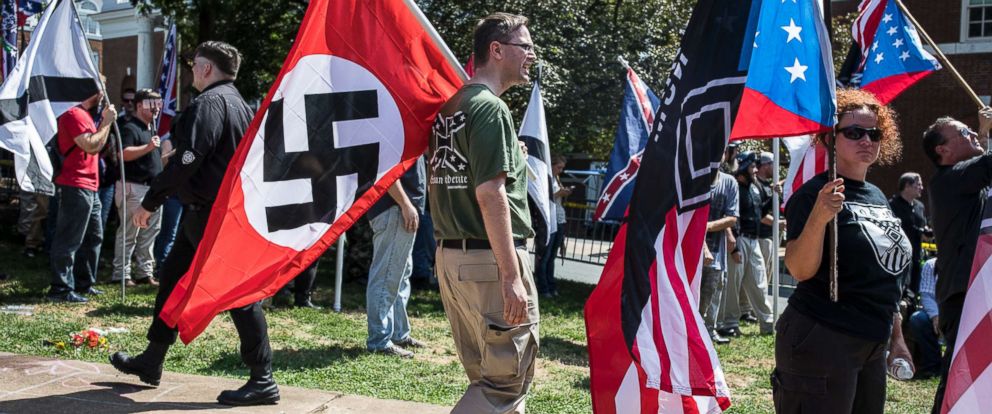
Simply because they have a different point of view.
Or any politician that openly disagree with certain politicians that have been in office for quite some time. It's a known tactic that has been in effect for a long time now. If you find yourself losing a debate, compare your opponent to Hitler.
I love how to the "free speech advocates" genocide is something that you just "disapprove" of. Im pretty sure, baring literally nazis, you can get just about every person on board with "It's ok to censor people that want genocide".
Maybe you're one of the exceptions. But if so, I'd so some introspection about why "we should indiscriminately kill people" deserves the same consideration as "we shouldn't indiscriminately kill people"; because that's the debate.
Well gosh, that sounds simple! Who could possibly argue with that! And of course, quite a large number of Americans believe that legalizing abortion was genocide. So we're all on board with shutting down plannedparenthood.com then, right?
And to think, I thought censorship was a complex issue.
It is important to understand why people feel compelled to identify with Nazism. If we don't understand why something happened, there is nothing we can take away to prevent it in the future. What we have with Daily Stormer is a quite literal database of interactions of people who self identify as Nazis... I'd say deleting it is not the most productive thing we could do with such information.
If you'd like some reading material:
The Rise and Faull of the Third Reich by William L Shirer - the single best historical overview
Anti-Semite and Jew - by Jean-Paul Sartre - an examination of the fundamental dynamic of nazi ideology
The Nazi Conscience by Claudia Koonz - examines the nazi worldview in detail
Kill All Normies by Angela Nagel - examining the intersection of chan culture and far-right ideology
* What we have with Daily Stormer is a quite literal database of interactions of people who self identify as Nazis... I'd say deleting it is not the most productive thing we could do with such information.*
True, but it's not some petri dish that you can keep isolated in a lab, is it? You have to balance the benefit of what you might learn against the costs that their organizing activity imposes on other people.
EDIT: One other important point--who's to say that censoring Nazis is even an effective way to limit the spread of the ideology? It could well galvanize Nazis or push those on the fence over to the wrong side. What are our motives? Are we more interested in limiting the spread of intolerance, or do we want to make sure there are plenty of Nazis to punch?
You mean close to 50% of registered voters. Which are less than 40% of the population who are eligible voters. And that number is probably off too, thanks to voter suppression, disenfranchisement, and gerrymandering of voting districts.
Furthermore, it was the electoral college who decided who the president should be, in many cases going against the popular vote within their state. When you understand how the electoral votes are decided upon, the number of voters who voted for our current president grows even smaller.
In short, it's a relative minority who actually voted for Trump, and all the voters together are in the minority of all eligible citizens who can vote. Why those others didn't vote is up for debate, but I've already mentioned three potential reasons (not counting apathy).
So that other portion of the population that didn't vote - we have no idea how they stand ideologically on political and social issues. But we can certainly say there's a percentage of them who would have voted for Trump, and the ideology that supports him.
Greater than 50% of the population? Not likely. But it isn't a small percentage, either (in fact, it is probably somewhere close to his polling numbers - around 30%).
I hope you realize that's exactly what you're doing.
>No one is loosely throwing around the term Nazi, these groups self identify as American nazis, carry fucking nazi flags, are on video chanting "jews will not replace us".
Yes, there were a handful of those. And there were a whole bunch of other people who're simply tired of being the only ethnic group that's not allowed to advocate for its own interests.
The value of an online community exists within participation from those that visit the website. Anyone that visits can explore the ideology from the perspective of those that believe in it, which is an invaluable tool for education.
What happened in Charlottesville was a moment in american history, no matter which side you fall on. What google, godaddy, and cloudflare are doing is (understandably) limiting community engagement on extremist websites. However by doing that it is also restricting those that want to understand who-what-where-when-why-how from accessing the conversations that occurred, and obviously, they did indeed occur. Now, anybody that wants to explore both sides of the event has to do so by navigating a barrage of news articles which loosely throws around the term "nazi", and a smaller subset of opinion articles which view it as a censorship issue.
It makes the stance of anti-censorship & anti-nazi an impossibly difficult stance to take because these two issues are being viewed as two sides of the same issue. This is not conducive to a proactive internet culture. For the first time in history we have the opportunity to explore opposing political/race ideologies from inception to protest, and instead of using it to learn about human nature and group think, companies are hitting a mute button to win a popularity contest with investors.