To quote Wikipedia a little: "Capitalism, Gramsci suggested, maintained control not just through violence and political and economic coercion, but also ideologically, through a hegemonic culture in which the values of the bourgeoisie became the 'common sense' values of all. Thus a consensus culture developed in which people in the working-class identified their own good with the good of the bourgeoisie, and helped to maintain the status quo rather than revolting."
In his theory any culture C (!Hegemony)>C (Hegemony). When he refers to Hegemonic culture he was talking ato the time about what he called "Fordism" which was the state of the art in enlightened capitalism at the time meaning treating and paying workers well with the workplace working in tandem with the family to re-enforce the traditional family unit.
Gramsci was trying to figure out a way to cause communist revolution at the time and he said that in order to attack Fordism they must get together everyone who is opposed to the dominant culture, including socialists as well as all cultural minorities including civil rights activists, feminists, libertines, homosexuals, radical islamists, some criminals, etc who felt they had some greivance with the dominant culture. It really didn't matter if they were morally justified or not by any philosophy. The point was is that they were opposed to the hegemony and that's all that mattered. Thats because the point of their activity was not to change laws within the current system, but to create discontent to foment a socialist political revolution by any means.
Now these days this strategy has morphed into something that is not a communist plot, but just a general strategy to seize power in organizations. The reason you can't say any culture is better than any other except the hegemonic culture is because it ideologically undermines the means of political revolution that has been picked up by several generations of political opportunists who use this strategy to build and maintain a powerbase.
The "hegemonic" "bourgeoisie", secure in the status quo, sees politics as a game for "opportunists", while the oppressed classes lay aside their differences so they can try build enough power to overthrow the oppression and end their suffering.
http://www.imdb.com/title/tt1013753/quotes/qt1525548 [City Councilman Dan White is complaining that he is having trouble getting re-elected because his base doesn't have any problems that need government intervention, while 'lucky duck' Harvey Milk has the natural support of the gay voter base who want the police to stop murdering them.]
Dan White: You have an issue [gay rights]. Harvey Milk: It's more than an issue. This is our life we're fighting for.
Now, since the hegemony has adapted and added tolerance of homosexuality and disapproval of racial and gender discrimination, the Gramscians are reaching further and further into the discontented for supporters. What's really revitalized the cultural right is when the Gramscians tried to pull in Islamists and non-citizens (the least politically charged name I could come up with for this group) into the coalition of the disaffected. The contradictions in their ideology as a purported means for peaceful change of the existing system just got too huge and many people didn't understand the justification for the movement anymore in terms of a nationalist and progressivist basis. This is similar to how many people lost the plot on the justification for the Iraq war on a nationalist and progressivist basis.
It seems like his interpretation accords entirely with what you're saying.
Wait...you're saying that they pursue their own interests?! How dare they!
The fight a few years ago within the Sierra Club environmental organization between pro and anti-immigration factions was a similar display of the political contradiction's that plague the coalitions of non-hegemonic cultures.
There are still lots of dogmatic and theoretical Marxists of various flavors, but since the financial crisis the left has become more agnostic and pragmatic. Wait until you see the next phase of our cunning plan.
As a parent, I can vouch for the fact it’s difficult to successfully raise children but there are many other possible ways to support the young in becoming net contributors to society because there are clearly many viable cultural alternatives to the nuclear family that could thrive under a system other than the kleptocratic oligarchy of late US neoliberal globalist vulture techno-capitalism.
Wax argues competently but is guilty of a slight lack of imagination as most conservative thinkers are; the preference to move backwards towards a solution based on a mythical idealised point in the past, letting their preferred outcome dull their analysis of their cognitive biases.
Unfortunately shutting down debate seems to be the favoured approach of those who are over-engaged with identity politics at the current time. It’s almost as if the left have been infiltrated by self-loathing alt-right 4chan agent provocateur trolls who are so scared of choice and diversity that they want to speed a “return” to a totalitarian hegemonic monoculture by getting the left to do their work for them. I think that the actual situation is maybe more prosaic, a case of undergraduate courses teaching critical theory without first teaching the fundamentals of critical thinking (with social media is turning the heat up across the board).
It is clear that cultures can be valued against one another only when metrics can be agreed. Wax seems to unsafely assume that there is a consensus on metrics and I think there is a need for more science and philosophy in that area before real progress can be made.
There is such a thing as legitimate authority based on domain knowledge but cultural legitimacy doesn’t seem to quite work in the same way. New generations will experiment with solutions to the problems (and privilege) they are faced with in their time. The debate has become more shrill as the web has accelerated change and revitalised sub-cultures, and conservatism will act, as it always has, as a speed brake on change.
I see this statement as a tautology, or at the very least as an ill posed question.
I think this might be formally incomputable...
I may not be able to compute it. I may not even be able to measure it. But I think that anyone who disagrees is making a far less reasonable claim than I am making, and therefore has the burden of proof.
http://www.iffs.se/media/1906/culturemap_may2015.jpeg
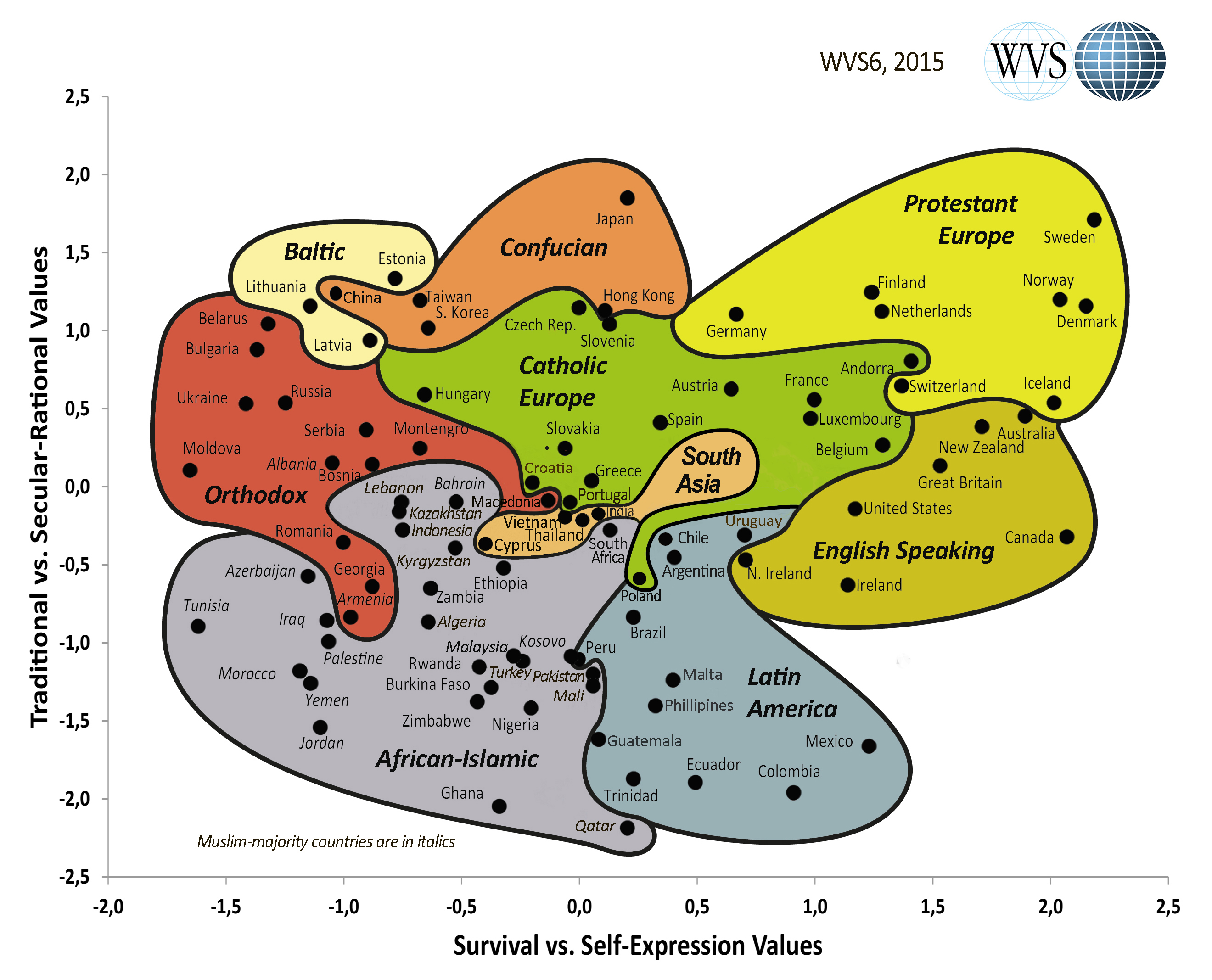
and notice how Anglos, even when separated by oceans for hundreds of years, tend to cluster in one corner of values-space.
I have no idea how to interpret this graph.
(I have no prior knowledge, I just searched)
I agree that it's best to inspect culture from the bottom up rather than the top down. Start with the most granular units. Is anyone here acquainted with the current sociological orthodoxy or is that population mutually exclusive with HN commenters? :)
I think we can rank our current culture as better than that one. If we can rank two culture than it is possible to compare them. That said, we might not be able to conclude if Japanese or German culture today. But we can say that Sudan could be improved by adopting parts of those cultures.
I think saying we cannot rank cultures leaves up hobbled when it comes to critically evaluating them.
> If that's what's actually meant by the phrase 'all cultures are equal' (and I've never heard of anyone presenting it that way) then it should be stated as such because then we can work toward identifying those metrics so we can objectively improve our own culture.
I agree with you about "all cultures are equal" being a hard statement to defend if you take it to literally and nihilistically to mean that there is no objective way to measure good or bad. Not a lot of people are that nihilistic. Most people believe in some degree of moral relativity and some degree of moral absolutism. It's hard.
I don't have a rigorous proof for my feelings towards this, but I feel like the goal shouldn't be to reduce CULTURE down to KPIs. I don't think we should be putting culture on a scale and asking how it effects the economy because I think it's the kind of bad social science that people on HN usually detest. This is a good letter from one of Wax's critics, posted to Heterodox Academy:
https://heterodoxacademy.org/2017/09/03/i-dont-care-if-amy-w...
Additionally, cultures are porous, overlapping aggregations of chaotic, abstract and mutating human created concepts which resist analysis almost by definition.
Assessing a culture based mainly on its economic expediency seems like a startlingly narrow criteria?
Without defending slavery, the obvious problem with your line of reasoning is that most people (implicitly most people alive today) are influenced by C(now). Even if you identify a group of values that are relatively constant across cultures (including bygone cultures), the best you can do is say "culture X better conforms to the majority values than culture Y". It's probably worthwhile to be able to make such a statement, but it's still not an objective statement. If you want to make objective statements about morality and cultures, you need to subscribe to a philosophy of moral absolutism, which is antithetical to liberal tradition prior to a few years ago.
Worse, I'd guess that there is a liberal/conservative element here. Liberals are more likely to believe that C(now) > C(slavery); they are also more likely to believe that all cultures are equal.
I disagree that conservatives are more likely to believe that C(slavery) was better than C(now), but I agree that conservatives are more likely to process an absolute morality position (with liberals it seems more complicated--most would say they support moral relativism, but they seem to view other moral systems as fundamentally racist and thus evil, which can't be far from moral absolutism). This is more an elaboration on your point than a correction, I think.
Why? I can consider something subjectively evil, that is, I can feel a strong moral repulsion without considering that judgment to be universal.
If moral relativism is true, as I believe it is barring evidence showing the opposite, then enforcing one's subjective morality is inevitable. Banning slavery and rape, enforcing property rights, all of that is enforcing subjective morality, since there's no other.
But it's not absolutism if one recognizes that the enforcement is based on subjective opinion and not on intrinsic qualities of the actions being banned.
Essentially, it's might makes right, and I just happen to be lucky that we opponents to slavery are mightier than its advocates.
You may not be defending slavery, but you are suggesting that we cannot make a definitive statement about whether slavery is good or bad. If we can't do that, then what's the point of practical discussion about the direction of our civilization?
I do believe that the concept of tolerance can go too far, and that simply tolerating intolerant people can actually give you a worse outcome than censoring them. But I'm afraid that the left (of which I consider myself a part) goes too far sometimes. It's taboo to even try to discuss some topics, and people who don't understand and are just trying to learn get slapped down. That's not helping.
One concern I have is that the left is arguing that it should be okay to punch intolerant people ("what's wrong with punching Nazis?"), but they are also happy to use "intolerant" to describe pretty much anyone with whom they disagree (the Christakis/Yale incident and the Google Memo fiasco come to mind, but I see this all over). Anyone who isn't convinced about theories of structural racism or discrimination as the root cause of all disparities are increasingly called intolerant (to your point about people getting slapped down), and it seems like only a shallow victory for liberal thought (people are "accepting" these theories out of fear, and will probably vocally challenge them again when the fear is removed). The left should do the hard work of persuading, and if they fail to persuade huge swaths of the population, perhaps they should step back and examine their theories instead of taking it as evidence that the country is indeed full of Nazis (because only Nazis would disagree, right?)
Besides being concerned about abusing a hypothetical "right to punch Nazis", I'm equally concerned that suppressing hate is more likely to have the reverse effect (which probably best explains the uptick we're seeing now, though I can't prove it). It seems like the left had a really good system several years ago, which was to challenge bigoted ideas in open debate. It may not have completely rooted out hate, but that could be because it wasn't practices long enough or well enough or perhaps there is simply some small percent of people who are unreachable with reasoned debate and we reached everyone else (we seem to have done a good job of making these people insignificant, prior to the last couple of years).
For example, what is the best color? Many people have strong color preferences, but the question doesn't admit of a single objective answer.
Unsure of why I'm getting downvotes.. Are people completely unaware of the fact that some people enjoy pain?
You can also examine things from other perspectives.
Darwinian, perhaps: does enjoying pain give any kind of evolutionary advantage? Maybe in a few niche areas, but overall, no, since pain is a way for our brains to signal damage, or future damage if we keep doing what we're doing. Ignoring pain up to a certain threshold can be useful, but enjoying pain to your detriment is not.
Or maybe just economic: does enjoying pain give any kind of economic advantages?
And so on...
I think it's important to acknowledge that there are no absolutes when it comes to opinion, but sometimes you just have to observe near-unanimity and go with it.
Is American culture (a loaded term because American culture is the product of numerous sub-cultures) better than all other cultures because of our economic strength? If not, then what are the objective measures that define a "good" culture.
I'm very glad slavery doesn't exist, because I value equality and freedom. Yet still, I'd ask who is the authority that determines that one culture is better than another because they hold that value?
Europeans via too many systems to name here (e.g. colonizing much of the world, forcing religion on indigenous people, slavery, apartheid, etc.) imposed their cultural values on the world and then held them up as the best.
Ultimately, it's not right to conflate what you believe with what is objectively good. It all depends what your solving for (e.g. profit, equality, harmony, etc.)
There are some tools for objectively judging morality aka "good and bad". One is the principle of universality. So an outcome is moral if you can reasonably state that you would be equally happy to be on either side of the table. Slavery generally fails this test, since most people would prefer not to be slaves. Virtually everyone on either side of the slavery divide (slave/free) valued freedom, some of them just didn't value the freedom of other people.
Arguably slavery never went away, it’s just that the slavery franchise was disguised/rebranded and then extended as social mobility was slowly rolled back.
I think it went away. Capitalism doesn't force anyone to work, you may choose not to participate in the labour market and be homeless.
[1]: There's several good texts exploring how people may have thought at various times in history (because it's all speculation, of course), but one I enjoyed was A Time Travelers Guide to Medieval England.
The tool you mentioned makes a lot of sense for issues that have a clear preference e.g. slavery or not, but I suspect it would show cracks if we start looking at more subjective issues (which I imagine dominate nowadays).
Also, it's not true that a moral relativist must have no values. One can have values while believing they are not objective, but closer to preferences held very strongly.
I'm still completely opposed to slavery and willing to fight it, by force if necessary.
Is that dystopic?
To play the devil's advocate (since I don't agree that all cultures are equal), three answer:
1) Mere preference/taste.
2) Who said "change is required"?
3) Within a culture we might have criteria to stand as impetus for change/legislation etc inside the culture. So the statement just means that we can't use them to judge another's culture but only our own.
1. All cultures are equal in the sense that they are equally as good. 2. There is no way to compare the merits of any two cultures.
(1) is a claim that attributes equal merit to each culture. It is then necessary to establish what exactly these merits are.
(2) is a claim that does not per se exclude the possibility of there being a matter of fact about which culture is superior in which ways w.r.t. other cultures. It denies the possibility of establishing what the fact of the matter is.
(1) admits only two possible presuppositions. Either (a) all cultures are equal because the good they impart onto individuals and societies is ultimately the same and thus differences are merely cosmetic, or (b) cultures are not a good (that is, neutral or inert w.r.t. the good).
(2) admits two possibilities as well. Either (a) our ability to know is limited or impaired or (b) we cannot know because there is nothing to know, i.e., (1b).
I think focusing on (1) in this context is a waste of time because clearly no one in this context actually believes it. Protests have a motive and motives only make sense w.r.t. to some end. As you point out, what's the impetus when change produces no change in the good? Protesters and revolutionaries may hold incoherent and confused beliefs, they may have ulterior motives, they may be wrong, but ultimately there is a belief that what is now is evil and what they aim at is better.
Ultimately, to be able to judge the merits of any culture requires (at least) a sound philosophical anthropology. You need to understand the nature of man to know what he requires to flourish. Only then can you judge whether, in what ways and to what degree a culture enables that flourishing.
Not to split hairs, but you were the one who phrased it like that.
That is, by the act of making the argument, they refute the argument they are making.
Not necessarily. There is a system of logic where a double negation doesn't yield the same result. (e.g. if A = True, then !A == false, but !!A == true is not necessarily true)
#Pedantic #ImProbablyWrong
So let's accept the statement 'all cultures are equal' at face value: all cultures are equal and therefore there exists no metric for measuring 'goodness' or 'effectiveness.' If C(now) captures my current cultural state and C(future) captures my future cultural state and we're saying both of these states are equal - because all cultures are equal - then where's the impetus for any new legislation? Where's the drive for change?
In the United States our past culture included slavery, which we'll call C(slavery). Are we really saying C(slavery) == C(now)? I bet most people would claim C(now) > C(slavery) and if so should be suspect of any claim that all cultures are equal.
This isn't a rigorous proof, but I do think it calls into question the notion that all cultures are equal. But maybe that's not what the phrase actually means: maybe what they really intend to say is we've yet to identify unbiased metrics by which we can use to measure cultures and thus correlate them. Presumably most people would bias the metric in such a manner that their culture turned out to be the best. If that's what's actually meant by the phrase 'all cultures are equal' (and I've never heard of anyone presenting it that way) then it should be stated as such because then we can work toward identifying those metrics so we can objectively improve our own culture.