I was not able to answer that question right away, and their hint to draw it helped a lot. I did not end up getting accepted.
I don't think after playing 20 or so levels I was much smarter for it. It turned out to be a bunch of rules that were extremely limited. You do begin to appreciate trig much more.
If you are being given a geometry subject test and are prepared for it, this is fair game. If the question is just given out of the blue as a brain teaser, then no, the university is not mining useful signals at all.
Either they can't be gamed, or they select for people who can at least be bothered to do the work to game them.
Which is par for the course for an educational institution (and a business one could argue).
Or you can easily derive the radius if you remember that a meter was initially defined as 1/10,000,000 of the distance from the equator to the North Pole. So you can easily calculate the Earth's circumference, and from there the radius: 10,000,000 * 4 / 1000 / 3.1416 / 2 = 6366 km.
Wikipedia gives 6371 km as the mean radius.
Perhaps it's multiple choice.
  A.  Dreadfully sorry, but I'm afraid I haven't memorized the circumference of Earth.
  B.  What do you mean?  Over the poles or 'round the equator?
  C.  Is that 10 km above at all points on the rope, or just one?
  D.  What's the rope made of?  Jute?  Sisal?  Nylon?  How far apart are the supports?  Young's modulus...
E. I don't know about that, but I have inherited a rather large quantity of string in 3-inch lengths...2 x Pi x Cat would levitate the rope by the height of the cat along the entire circumference of the Earth, allowing a billion cats to go under it simultaneously.
You could even make do with no additional rope if you're allowed to take advantage of terrain.
Assuming a 0.3 meter high cat, you only need ~0.12mm of extra rope (about the width of two sheets of paper) to be able to pull it up at a point and let the cat through.
https://upload.wikimedia.org/wikipedia/commons/2/21/Geometri...
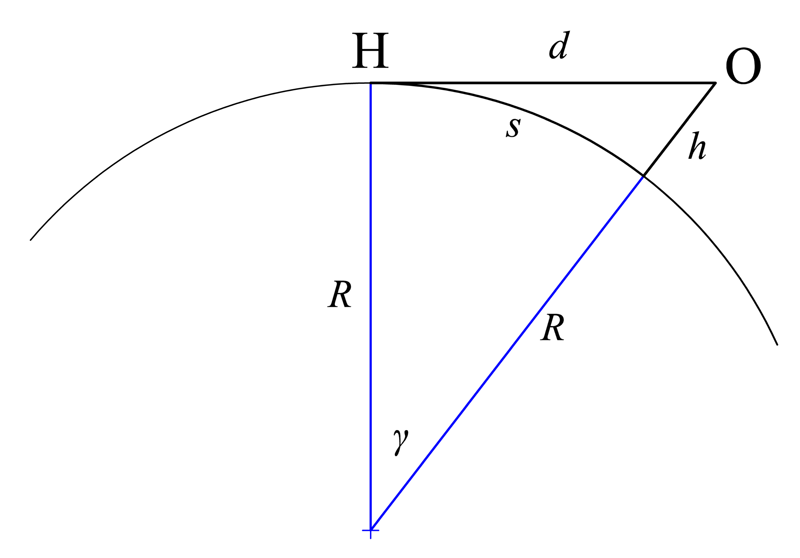
R ≈ 6.4E6
h = 0.3
d = √(2Rh + h²) ≈ 2.0E3
γ ≈ sin γ = d/(R + h) ≈ 3.1E-4
extra rope length = 2 × (d − γR) = 2R × (tan γ − γ) ≈ 2R × γ³/3 ≈ 0.13E-3

If kovek's question was like the first image there, it'd be a simple radius/circumference calculation (2 * pi * 5km). But it sounds like the second image to me - which makes it into more of a horizon line problem.
(I'm assuming all cats are shorter than all dogs.)
My interpretation is that the rope is pulled taut to a height of 10 km at a single point, so that it runs in a straight line to the horizon in either direction and lays on the ground the rest of the way; this is also relevant to the question of longest line of sight from a given height.
So yes, you could supply the answer in terms of r radius, but you do need to know the radius unless I'm missing something obvious.
as its not a list of just the highest peaks in the world
longest sightlines also depend on the surrounding topography that blocks or doesn't block a sightline
this seems to account for the numerous Spanish entries on the list, where the large Spanish plain with high peaks on either side, enables you to see from 1 peak to the other, w/o anything on the plain blocking your view
Also it shows that simply being tall (airplanes go higher than Everest) doesn't get you on the list. The second paragraph puts an upper bound on sight lines between two mountains of a given size. The longest sight lines are pretty close to that limit. And it gives a simple experiment that anyone can carry out from an airplane which will let you see the curvature of the Earth.
It is meant to show how to calculate the position of the horizon on a smooth planet. Obviously your line of sight typically includes tall things beyond the horizon. However this calculation lets you know both how far away your horizon is, and how far beyond that a tall object could be seen if nothing else was in the way. Which puts an upper limit on how far away it can be.
A little bit of elementary geometry gives you a lot more than I expected it would the first time I amused myself by figuring the calculation.
Actually finding those points requires a lot more work, which this list does.
Or ask him not be a dumbass.
What you do is put up $10000 of your money against $1000 of his (10 to 1! You can't lose!), on a bet where the geographical mathematics ensures that you are 100% guaranteed to win. Or something--anything--that can demonstrate with real tangible consequences how being intentionally stupid can hurt you and those around you.
Build two identical UAVs, and run a race between two distant cities. One UAV follows a great circle. The other follows a rhumb line. Discounting adverse weather, the great circle route will win, every time.
The connection between height and distance that this shows is why old ships used to have a crows nest. I love that connection, and you know how to do the calculation for why it matters. But proving that it is right is harder, particularly if you don't live near a large body of water.
With a bit more trig and a map you should be able to figure out the angle above the horizontal that a mountain somewhere in the visible distance should be. That angle should not be the same as it would be if it was flat. Verify it. Go driving somewhere else, verify it again using the same mountain.
But honestly, I'm personally most convinced by the fact that a phone call to someone in a different time zone makes it easy to verify that you're pointing different directions relative to the Sun.
As much as people like to point to things like eclipses, that relies on knowledge that you cannot verify yourself. I prefer verifications that you can duplicate with direct observation, without relying on outside experts. Because flat Earthers do not trust experts.
The Earth is roughly 6370 km which is not far from 6400, so if your eyes are 2m = 0.002 km up then the horizon is about sqrt(264000.002) = sqrt(25.8) km away, which is roughly 5 km or a bit over 3 miles.
If you apply this to a 6 km tall mountain, the horizon is about sqrt(263706) km away which is about 276.5 km. So something of the same height at the opposite end of the horizon would be 553 km away. So the top distance of 538 km is pretty close to the maximum that we would expect.
What about an airplane? An airplane flies about 11 km up. So it can see around 375 km. If you work it out, that puts the horizon about 3.37 degrees below horizontal. This isn't much, but if you take a plumb line and a right angle on an commercial flight, it is enough to actually see that the horizon is below horizontal.