The answer to the first interpretation is considerably less than twice the height of the cat, and I think it's an interesting result as well:
Assuming a 0.3 meter high cat, you only need ~0.12mm of extra rope (about the width of two sheets of paper) to be able to pull it up at a point and let the cat through.
Here's the calculation:
https://upload.wikimedia.org/wikipedia/commons/2/21/Geometri...
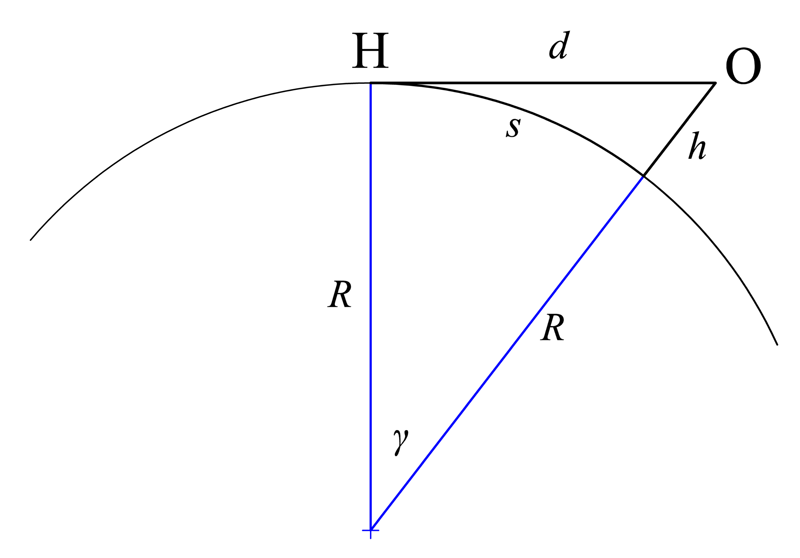
R ≈ 6.4E6
h = 0.3
d = √(2Rh + h²) ≈ 2.0E3
γ ≈ sin γ = d/(R + h) ≈ 3.1E-4
extra rope length = 2 × (d − γR) = 2R × (tan γ − γ) ≈ 2R × γ³/3 ≈ 0.13E-3
Re:Longest Lines of Sight on Earth
by davidmanescu on Thursday July 27, 2017 @05:41AM
(#14863806)
Follow-up question - after extending the rope by 0.12mm and pulling it up to allow the cat to pass under it, how far away are each of the two points where the rope lifts off the ground?
As the article explains, these points are about sqrt(2Rh) = sqrt(2 x 6400km x 0.3m) = sqrt(3840000m^2) ~ 1.96km away from the cat.
Re:Longest Lines of Sight on Earth
by davidmanescu on Thursday July 27, 2017 @06:30AM
(#14864023)
Did a back of the envelope trigonometry calculation as an approximation, seems to check out :)
Haven't done any calculations but I would guess half of the Earth circumference? because if you want to minimize the length of the rope then you have to maximize distance between those two points.
Re:Longest Lines of Sight on Earth
by mannykannot on Thursday July 27, 2017 @09:53AM
(#14865230)
That would be the same as the 'how far away is the horizon' calculation at the top of this thread, right? (assuming weightless rope.)
2 x Pi x Cat would levitate the rope by the height of the cat along the entire circumference of the Earth, allowing a billion cats to go under it simultaneously.
You could even make do with no additional rope if you're allowed to take advantage of terrain.