I miss them a lot and appreciate the effort here, but don't forget the visual model for data manipulation wasn't invented here but was testsd refined and proved functional by previous existing services
I work for a startup that builds a dataflow app platform that fits that description nicely. We support gathering data from databases, files, APIs, etc., full graph-based flow control, strong .NET types on everything, tons of premade boxes for common operations, and support for C#/Python/R/F#/VB for custom data manipulation. Here's a quick example dataflow: http://blog.composableanalytics.com/2016/09/25/querying-data...
True, I learned about it when it was already dead, but thought the goal was similar to the stuff Zapier offers and I would really like to try it. Not to automate stuff, but to checkout the visual editor.
We also have code/scripting steps -- https://zapier.com/help/code/ or https://zapier.com/help/code-python/.
I just posted it on Show HN https://news.ycombinator.com/item?id=14469734 or the direct link https://webmatr.com
Yahoo Pipes didn't really offer that, or any anyonymous stdin/stdout. So huge graphs were necessary for complex problems.
But Yahoo Pipes did have submodules. You could have one of your pipes as a block in another pipe (I'm planning on supporting that at a later stage). And it had userinput that could get assigned as additional input to blocks in a pipe (for that I don't have a mental model yet).
OTOH unix-style pipes (also used in jq), shpuld be even more limited, being only a tree. They can get too complex, and then you use files as a way to implement modules (in a sense). So pipes have their place.
It is, which is why basically all graphical modelling techniques used for system analysis use it. An executable diagram system that doesn't leverage the experience of system analysis diagrams seems somewhat poorly considered.

All of our integrations can be converted into a API with a click of a button too.
[0] I suppose Rhombi symbolize choice. But where are the branches? What if "Already Done" is true? Or does the else-branch enforce implicit fail-state somehow?
[1] What's the difference between parallelograms and squares?
[2] What's the scope of the "For Each Issue"?
[3] Why is the second output of "Copy Webhook" named ("output1"), but not the others? Are they implicit default output (maybe "output0")?
[4] What happens with longer pipelines? Do you wrap or have a scrollbar?
Furthermore the size of the modules have same size, so one gets into rendering issues (e.g. the names of some nodes don't fit the "boxes"). Sorry, I didn't want to sound harsh, I just think that visual programming is not automatically simpler, just because it doesn't use text (at least directly - one has also to name "modules"). You also don't use the "free-canvas" in its extreme form I described (where you can rearrange everything), as you've e.g. implicit edges between nodes, which is a good idea probably, as users get a feeling about the complexity of pipelines by measuring their length (which would not work if there are different lengths for edges).
[1] They denote different categories - parallelogram = READ (i.e fetch data from somewhere), square = Transform (modify existing data)
[2] For Each Issue - for each object in the specific, targeted array of incoming JSON object... (basically split the array chosen)
[3] Correct
[4] You can adjust the rotation of each output, so it could snake around. You also can drag the output of one to the input of another that are not side-by-side and it will mark them as connected, so you have layout in any way. Finally, you could split up into separate pipelines and use another Snap to tie them together.
I don't think you are being harsh - I'm not sure there is any way for a visual programming language to be both powerful enough to permit massive customizations and concise enough to be immediately readable. Some level of interpretation has to be done.
[1] https://cycling74.com/products/max/
[2] https://images-na.ssl-images-amazon.com/images/G/01/software...

It's great at getting out of your way and letting you focus on the results. It's definitely not a typical programming language.
It's great for integrating off the shelf stuff from any major test equipment company. Flow a couple lines and boxes and you've got a PID circuit. Add a few more and you've got a real time oscilloscope. Add a few more and you have data logging. At some point you need to sit down and restructure to get it maintainable, but people who are good with it design it well from the start.
It fits the test bench and small/mid-size experiment system very well.
I believe so.
Furthermore high-level languages with syntax-highlighting (think Haskell, Python, Elm, etc.) in state-of-the-art text editors are in a better position than the "free-canvas" node-edge editors to provide the base for such a widely used language.
Blockly goes into the right direction, but has a childish touch and I do not think the keywords should have a background with padding.
"set", "repeat", "do"? What?
http://www-sldnt.slac.stanford.edu/hepvis/Papers/Web/9/x1602...
My sister had rocked up fairly homeless the week before, we put a solid 36 hours on CosmoWorlds and my sister ended up in an awesome career thanks to what was on that one floppy disk - VRML.
The ambition of Cosmo Worlds was something else, we ended up with a flat web instead.
I thank you sir for Cosmo Worlds!!!
The general-purpose ones did pretty bad (at least I don't know of any complex system tools - say kernels - implemented in them), but there are some niches were some people seem to like them.
  - LabVIEW for control system prototyping
  - Shader-Languages for image processing (games via Unreal Engine and rendering pipelines like Blender)
  - Model-Editors for simulations and in engineering
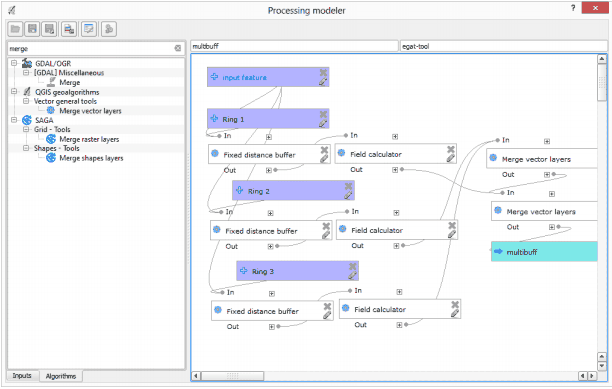
It makes sense that domain-specific ones do better, as they don't have to provide tools for stuff, which is uncommon. It is also easier to implement fold-like structures (say function f: A -> B) that process data with clear input and output than programs that do more IO (say f: A -> IO B). If you do complex IO, you have to introduce some concept of order and time in your system and it is not clear how to do this via the graph approach (example: while-loop), or just can be misinterpreted (edges/connections may symbolize ordering on one hand and data-flow on the other hand).
Assuming one should be able to program general-purpose systems (like all the tools we love: operating systems, databases, interpreters, web-servises, etc.), the solution might be not trivial, but I suppose it is more like the interactive notebooks than the graph approach.
Furthermore I think it makes sense to always have a semantically identically text-based language, as this just makes tooling simpler.
Are you saying people don't use "I've" in spoken language? Because it see it regularly, "I've never" is even a drinking game.
https://en.wiktionary.org/wiki/have#Verb
My impression is that standard American English only contracts the auxiliary verb ("I've biked up Mount Tamalpais") and not the possession verb (?"I've a pair of prescription sunglasses"). Hence "I've been diagnosed with bronchitis" (auxiliary) but not ?"I've a case of bronchitis" (possession).
However, I think this rule is different in Commonwealth English, so we might just be witnessing a difference in English varieties.
Having said that, commonly I wouldn't say, "I've a case of bronchitis," rather just "I've bronchitis." It feels more natural to say "I have a case of bronchitis." However, this may just be personal preference.
This does not mean that text is the only way to implement programs (and even if you connect nodes, you're still programming), but maybe a good local optimum is in-between, e.g. interactive shells like Jupyter's Notebook and the Mathematica interface. I know there is LabView, the Blender-Editor and AFAIK some Unreal-Engine tool that uses this model, but bigger programs seem really incomprehensible to me.
It's always easy to show-case 5 programs in these node-&-edge editors, but I do not think it is the best approach for visual languages, as one should not under-estimate the layout problems and how to represent information in boxes.
So, I am all for new ideas in visual programming, but I am not sure if the "free canvas" approach works.