From an environmental perspective, it is better to use surface area which is already built up than pristine natural desert land. The house itself already imposes an ecological cost. A solar roof adds around zero to that cost.
I've heard the stat thrown about that 50% of energy generated is lost to transmission. If that's true then there's efficiency to generation at home.
It probably doesn't figure into anyone's decision but decentralized generation leads to a more resilient "grid". As it stands we are potentially vulnerable to warfare/terrorism attacks on the grid.
Tesla the consumer brand is about being smarter than your neighbor. Wow you have a car which is electric yet more performant than my car? Wow you have solar panels and the aesthetic is better than mine? Wow you're completely off the grid? So much material for dinner parties. In short there is a good value of cool factor for amount of work. And there are people who break the market logic and bake their own bread, plant their own vegetables.
You're right that power from a solar farm will be an option somebody but for many people it's not an option yet. This is something you can do in the near term.
It's more like 5%. The larger numbers you're thinking of might be including generation losses. Coal plants are around 33% efficient in terms of converting the fuel's energy into electricity. Natural gas is better, but still under 50%.
Home electricity costs around $0.15/kWh, while power plants sell electricity to the grid for around $0.03/kWh. The difference pays for installing and maintaining the grid and local distribution wires to your home. Depending where you are (I live in a forest, where a tree falls on the power lines a few times a year and they have to send out guys in a bucket truck to fix it) it's expensive.
Because of net metering, home solar panels effectively get paid the home rate. It's kind of unfair. If you have enough solar panels to zero out your home bill, you're getting something valuable (reliable nighttime power) that cost money (to install and maintain the wires) for nothing. But that's the system we have.
Sometime before we hit 100% solar power, the system will have to change.
Wth is wrong with the USA? It seems like you're getting screwed over everything. 10x electricity, 100x healthcare and education - is US market really just a bunch of colluding monopolies?
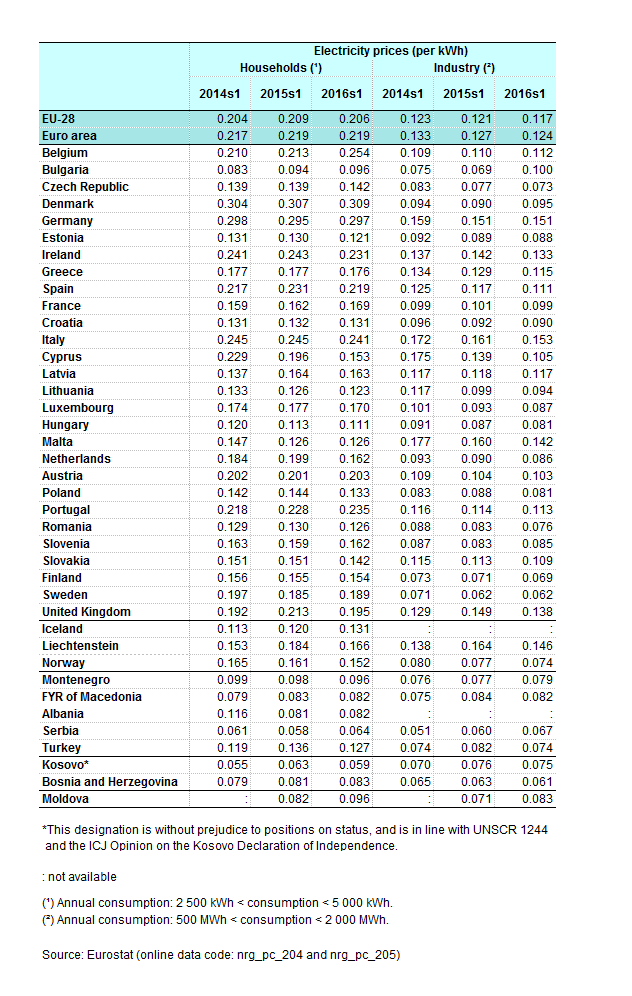
http://ec.europa.eu/eurostat/statistics-explained/index.php/...
Here's a chart of energy prices on a Prague energy exchange, currently it's about 30 EUR/MWh = 0.032 USD/kWh. I pay a bit more than that (incl. distribution) with a good tarif (low cost broker), but even conservative people I know who don't renegotiate energy prices get about 0.06 USD/kWh incl. all distribution fees.
That said, electric distribution network in our country is probably underinvested. Is the premium you're paying in US based on distribution network cost?
The economic calculation for one of these roofs probably looks very different depending on where you live.
If you live downhill from work, however, then the only way to use that to your advantage would be to work an evening / night shift.
Put a solar roof on a home and it is the homeowner's responsibility to maintain it.
* on site transmission cost is $0 for power used
* the effect of a man-made or natural disaster in one location is contained: throwing a breaker for maintenance at the Arizona border doesn't shutdown power across an entire region: https://en.wikipedia.org/wiki/2011_Southwest_blackout.
I live in western WA and I had a view to get a solar installation a couple of years ago, because despite our climate and sunshine conditions - and already having the greenest (hydroelectric and wind, mostly) and cheapest electricity in the country ($0.11/kWh) - there was a generous feed-in tariff - which meant my planned $40,000 investment in a solar system would pay itself off after 10-15 years, however in late 2015 the state decided to put an end to that and if I had the system built now it would take 25+ years to pay for itself, at which point the system's warranty would be expiring and I'd need to shell out more money to replace it.
You don't buy cold air piped from across the city, you make it locally. Why?
In Sweden it is quite common to pipe hot air (and to a lesser extent cold air) across the city rather than each house making it locally. Once of have the basic infrastructure in place it is a lot cheaper and more efficient.
No, they don't. You still need almost the entire national power grid to supply your home with night-time electricity... That infrastructure won't be going anywhere.
An even worse outcome will be every home having local power storage infrastructure. Tens, or hundreds of thousands of dollars for a power wall, or a compressed air storage system is much more expensive then maintaining the grid.
"Just buy a $15,000 PowerWall, which you will need to replace every 10 years" is, compared to grid electricity, incredibly wasteful.
There's a reason why customers and users overwhelmingly prefer centralization, even if its harmful for them in the long-term. It's cheaper, and people would prefer it to be someone elses' problem.
There's also the matter that if, say, 40% of the population disconnects itself from the grid, that doesn't mean that the cost of maintaining that infrastructure will drop by 60%. Someone will have to pay for it.
You are right that it does not yet work out, it's $0.17/kWh for the powerwall (assuming you fully charge/discharge it each night) + cost for panels. Given that grid-disconnected users would want some buffer, an off-grid system probably works out to ~$0.40/kWh all in for battery-stored electricity
You could save a big chunk of this by some habit changes, most of the cost comes from the batteries, so scheduling energy intensive activities to run during the day reduces your cost for them to $0.10/kWh or so.
Honestly I am surprised how close these numbers are. I initially was sure the grid would survive in cities, but now I am not so sure. In 10 years these numbers will likely be half what they are now (batteries in particular will be way cheaper). It might all be enough to kill the grid in many places.
Photovoltaics can¹ change the other side of the equation² so that locally generating it would be better.
1 - But it's not certain by any means. The current biggest obstacle is battery storage and maintenance.
2 - losses and infrastructure costs vs. gains from scale.
Additional solar power absorbs sunlight and produces electricity. One benefit is that the house under it is cooler and needs less air conditioning as a result.
Also balancing the energy infrastructure for a state/country with significant solar/wind sources adds significant new complexity for the power grid. It's definitely most efficient to keep your homes power use off the grid as much as possible.
Additionally at least in California peak power use is air conditioning related and follows a power use curve pretty similar to solar production. So the hottest days/times have the most power generation (there's some lag). This allows the state to minimize power production only for those worst case days in late summer, which is the most expensive (power, cost, and environmental impact) power plant.
Power plants can be quite efficient if utilized 100%, but the difference between minimum power and maximum power needs can create huge inefficiencies where solar can help.
I'd also argue that adding distributed power use makes the grid overall much more robust. Earthquakes, major storms, attacks against infrastructure, etc are all less of an issue if a decent fraction of houses produce most of the power you need.
Rooftop solar gives you a way to be less dependent on the local utility for something you need to live a modern lifestyle. If you live somewhere where electric rates are high or power outages are common or most of the electricity comes from burning coal, you can now work around that by generating electricity locally.
It's sort of like storing a file locally versus storing it "in the cloud". Both approaches will probably work, but you might choose one or the other based on some weighted combination of reliability concerns, privacy concerns, available bandwidth, and whether you want to share the file across multiple computers or multiple users.
I'll spare you the anecdata, but the choice of bread and vegetables are specifically poor support structures on which to build your argument for centralization. They can (in some cases) be made more cheaply, but the quality suffers substantially.
Electricity, while lacking the strongly subjective "quality" dimensions of food, still suffers from long-range distribution. Transmission and stepping losses (as well as transit costs) are a large portion of why we don't have just one enormous generation center for the world. There's obviously a balance, but for the cost of land and the added loss of converting solar's DC to AC, local generation gets a little more advantage.
Why they expect people to make electricity at their homes? You can buy a little piece of land in a dessert, put solar panels there and distribute the electricity to other places. And you don't have to climb on any roof during the installation or the maintenance.
It is not profitable today in a free market to bake your own bread or to plant your own vegetables. Because if it is done in a large scale by professionals, it can be made much cheaper while keeping the good quality. So I don't understand, how the home-made electricity could economically compete with the professional energy farms of the future.