Setting that aside, emissions per GDP is an interesting and useful statistic, but it doesn't paint a complete picture. If you were to entirely eliminate the top three highest emissions per GDP countries from your list, you will have done nothing to combat climate change. If you sort that list by total emissions, the US ranks #2 a short distance behind China. China is actually fifth from the very bottom of that list.
It's a complex situation and will have an impact on the global economy no matter what. We can decide to do something now and take short-term losses to prevent massive devastation in the long term from doing nothing.
> I am really not impressed by any sides efforts to combat global warming.
Hmm. What would impress you? I honestly think climate change is the most important issue in the world right now, and I would love to know what we can do to get you on our side.
Climate change is a shibboleth and people largely appear to recognize it as such. For example, in Ware County, GA (to pick somewhere at random), 70% of folks voted for Trump but 2/3 answered "yes" to "global warming is happening."
> I honestly think climate change is the most important issue in the world right now, and I would love to know what we can do to get you on our side.
Supporting diplomatic efforts to combat climate change are virtue signaling. I'm an environmentalist and I agree that climate change is probably an impending disaster. But diplomats aren't going to fix it. The Kyoto protocol, for example, accomplished almost nothing: http://www.circularecology.com/news/the-kyoto-protocol-clima.... The only thing that can save us (if we can be saved) is technological breakthrough, and the prospects of that happening won't change based on U.S. participation in international climate change protocols.
I think change absolutely has to come from governments and thus diplomats. Are corporations going to cooperate at a global scale to fix this with no regard for short term profits? Corporations like Exxon knew about climate change 40 years ago. Personally I think we should be litigating against a corporation that would hide something of global importance like that.
Where is the money to research these technical solutions going to come from? The article you linked showed that there were improvements among the signatories even though without the fall of the USSR it would have been 2.7% vs. 4.7%. Still it was something vs. just saying "this problem is too big to solve, let's hope some smart scientist finds a fix before we all die". Had China and the US been adhering to the Kyoto protocol undoubtedly the impact would have been much greater.
That's rearranging deck chairs on the titanic. And acting as if that's an important thing to spend political capital on is precisely "posturing and pandering."
What should they spend political capital on? Seems like this section is also going to help develop technological solutions: https://en.wikipedia.org/wiki/Paris_Agreement#Ensuring_finan...
How could we fix the climate more effectively? Elect a world dictator / threaten other countries with nuclear annihilation unless they cut their emmissions.
Would we rather live in that world?
One way to ensure that doesn't happen is to put a tax on carbon emissions. Governments then become dependent on fossil fuel usage for revenue and will enact policies that ensure that revenue stream never gets cut off.
The quest for things, the newest things, the newest non-upgradable things, is leading us into disaster. We can't keep throwing away phones after two years or purchasing new laptops instead of fixing what we have. We don't have the raw materials to replace the millions of gas cars on the roads with electric/hybrids.
Things like rail, consuming less, paying more for longer lasting devices, smaller factories that produce fewer yet higher quality goods, etc. etc. will fix the underlying problems. Things like CO2 emissions, the massive plastic patches in the oceans, heavy metal in our water supplies, toxic waste--these are all symptoms and not the root problem itself.
It requires a massive change in thinking, advertising and economies. For example, Intel should be happy when it has a massive growth reduction because it means they created something that lasts a long time, is still valuable and is non-disposable. Companies need to be rewarded for things that simply last longer or can be upgraded, recycled or refurbished. The fundamental role of money and its representation of resources has to change. Our values about what is valuable needs to change.
Climate change is just a runny nose out there that people try to plug up with pseudoephedrine when the real problem is the virus that's killing your body.
What if that were extended based on toxicity? Enough so that throwing out year old electronics started to get expensive enough that consumers started valuing longevity again?
I don't think you'll get US buy-in for any sort of manufacturer-targeted externalities tax. See carbon tax debate. But, if you tax the consumer (either on the front or back end), demonstrate that the tax revenue is 100% funding something they believe in (e.g. toxic electronic waste fee -> parks, libraries, and after-school programs) then you might have a shot.
Part of the problem is that the 60s-00s were in Moore's Law, so there was a finite performance incentive to upgrade devices frequently. I'm hopeful as that changes, build quality becomes a key distinguisher.
Now I get that all of these things may be required to save the planet. But the alarmists have been warning of impending doom and destruction for decades now, and everything is still fine. So maybe let's practice some level-headedness and stop disingenuously pretending that the skeptics are just stupid extremists?
It would be a concentrated effort of just 5 years going all the way at the scale of the Manhattan or Apollo projects, just a question of somebody really wanting to do it. It's just that it's way less sexy.
Isn't the 1.5 trillion number the total cost projected out to 2070 or so? (with maintenance included)
You can't take the cost of the whole program to 2070 and then state that nobody would miss the program. Not saying that defense budgets aren't up for debate, but your line of reasoning is not convincing.
What do you do about the expansion of populations (http://www.nzdl.org/gsdl/collect/fnl2.2/archives/HASH8cd2.di...) in developing countries that are still waiting for rapid growth? Intuitively, as they transition to developed economies that will come with greater CO2 emissions. Do you force them to adapt less economically viable sources of energy consumption? Natural gas may be the best bet there. I am not holding my breath for solar power and wind turbines to be adopted by countries that still face widespread malnutrition.

I don't think democracy and liberal capitalism will have any consequential solution to global warming, people are too inherently motivated by short-term and local gain. Unfortunately, any massive change will probably have to be dictatorial/authoritarian/militant, what are the byproducts of that?
On the poorest economies, quite a few of them are close to the equator were solar looks very good, plus a rather nice thing about solar is, that it scales very well. In countries were malnutrition is still a wide spread problem, a solar powered lamp enables people to work outside of daylight hours, and a solar oven prevents them from sitting in kerosene fumes while cooking. This are small appliances with a rather minimal footprint, but improves their lives in ways it is hard to imagine for us, who are just used to always having electricity.
Plus, there is not reason to assume that they have to take the same development path as the developed economies. They have the second mover advantage, that is developing economies can avoid the problems western industrialization did create, simply because they can see these problems in the west.
How about: Voting for policies of boosting the development of renewable energies in the US, putting to work all the unemployed of the coal mines, so it's American companies (instead of, say, Chinese) that make them more economically viable than non-renewable sources. So when these countries transition to developed economies, they become consumers of American manufacturing.
http://www.ipcc.ch/pdf/assessment-report/ar5/wg1/WG1AR5_SPM_...
The lowest one is "if we soon stop using the fossil fuels completely" which is not going to happen.
And to those who don't believe:
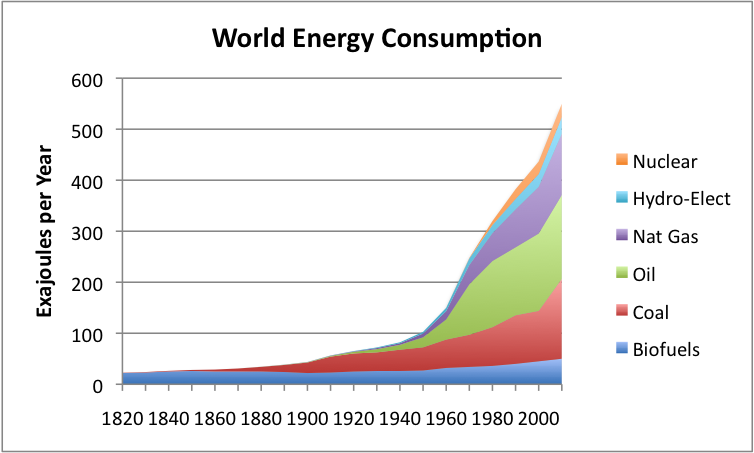
It is caused by humans: see the energy used in the last 200 years:
https://gailtheactuary.files.wordpress.com/2012/03/world-ene...
And see what it means that the "climate changed before":
The principle the warming works is the same why you wear a coat in the winter: the coat keeps the surface temperature of your body warmer, even if the coat itself doesn't produce a new heat. A thick coat keeps you warmer than a thin one. More CO2 does the same to the Earth surface. Without the greenhouse gases the average Earth temperature would be 0°F (or -18°C) and it is 59°F (15°C). And "a few degrees more" is really a lot and awfully fast, see the xkcd drawing again.
That's called the "wishful thinking" fallacy, to which you cling to confirm your previous "investment." If we'd look at your sources of the apparent "conflicting" data, we'd be able to see that they are intentionally biased, fabricated, cherry picked or whatever. But I would be surprised that you accept that fact, on average it doesn't function that way psychologically. Which is how humans work, but not a scientific argument.
Anyway, the natural processes, unless cataclysmic, don't make such rapid changes that we experience now. The speed of the change is orders of magnitude faster now than the non-cataclysmic natural ones. It is really going to be worse than most can even imagine. Our children or grandchildren are going to hate us for not doing enough. The politicians and lobbyists who only see their own benefit will be dead and won't care.
To compare with the "good old times": the study of human DNA shows that 70000 years ago, only 2000 humans survived one extinction event:
http://news.bbc.co.uk/2/hi/science/nature/2975862.stm
And then there was no civilization infrastructure to fail, just the hunter-gatherers, ready to move.
So I don't understand why so much of the left chooses to frame the issue in such a way that makes it contingent on that cause.
I think here's where you're going wrong. There's a difference between "is caused by" and "contributes to".
It would be internally consistent to form an argument that supposes an alternate root cause, e.g., solar activity cycles and cycles of the Earth's magnetic field. One can state that these natural problems are (hypothetically) the root cause, while still acknowledging that CO2 is a greenhouse gas and thus decreasing our CO2 emissions - even if we weren't doing anything naughty on our own - might serve to mitigate the damage expected to be caused by those long-term natural cycles.
The common jargon in Liberalese is "anthropogenic climate change", i.e., climate change created by humans. My argument is that they'd have an easier time getting people on board if they went about this without assigning blame.
Saying "there's a problem we need to solve" is going to get a more productive reception than saying "you created this problem and now we need to solve it".
How would someone go about it, and would you trust them?
That's if we keep burning all the carbon. Yes, causes are important.
So you're saying that we need consensus to do things now? My sides are splitting.
Can you name a thing that you think we have "consensus" about?
edit: and wait... "easier to find consensus"! I admit you lost me there. We just don't live in the same world. Do we have consensus for the policies we have now? So what is the justification for favoring them?
"Total radiative forcing is positive, and has led to an uptake of energy by the climate system. The largest contribution to total radiative forcing is caused by the increase in the atmospheric concentration of CO2 since 1750 (see Figure SPM.5). {3.2, Box 3.1, 8.3, 8.5"
"Human influence on the climate system is clear. This is evident from the increasing greenhouse gas concentrations in the atmosphere, positive radiative forcing, observed warming, and understanding of the climate system. {2–14}"
http://www.ipcc.ch/pdf/assessment-report/ar5/wg1/WG1AR5_SPM_...
The politicians, lobbyists and the media aren't the same as the scientists.
So to get the "emissions per GDP", you have to read the table backwards, which means the United States is (among Australia, Israel, Canada) emitting more CO2 than most other developed countries, in particular Western European ones. For example, Germany produces roughly 60% more economic output (3,612 USD / ton of emissions) per CO2 emitted than the United States (2,291 USD / ton) and the United Kingdom (4,284 USD / ton) almost twice as much.
In any case, maybe a better figure would be "emissions per capita", which paints a similar picture: https://en.wikipedia.org/wiki/List_of_countries_by_greenhous...
[Update: Of course, all of these figures are not that helpful because they ignore how much CO2 emissions one "outsources" by buying products manufactured elsewhere. If you are primarily a service-driven economy, you will have much lower CO2 emissions in your country, but you will most likely still buy a lot of stuff from China etc. which will produce CO2 emissions there. That's e.g. why Switzerland is not as green as it would seem from this table.]
It's hardly surprising that a developed-world, service economy would produce fewer emissions per GDP than a developing economy that is geared toward mining and manufacturing.
It's also worth noting that the likely benefactors of those developing-world emissions are the people in developed countries. So even regional estimates of emissions, let alone emissions per GDP, probably miss the point.
It seems that way. But considering that so much of the emissions are produced in the course of producing goods, it makes sense to tie the emissions to the production. In the extreme case, where a single nation produces all goods consumed by the world, we'd expect the large portion of global emissions to come from that one nation, and the emissions of the rest of the world to be very significantly lower.
Obviously this isn't perfect. Other activities than production produce emissions - notably transportation. But I believe that those dollars are captured in the GDP total.
I think we then get down to "which people are profligate consumers", and I'm not sure how to factor that in.
These industries are emphatically not equal contributors to greenhouse gas emissions. So it makes little sense to aggregate them and measure the emissions to GDP ratio.
The reality today is that no efforts are made whatsoever by any political movement on the planet to combat global warming, in the entire planet (except perhaps the CPC of China, against all odds). American Republicans do not even have the hint of honesty of admitting the issue at stake. They denied it 10 years ago, now they want to turn their audience into believing that it may not be human-caused.
> I would love to see more discussion beyond conservatives are anti-science radicals who want to kill the earth.
The discussion was over dozens of years ago, there is no debate. Human activity (intensive farming, petroleum and coal burning, cement production, ...) is causing climate change, period. And the changes are already past the point of being reversible. The data is plentiful and everywhere for the world to see.
If the media were unbiased and wanted to show the viewers the actual state, there would be always 20 scientists in the studio, 19 scientists speaking that the global warming is real and only one speaking that he believes it's not. Then every viewer would understand.
"One person per side" is the core of the problem. That's how people get the impression it's 50-50: on the question "most scientists think global warming is happening" unsurprisingly only 49% of the public answered yes. They always see on the TV, at best, one guy speaking against another guy. The impression then: 50-50. It's not.
I don't think that is true, in the UK there have been efforts, for instance our coal use is the lowest for 150 years[1]. It isn't anywhere near enough to solve the problem but it isn't nothing either.
[1]: https://www.theguardian.com/environment/2016/mar/31/rapid-de...
You might find this attitude counter-productive in achieving your goals, especially in a democracy.
If 95% of the scientists of the whole world agree the global warming exists and is human caused, that "formal discussion" is really over since 1990. Since then there was no debate if. You can read the results of that discussion in the IPCC reports, the last summary here:
http://www.ipcc.ch/pdf/assessment-report/ar5/wg1/WG1AR5_SPM_...
If you mean that the politicians would like to "debate" between themselves "what to do about it," they sure do. But they shouldn't be allowed to doubt all scientists of the world. It's criminally irresponsible, considering the potential dangers.
It's also extremely simple in basic principles: without naturally occurring greenhouse gases, Earth's average temperature would be near 0°F (or -18°C) instead of the much warmer 59°F (15°C). More greenhouse gases, the higher the temperature on the surface. The same way you cover yourself with the blanket, under the blanket it's warmer, not because you produce more heat but because more warmth stays under the blanket. It's that simple, as simple as wearing the coat not to freeze in the winter, and unbelievable that somebody can be manipulated to doubt it.
P.S. Surveys of scientists' views on climate change (to answer the question to this post):
https://skepticalscience.com/global-warming-scientific-conse...
But they are of course less important than the IPCC which is official, worldwide and in the agreement since 1990.
I often read this number, do you know where it came from, and what 95% of scientists agree on specifically?
EDIT:
https://www.scientificamerican.com/article/how-to-determine-...
One of the problems with Cook's appeal to authority is this: So far, no one has quantified the consensus among natural scientists on global warming. In fact, it cannot be done easily, said Jon Krosnick, a social psychologist at Stanford University who has been studying communication strategies for decades.
While the Cook study may quantify the views expressed in published literature, it does not establish the beliefs of any defined group of scientists, Krosnick said.
"How do you determine who qualifies to be surveyed and who doesn't qualify?" he asked. "Personally, I haven't seen anyone accomplish that yet."
EDIT2: This might be an interesting read if it wasn't behind a paywall:
https://www.iceagenow.info/97-percent-consensus-errrr-not-ex...
http://link.springer.com/article/10.1007/s11191-013-9647-9#p...
Only if you don't understand the basic science or you have a denialist agenda.
If you want to know the facts, see:
https://www.bloomberg.com/graphics/2015-whats-warming-the-wo...
And those are good and precise calculations.
But even for the simplest, back-of-the-napkin calculations, you'd have to deny the contribution of CO2 to conclude anything else. And the CO2 contribution is 100% proven.
The same stands for the basic chemistry: The humanity burns immense amounts of carbon, burning hydrocarbons produces CO2 (if there's enough fresh air) or CO (if there's not). If you don't believe that, I suggest you to close yourself in a sealed room and burn a fire (coal) inside and keep it burning. You'd die, provably, unless somebody rescues you.
http://www.smh.com.au/nsw/man-died-from-carbon-monoxide-pois...
The concentration of the CO2 increased proportionally to our burning of the hydrocarbons increased, and additionally, the seas got more acidic. Everything fits.
See also:
http://rationalwiki.org/wiki/Argument_from_incredulity
P.S. If you "just" doubt in the study of over 12,000 peer-reviewed climate science papers, you are free to evaluate them yourself and to publish your take on them. I really doubt that the results would significantly change, if the scientifically valid methods are used. I have emphatically not called you personally a "denialist." But I argue that you can't be intellectually honest if you use an "argument from incredulity" (which you suitably call your "spider" that is, in reality non-existing, non-sense sense) or stating "there are many ways one could interpret this" which obviously isn't true. You linking to the work which main conclusion is "that partisan presentations of controversies stifle debate" has also no relevant scientific value, as the scientists agree about the human caused global warming occurring at least 30 years already. There are scientific facts, and to establish other facts you have to do real scientifically valid work. Scientifically valid also means accepted by the scientists. The majority of them in the relevant field. Again, politicians, lobbyists and media don't count. It's very known that the US public perception of the scientific agreement is wrong (including OP the statistics we comment), and your "spider sense tingling" (your name for you avoiding logically and technically valid arguments) fits that exactly.
https://static.skepticalscience.com/graphics/consensus_gap.j...

Simple, honest skepticism, what used to be considered an intrinsic part of the scientific process, literally isn't an option? The irony. :)
Note that in this case I wasn't questioning the science of global warming, I was questioning the methodology and manner in which they qualitatively reviewed these scientific papers. There are, in fact, many different conclusions one could draw, depending on your agenda. Presenting it as nothing more complicated than simple math seems suspicious. Being accused of being a "denialist" when pointing this out is cringe worthy.
Even for things that are substantially better understood no one would ever say "there is no debate".
When folks like the above say "there is no debate", it should be quantified with that.
There simply is no worthwhile discussion to have about whether or not human activity has been a cause of climate change. 'Debating' it is akin to debating the existence of gravity or a causal link between smoking and cancer or whether or not quicksort is better than bubblesort. That is, it would be similar if there were a very wealthy and powerful 'bubblesort' lobby that funds and props up any argument that favors it, no matter how ridiculous or how much bad faith is required to make it.
Many of the climate change skeptics actually allege a huge conspiracy and accuse the enormous consensus of educated scientists of lying or being fundamentally incompetent, which puts them on the level of cranks that don't deserve a moment's notice. But there's a lot of money and prestige in denial, it's a huge business because the longer we deny the more money certain large companies can make. So these cranks (and the minuscule fraction of qualified honest skeptics who barely exist) get credence and money far beyond their due. They get paired off 1-on-1 with an actual scientist in the public sphere. They get asked to speak on commissions. Which is what I have a problem with.
I don't have a problem with John McAfee existing. I'd have a problem with him and Ron Rivest holding a public 'debate' about RSA to 'understand the controversy'.
And you'll notice I never mentioned second-hand smoking. Evidence has always been shaky and arguable about how much of an effect it has, it simply followed the same moral panic as the very scientific smoking evidence. And we found out we were being lied to and results were being fabricated and manipulated by extremely powerful interests about smoking, so to be on the safe side we chose to trust nothing pro-tobacco after that, a correct choice I think. A societal immune response against the cancer that infected us, if you'll pardon the appropriate analogy.
I picked smoking as an example because the evidence is incontrovertible and because it was covered up as long as possible by actively malicious corporations and lobbying groups with the intention of killing as many people as possible so that they could sell more cigarettes to unwitting innocents/children. It's a history lesson that we should give very little credence to "skeptics" who happen to always end up having connections to vested corporate interests and insist "the science just isn't settled yet" but provide no evidence to back their contrarian claims and insist that we should drag our feet. Sound familiar?
1. Climate change is a hoax.
2. Climate change is real, but natural.
3. Climate change is real, caused by humans, but beneficial.
4. Climate change is real, caused by humans, harmful, but attempts to fight it don't help.
5. Climate change is real, caused by humans, harmful, can be fought successfully, but the cost isn't worth it.
I too would like to see more productive discussion, but it's hard when every discussion on the subject is flooded with people arguing in opposition to the facts.
If you're discussing a topic with someone who relies on illogical crutches and isn't interested in discussing the topic... why are you even talking?
Some combination of: they're related to me, they vote, they barge into conversations and start arguing against the facts.
If someone barges into an discussion like that and you attempt to confront them with reason and argumentation, you're gonna have a bad time only further poisoning your perspective of the "other side".
And sure, this sort of thing is not unique to climate change denial. What is unique is the consequences that denial is having to the planet (and therefore me), and their presence in forums that are otherwise at least vaguely aligned with facts.
tl;dr: People may deny the problem, but when the solution isn't political in the first place, I can't see why it matters.
Yes, renewables are getting quite cheap, and coal is dying one way or another. But the amount of coal that gets pumped into the atmosphere before we're done with it will be far higher than it needed to be.
If you think the solution isn't political, then obviously you'll disagree with me, but you're unlikely to convince me that government intervention doesn't matter here.
But when you already have a solution in mind... Politics is an obstacle or a gauntlet, not the solution you're working towards.
It would never fly with other subjects: "handgun injuries per taxable income" shows that only the poor get shot, so it's not really as much a problem as you think.
My vague guess is that you're trying to use "GDP" as some kind of proxy for "industrial output", and saying that while the US emits a ton of CO2, that's OK because we actually need to do that to produce all the wonderful thigns we do. Except that's not what GDP means at all, and industrial production stopped being a dominant fraction of that number like a century ago.
Having lots of web developers and Starbucks franchises in our economy doesn't give us a license to pollute.
(Edit: literally minutes after I posted this, there's a WaPo story up saying that the Trump administration is floating the possibility of a carbon tax of some sort. So maybe there's some hope for conservatives after all.)
(For the record, I am stuck between supporting crooks and hacks who claim to be conservative, and supporting liberals, and so I'm backing liberals for the duration.)
Pretty gross.
I'd love to be having policy conversations about solutions instead of doing that.
Real solutions look like building out a renewable infrastructure. A thing that is happening everyday already, spearheaded by humanely conscious individuals and companies (Google, Apple, etc). There is literally nothing for the government to do in this situation but get out of the way and facilitate such endeavours.
Instead, we talk about carbon taxes >.>
I think calling that a "humanely conscious" government, as you say, would have been appropriate too.
This is a major point. It's not that conservatives (in general) don't think it's happening, but believe that the solutions provided won't yield results to how expensive or "sacrificing" they are. Especially when you have big lobbies involved and especially when you consider China and how they have no real plan on cutting emissions.
China forced all taxi drivers in Beijing to use electric cars, a desperate and very controversial move. [2]
China is highly subsidizing its high-speed rail companies, bleeding billions of dollars per year, to cut other transportation methods. [3]
I am not saying to follow their example (some of their actions are probably not the best investments, environmentally speaking), but saying they do not have a real plan is quite untrue.
[1] https://en.wikipedia.org/wiki/Solar_power_in_China
[2] http://mashable.com/2017/02/27/china-electric-taxis/#r749sZh...
To expand upon the conservative reasoning:
Suicide never fixed anything. Killing our own economy and literally killing our own people makes some people (suspiciously never the people doing the suffering...) feel better about themselves not being as guilty. But lets face it, unless you can get "cult leader" levels of suicidal thinking into the entire species, human #235325 sacrificing himself and his family merely means human #85735 over there is going to burn the coal and oil, perhaps a little later. All the "conservation" stuff has no impact on the earth. A history book a million years from now would read something like "all the coal got burnt; some felt holier than thou for not personally burning; but it all got burnt" For some, being anti-suicide is a religious belief. For others, its just common sense. Why should I kill my kids so they don't burn coal which supposedly makes them holy, when someone else's living kids will burn the coal anyway? Why can't those people simply accept cyanide pills for themselves and their families, why do they insist on dragging us into their death cult kicking and screaming? In the long run from the earths point of view what does it matter if its all getting burnt anyway? Will mother nature "feel better" knowing a Chinese dude burned the oil instead of a rural white guy burning the same oil?
Wisdom about time is stronger on the right than on the left, see financial investment for example. Or just simple time preference WRT criminality statistics. Lets say we have to kill a million americans by ripping away their jobs and forever dumping them into drug addicted rural poverty without medical treatment leading to young death, lets really make them suffer because thats what we need to do to lower the carbon rate by 5%. Whats the result of all that human suffering? Well, the same sea level rise will happen and same climate change will happen, just maybe a couple weeks or months later. Perhaps the next ice age will arrive a few months sooner. But the human cost, oh my God. From a moral or ethical standpoint its pure evil to torture people just to move a date on a calendar that doesn't matter anyway. Its pure evil, basically. Many things are inevitable such as death and aging. The best measure of a human being is in how you face the inevitable. Grotesque slaughter and torture says more about the people proposing that "economic fine tuning" than they want made public. I would rather bravely face a 30M sea level rise on November 23rd 2071 than shoot my neighbor's kid in the head today to face the same 30M sea level rise on November 24th 2071. Sociopaths will do anything to get ahead, but conservatives have moral and ethical standards. Conservatives frankly are just braver people. Look at military demographics for example. I could support environmental policies that will ensure my survival a little longer, but what good is mere survival if you have to become a monster to do it? You have to truly and deeply hate your fellow man to support "economic fine tuning" like is usually proposed, have a deep desire to experience other's suffering and pain, especially of the unwilling, of the lower social classes. I'm not libertarian enough to say that's an OK way to look at the world.
Some are not part of social groups where holiness signalling spirals would benefit them so they don't bother signalling. If all your academic friend retweet your guilty terror of global warming you get a big payoff. If you don't, you're not "cool". You have to do this thing. The thing don't mean anything its just what you have to do to be cool. Not everyone hangs out with degenerates, frankly. Or their personal variety of degenerate gets "twitter cred" quoting the bible or just being a normal human or whatever. Just saying a lot of noise in the system comes from metastasized social media. A cancer of social signalling that only benefits itself and its own growth rate while lowering quality of life. Some ideas are just bad in a certain moral or ethical sense to propagate. Some folks have religious prohibition of proudly publicly being "holier than thou" and frankly thats good.
> conservatives have moral and ethical standards.
And liberals don't?
> Conservatives frankly are just braver people.
Got it, this is satire.
I guess that's actually a pretty good summary of the right-wing leadership in the West.
You claim that conservatives "(in general)" do believe in global warming but poll after poll after poll demonstrates otherwise[1]. 85% of Republicans don't think humans are to blame and (by extension) there's nothing we could possibly do about it. The Republican President claims quite emphatically that it's a "hoax." How do these observable facts jive at all with your claim that conservatives don't believe in the "solutions" when most don't even acknowledge the problem.
As for your fantastic claim that China won't cut emissions again, I suggest looking at reality. See the Climate Action Tracker for China [2]. China is on track to achieve its peak admissions by 2030 which is what they agreed to under the historic Paris Agreement.
The facts are out there. There's no need for you to make up fantastical claims you just have to have the courage to look at them.
[1] http://www.latimes.com/science/sciencenow/la-sci-sn-climate-...
That was a joke made on twitter.
Interesting, I was under the impression that most conservatives were climate change deniers (or at least mild deniers as in it may be real but not a big deal).
That being said, a conservative friend of mine argues that what we need to solve environmental issues (and GW in particular) is more growth, more production and consumption. In his opinion, a side effect of this will be more investment in research and eventually new solutions to the environmental problems (as it has happened many times in history, for instance, think of horses being a nuisance in NYC). I would call that a serious leap of faith, but at least there's some logic in the reasoning!!
We didn't leave the stone age because of social status signalling holiness spirals declaring the in-group hates stone and stone workers. Or by making everyone feel guilty about the earth only having a finite calculable amount of usable stone. Or by patting ourselves on our backs for a job well done by lowering the third derivative of stone use to a slightly lower yet still large positive number.
+1
I noticed that even in the Yale study, the options on solutions were limited to those with broad left of center options.
Other options, include some that have been pushed by people right of center to address climate change, were not listed. E.g., nuclear power.
If you are at all interested in why things are as they are, you might start with the time-honored practice of following the money.
Interesting once you start to take into account other countries contributions to global warming. The United States is relatively low among developed economies when it comes to emissions per GDP : https://en.wikipedia.org/wiki/List_of_countries_by_ratio_of_... .
I am really not impressed by any sides efforts to combat global warming.
Of course this will be met by criticism from HN, but I would love to see more discussion beyond conservatives are anti-science radicals who want to kill the earth.