We wish we had a train system in many cities that allowed the middle class to live 40-60 minutes away from their jobs.
Ultimately however the main problem is wealth inequality. If median income had increased with GDP since 1980, instead of all gains going to the 0.01%, you would be able to afford to live in the suburbs of San Diego.
Since the demand for such cities is quite high--a large number of middle class voters would like to live in one--would a mobilization of political will enable us to change to situation somewhat, at least over the medium to long term?
The problem of income inequality is one and the same as the housing crisis - ie, the wealth gap is nearly entirely explained by real estate.
The problem is that the 0.01% -- households worth more than ~$100M -- have received almost all the wealth gains since 1980. That's not just real estate -- it has to do with globalization as well as tax and policy decision.
So the very rich have gotten much richer, while median incomes (I.e. middle class incomes) have not increased.
See Fig 1 of this paper: https://gabriel-zucman.eu/files/SaezZucman2014.pdf
It's not surprising that those who started with the most, also got the most gains.
1) Reagan fired the air traffic controllers in 1981.
2) This set off a wave of anti-union action - http://www.alternet.org/story/154595/how_ronald_reagan_broke... - causing the great decoupling of wages and productivity: https://upload.wikimedia.org/wikipedia/commons/4/45/Producti...

3) ...which caused staggering levels of wealth inequality: http://www.bankers-anonymous.com/wp-content/uploads/2015/04/...
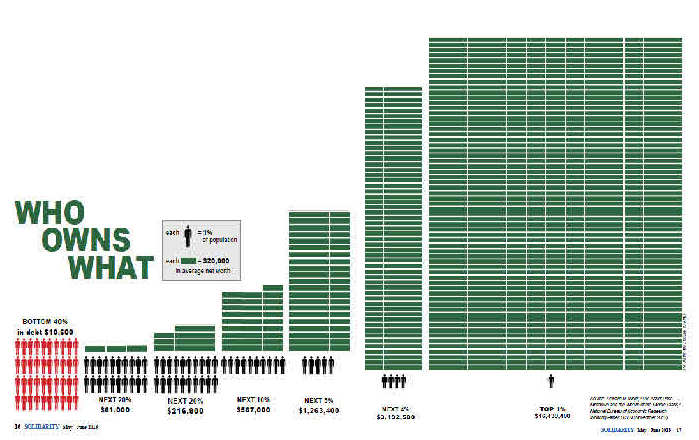
4) And all that accumulated wealth ended up being lent back in the form of loans (e.g. student loans), mortgages as well as bidding up the price of real estate which your grandma - a 'boomer' profited a small amount from - which is why this is actually all her fault.
The one and only fix is more houses. That's it. Any other solution is just picking winners and losers different ways. But no matter which way you pick the same number of people win and the same number lose.
Unfortunately, it's not that simple. The heart of the problem in many parts of the country is that we fund our schools with property taxes.
Hence, a cycle of better schools and increased demand in concentrated areas, which causes the supply-demand imbalance and price increases. Compounding this is the fact that people in such areas actively block "higher density" housing, which naturally means fewer houses per acre.
Building more houses would help to a limited extent, but the shortage would still exist and resistance is stout.
Hence, the shortage of housing is just a symptom of how we fund education, which is the real problem.
>Inequality is not the problem
Inequality absolutely enters here because if wealth/income were more evenly distributed, then funding for schools would be more evenly distributed, thus alleviating concentrated housing demand in small areas with better schools and driving up prices.
If Concord schools had to take any number of first generation impoverished immigrants with poor English language skills, their test scores would implode. That doesn't happen, because working class immigrants don't buy the $800K homes in Concord.
And, what's the history? Were these schools neglected for years, then the state recently started pouring in money?
I mean, maybe there are some exceptions (perhaps partially gentrified cities where some tax base is moving back into cities at inflated prices?), but these would generally be outliers. Since wealthier people have fled most major cities for the burbs, the tax base and educational investments have generally followed them. You see this over and over again in communities throughout the country.
For example:
http://www.npr.org/2016/04/18/474256366/why-americas-schools...
Cambridge (expensive city) $27,569 per pupil
Concord (expensive suburb) $17,517 per pupil
http://profiles.doe.mass.edu/state_report/ppx.aspx
Rankings
Cambridge Ringe and Latin was 214 out of 340
Concord Carlisle High was 27 out of 340
https://www.schooldigger.com/go/MA/schoolrank.aspx?level=3
Not cherry-picked data.
A lot of the difference is that cities, even expensive ones, are cities. A lot more diverse student body. A lot more students with problems at home. More disruption, etc. You can spend more money but the average student in the city school almost certainly has less parental involvement and less of a home environment that's conducive to learning than in the tony suburb.
The linked article (and decades of debate) notwithstanding, it's also hard to really correlate spending per pupil with educational outcomes past a certain point--especially as measured on standardized tests. Poorer cities do spend less. Two Lawrence high schools have the worst test results in Massachusetts. But its spending, $14,475 per pupil, is still only a bit less than Concord.
Definitely does in my city. Teacher pay's also substantially higher in the inner city schools. Most teachers still don't want to work there because they're stuck in a seemingly-inescapable poverty-and-culture-driven "bad homes -> bad students -> burnt-out and bitter faculty" rut, which makes them a discouraging, abusive, and dangerous hell for faculty and students alike.
Source: my wife and probably half my circle of friends are teachers.
[EDIT] in fact, some of the better suburban schools pay worse than the so-so suburban schools, let alone the high-paying inner city ones, because they can. Good teachers will still work there because the environment is nicer and more rewarding (that is, the students are way easier to teach, and the community tends to be supportive)
Despite having significant growth opportunity San Fran is already twice as dense as Seattle. Therefore Seattle has room for explosive housing growth. It would need more changes than just housing of course. But that's to be expected and totally doable.
Cities are huge economic multipliers. We don't need more cities yet. The ones we have are perfectly great! We need to more efficiently use what we already have.
This housing crisis isn't affecting just "top tier" cities. It's not just New York and San Fran. It's Seattle. It's Denver, Austin, and Portland. It's even Nashville!
Every city, top to bottom, needs to be doing more. And they need to start now as the longer they wait the more expensive the infrastructure adjustments become.
So long as you also build all the transportation, schooling, utility, and other infrastructure needed to support it.
Additional housing will result in a larger tax base which will automatically cover additional schooling needs.
I am hopeful for autonomous app hailed buses, but there's definitely a big chance it doesn't all work out that way, and even then there is clearly still a physical limit on how much existing road infrastructure can handle.
Wat? That is literally the opposite of reality.
The problem is cities are TOO POPULAR. Cities so successful that only the rich can afford to live in them! Increased property values, more property tax revenue, higher resident earnings and spendings. Cities aren't being decimated. Cities are so economically successful that poor people are being forced out so more rich people can move in!
The article, titled "The Middle Class Can't Afford to Live in Cities Anymore" is about people earning $50,000 to $125,000 who can't afford housing in cities. It's not about rural or rust belt communities with no jobs. Housing is plenty cheap in those areas. They just lack the jobs to go with it. A very real but very different problem.
It's easy to say and hard to do, but concerns like a good neighborhood or decent commute when looking for living arrangements in the cities is definitely not as common in Europe as it is in the US.
http://www.globalpropertyguide.com/most-expensive-cities
You will find that European cities are very expensive to buy in and equally bad to rent in. Paris, Geneva, London, Helsinki, Stockholm, etc... all suffer from the exact same issues we're now seeing in American cities.
You could argue that the make-up of those cities are superior, as their suburbs are much more compact and urban connected with much better public transportation. This coupled with a culture that is much more ok with living in small spaces helps the middle class immensely.
In terms of a priced out middle class, however, the United States is really just catching up to the rest of the world.
Or of course you go to rust belt equivalent communities. Northern Spain. Southern Italy. Very cheap, beautiful even, housing for no money whatsoever. And not a chance in hell of finding a job there.
Our modern economy wants to centralize in cities, and not doing so is leaving free lunch on the table. Also keep in mind that more people in cities = cheaper suburbs for those who prefer it.
Increased centralization in cities is a bit of a problem. But cities are such an economic multiplier that it's difficult not to. That's a tougher nut to crack.
If you're not rich you might as well say fuck it, relax, and be poor. The middle class has to pay for _both_ the profits of the rich and the welfare of the poor, while not being able to afford a decent life for a family despite working hard and doing everything right. It is a totally exploited class.
Yes, they will be living in condos and apartments. You can have a large detached home, or live in a city. You can't have both.
We have lived for more than a decade with four children in a house with fewer finished square feet of floor space. I'm curious about what "good neighborhood" means here, because my children can walk or bicycle all over the place, without fear of mishap, and the local public schools here draw people from all over the country. "Reasonable commute" is also a term I'd like to understand better in this context. How tied to location is the employment you each have, if you are able to move out of state?
I have to think that it's possible for middle-class people like my family (at a lower income level, currently, than what you self-report) to live in cities, because we do. Most of our work happens to be in outer-ring suburbs, so "reasonable commute" puts us there, but other people with work nearer into the center of the metropolitan area can live affordably further in.
Disclosure: we live in an other ring suburb of Minneapolis, just outside the beltway freeway around the Twin Cities, and barely within reach of the bus system. My wife and my third son bike-commute often, year-round.
You don't come across as negatively "privileged", but perhaps if you can afford to send your kids to college, and plan for retirement, and have a rainy day fund to boot, you might consider yourself blessed compared to the situation many people find themselves in. I'm well enough off, but I'd give an arm to be in your position. :)
This is true for a very small percentage of the population.
Things are more reasonably priced here, but probably still higher than their intrinsic value. However, at least we can afford them without mortgaging our (and our kids') future.
The truth is that this isn't a situation the government has shown any ability to solve for. There are a myriad of reasons, but ultimately my feeling is that federal housing policy is deeply flawed.
Inevitably, by necessity, the solution to this mess will come from all those in the middle class who've been forced to find another way. Our voting with our feet will shape the next ten to twenty years in ways which are hard to predict. One likely outcome is that big cities will not be able to maintain their current housing price structures. A tipping point will come. You can't build a viable local economy only on the top and bottom of the income spectrum. You need a robust middle class. Otherwise the absence of the middle class creates a vacuum, and conditions for an implosion into that vacuum.