News for hackers. Stuff that matters.
Re:Blockchain Healthcare 2016 Report – Promise and Pitfalls by dvcc on Wednesday October 05, 2016 @03:19PM (#12646894)
I read through this and I still have no idea what they actually applied the idea of the blockchain to within healthcare. To an HIE? Does each patient receive their own "wallet" that is their patient record? This just seems to be a generic overview of EHRs/Blockchains within the same page.
Re:Blockchain Healthcare 2016 Report – Promise and Pitfalls by waynevaughan on Wednesday October 05, 2016 @03:31PM (#12646997)
Thanks for reading the report. This last weekend there was the first Blockchain Healthcare conference where blockchain was pitched as a panacea for a wide spectrum of healthcare problems.

https://godistributed.com/health/

Our report was targeted at a non-technical audience. Printed copies were distributed to about 500 attendees. We wanted to make them aware that while there may some opportunities for using blockchain technology also comes with substantial risks. We want to help them cut through the hype and maintain a healthy dose of skepticism.

Gartner recently placed blockchain technology at the beginning of their hype cycle.
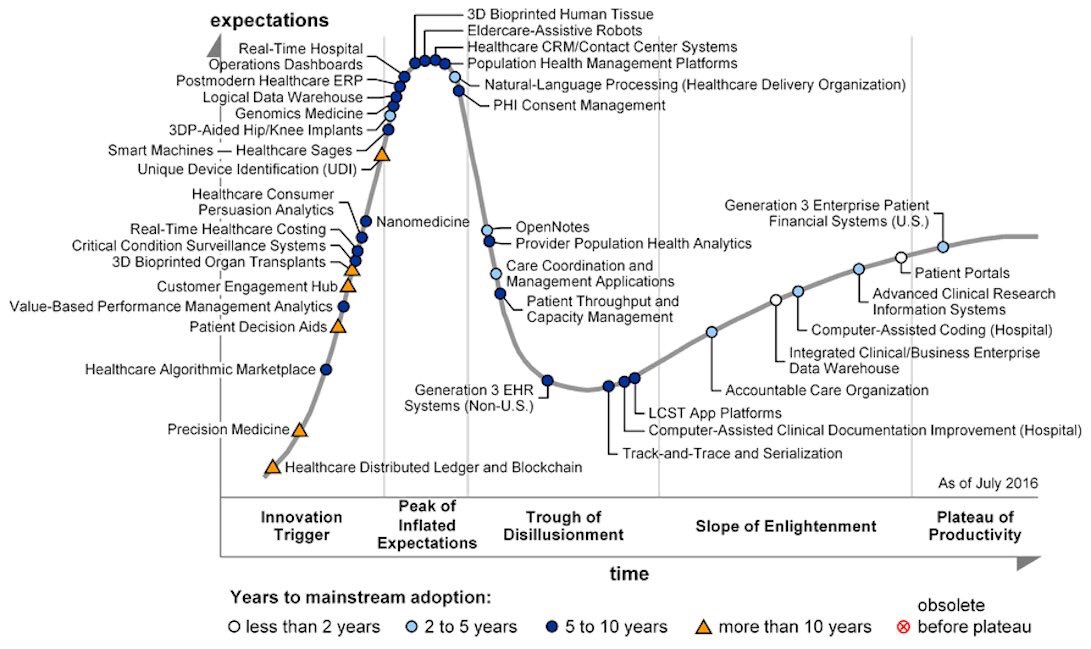
https://pbs.twimg.com/media/CtxEq0MWAAA3EQe.jpg

Re:Blockchain Healthcare 2016 Report – Promise and Pitfalls by RyJones on Thursday October 06, 2016 @01:35AM (#12650443)
Not coincidentally, Hyperledger just started a working group for healthcare. [0] Coincidentally, a healthcare application won this week's Hackathon in Amsterdam [1] https://www.finextra.com/pressarticle/66385/medical-data-app...

[0] https://lists.hyperledger.org/pipermail/healthcare-wg/2016-O...

[1] https://www.finextra.com/pressarticle/66385/medical-data-app...

Re:Blockchain Healthcare 2016 Report – Promise and Pitfalls by asciihacker on Wednesday October 05, 2016 @03:58PM (#12647240)
I dont see the application myself either. Why not leverage existing robust technologies like a relational database?
Re:Blockchain Healthcare 2016 Report – Promise and Pitfalls by kysar_tom on Wednesday October 05, 2016 @04:07PM (#12647329)
You could, but a relational database isn't distributed upon 5,000+ worldwide nodes in an immutable data ledger. That's the value the Bitcoin blockchain provides, it allows you to stick data into a transaction that will be there forever. The Bitcoin blockchain provides an economic incentive to keep the data accurate and accessible, as it would be (near) impossible to pull off a 51% attack in todays day and age.

Many databases can be modified by the ones who centrally operate it. The Bitcoin blockchain is the worlds first distributed global database that takes the burden of trust off your internal systems and records.

Re:Blockchain Healthcare 2016 Report – Promise and Pitfalls by feral on Wednesday October 05, 2016 @04:26PM (#12647501)
No; using the Bitcoin blockchain to store medical records is a terrible idea.

Yes, they are robustly distributed on each of 5,000 worldwide nodes.

But, think about that! How's that going to work for 10 million patients' MRI records? Each MRI being a series of high res images?

That's not possible with Bitcoin - its not designed to store near that quantity of data - its not even desirable.

I don't know what the advantage of Blockchain is with healthcare, but its certainly not storing your medical records on the Bitcoin blockchain. [Standard disclaimers about predicting the future apply.]

Maybe a hash of them, so you know they aren't tampered with, or that sort of thing - but that seems like a second order problem.

Re:Blockchain Healthcare 2016 Report – Promise and Pitfalls by waynevaughan on Wednesday October 05, 2016 @04:41PM (#12647647)
No one is advocating putting medical records on the blockchain. That's crazy.

He's talking about using a technology like Tierion or Chainpoint to anchor a hash of the data in the blockchain. This can be used to verify the integrity and approximate timestamp of the data.

http://tierion.com http://chainpoint.org

Re:Blockchain Healthcare 2016 Report – Promise and Pitfalls by feral on Wednesday October 05, 2016 @06:04PM (#12648352)
> No one is advocating putting medical records on the blockchain. That's crazy.

The post I responded to seemed to be.

It implied the data would be "distributed upon 5,000+ worldwide nodes in an immutable data ledger", and said it would:

"be there forever" "keep the data accurate and accessible"

I think its legit to call this out. Blockchain is a great technology, but its being hyped as if its the world's only distributed database.

> This can be used to verify the integrity and approximate timestamp of the data.

That may indeed be beneficial, but isn't the panacea that is being touted.

Re:Blockchain Healthcare 2016 Report – Promise and Pitfalls by waynevaughan on Wednesday October 05, 2016 @07:06PM (#12648747)
"That may indeed be beneficial, but isn't the panacea that is being touted."

We agree. That's the primary conclusion of the report.

Re:Blockchain Healthcare 2016 Report – Promise and Pitfalls by kysar_tom on Wednesday October 05, 2016 @05:18PM (#12647977)
Should have been more clear. No records should be stored on the Bitcoin blockchain, only a hash of the data. Using a service like Tierion, a hash of your data is anchored into the Bitcoin blockchain, and Tierion gives you back a blockchain receipt. That blockchain receipt is a cryptographic proof that can be used to verify the integrity of that data at a later point in time.
Re:Blockchain Healthcare 2016 Report – Promise and Pitfalls by kitsune_ on Wednesday October 05, 2016 @04:49PM (#12647723)
I still don't see the point in a 'permissioned blockchain' without proof of work. If you just put Paxos / Raft / any other consensus protocol on top of a 'blockchain', all you're basically doing is reinventing distributed databases.
Re:Blockchain Healthcare 2016 Report – Promise and Pitfalls by kysar_tom on Wednesday October 05, 2016 @05:16PM (#12647967)
Tierion uses the Bitcoin blockchain for these reasons. Proof of work is what really secures your data.
Re:Blockchain Healthcare 2016 Report – Promise and Pitfalls by kitsune_ on Thursday October 06, 2016 @03:52AM (#12650864)
Is this a trustless system? If so, what is the game theoretic aspect of it, what nodes do the mining and what are their incentives? If it is not, what prevents you from implementing a traditional distributed system with traditional consensus protocols? I'd wager that traditional methods are much more performant than the BitCoin blockchain in that scenario.
Re:Blockchain Healthcare 2016 Report – Promise and Pitfalls by ChoHag on Thursday October 06, 2016 @08:26AM (#12651823)
> You could, but a relational database isn't distributed upon 5,000+ worldwide nodes in an immutable data ledger.

The DNS would like a word.