waynevaughan
Wow was I surprised to see this on Hacker News! It's my view that decentralized systems will almost always be less efficient than centralized systems. This is because centralized systems can organize information in a more efficient manner and use specialized hardware. Decentralized systems give you privacy, redundancy, anonymity and other benefits at a significant additional cost.
Bitcoin has the potential to provide a mechanism for decentralized systems to set prices and allocate resources. We'll see how this plays out over time.
We agree. That's the primary conclusion of the report.
“…the term ‘blockchain’ has been so misappropriated that no one knows what it means anymore.” – Elaine Ou, Bloomberg
People are using blockchain to describe Bitcoin, private ledgers, the public Ethereum network, private Ethereum forks, and other tech that shares design characteristics with Bitcoin.
He's talking about using a technology like Tierion or Chainpoint to anchor a hash of the data in the blockchain. This can be used to verify the integrity and approximate timestamp of the data.
https://godistributed.com/health/
Our report was targeted at a non-technical audience. Printed copies were distributed to about 500 attendees. We wanted to make them aware that while there may some opportunities for using blockchain technology also comes with substantial risks. We want to help them cut through the hype and maintain a healthy dose of skepticism.
Gartner recently placed blockchain technology at the beginning of their hype cycle.
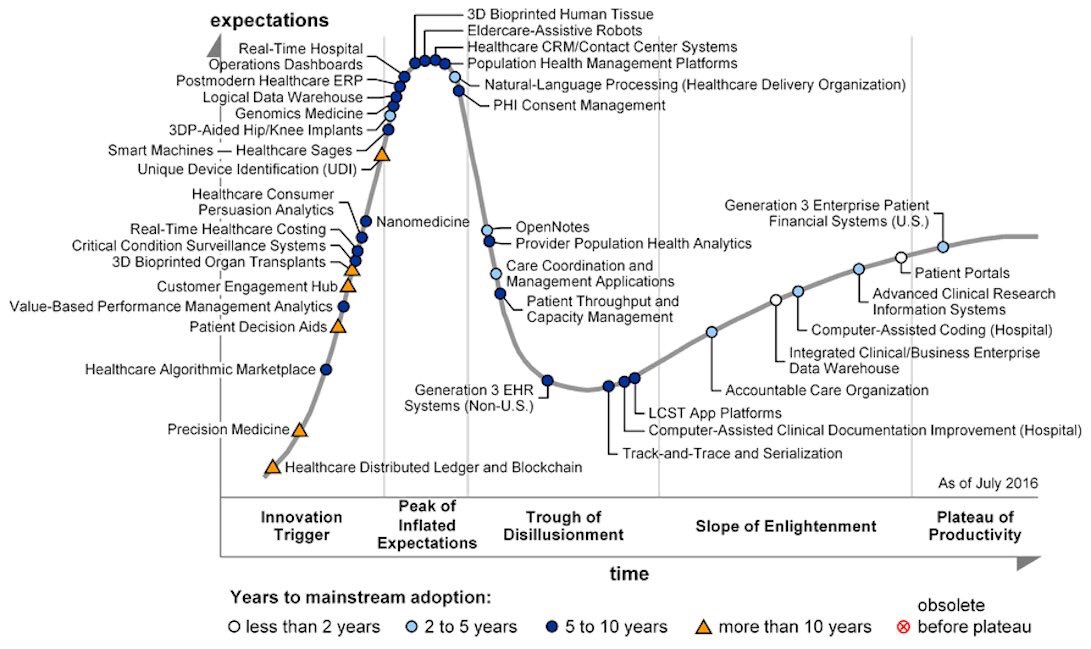
You can't just blockchain all the things and expect all the costs that are part of the current system to disappear.
In a perfect world, the insurance company would maintain a central database of claims data and everyone would work off that data. In the real world, data is being shared in an inefficient manner.
Insurance companies spend $2billion annual on fraud and compliance. Our solution helped them reduce their costs.
That's a big question. Here are a few points:
1) Tierion does not require an altcoin. Factom does.
2) Tierion is a working product with paying customers. Factom is still in the very early stages of development. There is no user interface and only rudimentary developer tools.
3) You can sign up for Tierion in 30 seconds. We have an easy to use API and developer documentation. With Factom, you have to install three command line interface programs, exchange Bitcoin for Factoids, convert Factoids to Entry Credits, and then you can use the command line interface to write data to Factom. It's a very complicated experience. They are working on a docker image to make things simpler.
Factom has chosen to create a blockchain that is anchored to the bitcoin blockchain. If you choose to use Factom, your application will have a dependency on the Factom blockchain. If it fails, your application will probably fail. They have also chosen to create an altcoin. If you choose to use Factom, you will always need to acquire Factoids to write additional data to a Factom chain.
With Tierion, we've created a scalable protocol for recording data in the bitcoin blockchain and generating blockchain receipts. These receipts are portable. You can store them wherever you like. You can also share them with other applications that can independently verify the receipt.
Factom is still in the very early stages of development. They just reached their first milestone required to receive their first payment from the Factoid crowdsale. The second milestone requires Factom to build a storefront and a consensus mechanism for eight federated servers. This will likely take several months. The third milestone requires moving away from the current centralized model to a decentralized model. This will likely take several additional months.
I hope anyone who has been looking at Factom gives Tierion a try. I think you'll prefer our developer experience and you won't miss the reliance on an altcoin.
Instead, Tierion generates a blockchain receipt for each record, which provides irrefutable proof that your data was recorded in the Bitcoin blockchain. Anyone with this receipt can verify the timestamp and contents of the record.
It's not practical to store large amounts of data in the blockchain for the following reasons:
1) Bitcoin can currently handle seven transactions per second 2) You can only store 80 bytes of data in each transaction 3) The average transaction fee is currently $.03
Tierion is able to overcome these design constraints and generate blockchain receipts for millions of records. The specifics of how we do this is described in the following white paper: http://Tierion.com/chainpoint
Here's a real world example: We recently won the Coindesk hackathon by building an insurance claims processing application that creates an audit trail for the claims process by recording each step in the bitcoin blockchain. Our solution offered two main benefits. First, Tierion generated a blockchain receipt for the initial claim. This gives both the insurance company and the claimant a verifiable proof of the claim's timestamp and contents. Second, most insurance companies use an outside network of providers (call centers, data processors, etc.) to handle claims. By using Tierion, we created an immutable audit trail for the claims process. This gives the insurance company a record of how the claim was handled without having to integrate all of their external vendors.
An enterprise customer built a prototype that collects data from MRI machines to track its usage and maintenance schedule.
There's a list of use cases at https://tierion.com/features.
We went live on September 1st. In the coming weeks, we'll be showcasing the creative solutions that we're seeing customers build.