The risk to the child for a specific situation does not change based on the reason why a parent put the child in a situation, the same way that the probability of getting hit by a landmine doesn't change based on whether you're walking across a minefield to cheat on your spouse or to save a baby.
The researchers wasn't asking "how good of a parent do you think they are", they were asking "how risky do you think this behaviour is", and it is irrational to be changing your estimation of the risk in a situation based on the reasons for being put in that situation (but what else is new when it comes to human psychology).
They may not have asked that question, but that seems to be the question people were answering. Isn't it somewhat obvious that we almost never answer the literal question?
If I consider the situation where the parent left their 2 year old alone to go meet a lover vs going to work to put food on the table, I'll judge the former situation more harshly. To explain myself, I'd say both situations put the child at the same risk, but the first situation is not a responsible reason to assume that risk.
In short, when you present these scenarios, you're not asking me, "mathematically, which situation is more dangerous for the child?". You're implicitly asking me, "is this parent making a responsible decision?".
It seems likely to me that the respondents deviated from the question strictly asked using at least in part that reasoning.
I'm not saying the reason itself changes the risk. I'm saying the reason gives me insight into the kind of parent a person is and the likelihood of their being higher risks in the child's environment. Or to use your analogy, there's probably a lot more 'land-mines' in the house of a parent who leaves to play pokemon than in the house of a parent who left their child alone due to an accident or unforeseen circumstances.
If you can't see that than you are blinded by your own sense of rationality.
Isn't it more likely that the drug-addicted parents are more likely to leave drug related paraphernalia around. I'm talking about mostly-empty baggies of cocaine, methamphetamine, weed, whatever. Needles, bongs, half empty bottles of booze.
Isn't the drug-addicted parent more likely to not be aware or not care or not notice all sorts of other safety related issues.
Probably the working-parent shouldn't leave a child under a certain age unattended. But it seems perfectly reasonable that people should judge the drug-addict house as more dangerous.
I don't claim to have full knowledge of every situation, but as someone who spent the better part of a decade injecting meth on a very regular basis I feel my opinion ought to carry some authority.
Do you still feel the child is in more danger if left unattended by the drug-addict parent leaving to buy drugs versus the working parent leaving to work? How about the drug-addict parent leaving to work versus the working parent leaving to buy drugs?
But that statistic is based on general population. My contention is that our moral judgement can be used to heighten perceived risk to a child, even though it might blow it well out of proportion. So just because the average child is at a perceived risk of being injured at x% when left alone, I don't think it's wrong to say a child of parent I judge to be amoral or willfully negligent is most likely at an increased risk of being injured.
For those circumstances where that is the case then ok.
Now that the people really answered a different question that they were actually asked is another thing. Not uncommon with humans in psychological studies.
This research is saying we shouldn't change our assessment of the risks to a child in a situation based on our moral assessment of their parents. I'm saying the fact that the parents are drug addicts or willfully negligent is likely indicative that the child IS at higher risk that the statistical average.
Not sure how I can make this any clearer in any of my responses.
My problem with those kind of statements is that you don't quantify the risk. Sure, "probably" at a "higher" risk. How much higher and does it really matter that is slightly higher? we do riskier activities all the time in exchange of convenience, fun, perceived necessity, etc. Sure, my kid is at a higher risk of injury by playing in the backyard (even if supervised) than by staying indoors in his room with padded walls, but at what cost? what about enjoying life a little more?
Furthermore, you're judging just on the probability (not on the reality of the circumstances for those parents) that allowing one activity you don't agree with (playing pokemon leaving child unsupervised) implies a lot of other "bad parenting" habits. Even if that were true (and I'd like to see real concrete numbers), judging people that way is a nasty habit IMO.
Your judgment of morality should not be allowed to impact your judgment of the risk to a child, because that impact is based on your own assumptions. Those assumptions are highly unreliable, unlike factual risk assessment.
If you need a reminder of why assumptions like yours are unreliable, here's a very short read that drives the point home: https://mostlysignssomeportents.tumblr.com/post/66889970151/...
> Letting children play is dangerous, being negligent is safe
Very 1984.
My point is that the parent who is accidentally negligent most likely is providing their child with a safer environment than the parents who intentionally leave their child alone.
BTW have you even had a 2-year old? I doubt very much there was ever a point in history where 2-year olds were left with zero supervision. Sure it might be an older sibling or some other community member watching them, but I can't imagine how someone feels leaving a 2-year old alone at home is a reasonable thing.
In Denmark today 0-2 year olds are regularly left outside in a baby stroller to nap while their parents are inside.
Edit: I think a lot of people in this thread are getting the idea that I'm advocating parents need to helicoptor parent their 2-year olds 24/7. Not at all what I'm saying. I don't think you are greatly increasing risks to your child in that scenario.
Shows a toddler in Mongolia--probably younger than two--tethered to a bed in a tent all day while her parents work in the field. She gets checked up on at lunch time when her parents come back (and probably other times).
Such actions are routine in other cultures.
In both cases you usually don't see whether the parents left their child intentionally or not.
Whatever the real reason, harassing the parents is quite a judgement based on a statistics with sample size 1.
Point I'm making is directed at the study, which contends that our moral judgements should have no impact on how we assess the risk to a child. Even though I think our morals are heavily skewed and unnecessary, I bet they at least point in the correct direction of what the risk to a specific child is as compared to the average statistical risk to all children.
Your comment seems culturally biased. See the movie Babies? The Mongolian baby Bayar was often left alone for hours.
I don't know how much context was put into the actual study, and I agree that we make a lot of moral judgements without all the facts. But it seemed like the jist of the research was that our moral judgements of the parents should have no basis in our assessment of the perceived risks to a child. I refute that to an extent.
Maybe you agree with this already, but it wasn't clear in your comment.
I think in that instance our moral judgement of the parents is pointing us in the general right direction of the risk to the child. Though our moral judgement IMO massively overinflates that risk.
Yet, how does society morally look down on a parent that places their children at such a huge risk?
I was under the impression that child-safe pool fences (legal requirement in Australia) have reduced the number of children drowning in the family pool.
I was also under the impression that the various ad champagnes over the decades about not leaving children unattended in the bath have also reduced the number of kids drowning in the bath.
I was also under the impression that requiring all new homes to have RDCs (Residual Current Device) installed has reduced the number of electrocutions of children and non-children.
I was also under the impression that providing various first aid techniques can and does save lives.
As far as I'm aware requiring all occupants of a motor vehicle (except buses, for some reason) to wear a seat belt, and requiring all new motor vehicles to be fitting with airbags, has reduced the number of children being injured or dying in motor vehicle accidents.
Also see: traction control; ABS braking; smoke detectors; PDFs (Personal Flotation Devices); food safety regulations; bicycle helmets / skate helmets / etc; bicycle lighting; step barrier / balustrades & handrails; exit signs and fire escapes.
I could go on.
As someone who leans a little left of centre (but only a tiny bit, I'm a closet right-wing), I think some regulation is a good thing. But maybe that stance just encourages the weak to thrive, thereby diminishing the viability of the entire species. Only time will tell.
I imagine the vast majority of people reading this don't have a problem with requiring houses to have smoke/CO detectors, for example.
Where you get into arguments is when some behavior is only somewhat common or where, as discussed here, the safety benefits seem to be more a matter of perception than statistics. And "the children" complicates things because it's not a clear case of exercising personal responsibility as is the case with adult behaviors.
Metal, glass, ceramic, stone... there is no need for alarms if you avoid building a house with firewood. Note that this includes the roof support, roof exterior, studs (metal is standard for commercial construction), insulation, cabinets, and flooring. Do things right, and the alarm becomes pointless. All it does is annoy you when you stir-fry or make toast.
In case of government regulation, each regulation ends up imposing significant cost on the entire society to prevent handful of deaths which is a massive waste of resources. I am pretty sure destruction wealth also results in some human misery.
Consider USA:
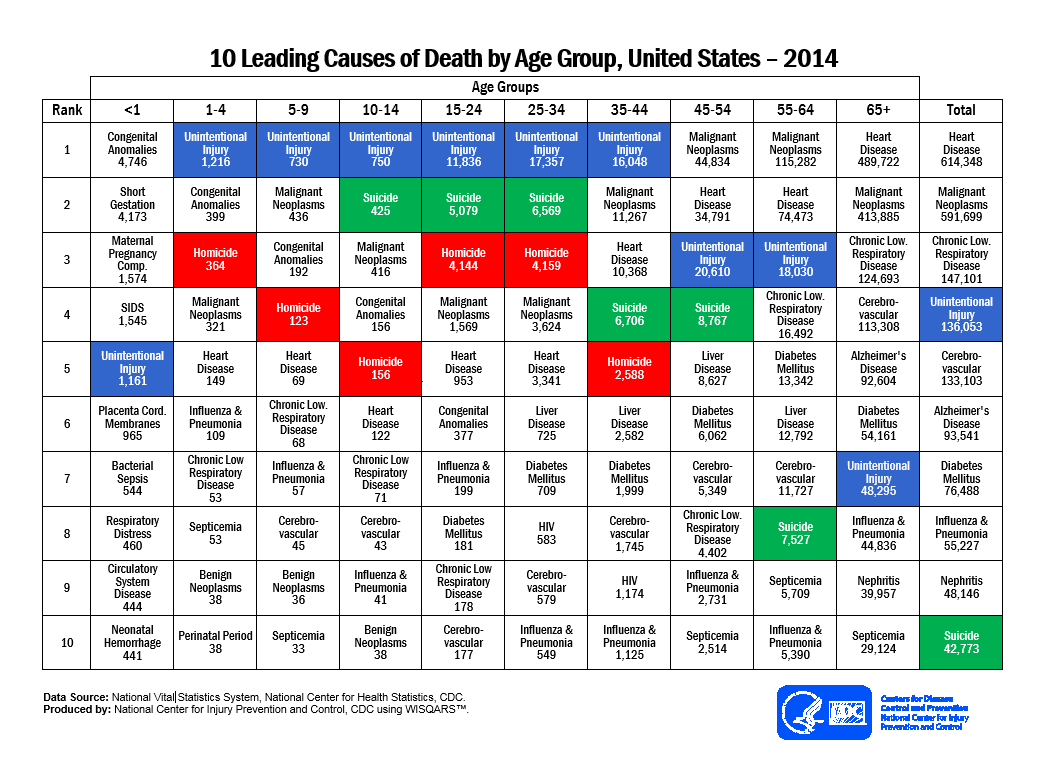
Total deaths caused by unintentional injury in 2014 for children below 14 is 3857 [1]. For a population of 300M it is pretty insignificant. Even if we just look at population below the age of 14 (30M) it is merely 0.00012856666. This is just pure noise.
Sure you can come up with a regulation that imposes a very heavy cost on entire society to eliminate one cause of unintentional injury but I really wonder if it has any impact on the overall number at all.
Unfortunately I don't have more data to backup this claim but if I had to put my money on whether these rules will bring down child mortality I would bet it wont make a difference.
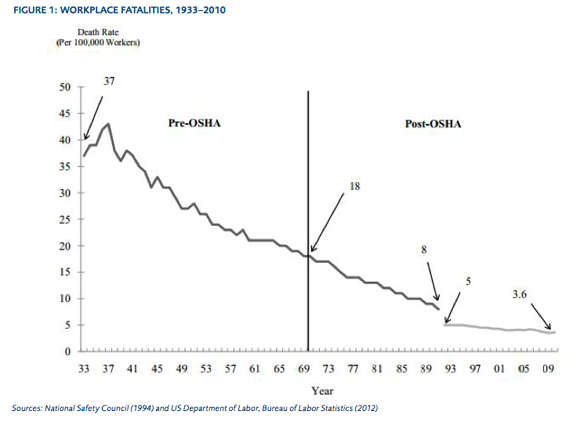
I also think that child mortality will go down over time even if we don't pass a lot of laws and people themselves will figure out solutions to avoid these deaths. A good data point to verify is this OSHA's impact on worksplace safety in USA.
I turns out that workplace safety was getting better even before OSHA and the giant regulation made absolutely no difference what so ever to the decline in worksplace deaths but put a significant cost on businesses. [2]
[1] http://www.cdc.gov/injury/images/lc-charts/leading_causes_of... [2] http://mercatus.org/sites/default/files/workplacefatalities5...
Here's a mother who left young children (oldest was four) to fend for themselves for a day while she went off on a drink and drug "binge": https://www.theguardian.com/uk/2009/nov/17/binge-mother-drug...
Plenty of deaths feel preventable. Her's a mother who didn't supervise her children and they ran into traffic. That event caused social services to take interest in her, and they advised her to cover a garden pond. She didn't, and one day while she was not paying attention to her children one of them died. That's a tragedy for that family.
For instance a parent that would leave a 2-year old alone to go play pokemon probably has other terrible parenting judgement/skills and most likely the environment they leave the kid in IS actually more dangerous than someone who accidentally leaves their kid alone.
They are standardizing risk assessment across all environments, but that's statistics not reality. Certainly some peoples moral assessments have gone overboard (it's crazy that kids can't go to the park unattended when they reach a general maturity). But I don't think it's unreal to assess the risk to a child as higher if you also think their parents are amoral and likely bad parents. Those kids ARE probably at higher risk in my opinion, either from their parents not being as cautious at establishing a healthy environment or in not being good enough parents to teach their kids how to behave in a safe manner when left alone.