News for hackers. Stuff that matters.
Re:ReactOS, a 17-year quest for an open-source Windows, has ... by SwellJoe on Wednesday December 16, 2015 @08:52PM (#10748961)
I've always been strangely fascinated by this project. I don't understand it. I appreciate the technical skill involved, and the amount of effort expended. But, I can't imagine working on it.

From my perspective, Windows is an inferior system to any UNIX-based system on almost every front. It has a very strong application ecosystem, but technically it's unpleasant to work on (for me). So, given that, if there's something I want an OS to do that Linux can't do, I would be motivated to work on making Linux able to do that thing so I could do that thing on an Open Source OS I enjoy using, rather than work on replicating Windows so I could do that thing on an open source OS I don't enjoy using.

But, it seems there are people who genuinely enjoy Windows more than Linux (or BSD), and are willing to work for 17 years in pursuit of being able to run an Open Source Windows version. I admire them for it, but still can't understand it.

Re:ReactOS, a 17-year quest for an open-source Windows, has ... by pjmlp on Thursday December 17, 2015 @03:01AM (#10750189)
- Written for thread based applications, not processes

- Asynchronous IO architecture only matched by Solaris

- Object based architecture

- OO ABI (more so with WinRT), besides the C one

- Allows C++ in kernel space

- Components as interoperability between applications

- User space driver model, specially nice for graphics drivers

- Pursues the mainframe ideas of safer languages for system and application's programming

- Powershell is closer to Xerox PARC REPLs than any UNIX shell, except for Mac OS X.

And what brought me back, after 10 years mostly in UNIX land, culture of using graphic based tools instead of a PDP-11 experience and desire to try new approaches to OS architecture.

Re:ReactOS, a 17-year quest for an open-source Windows, has ... by sspiff on Thursday December 17, 2015 @05:32AM (#10750624)
> Powershell is closer to Xerox PARC REPLs than any UNIX shell, except for Mac OS X.

Which shell do you mean on OS X? I thought they just shipped with zsh or bash?

Re:ReactOS, a 17-year quest for an open-source Windows, has ... by pjmlp on Thursday December 17, 2015 @05:47AM (#10750682)
I had Apple Script and Swift Playgrounds on my mind as I typed it.
Re:ReactOS, a 17-year quest for an open-source Windows, has ... by chris_wot on Thursday December 17, 2015 @07:08AM (#10750984)
To see the overall architecture, the following block diagram I created for Wikipedia some time ago might be helpful:

https://commons.m.wikimedia.org/wiki/File:Windows_2000_archi...

Incidentally, it annoys the living snott out of me that I took the time to put a PNG version of this together, someone redoes the diagram as an SVG then someone loads it to commons and I don't get any credit!

Update: I speak too soon. The image viewer doesn't show it, but the main page does.

Re:ReactOS, a 17-year quest for an open-source Windows, has ... by pjmlp on Thursday December 17, 2015 @07:16AM (#10751006)
Quite nice. Have you though about adding the new WinRT changes?
Re:ReactOS, a 17-year quest for an open-source Windows, has ... by chris_wot on Thursday December 17, 2015 @07:30PM (#10755800)
I haven't been following :( do you have a good pointer to info?
Re:ReactOS, a 17-year quest for an open-source Windows, has ... by skissane on Thursday December 17, 2015 @01:21AM (#10749927)
> From my perspective, Windows is an inferior system to any UNIX-based system on almost every front.

The core architecture of Windows NT is actually pretty nice. Its chief architect, Dave Cutler, was one of the lead developers of VMS. I think Windows NT and VMS do IO much better than Unix/Linux - making the basic primitives asynchronous, and layering synchronous IO on top, instead of asynchronous IO being a fragile afterthought. However, Microsoft has (no doubt forced by backward compatibility) layered a lot of less than pleasant legacy cruft on top of this nice core.

Re:ReactOS, a 17-year quest for an open-source Windows, has ... by aangjie on Thursday December 17, 2015 @02:59AM (#10750186)
That's an interesting point you make. I've not digged into NT, but is there some fork of linux that provides the same. I can think of GNU Mach, being a case of taking that to the extreme end (i.e: micro services making together a kernel).
Re:ReactOS, a 17-year quest for an open-source Windows, has ... by skissane on Thursday December 17, 2015 @09:54PM (#10756318)
I don't think GNU Mach in itself provides any IO facilities, as opposed to other layers on top (e.g. GNU Hurd). (And neither is a fork of Linux.) I'm not particularly familiar with Hurd, but I had a quick look at the Hurd Reference Manual, and it looks to me like the primary IO primitives are synchronous, and there are a couple of additional calls which provide some asynch support. This is different from the NT/VMS approach, in which the primitives are asynch, and synch is implemented by combining an asynch IO call with a wait for completion.
Re:ReactOS, a 17-year quest for an open-source Windows, has ... by userbinator on Wednesday December 16, 2015 @09:07PM (#10749020)
IMHO the nixes have a far superior CLI, but Windows' GUI is (at least pre-Metro, i.e. Win32 desktop) superior to the many disjoint alternatives that the Linux/BSD/OS X/Solaris/etc. world has. Instead of Qt, Gtk, and all the others, Windows just has Win32 and all apps have basically identical look-and-feel (except for those that go out of their way to reinvent the standard GUI elements, but in my experience this is much rarer on Windows) and it's relatively easy for them to interact.

(I've been writing Win32 apps for over a decade, so maybe I'm biased that way, but I definitely prefer (ba)sh over command.com/cmd.exe. My ideal environment would be a pre-Metro Windows GUI with a UNIX-based filesystem and command prompt...)

Re:ReactOS, a 17-year quest for an open-source Windows, has ... by sho_hn on Wednesday December 16, 2015 @09:10PM (#10749036)
> Instead of Qt, Gtk, and all the others, Windows just has Win32

No, Windows has Qt, Gtk and all the others, too. Virtually any regular user Windows install has 2-5 Qt apps on it. And Windows has been infamous for apps reinventing standard UI elements with skinned monstrosities.

Re:ReactOS, a 17-year quest for an open-source Windows, has ... by dlitz on Thursday December 17, 2015 @02:41AM (#10750145)
> And Windows has been infamous for apps reinventing standard UI elements with skinned monstrosities.

This becomes painfully obvious when you start working with any kind of GUI automation tools (e.g. AutoIt). I imagine users of screenreaders have similar issues.

Re:ReactOS, a 17-year quest for an open-source Windows, has ... by donatj on Thursday December 17, 2015 @12:40AM (#10749788)
It's been about 5 years since I was a regular Windows user, but I can't think of a single Qt app I used on a regular basis. Care to name some examples?
Re:ReactOS, a 17-year quest for an open-source Windows, has ... by sho_hn on Thursday December 17, 2015 @01:36AM (#10749975)
EA's Origin and TeamSpeak (-> most PC gamers), VLC (-> most young tech-savvy media consumers), various device bundled software like the stuff that comes with TomTom GPS, the LightScribe control panel, ... it just accumulates. Germany's official tax app is Qt so that's a whole country right there. Many HN users might use VirtualBox which is Qt. The new Radeon Control Panel is Qt, too, so anyone who buys an AMD graphics card and installs the drivers. Many slightly geeky users use qBitorrent ever since uTorrent turned bad. Lots of one-off mini apps such as game launchers and settings apps are often Qt. And lots of weird random stuff people use for specific interests ... knitting pattern software, kids edutainment apps, language course CD apps, scientific citation managers, IRC clients and other messengers (Telegram desktop is Qt), ...

This is before you get into pro apps like Mathematica or Maya (and half of Autodesk's other apps and Nuke and so on). Or not-pro but widely used and semigeeky stuff like Avidemux. Or Valve's video making tool for Source engine video games like TF2 used by game YouTubers and esports people.

Qt is a pretty common way to write GUI apps for Windows. Just go to any regularly used Windows PC with a 20-something user and I almost guarantee you will find a few qtcore DLLs.

Re:ReactOS, a 17-year quest for an open-source Windows, has ... by coldtea on Thursday December 17, 2015 @02:08AM (#10750065)
Common is an exaggeration. You mentioned a handful of examples, most of which are either programmer/geek intended or niche (the LightScribe control panel? German's official tax app? language course CD apps? Virtualbox? scientific citation managers, etc?)...

The fact is a user can go for years without ever using one. And in the tens of millions of apps available for Windows, QT based ones make for less than 1/1000...

Re:ReactOS, a 17-year quest for an open-source Windows, has ... by sho_hn on Thursday December 17, 2015 @02:15AM (#10750081)
I don't really know why you seem to have an axe to grind here. My original assertion was that most Windows PCs used by regular consumers have copies of Qt on them, and I stand by that. How that happens is not hard to see across the examples I gave: Widely deployed hardware support software, widely used content client software, auxiliary roles in widely used entertainment software, software required by law to use by a decently-sized country population, software used in content creation of various kinds, software used by students and in the course of common hobbies ...

Yeah, a user can conceivably go for years without using one. By far most won't though, or will have Qt apps installed they don't use frequently.

Qt is an 800k developer ecosystem[1] -- do you think they all work on Wireshark? Most of them write Windows apps.

1 = https://youtu.be/sa2gS9GKG9Y

Edit: windows.com seems quite taken as well: https://blogs.windows.com/devices/2011/03/15/10-qt-use-cases...

Re:ReactOS, a 17-year quest for an open-source Windows, has ... by coldtea on Thursday December 17, 2015 @09:32AM (#10751623)
>I don't really know why you seem to have an axe to grind here.

Not sure about the "axe to grind" thing -- I didn't call any names, and it kind of calls for people to see any kind of reply from me as further "aggression". I merely stated my opinion based on what I've seen 15+ years in IT (including using QT to write some KDE API based apps).

I believe I have a quite good understanding on where QT stands in the "commercial apps" landscape, and common isn't the word I'd use for it. Skype would be the biggest success story, if they still use it, and it looks quite different from the regular QT/Windows look (which is what we were discussing).

So, just by Skype alone sure, you'll find "most Windows PCs used by regular consumers have [a copy] of Qt on them", but that's not enough to call it common in my book. Most regular PC also have had Java applet SDK and even JREs, and one could cite a few apps using it, but few would call Swing "popular" in the desktop space.

As for Qt being a "800k developer ecosystem", a lot of them work on internal enterprise tools, automation software and stuff like that, which has been a traditional market for TrollTech and QT in past decades. Then there's always KDE of course too.

Re:ReactOS, a 17-year quest for an open-source Windows, has ... by sho_hn on Thursday December 17, 2015 @09:40AM (#10751684)
> As for Qt being a "800k developer ecosystem", a lot of them work on internal enterprise tools, automation software and stuff like that

Many of which run on Windows, FWIW.

Re:ReactOS, a 17-year quest for an open-source Windows, has ... by coldtea on Thursday December 17, 2015 @10:28AM (#10751986)
Sure, but our original discussion, lost in the sands of time, was about UI libs and how "regular windows users" have lots of QT apps. In the enterprise all bets are off, and all kind of crap is used, including tons of Swing, Flex, old VB6 apps, etc.

In fact, as I've just checked it again to be sure, the whole initial point was a non starter, trying to paint Windows as equally fragmented, UI-wise, as Linux.

Re:ReactOS, a 17-year quest for an open-source Windows, has ... by sho_hn on Thursday December 17, 2015 @10:48AM (#10752121)
I'd say Windows is a bit more fragmented UI-wise than Linux, even if you remove Qt from the conversation entirely. There simply hasn't been a strong notion of "this is how a Windows app looks" since the, say, Win 98 days between multiple different generations of MS-blessed designs, the skin-heavy era and a myriad of toolkits. The classic "Windows app" design in my mind is Notepad, and few apps look like Notepad. I admittedly don't use Windows heavily, but the few apps I use occasionally inside a Windows VM or on the dual-booted Windows on my laptop all sport widely different UI appearance:

- iTunes (built on a port of some of Cocoa I think)

- Spotify (custom UX, also on Linux - using Qt - but I don't bother)

- Steam (custom UX, own toolkit - also on Linux)

- EA Origin (custom UX, made with Qt)

- KakaoTalk (custom UX, I think using a native toolkit though)

- LINE (similar to Kakao)

- Telegram (custom UX, built on Qt - actually this runs fine on Linux, but I keep it in the VM alongside KakaoTalk because it's the same use case)

- Firefox (custom UX, with native-ish theming by its own XUL toolkit grabbing stuff from Windows APIs)

- Chrome (custom UX, built on a custom toolkit called Aura with some Windows exceptions)

- Kodi (custom fullscreen UX)

All of these are apps with user numbers in the range of hundreds of thousands to tens of millions, and they're all unicorns. (You may never have heard of KakaoTalk or LINE, say, but both have 50+ million desktop installed bases.)

Some of the above (Telegram, Firefox, Chrome, Steam, Spotify) show up on Linux just the same, no better or worse. Outside of that, most apps people actually use on Linux:

- KDE/Qt apps, which import a lot of standard structure from kxmlgui and DE settings (e.g. dialog button order, standard dialogs) from Qt's QPA plugins

- Gnome apps, which follow a strongly defined HIG

- Non-Gnome GTK+ apps imitating the Win98-style HIG for the most part (which overlaps a fair bit with the kxmlgui standard structure)

Sure, there's a long tail of other toolkits on Linux (just as on Windows), but my argument is basically: Going by the most-used apps, Windows and Linux suffer this problem (if you consider it one) to a similar degree, but Windows slighly worse because outside the apps showing up on both platforms, the remaining popular Windows apps are more fragmented UX-wise than on Linux with its three broad categories.

Heck, Windows 10's bundled apps are fragmented UI-wise to a much greater degree than any competing offering due to the classic/Metro divide.

It's an utter mess. An interesting question is whether this messyness hasn't had some benefits (like allowing app designers to iterate and innovate individually, with no concern for following a system HIG, allowing the overall platform not to fall behind the curb). But arguing the mess isn't there is very strange to me.

Re:ReactOS, a 17-year quest for an open-source Windows, has ... by JonathonW on Thursday December 17, 2015 @12:58AM (#10749856)
I am a regular Windows user (split between OSX and Windows, actually, but Windows gets used on a daily basis) and I can't think of a single Qt app I use on a regular basis now. Actually, with my current workflow, I can't think of a Qt or GTK app that I use on a regular basis on either platform.

I guess Wireshark's Qt and it gets used occasionally. But most of the cross-platform Qt and GTK stuff I used to install (Pidgin and GIMP immediately come to mind) I haven't even installed on a machine in ages. I've moved to native alternatives for a lot of the stuff I run, and what cross-platform applications I do run (Chrome, Sublime, etc.) tend to implement UIs with the native toolkit, since that's a much better experience on non-Linux platforms.

Re:ReactOS, a 17-year quest for an open-source Windows, has ... by laumars on Thursday December 17, 2015 @06:19AM (#10750798)
Chrome uses Aura (http://dev.chromium.org/developers/design-documents/aura)

I'd also argue that Qt applications are still "native" in that they run as a native EXE (or ELF on nix). Granted they don't use Win32 APIs, but then calling them non-native because of that is a little like calling Windows OpenGL games non-native because they don't use Direct3D. But that's an aside point.

On the whole, I don't think it makes sense to categorise Windows desktop applications by what toolkit they use. MS Office 2003 didn't use Win32 toolbars. Office 2007 then introduced the ribbon bar, which changed in appearance in every subsequent release of MS Office. And even within MS Office, Microsoft doesn't always follow the same design patterns (Office 2007 used ribbon in Word and Excel but not in Outlook). Even outside of MS Office, some Windows applications in WinXP used different menu bars to the ones provided by the Win32 APIs (you can see by looking at whether menu items go 3D or just highlight when you hover over them). One example was the difference between Windows Explorer and Notepad. Plus often older Windows utilities go completely unaltered for years, eg the add font dialog box in XP was still using Windows 3.1 APIs: http://apagreekkeys.org/images/addFont1.jpg ....and this is all without discussing the disruption Metro has caused.
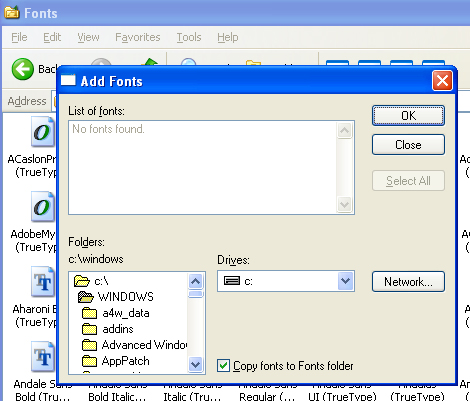
I will grant you that in spite of these criticisms, Windows still fairs better than Linux in terms of uniformity. But it's certainly not consistent enough to define anything that doesn't use Win32 widgets as non-native.

Re:ReactOS, a 17-year quest for an open-source Windows, has ... by cozzyd on Thursday December 17, 2015 @12:58AM (#10749858)
Skype might be the most popular.
Re:ReactOS, a 17-year quest for an open-source Windows, has ... by pjmlp on Thursday December 17, 2015 @03:10AM (#10750209)
Skype was written in Delphi originally.
Re:ReactOS, a 17-year quest for an open-source Windows, has ... by Qerub on Thursday December 17, 2015 @02:56AM (#10750175)
Last time I checked Skype only used Qt on Linux.
Re:ReactOS, a 17-year quest for an open-source Windows, has ... by rilut on Thursday December 17, 2015 @04:25AM (#10750397)
Not a common app, but GOG Galaxy is built on Qt
Re:ReactOS, a 17-year quest for an open-source Windows, has ... by pjmlp on Thursday December 17, 2015 @03:08AM (#10750200)
Only if you ignore Powershell.

You can orchestrate scripts in FP style, similar to the REPLs in Xerox PARC workstations, access any .NET, DLL or COM API as if it was part of Powershell, manipulate data without parsing it all the time, interact with running applications via Windows APIs....

Re:ReactOS, a 17-year quest for an open-source Windows, has ... by pjc50 on Thursday December 17, 2015 @07:00AM (#10750962)
I've tried to adopt powershell, and here are the obstacles I encountered:

1) You can't write or run scripts "out of the box", you need to do a security incantation first. A oneoff hurdle, but right at the start of the learning curve.

2) Perhaps because of (1), it's not very dogfooded: on a UNIX system, there are lots of already-existing shell scripts sitting around as parts of the OS. PS is not so rich in examples.

3) If you do actually want to parse data, it's not very good at this.

4) I've not worked out how to save intermediate stages in a pipeline to persistent storage.

5) Hasn't yet developed much of a "user culture", although I think that will come eventually.

Re:ReactOS, a 17-year quest for an open-source Windows, has ... by nailer on Thursday December 17, 2015 @09:33AM (#10751631)
You can't run scripts out of the box on nix either: you either need to manually mark the script as executable or invoke the interpreter and pass it as a parameter.

Not saying that's a bad thing, just that we (as Unix folks) do things intuitively that we forgot we once not intuitive.

Totally agreed on 2 though 5 though.

Re:ReactOS, a 17-year quest for an open-source Windows, has ... by noselasd on Thursday December 17, 2015 @09:34AM (#10751637)
What comes to mind by 4), is "tee", which powershell also has - but that's perhaps not what you want/mean ?
Re:ReactOS, a 17-year quest for an open-source Windows, has ... by pjc50 on Thursday December 17, 2015 @10:55AM (#10752167)
Almost, but not quite. Tee writes the pipeline to disk as text; you can't trivially take the written output and pipe it back in as objects. It's lost the magic.
Re:ReactOS, a 17-year quest for an open-source Windows, has ... by noselasd on Friday December 18, 2015 @03:24AM (#10757366)
Fair point. I believe you can use the Export-Clixml/Import-Clixml or ConvertTo-Xml/ConfertFrom-Xml for doing just that.
Re:ReactOS, a 17-year quest for an open-source Windows, has ... by pjmlp on Thursday December 17, 2015 @07:18AM (#10751013)
Regarding 1), at least it avoids the curl | sh => send $HOME to the world of current UNIX users.
Re:ReactOS, a 17-year quest for an open-source Windows, has ... by mkesper on Thursday December 17, 2015 @07:10AM (#10750992)
Re:ReactOS, a 17-year quest for an open-source Windows, has ... by z3t4 on Thursday December 17, 2015 @05:35AM (#10750636)
I use windows for the GUI. Win8 is very battery friendly, heck it uses less battery then Linux in console mode.
Re:ReactOS, a 17-year quest for an open-source Windows, has ... by cm2187 on Thursday December 17, 2015 @07:11AM (#10750994)
To me the superiority of the windows GUI isn't really beauty or consistency (which with Windows 10 is basically gone, you have three styles in the same OS - Win 8, Win 7 and Win XP). And Windows has many other rough GUI edges.

To me the real superiority of the windows GUI is that almost all of the settings are accessible with a GUI. In Linux or MacOX you very quickly end up having to write some command lines or editing a text file. That's great for already experienced users or administrators running batches. But to the common user, discoverability and intuitiveness is crucial and you are not helping them with an OS they can't understand or control. One should be able to visually see the state of the system.

If CLI had auto-complete/intellisense features, the gap would be smaller.

Re:ReactOS, a 17-year quest for an open-source Windows, has ... by flavor8 on Thursday December 17, 2015 @07:33AM (#10751073)
Regedit is not "discoverable".
Re:ReactOS, a 17-year quest for an open-source Windows, has ... by cm2187 on Thursday December 17, 2015 @07:48AM (#10751144)
Arguably it's not that bad, you can visually go through sections / sub sections, which is an order of magnitude better than having to call individual keys with a command line. But I wouldn't call that a good GUI either.
Re:ReactOS, a 17-year quest for an open-source Windows, has ... by kybernetyk on Thursday December 17, 2015 @04:53AM (#10750494)
>but Windows' GUI is [...] superior to [...] OS X

Hmm ...

Re:ReactOS, a 17-year quest for an open-source Windows, has ... by Zardoz84 on Thursday December 17, 2015 @06:15AM (#10750786)
If you think that an NOT USER CUSTOMIZABLE GUI is superior...
Re:ReactOS, a 17-year quest for an open-source Windows, has ... by recursive on Wednesday December 16, 2015 @09:13PM (#10749044)
Some people (like me) have invested a lot of effort learning how to use Windows. Some of those aren't particularly interested in technical superiority. The just want to use a computer in the sufficiently good way that they already know. Personally, I find Linux difficult to approach, because of the overhead involved in just getting back to my current level of proficiency. If I needed to learn it for a job, I would. I might even do it independently, eventually.

It's similar to the dominance of QWERTY.

But even I would much sooner learn how to use linux, than embark on a crazy project like this.

Re:ReactOS, a 17-year quest for an open-source Windows, has ... by beagle3 on Wednesday December 16, 2015 @11:01PM (#10749440)
Could you give your opinion on Win8/8.1/Metro/Modern ? How would you rate its effect on your proficiency?
Re:ReactOS, a 17-year quest for an open-source Windows, has ... by codedinosaur on Thursday December 17, 2015 @12:54AM (#10749839)
My situation is almost identical to recursive. I upgraded to Windows 8, right when it came out. Hated the jarring dual interface. But the only thing I had to do was install Classic Shell[0]. And I was back to the familiar Windows. Practically nothing else changed from the UI perspective. The same with Windows 10 as well. I'm addicted to the Win32 based Start menu and the ability to right click files and folders from search results. So I installed Classic Shell over the new Metro based Start Menu and everything is back to normal again. Plus, I don't miss out on the speed and security improvements.

[0] http://classicshell.net/

Re:ReactOS, a 17-year quest for an open-source Windows, has ... by beagle3 on Thursday December 17, 2015 @02:59AM (#10750185)
Thanks. Does it totally kill metro? Everytime I work on a Win8 computer, I manage to do something that brings metro up (e.g, press the network icon in the notification area on the right, or press the "Windows" key on the keyboard), and start cursing ....
Re:ReactOS, a 17-year quest for an open-source Windows, has ... by tracker1 on Thursday December 17, 2015 @04:36AM (#10750431)
I'd say upgrade to 10, not as nice as 7, but way better than 8/8.1 ... just disable the two bing search options (they're annoying).

Also used ClassicShell on Win8.. if you lauch a metro app it will go metro mode.. but that's the only case.

Re:ReactOS, a 17-year quest for an open-source Windows, has ... by codedinosaur on Thursday December 17, 2015 @05:50AM (#10750697)
It does not quite kill metro, but it hides it really well. Pressing the Windows key or the Start button gives you the Old school menu. If you want the new Metro Start screen on Windows 8.1 or the menu on Windows 10, you have to press Shift+Enter. So unless, you specifically or accidentally press Shift+Enter you will never see Metro again.

The only time I had to go to the Metro Start Menu was to find the Universal Apps like Mail and Edge browser. These don't show up on the Classic Shell results for some reason. Once I pinned them to the taskbar however, I haven't needed that Metro screen again.

Re:ReactOS, a 17-year quest for an open-source Windows, has ... by ikurei on Thursday December 17, 2015 @02:57AM (#10750180)
> if there's something I want an OS to do that Linux can't do, I would be motivated to work on making Linux able to do that thing so I could do that thing on an Open Source OS I enjoy using, rather than work on replicating Windows so I could do that thing on an open source OS I don't enjoy using.

That's a great ethos, but it's not that Windows can do something Linux can't. If you want to play a game/use a CAD made only for windows, are you going to pour years into cloning it? Yeah, Linux has, at least, competent applications for almost every need, but sometimes what you want just isn't available.

ReactOS is shooting for the moon, but if it took off and got to an almost 100% windows-compatible state, I'd be glad to have an Open Source Windows.

Re:ReactOS, a 17-year quest for an open-source Windows, has ... by eloisant on Thursday December 17, 2015 @03:37AM (#10750274)
If you want to run Windows applications on an Open Source OS, the Wine approach is much more realistic. It's also nicer because for everything that Linux can already do, you don't have to mimic Windows.

Anyway, desktop applications are not that relevant today, and most of those that are (like web browsers, developer tools) are cross-platform anyway.

Re:ReactOS, a 17-year quest for an open-source Windows, has ... by snvzz on Thursday December 17, 2015 @05:46AM (#10750680)
ReactOS shares a lot of code with Wine. Mostly DLLs. Code flows both ways.

Even if you're never going to use ReactOS, it still helps make wine better.

Re:ReactOS, a 17-year quest for an open-source Windows, has ... by Nullabillity on Thursday December 17, 2015 @05:26AM (#10750596)
IIRC, ReactOS is based on Wine anyway.
Re:ReactOS, a 17-year quest for an open-source Windows, has ... by redblacktree on Thursday December 17, 2015 @01:26PM (#10753272)
> Anyway, desktop applications are not that relevant today, and most of those that are (like web browsers, developer tools) are cross-platform anyway.

Yes, but PC games are very relevant. They are the entire reason I have a Windows machine at all.

Re:ReactOS, a 17-year quest for an open-source Windows, has ... by rogeryu on Thursday December 17, 2015 @08:34AM (#10751338)
Exactly. I have some apps that don't run on Linux, like Photoshop and at work the printer driver. It seems that ReactOS is much faster than XP running in Virtualbox, and if Photoshop and that printer driver work in ReactOS, then I'm all for it.

I hope this does provide a better user experience than Wine, because I've tried that, and after a while Photoshop breaks down somehow. Elements on the page disappear, file operations don't work and in the end it all stops. I want something that is stable, and I hope this works better than Wine, even if both share much code.

Re:ReactOS, a 17-year quest for an open-source Windows, has ... by alok-g on Thursday December 17, 2015 @01:50AM (#10750013)
Below are the issues I face with Linux:

- Windows has better accessibility support. (Windows 10 has messed some of it up.)

- When there are issues, it is easy to find help with Windows than for Linux. Unless it is about a BSOD which are rare now.

- While there are many claims that Linux does not need a firewall, I do not agree. Setting up a firewall on Linux is a lot more challenging (newbie here) than on Windows. For example, on Windows, I can easily control which application can access the Internet using some paid firewall product.

- Finding replacement for Windows applications on Linux is a troublesome, especially given that most of them would have minor unadvertized issues like accessibility or some counter-intuitive thing with zero documentation.

Re:ReactOS, a 17-year quest for an open-source Windows, has ... by SwellJoe on Thursday December 17, 2015 @02:17AM (#10750088)
Accessibility is an excellent reason to choose Windows, probably sufficient even on its own, if you need an accessible system. Accessibility is hard, and requires a ton of resources to do well...Microsoft has been willing and able to expend those resources. I do know users who require assistive technologies to work who use Linux, but it's rare and they're extremely technically savvy themselves (usually software developers).

As for finding help, I usually find it's the opposite, or at least the kind of help I find for Windows is often very cargo cultish. e.g. "I did these fifteen mysterious steps, and my problem when away. I think that's what fixed it." I feel much more in command of the system with Linux. This is, admittedly, at least as much my own depth of knowledge. I've been building products for Linux for two decades, including kernel development, patching system libraries and services, etc. I actually understand Linux systems on a pretty deep level; I don't understand Windows systems, beyond the GUI.

Firewall? Meh. The default firewall on a Fedora system is fine. There are tons of free tools for managing the iptables firewall (and firewalld simplifies management at the expense of flexibility). I never use a UI, though, as it's pretty easy to use once you understand the basic concepts. But, a firewall isn't really the most important part of securing a system.

Application replacements could definitely be an issue, with regard to accessibility. I am more comfortable with Linux options because of familiarity. I'm less productive with the "leading" applications than I am with their Open Source competition in almost every instance. Inkscape is easier for me than Illustrator, Gimp easier than Photoshop, but again it is due to extreme familiarity. Over a decade of use vs. occasional forays into the Adobe products because a designer I'd hired wanted to go back and forth on designs and was using Adobe products.

Sometimes ease of use is just another way of saying "What I'm used to". I'm just much more used to Linux. I used Windows full time for a little under a year after switching from Amiga in 1995, then switched to Linux, and have been using Linux almost exclusively ever since...I have a Windows partition for games and audio recording. Of course, I've been using it almost exclusively all that time because I strongly prefer it and always have, even when it was really rough around the edges and patching and compiling kernels was just a normal part of being a Linux user. I don't miss those days, but the strength of UNIX/Linux over Windows (to me) stood out even then and even with all of the warts.

Re:ReactOS, a 17-year quest for an open-source Windows, has ... by dingaling on Thursday December 17, 2015 @05:31AM (#10750617)
> The default firewall on a Fedora system is fine

It really isn't.

Try blocking one particular program from accessing the Internet. You'll end-up messing around with assigning programs to group ownership and then adding ip tables rules.

Linux-Android goes all the way and sandboxes programs which makes firewalling easier. But desktop Linux is far behind.

Re:ReactOS, a 17-year quest for an open-source Windows, has ... by flavor8 on Thursday December 17, 2015 @07:36AM (#10751091)
Re:ReactOS, a 17-year quest for an open-source Windows, has ... by DanBC on Thursday December 17, 2015 @06:36AM (#10750862)
> While there are many claims that Linux does not need a firewall, I do not agree.

Aren't the claims more like "you shouldn't run the firewall on the same machine that you want to be firewalled"?

I know that programs like Windows Firewall or Little Snitch (OSX) are good enough for most stuff, but when they're not good enough you're going to regret not having a seperate firewall.

Re:ReactOS, a 17-year quest for an open-source Windows, has ... by restalis on Thursday December 17, 2015 @08:01AM (#10751193)
A local firewall can be set up along with an external firewall. Having a firewall only somewhere on a separate machine doesn't address the use-case alok-g described - he (and many others including myself) may want to "easily control which application can access the Internet".
Re:ReactOS, a 17-year quest for an open-source Windows, has ... by xcasex on Thursday December 17, 2015 @05:22AM (#10750583)
I vehemetly disagree wrg. to firewalls and a11y.

Gnome-Shell (default on fedora et al.) has since the GNOME projects 2.x release had _stellar_ accessability support.

Firewall? you fail to mention what you'd block. there are ease of use projects shipping per default such as UFW. But since it's uncommon in the post-inetd era to have services running and exposed publicly, i fail to see the usecase.

bsods? uncommon? i have four baytrail tablets that spew forth a bluescreen once a day.

Re:ReactOS, a 17-year quest for an open-source Windows, has ... by fsloth on Thursday December 17, 2015 @02:24AM (#10750102)
"From my perspective, Windows is an inferior system to any UNIX-based system on almost every front. It has a very strong application ecosystem, but technically it's unpleasant to work on"

I suppose this depends on the workflow. Powershell is just as powerfull for me as bash (I can't help to learn the syntax for either of them - I just google the expression for iterating a command over files and whatnot)

I start applications with a shortcut - on windows this is windows key + plus a few starting letters of the application name.

That's about all I need from the OS.

"if there's something I want an OS to do that Linux can't do, I would be motivated to work on making Linux able to do that thing so I could do that thing on an Open Source OS I enjoy using,"

This might be the main difference- for me the OS is just an underlying substrate to support my programs I want to run and develop. For third party apps - once I'm in the application the OS pretty much fades into the background unless there is a problem - and quite a lot of the code I write is pretty much platform agnostic.

The main point of the OS for me then is, how much of it works unobtrusively out of the box. And since windows comes in the box for off the shelf hardware it's the easiest for me.

I did do dual boots in the past but now I don't see the point anymore for desktop use. For some document batch runs I've not yet found equivalent for windows world for so for those I see the value for a virtual machine. My NAS box runs linux and it's pretty sweet.

So are there anything that actually locks me on windows? Visual studio is really, really nice for C++ development and that alone would be a sufficient reason for me to run windows. And then comes the sweet, sweet surface pro with its fantastic pen - basically, that combined with Manga Studio takes me to a place of digital art bliss (no, I'm not a paid advertisement - I've used digitizers for two decades and drawn all my life I know what I like - even if just for a hobby).

That said, I don't trust proprietary stuff for anything of value - i.e. data and programs which I would like to be able to run always - but the windows platform offers currently the best platform for the creative activities - coding and art - that I do at home.

Re:ReactOS, a 17-year quest for an open-source Windows, has ... by qubex on Thursday December 17, 2015 @09:52AM (#10751750)
You're confusing the OS with the UI. This is sadly commonplace.
Re:ReactOS, a 17-year quest for an open-source Windows, has ... by fsloth on Thursday December 17, 2015 @12:12PM (#10752702)
Sorry, did you answer to a wrong message? I don't know how your response applies to my message.
Re:ReactOS, a 17-year quest for an open-source Windows, has ... by qubex on Thursday December 31, 2015 @02:40AM (#10816697)
Sorry indeed — it does indeed seem I answered the wrong comment. My apologies both for that and for the delayed response.
Re:ReactOS, a 17-year quest for an open-source Windows, has ... by krylon on Thursday December 17, 2015 @02:33AM (#10750127)
Personally, I strongly prefer Unixoid systems, too.

But in my day job, I am a Windows admin (and helpdesk monkey). If there was a system that is both free software and binary compatible with Windows, that would be pretty nice, if only to give Microsoft some competition.

And on the corporate desktop, Windows totally and utterly dominates. Replacing it is next to impossible, because most of the applications (at least in our case) are not available for other systems. So a free software-alternative that maintains compatibility would be really nice.

(Of course, ReactOS is aiming for XP-compatibility, so even if they reach 100% compatibility, they still have a long way to go...)

Re:ReactOS, a 17-year quest for an open-source Windows, has ... by restalis on Thursday December 17, 2015 @08:50AM (#10751404)
ReactOS aims to be compatible with Windows 2003 only on the kernel level. Compatibility on the user-space level is not restricted to that.
Re:ReactOS, a 17-year quest for an open-source Windows, has ... by krylon on Thursday December 17, 2015 @11:05AM (#10752238)
That's good to know. Thanks!
Re:ReactOS, a 17-year quest for an open-source Windows, has ... by tracker1 on Thursday December 17, 2015 @04:25AM (#10750392)
Windows can run an executable with a GUI interface compiled for 32-bit Windows over 20 years ago...

Though it's far from perfect, Windows has a better binary compatibility record than ANY other OS for far longer periods of time. There is something to be said for that. It's only recently (for 64-bit windows) that DOS support (ntvdm) has been unavailable.

Re:ReactOS, a 17-year quest for an open-source Windows, has ... by dTal on Thursday December 17, 2015 @06:35AM (#10750860)
At the user experience level, you're certainly correct.

However, as a sibling comment notes, Linux has also preserved binary compatibility (at the kernel level) for a similar amount of time (of course as long as neither of them break compatibility then Windows will have the numerical edge as it's slightly older).

So the question becomes, why is compatibility so apparently good on Windows and so apparently bad on Linux? I feel it's to do with a culture of dynamic linking and compiling your own software. A statically linked X11 application from 15 years ago will, as far as I can tell, run fine on Linux - it's just that such things are rare. You're far more likely to come across either a dynamically linked binary, or a source tree. This seems to be reflected in source code compatibility, which is better in Linux.

Re:ReactOS, a 17-year quest for an open-source Windows, has ... by tracker1 on Saturday December 19, 2015 @04:58AM (#10763169)
But the core libraries used in Windows aren't statically compiled... they're dynamically linked, and work across windows versions for decades. I regularly have several applications I need to re-install, or correct configurations for after doing maintenance updates in Linux. In windows, usually only system utilities (A/V) are broken between major version upgrades.

There really isn't a comparison, but it does have value to a lot of people. I don't mind so much, but there's enough people that do. I've helped many people over the years switch away from windows, and half of those switched back to windows within a year.

Don't get me wrong, I really like Linux... but stability for the standard atypical end user isn't very good at all.

Re:ReactOS, a 17-year quest for an open-source Windows, has ... by pzone on Sunday December 20, 2015 @04:38AM (#10766588)
The standard on Windows is to toss a bunch of .dlls in with your distribution. Linux uses package managers and tries to avoid multiple copies of shared libraries.
Re:ReactOS, a 17-year quest for an open-source Windows, has ... by tracker1 on Monday December 21, 2015 @01:16PM (#10772432)
I don't remember seeing kernel32.dll or system32.dll or a lot of others in any software distribution (outside windows itself).
Re:ReactOS, a 17-year quest for an open-source Windows, has ... by SXX on Thursday December 17, 2015 @05:19AM (#10750573)

    > Windows can run an executable with a GUI interface compiled for 32-bit Windows over 20 years ago...
Linux can also run really old code that is 16-17+ years old: Loki Software games ports from 1998-1999. Though there just no need for average user to run anything that old so it's usually not available out of box.
Re:ReactOS, a 17-year quest for an open-source Windows, has ... by ArkyBeagle on Thursday December 17, 2015 @02:51AM (#10750165)
I barely notice the difference between Linux and Windows these days. A lot of that has to do with having a common scripting language between the two.
Re:ReactOS, a 17-year quest for an open-source Windows, has ... by Joeboy on Thursday December 17, 2015 @05:20AM (#10750576)
Is there a common scripting language that they both speak natively?
Re:ReactOS, a 17-year quest for an open-source Windows, has ... by ArkyBeagle on Thursday December 17, 2015 @01:39PM (#10753383)
I am not sure what "natively" means. I use Tcl because it's a conservative choice; very nearly any of the usual suspects will run on both. There are of course many small and irritating differences.