Pensions are an issue that divides rich and poor. This guy is rich. We are not. This article seems to be about him trying to destroy our pensions.
The so called existential crises were created by the financial sector he hailed from. They did not appear out of thin air. For example:
https://www.wsws.org/en/articles/2014/01/14/swap-j14.html
When the financial sector is in trouble, they get given virtually unlimited bailout money and they have interest rates set to accommodate their desires.
When municipalities and pension funds are in trouble they are told to go fuck themselves.
And blaming the financial sector for the pension crisis is ridiculous. States and municipalities entered into very risky financial arrangements because for years they made very optimistic actuarial assumptions about pension fund growth, and committed to benefits that could not be sustained once population growth plateaued.
Investing in those risky assets was a gambit to get the kind of returns they needed to stay solvent. That gambit failed, but financial companies didn't create the underfunding that led to the need to invest in risky assets in the first place.
Whatever your political slant, in this case it looks like class warfare, it can be turned against itself when debt starts limiting the degrees of freedom political action can take. Conservatives will do the same thing -- for them the argument will be something like "if we can't fund the national defense/LE, why do we need a government in the first place?"
Long term, this debt problem, whether local or national, is some nasty, radioactive stuff.
That's the problem, isn't it. If you can use debt or a surplus to game the system, everyone loses at someone else's benefit.
If you want to force companies to support retirement, force them to pay into employee's retirement accounts.
The benefit of individual accounts is that they're a lot harder to raid or defund.
Your idea of only individual retirement accounts is a terrible one.
Uh, then choose a different financial firm? I have $100k+ in my brokerage and pay about $10 a year in fees...
The middle class is gone.
>They are way better off than the young people who will be paying for them.
As opposed to the oligarchs who are trying to leech wealth from both groups?
>And blaming the financial sector for the pension crisis is ridiculous.
Did you read the link? What happened to Detroit was looting and fraud. Plain and simple.
>States and municipalities entered into very risky financial arrangements because for years they made very optimistic actuarial assumptions about pension fund growth
Optimistic == We assumed that interest rates would not be dropped to zero to bail out the financial sector. This was a reasonable actuarial assumption pre-2008 and it should have been a reasonable actuarial assumption post-2008.
>Investing in those risky assets
Investing in those risky assets largely happened after the government decided to drop interest rates to zero in order to bail out the banks. Much of it was also driven by un-prosecuted fraud.
- sun-belt city has a lot of young people moving to it, not so many kids, not much infrastructure
- city hires young workers, builds infrastructure, assumes a high return to pension funds
- city has older people over time, more kids, more infrastructure, needs to raise taxes
- taxpayers resist, city assumes even higher return on pension funds, raids pension funds to balance budget
- early hires are ready to retire, pension is broke, taxes go up
- taxpayers move away to new city or suburb, sun-belt city faces rust-belt city dynamics and can't afford pensions
financial market returns have if anything been unusually good the last 30 years regardless of the crisis, volatility, financial sector shenanigans... if you see a true bear market like the 70s God help those new rust belt places.
whatever the problems with the financial sector, there's an unstable dynamic where new growing places have a virtuous cycle, and once you cross a threshold and growth slows, it reverses and you have a vicious cycle of decline.
This is US-centric.
The industry left for China because, again, the government is placing the interests of financiers over the interests of average Americans.
They do this by following a strong dollar policy (the polar opposite of China's weak yuan policy).
That's not so much the government as it is the companies doing the moving, it's all about the cost of labor and in developing countries that cost is a small fraction of a developed one, no matter what their currency policy.
The 'strong dollar' is only strong relative to other currencies, and is mostly strong because it is the reserve currency for many and the currency in which oil is being traded.
The companies are doing the moving because the Chinese government pegs its currency very low and the US allows its currency to float very high.
There's nothing at all inevitable about all that ridiculously cheap stuff coming from China or those abandoned factories in Detroit. It's all the result of a set of very deliberate policy choices.
>it's all about the cost of labor and in developing countries that cost is a small fraction of a developed one, no matter what their currency policy.
If labor were all that mattered all of the new factories would be built in the middle of Bangladesh rather than in the Pearl River Delta. Their labor is far cheaper.
Most of the world has lower cost labor. The work goes to China specifically because it has infrastructure of a rich nation but the currency of a poor nation.
Even with that there is no requirement for us to trade with them.
US elites also made a deliberate choice to drop trade barriers with China despite the repressive nature of the country. Again, because it serves the interests of US oligarchs.
>The 'strong dollar' is only strong relative to other currencies
What exactly did you think I meant by strong?
Governments can influence their currencies only so much before they too become overstretched and their limits are tripped well below the level at which the developed/not yet developed part would no longer make sense. We're not talking about 10 or 20% here.
The work goes to China because right now for some goods that makes the most sense to companies that have the option to choose. But this does not hold true for all goods and it will not hold true forever.
There is absolutely no requirement for you to trade with them, simply stop buying anything made in China.
As far as the lack of trade barriers goes, wasn't the US the biggest proponent of a free market worldwide?
I couldn't see jack shit going on when I visited. Just clothing factories. Clothing always migrates to where the labor is cheapest because it is one of the least capital intensive industries and most labor intensive.
Even then it was only in the area around Dhaka (and close to the container port).
North of Dhaka there was basically nothing except poverty (which is pretty much what it's like in most of Central China, too). No infrastructure = no industry.
>Governments can influence their currencies only so much before they too become overstretched
What you meant to say was "governments can push the value of their currencies up only so much before being overstretched". Pushing them down isn't all that hard.
Right?
>As far as the lack of trade barriers goes, wasn't the US the biggest proponent of a free market worldwide?
A) There's no such thing as a free market. It's an economic fairy tale.
B) US oligarchs are big proponents for tearing down trade barriers. Union leaders not so much.
C) Just how much do you think they cared about destroying US industry in the process?
Not all that long ago, China could make clothing, basic machinery and some consumer goods that were not too capital intensive.
It's an incremental process.
> Just how much do you think they cared about destroying US industry in the process?
Not a whole lot. But then again, that's their prerogative under the system you have in place. If someone wanted to keep the jobs local and to exclusively source their half-fabricates from local producers under exclusive contract stating that they were required to maintain this all the way up their supply chain then such a person might have cornered the market against those willing to sell out your countries manufacturing backbone.
The most likely outcome of such a plan would have been bankruptcy. It's an arms race and everybody that buys 'made in China' stuff because it is slightly cheaper is complicit.
It is indeed an incremental process. An incremental process some countries never begin.
>that's their prerogative
Why is it the prerogative of American elites to set trade policy that benefits them and fucks the rest of us over?
you don't want to have free trade and get cheap stuff from China, slap a massive tariff on them, you pay $2,000 for your iPhone, you deal with massive smokestack industries here, and of course become a manufacturing ghetto since you can't export anything if you refuse to import anything.
the flip side of strong dollar is a free lunch and influence since everyone around the world wants dollars. run a closed economy and forget about that.
in fact all of Silicon Valley is a product of globalization. Design in California, manufacture in Pearl River delta, sell globally, create a dominant tech culture and ecosystem, most of profits come back to California.
yeah, Wall Street is a problem, they're doing a few things like Dodd Frank, CFPB etc. to reduce the free lunch Wall Street gets, could do more.
honestly poor muni governance, idiots who refuse to pay taxes for services is a bigger reason pensions are broke.
If my rent dropped by 5% and my smartphone price spiked to $2,000 I'd still come out ahead.
If this policy continues indefinitely eventually the US industrial ecosystem will be destroyed completely. When that happens China will abandon its "keep the yuan low" policy and your smartphone will suddenly cost $2,000 but the US won't have the expertise or the infrastructure to suddenly rebuild all its factories. That will take decades.
Then the US will end up like Argentina - a pale shadow of its former wealth.
If a mercantilist trade policy was the only thing keeping the USA wealthy we're not going to stay on top anyway. You don't stay rich by trying to keep the rest of the world poor. That is the attitude that gets you to Argentina politics though.
It would be a shame if the richest country in the world were to say economic and civil liberties are great at home, but we're not going to lead by example and deal that way with the rest of the world.
Cheap yuan policy is history and has been for a few years, people don't seem to have caught up to that yet.
The $15 minimum wage is another example of this 'war on poverty.'
Some countries make an effort to be let hard-working poor people live with dignity if not much wealth. But here they pay 15.3% FICA on the first dollar they earn, and then people rant about the 47% who don't pay taxes and should have 'skin in the game.' And communities are designed with no transportation, housing options for the poor.
I am not rich, but I am young. And I despise the fact that I'm paying for retirement programs and pensions for people who just happened to be born at the right time with the right job.
It's fundamentally unjust that we're forced, by law, to pay for benefits we will never receive.
This is the attitude American oligarchs have been trying to inculcate among the young. This was notably the goal of Pete Peterson's "the can kicks back" astroturfing campaign as well as Stan Druckenmiller's college campus campaigns, and even this neat piece of astroturf: http://www.quickmeme.com/Baby-Boomer-Dad/?upcoming
The idea is to keep young and old divided so that they will not form a cohesive political bloc that will not fight for each other's interests. The young will be complicit in strip-mining the pensions of the old. The old will be complicit in the absurd ramp up of student debt and the removal of pension rights from the young.
Embrace reason.
You're delusional. Where did I ever recommend reading Atlas Shrugged? Ayn Rand is nuts.
Personal attacks are not allowed on Hacker News, regardless of how off-base someone else may be.
I'm young-ish, I have no pension, I work for myself, and I'm definitely not well-off by any stretch. I have no horse in the pension game, except that I'm largely in the same boat as you (I'm guessing).
The difference is, I look at the people with pensions and I don't think, "oh those pension-holding fat cats". I look at them and think, what happened to the rest of us?
Why is it only the people whose decent standard of living was locked in by law or extensive contracts, why are they the only ones who definitely get to retire now?
There is a big con going on here, but it's not those folks with pensions, it's that the rest of us are now reduced to fighting over scraps.
You're right: that is rather impolite.
> what happened to the rest of us?
Pensions are a fundamentally stupid system. You shouldn't be depending on an employer to fulfill a defined benefit. Even if everything works perfectly (ie. the employer remains solvent and doesn't raid its pension fund), it provides a HUGE disincentive against pursuing job opportunities or entrepreneurship.
The solution is that everyone should be saving for themselves. I fail to see the "con" in people saving for their own retirement.
The con is that pensioners can use the threat of violence to force me to simultaneously save for my own retirement and pay for theirs when they never saved a penny.
Even if defined benefit pensions still existed, I would never get one as I have precisely 0 interest in working for the same employer 10+ years. I don't see why I should be forced to pay for people who are lifers.
You're right, people shouldn't have to depend on an employer for retirement (or health care)--that should be up to our government to provide us.
As for "violence," I have no idea what you're talking about, unless you're actually suggesting that the pensioners are wheeling their walkers up to you and shaking you down. Remember, taxation isn't violence.
Most of the private economy switched to individual retirement accounts (401Ks/IRAs) so that you don't have to depend on the ability of a private company that may or may not exists 40 years from now (when you retire) and you can instead depend on yourself.
Save some money. It's simple. You'll be fine.
Except, it obviously isn't working out in practice. People can't save enough, and it's not just down to a personal failing--it's systemic.
People can't save enough because our wages have been separated from our productivity--and kept down--for the last four decades. That's bigger than the individualistic "every man for himself" type of advice that "save some money" sounds like.
Besides, the realistic view suggests that something bigger is wrong, and something better should be done, when simplistic advice like that isn't working.
I was talking about you. Personally. Frondo.
http://calcoastnews.com/2014/12/slo-countys-six-figure-pensi...
The battle isn’t between pensions and the financial sector. That is infighting. The real battle is between the people paying into government and those getting money from the government.
Not sure this is a liberal/conservative thing, although I'm sure it will be framed as such. At the end of the day, it is possible that the overall debt situation forces voters to either walk away from the debt -- or walk away from representative democracy. The two may not work together.
Of course, like everyone else I'm wrong about most every sort of prediction, but I note that Jefferson, observing revolutionary France, was quite concerned that inter-generational debt was quite capable of strangling any sort of revolutionary activity or peaceful refactoring of the way government works. I doubt his observations are any less accurate now than when he made them.
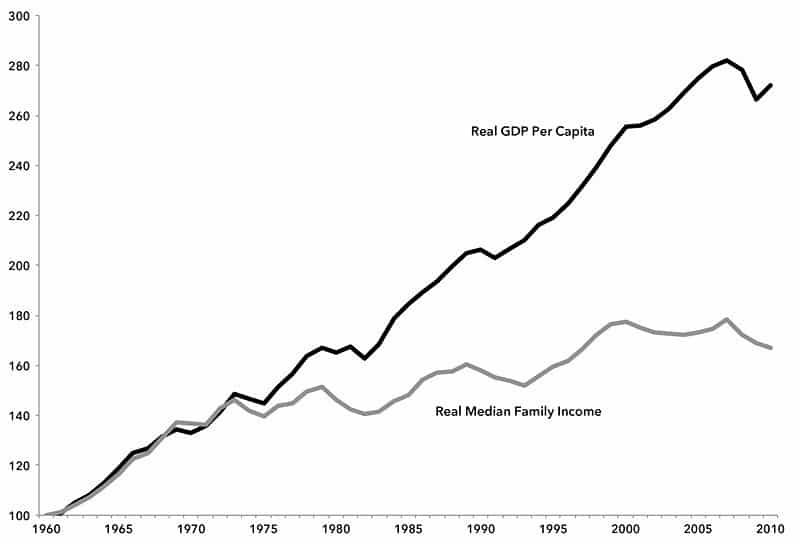
It doesn't make sense to me to worry about the knock-on effects of this loss (like unfunded pension liabilities) when this problem is still in place.
Does real median family income include non-cash compensation, particularly healthcare?
Literally? To Steal, from Websters: "to take (the property of another or others) without permission or right, especially secretly or by force"
Someone upthread suggested that Detroit was an example of how unfunded pension liabilities were the product of looting and corruption. I submit that Detroit is a better example of how artificially provoked demographic shifts can kill a city. However corrupt Detroit is, nobody can argue that it was better off after "white flight".
Pensions are going to be an issue that deeply divides younger and older liberals. State and local governments face existential crisis. Meeting pension obligations is going to require trading away the future prosperity of these places. What young millenials will want to move somewhere they have to pay high taxes, but get few services in return because all that money is going to paying pension obligations?
It's also going to be a major headwind to the trend of millenials moving back to urban areas. Cities have particularly screwed up their finances. E.g. Georgia pensions are pretty well funded, but Atlanta's is a disaster. As millenials get older and have kids, the cuts to public safety and education that will be necessary to meet pension obligations is going to drive many of them to the suburbs.