The second, in my opinion, represents a misunderstanding of why the (likely STEM) college degree has become the defacto gate to employment. Academic curricula, by design, focus far less on skills and masteries that are directly marketable and instead focus on building a foundation in a given field from which students can build on later (in either employment or higher studies and research). In my experience, the first 6 months to two years of many technical jobs is exactly the apprenticeship you're alluding to. However, they are being subsidized by the employer, not the taxpayer. Given the investment being made in new hires, the focus on cheap (from the employer's perspective) general signals to basic competence (like the ability to complete a degree at a university that already invests heavily in selecting for the best candidates) becomes a logical position to take.
I say all of these things, but unfortunately can't offer a solution. So long as the risk in a new hire is so one sided, I can't see the situation changing.
I come from an academic family (both parents had doctorates and one had a law degree), and I can appreciate the effect education has on one's ability to cross skill boundaries, read between the lines of empty rhetoric, and so on.
We already subsidize higher education to a significant degree. Perhaps if we incentivized high school graduates with state-subsidized apprenticeships that build into a tuition account (like social security, or a civilian GI Bill), people can still receive higher education with an assurance that they are a productive member of society in the first place. Sure, it raises the bar for entry if you don't have rich parents, but do we really need more indebted baristas with English degrees?
I feel like you're making a value judgement here that isn't entirely fair. The biggest shock to me after graduating (with a degree in Electrical Engineering degree suma cum laude from a top 5 engineering school) is how much a crock of utter shit the much spouted "STEM shortage" was. Not only are there plenty of graduates, the actual duties involved in the over whelming majority of the available jobs could be done by next to anyone.
When your indebted baristas are just as qualified for highly lucrative positions like enterprise software engineering it's a cultural problem not an individual problem.
As an aside, the smart companies are using this to make bank. I work in enterprise software for a major financial institution and these liberal arts majors are a gold mine. They spend the same amount in training that they would on any fresh hire but, because of lack of opportunities available for humanities graduates, can lock them into lower starting salaries and stricter performance metrics.
I feel like it's only a matter before the rest of technology catches up and realizes how much money they are leaving on the table by only hiring people that can code a red-black tree on the white board to develop their CRUD apps and maintain their databases.
Most people don't think much of it but people who cut hair, do HVAC work, plumbing, electrical, washing cars, running funeral homes, etc will be in demand until the thing they work on no longer exists. The only real barrier here is people willing to try to do it themselves to save money but that doesn't create competition so much as just removes a single customer.
Now, I don't blame entrepeneurship or technology for that, but it's not so simple to just change your personality to fit the economic imperatives of the day, and I simply don't desire to spend all my time as a disruptive wealth maximizer. The whole 'software is eating the _____ industry' mindset is the technological equivalent of slash-and-burn agriculture - it's not a sustainable strategy for the population at large, and we're seeing that reflected in many countries by the drift towards electing increasingly radical politicians of both left and right.
PS: 65 - 18 = 47 years. Just how many bricklayers do you need with 45 years experience and back problems?
But a corollary of my version of "Spoon!" is that skills matter, too. They're how you know the important details from the unimportant ones, and how to manage the important ones. The only way to get that kind of skills is by experience. To use your own example, have you seen the difference in efficiency and results between someone who's just been shown how to lay bricks and someone with 45 years of experience? Or even better, a team with someone with 45 years experience to tell the others when they're not doing it right?
Judging by the brickwork on my house, the answer to your question is "More than we have now."
  A master architect and a master mason

  Back in 1891, when the Citizens Bank building was under
  construction, there were two essential people on the job
  site. One was the architect. I imagine that the architect —
  someone who clearly cared about water management details —
  visited the job site regularly. The project was also
  blessed with the presence of a master mason — perhaps a
  recent immigrant from Italy — who knew how to sift sand and
  wield a trowel. Both of these people oversaw the work of
  others, and both insisted that every worker on the job site
  needed to adhere to high standards of quality.

  The results of their work included the impeccable mortar
  joints at the Citizens Bank building.
So, you can easily end up with vastly more people with 25+ years’ experience than <5 years’ experience. That's not a problem for programing or electricians, but for highly physical skills your body breaks down and you don't need 3 supervisors for every worker. For some jobs older workers are simply worse.
Now, with a solid general education these people can move on to less physically demanding work, but trying to plan out the economy 40 years into the future is a bad idea.
That seems to be false in practice.
Otherwise as I said in a different post you end up handing out medical disability early retirements to lots of people which is extremely expensive.
Old dogs might not learn new tricks, but people can.
Of course, even then you are only talking a grand or two pre-tax, which isn't the world, when it comes to programmer sallary, unless the old person has a bunch of dependents and the employer is paying for dependents.
I think it's pretty common for the employer to pick up most or all of the bill for the employee, and then have the employee contribute for their dependents, but it varies from company to company.
Y Combinator and, to a lesser extent, the better coding bootcamps, are trying to solve this problem and I feel we should be supportive of that and encourage more of those initiatives (and I'm not looking to start another subthread about the effectiveness of coding bootcamps, but merely pointing out that they are an attempt to solve the problem of mentorship at scale).
Trades also are inherently focused on a single area. Plumbers can't just pick up a rig and start pressure welding.
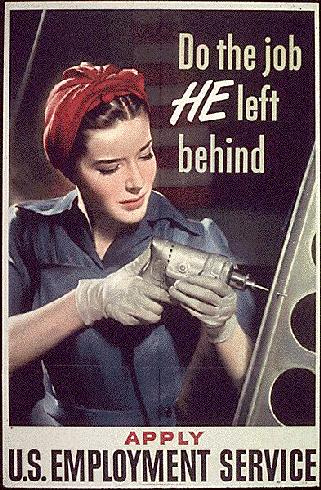
PS: Back in WWII we had job training programs that worked and worked quickly. http://militaryhonors.sid-hill.us/honors/images/dothejob.jpg Today, we have a surplus of workers.
Compared to arts and science degrees with substantial debt loads, years of no applicable experience, and a high probability of employment outside your field, the economic model of trade schools seems significantly better.
You are associating two things that have gone together in the past (guild-like systems and apprenticeships) - that don't necessarily need to go together. I am, well, very American in my personal attitudes towards unions. (Okay, maybe I'm a little more tolerant; I don't have a problem with unions in general, I just know they aren't for my personality.)
I've worked in the field for the last 20 years without a degree, and I've been educated, largely, by things that could be called apprenticeships or internships; jobs where I got paid little to do IT work or programming, usually with some, but not very much supervision. Sometimes it was an official-ish internship, sometimes they just wanted an IT guy and didn't want to pay more than minimum wage. I personally didn't see too much difference between the two types of jobs. It was pretty great socially, too; I'd credit it with being one of the major forces that got me out of high school without physical harm or a record. It was really neat being a 16 year old kid who everyone treated like, well, a 16 year old kid (meaning some species of especially disgusting mud) - and then to go to work for three hours a day in an office where nobody else was below 45, where they treated me as a human; a human who could do adult work.
From the age of fifteen I worked at a local computer store, then later some county offices... by the time I got out of high school (in '97, and yes, I know just how lucky I got) I had just a few more months of low-paying work (phone tech support, that time) before I got my first programming gig.
Just because of my personality at the time, I don't think I could have functioned in an official union setting. It took me more than a decade before I could accept that sometimes you need to follow rules that you disagree with, and sometimes... sometimes when you learn more, you start to agree with those rules. I mean, I guess that's what most people do in college, learn how to "play the system" - But the capitalist free-for-all worked really, really well for me; I didn't have to play the system. I could do my work, tell my boss what I thought, and if that caused enough problems, I could get another job.
I'm not saying that it's the best system for everyone; just that it worked really well for me... and there's no way I would have made it in an organization with standards and rules like a union, and unions have very different values; To this day, the idea of working at the same place for a decade seems really weird to me. Some of this, I'm sure, has to do with the fact that I came of age during the first dot-com, and I know how much "loyalty" you are going to get from the company you work for... but some of this is that I really do value the freedom of being able to walk, with two weeks notice, of course, with almost no consequences.
Now, I do see some benefits of unions; in airlines, my understanding is that they've been able to capture a lot of the value (for the workers) that would otherwise have been profits for shareholders. This is not happening in the computer industry. Sure, we get paid pretty great compared to plumbers or mechanics or what have you (I mean, plumbers or mechanics who don't own a company) but compared to the industries we enable... we capture a pretty small portion of that value in terms of salary.
Still, I do really well in the "perceived merit" system we have now, even though all my statistics are terrible or non-existent. No certifications, no degrees, lots of time as a contractor, I've run my own business, etc, etc, - I think like so many others in the computer industry, I feel like a more objective scale is going to rate me less highly than the current system, and I have no evidence that a union could, in fact, obtain more of the surplus value for the workers.
I'm talking about all of the existing tiers of education, with the early school being the most important. And the very fact that all the shit like "practical skills" and "employment prospects" are starting to corrode even the primary school is extremely worrying.
Maybe it's not what you are saying, but what I hear (and I think this is likely commonly heard) is "formal education makes you better" in the same way that a British person of 100 years ago might have said that being of good birth makes you better.
At that point, it sounds to me mostly like a class division, e.g. your parents had the time and money to educate you in ways that won't provide returns in terms of your own income.
I mean, I'm not saying that's what you are saying or even what you meant to say. I'm just pointing out what it sounds like to a group you probably have little contact with.
Further, as someone who is a fan of things like history and philosophy, aside from, well, being more entertaining to me, I don't think you can form a coherent argument that a person like me who knows a lot about the history of philosophy is "better" than a person who knows a lot about the history of, say, American Football or ice hockey.
I mean, it's a cultural marker, that's for sure; I'm much more likely to want to be around the philosopher than the sports fan, but is the philosophy fan better in any meaningful sense? I'm going to say no.
Any kind of education (unless it's a cargo cult education) makes you better, that's the entire point of it.
> "better" than a person who knows a lot about the history of, say, American Football or ice hockey.
Sports are good for education - and they're not practical and not earnings-oriented. How many of those who had a passion for sport in school went into a professional sport?
I am not opposing sport, STEM, music, arts, whatever else - I'm opposing an emphasis on any "practical skills" in general.
>I am not opposing sport, STEM, music, arts, whatever else - I'm opposing an emphasis on any "practical skills" in general.
So what standard do you have for "better"? Do you have any standard for "better" or "good"? would memorizing random strings of numbers, then, make a person "better"?
That very role of education I was talking about is preserving the accumulated knowledge of our civilisation. As it grows, an amount of general education everybody must withstand grow too. And instead there is a disgusting trend of simplification.
I would prefer to see a civilisation of polymaths rather than a civilisation of narrowly trained craftsmen.
If you think that doing things gives you a more narrow education than taking classes... I suggest you spend more time with people who do things.
I know it first hand.
> I suggest you spend more time with people who do things.
I do things. I know how narrow specialisation is and how it tends to narrow further with experience.
My original point, that you sound like an elitist when you start going on about how much better education makes you in impossible ways, still stands. If you want to sound that way, it's fine.