Now, I don't blame entrepeneurship or technology for that, but it's not so simple to just change your personality to fit the economic imperatives of the day, and I simply don't desire to spend all my time as a disruptive wealth maximizer. The whole 'software is eating the _____ industry' mindset is the technological equivalent of slash-and-burn agriculture - it's not a sustainable strategy for the population at large, and we're seeing that reflected in many countries by the drift towards electing increasingly radical politicians of both left and right.
PS: 65 - 18 = 47 years. Just how many bricklayers do you need with 45 years experience and back problems?
But a corollary of my version of "Spoon!" is that skills matter, too. They're how you know the important details from the unimportant ones, and how to manage the important ones. The only way to get that kind of skills is by experience. To use your own example, have you seen the difference in efficiency and results between someone who's just been shown how to lay bricks and someone with 45 years of experience? Or even better, a team with someone with 45 years experience to tell the others when they're not doing it right?
Judging by the brickwork on my house, the answer to your question is "More than we have now."
  A master architect and a master mason

  Back in 1891, when the Citizens Bank building was under
  construction, there were two essential people on the job
  site. One was the architect. I imagine that the architect —
  someone who clearly cared about water management details —
  visited the job site regularly. The project was also
  blessed with the presence of a master mason — perhaps a
  recent immigrant from Italy — who knew how to sift sand and
  wield a trowel. Both of these people oversaw the work of
  others, and both insisted that every worker on the job site
  needed to adhere to high standards of quality.

  The results of their work included the impeccable mortar
  joints at the Citizens Bank building.
So, you can easily end up with vastly more people with 25+ years’ experience than <5 years’ experience. That's not a problem for programing or electricians, but for highly physical skills your body breaks down and you don't need 3 supervisors for every worker. For some jobs older workers are simply worse.
Now, with a solid general education these people can move on to less physically demanding work, but trying to plan out the economy 40 years into the future is a bad idea.
That seems to be false in practice.
Otherwise as I said in a different post you end up handing out medical disability early retirements to lots of people which is extremely expensive.
Old dogs might not learn new tricks, but people can.
Of course, even then you are only talking a grand or two pre-tax, which isn't the world, when it comes to programmer sallary, unless the old person has a bunch of dependents and the employer is paying for dependents.
I think it's pretty common for the employer to pick up most or all of the bill for the employee, and then have the employee contribute for their dependents, but it varies from company to company.
Y Combinator and, to a lesser extent, the better coding bootcamps, are trying to solve this problem and I feel we should be supportive of that and encourage more of those initiatives (and I'm not looking to start another subthread about the effectiveness of coding bootcamps, but merely pointing out that they are an attempt to solve the problem of mentorship at scale).
Trades also are inherently focused on a single area. Plumbers can't just pick up a rig and start pressure welding.
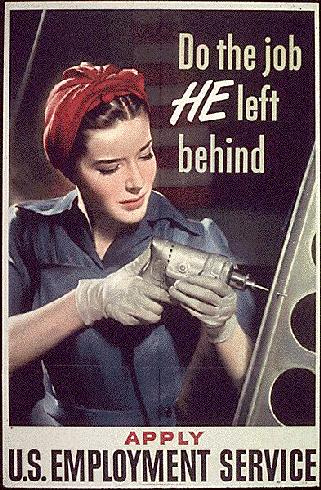
PS: Back in WWII we had job training programs that worked and worked quickly. http://militaryhonors.sid-hill.us/honors/images/dothejob.jpg Today, we have a surplus of workers.
Compared to arts and science degrees with substantial debt loads, years of no applicable experience, and a high probability of employment outside your field, the economic model of trade schools seems significantly better.