Of course, it'll still be a rare and power hungry configuration, so it's not like I'll suddenly be using a Macbook, but it's a nice progression.
Please don't :). New iGPUs may be catching up to old dGPUs, but meanwhile new dGPUs are just skyrocketing in power far beyond them.
I made this chart to easily see relative performance of most common notebook GPUs:
http://alteredqualia.com/texts/notebooks/nvidia-gpus.png

Or if you are interested in both desktop and notebook GPUs relative performances:
http://alteredqualia.com/tools/gpus/
What Intel does is great for rising minimal specs you can expect in notebook graphics, but you can do much better than that, even cheap modern dGPUs wipe out the best iGPUs. You can extrapolate Skylake Iris Pro from Intel marketing claims vs older Iris Pros, it's going to be better but not Earth-shatteringly better.
And this gap is just going to get wider in 2016, with HBM2 and 16 nm node sizes finally coming to GPUs (both to Nvidia with Pascal and AMD with Arctic Islands).
So if you're at 1/4 peak performance, you're still running a smooth game albeit not quite at full detail.
If you're at 1/16 peak performance... things aren't looking too good by the time you get your game smooth.
If you are game developer / graphics programmer / game player / designer / photo or video editor / VR enthusiast / anybody who cares about graphics, I would advise to get at least GTX 960M (if you have budget or size constrains, this should get you roughly to PS4/Xbox One levels, so relatively safe for this gen), but preferably GTX 970M (best price/power and you can still get slim notebook).
GTX 970M will get you about average GPU performance overall, including desktops (these days I get ~50-percentile rank in 3dmark firestrike with my GTX 970M notebook, so average GPU in September 2015 is at least as fast or faster, at least for that cohort of people).
So? When did the idea behind developing games got to have the most eye-candy to take advantage of new dGPUs?
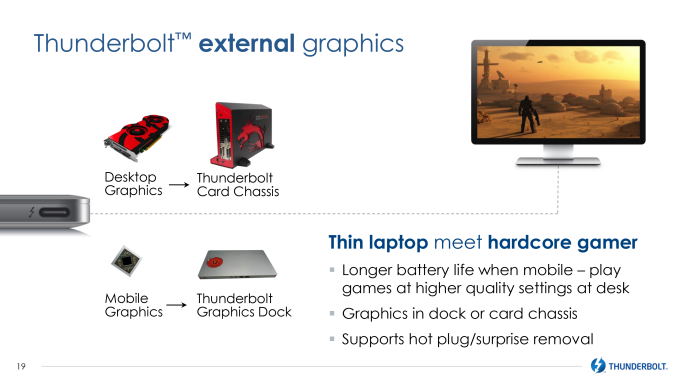
A decent CPU and adequate graphics is usually all I need in a laptop while traveling, but it would be nice to be able to plug in a more beefy GPU at home to play games and drive more monitors at higher resolutions.
I don't expect it to be cheap; but even if the chassis is a few hundred dollars, if you can reuse them for three generations of GPU and laptop, it's probably worth it.
http://images.anandtech.com/doci/9331/TB19_575px.png http://www.anandtech.com/show/9331/intel-announces-thunderbo...
even this GPU would make for a great value proposition in a midrange macbook pro
Additionally, Skylake brings DDR4 memory, Thunderbolt 3.0 (Thunderbolt over USB), and better performance/battery life. There's also possible wireless charging support, and the Skylake integrated GPU possibly has double the speed of the Haswell Iris chips.
- The ability to run external 5K monitors.
Since I usually keep a laptop for at least four years, it would be unwise for me to now buy a laptop that can't do both of those technologies which I really want to have.
Which USB devices do you use with your laptop?
Regarding 5k displays, currently I'm still not ready to buy even a 4k version, mostly because I'm waiting for higher frequencies (via G-Sync or FreeSync, both of which require a discrete card, and it's not at all clear if those will be supported in the next MBP). 5k monitors currently cost 4 times as much as 4k. Really hard to justify buying one anytime soon.
If Apple does not release Skylake MBP in October, I would recommend buying the current one, rather than suffering the horrible resolution of MBA for another 6 months.