seastarer
Re:AMD's Zen 6 Family: Feeding the Beast
on Tuesday November 10, 2026 @05:41PM (#50447329)
A multiplier also contains a generalized shifter network.
Multiplying by 2^n = shift by n.
Re:Who Is Vfmaddrnd231pd?
on Tuesday October 13, 2026 @02:13PM (#50076114)
Re:Who Is Vfmaddrnd231pd?
on Tuesday October 13, 2026 @03:00AM (#50067815)
The instruction was removed when Intel recommitted to AVX-512 on client CPUs (it is available in EVEX form IIRC)
Re:RISC-V Is Inevitable: State of the Union Keynote Argues
on Wednesday July 15, 2026 @05:51AM (#48918439)
You can try to re-vectorize the code for larger vector size.
Re:Removing fsync from our local storage engine
on Saturday May 09, 2026 @12:25PM (#48076156)
It's more correct to use O_DSYNC in addition to O_DIRECT. This adds FUA to the disk write if the disk requires it for durability.
Re:What Does a Database for SSDs Look Like?
on Saturday December 20, 2025 @11:55AM (#46337517)
It is actually very cheap if done right. Enterprise SSDs have write-through caches, so an O_DIRECT|O_DSYNC write is sufficient, if you set things up so the filesystem doesn't have to also commit its own logs.
Re:A Fast 64-Bit Date Algorithm (30–40% faster by counting dates backw...
on Thursday November 27, 2025 @09:51AM (#46069772)
Do these calculations take into account the lengthening of the days due to tidal friction?
Re:The Lunacy of Artemis
on Monday May 20, 2024 @07:20AM (#40414295)
They should have refused
Re:TSMC unveils 1.6nm process technology with backside power delivery
on Thursday April 25, 2024 @04:21PM (#40162508)
Translating 197 M/mm2 into the dimensions of a square, we get a dimension of 71nm. If we compute the "half-pitch", that's 35.5nm.
230 M/mm2 translates to 33nm "half-pitch".
Of course, transistors aren't square and aren't so densely packed, but these numbers are more real IMO.
Re:Canada's maple syrup reserve hits 16-year low
on Wednesday March 27, 2024 @12:59PM (#39841660)
Now I'm imagining submarines full of illicit maple syrup
Re:Maestro: A Linux-compatible kernel in Rust
on Wednesday January 03, 2024 @12:04PM (#38856484)
You can implement a virtual machine monitor (e.g. KVM) and then launch a Linux virtual machine to run drivers you lack.
Re:Power on the Moon. What Will It Take to Survive the Lunar Night?
on Friday December 30, 2022 @10:28AM (#34185859)
The energy cost of extracting oxygen is higher than you'd get from burning it.
Re:New ScyllaDB Go Driver: Faster Than GoCQL and Its Rust Counterpart
on Thursday October 13, 2022 @01:28PM (#33194013)
ScyllaDB is a rearchitecting of Cassandra, not just a rewrite.
Re:How Discord supercharges network disks for extreme low latency
on Tuesday August 16, 2022 @01:38PM (#32486116)
Some more data on Google PD: https://raw.githubusercontent.com/scylladb/diskplorer/master...
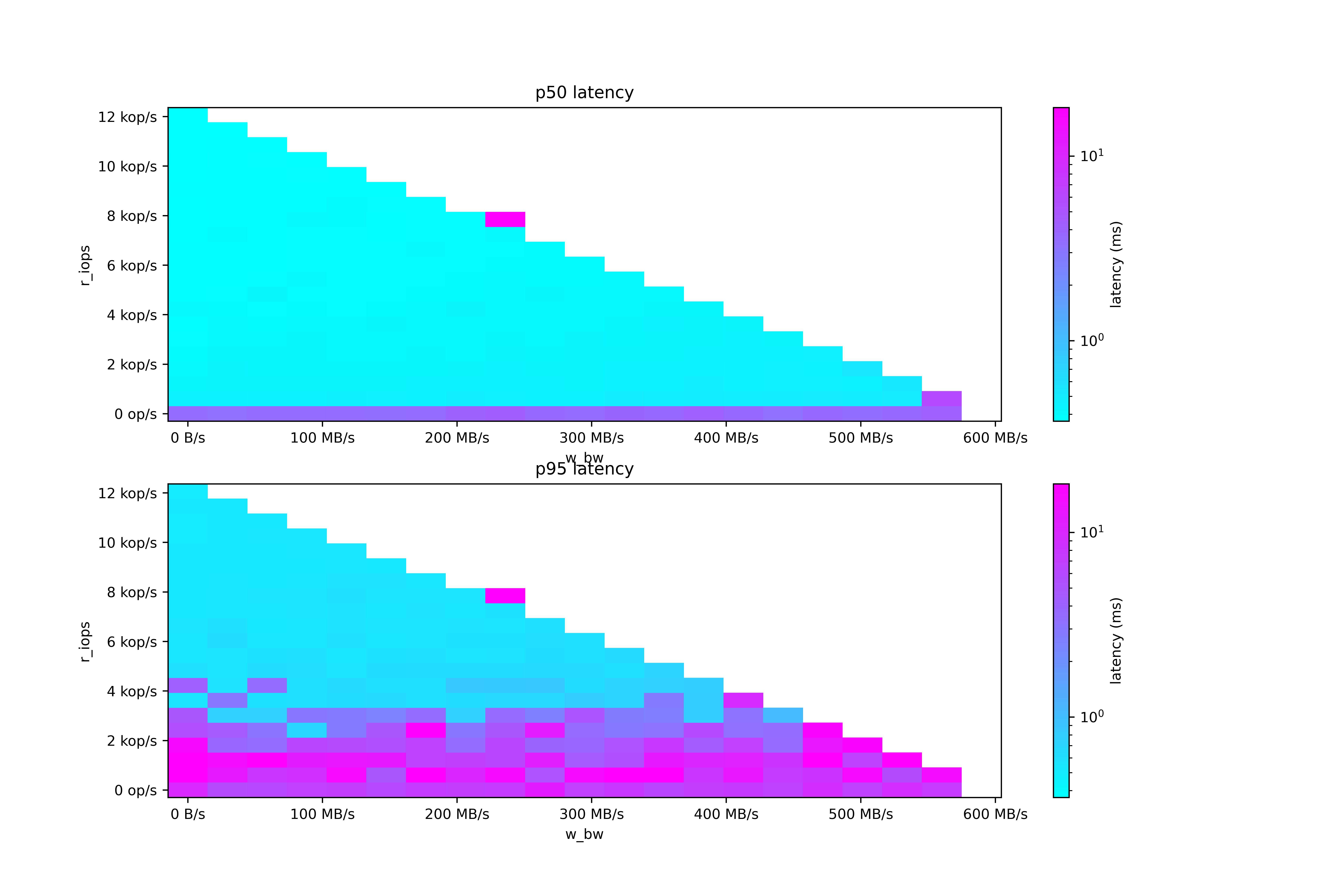
Very odd - notice how the latency is high when the read IOPS are low. When the read IOPS climb, 95th percentile latency drops.
Looks like there is a constant rate of high latency requests, and when the read IOPS climb, that constant rate moves to a higher quantile. I'd inspect the raw results but they're quite big: https://github.com/scylladb/diskplorer/blob/master/latency-m...
Background: https://github.com/scylladb/diskplorer/
Re:How Discord supercharges network disks for extreme low latency
on Tuesday August 16, 2022 @01:30PM (#32486015)
No.
Re:How Discord supercharges network disks for extreme low latency
on Tuesday August 16, 2022 @09:23AM (#32482380)
Persistent Disk read latency is usually good, but jitters up to 100ms. The scheduler can compensate for high latency (essentially applying Little's Law) but cannot compensate for jitter without saturating the disk.
Re:I/O Access Methods for Linux
on Friday October 06, 2017 @08:07AM (#15416110)
Specialized logging applications, databases, userspace filesystems, and virtual machine monitors.
Re:I/O Access Methods for Linux
on Friday October 06, 2017 @06:33AM (#15415684)
It happens sometimes. Very often? Not in my experience
Re:I/O Access Methods for Linux
on Friday October 06, 2017 @05:12AM (#15415427)
Multi-Terabyte SSDs are very common. An i3.16xlarge instance on AWS, for example, has 15TB of SSD storage.
Re:I/O Access Methods for Linux
on Thursday October 05, 2017 @07:11PM (#15413274)
> If you know your read and write patterns very well you can effectively use this for nearly asynchronous IO without the pains of AIO and few to none extra threads.
This may work for sequential reads, but not for random reads.
Re:I/O Access Methods for Linux
on Thursday October 05, 2017 @06:43PM (#15413120)
The diagrams are now correct (the read/write diagram was placed under the mmap section by mistake).
Re:I/O Access Methods for Linux
on Thursday October 05, 2017 @05:34PM (#15412758)
I see what happened, the read/write diagram got placed under mmap.
Re:I/O Access Methods for Linux
on Thursday October 05, 2017 @04:53PM (#15412504)
Right, the mmap read hit is incorrect, I'll fix it up.
ScyllaDB 1.7 released with counter support
Re:Designing the Scylla Userspace Disk I/O Scheduler (Part 1)
on Saturday April 16, 2016 @02:39PM (#11511725)
You're going to be right on that guess. It will take some time though.
Clustered ScyllaDB benchmark, 10X Cassandra
Re:Seastar: C++ framework for high-performance servers
on Sunday April 26, 2015 @12:23PM (#9442237)
We plan to reduce power usage on low load eventually.
Re:Seastar: C++ framework for high-performance servers
on Sunday April 26, 2015 @12:15PM (#9442208)
It ought to. There may be a minor porting effort involved. Note you need very recent gcc.
Re:Seastar: C++ framework for high-performance servers
on Sunday April 26, 2015 @10:11AM (#9441806)
Thanks. We "disable" C-states by polling -- the cpu never goes idle. This is partly because dpdk doesn't support interrupts, and partly because using interrupts is a major performance hit. We have plans to improve this, but nothing committed yet.