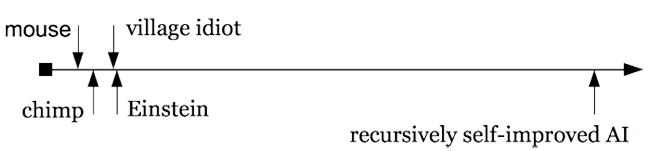
I actually don't quite agree with the spaces on this chart because the scientific method should set us far apart from mice and chimps so that they would almost merge in a single point.
Anyway, there are a handful of reasons to assume that an artificial general intelligence would likely turn out to be far superior to us: (1) Hardware is a much less noisy computation environment compared to the badly insulated neurons in our wetware (though this might be a feature rather than a bug), (2) our neurons operate at about 200 Hz, microchips at 10 million as much, (3) they would have extremely fast access to physical simulations and other computational resources, knowledge bases, other AIs, (4) they would never get tired, no body to maintain, no social obligations, and (5) they could replicate within seconds and easily modify their own sourcecode.
And how did you assign weights to these options?
I assume you didn't make the sophomore mistake of assuming a uniform distribution over all possibilities.
Once you're done enumerating as many possibilities as you can for what a superintelligence might have as its goals, simple and complicated or even nonexistent, and what the various outcomes of a superintelligent agent with those goals broadly look like, find out how many of them are positive, negative, or neutral to the future of humanity, especially if these things the superintelligence does requires resources humans also use. I did this once, it convinced me that the likely case is something negative for humanity, even if it's unlikely to be a Terminator/Matrix/Hollywood scenario or really any specific enumeration. What further convinced me that the likely outcome is still negative for humanity, in the event of people making an honest but uninformed attempt at after having created an AGI making sure it won't be net-negative for humanity, is understanding the complexity of human value and how almost right is still very wrong. (http://wiki.lesswrong.com/wiki/Complexity_of_value)