Sparks produce a broadband radio signal, that decays strongly with increasing frequency. Very little is present in the Megahertz region, which is why lightening doesn't interfere with FM radio that much.
Radio frequencies below the gigahertz or high megahertz region will not interfere with the Pi as the wavelength of these is too long to effectively couple into the short circuit board traces.
Xenon flash tubes are not that noisy in terms of unwanted RF. Apart from anything else, you wouldn't be allowed to sell such radiating circuits in consumer equipment.
A xenon flash puts out an enormous amount of blackbody light (high in IR and NIR) in a very short time frame (as short as 100 ns). Plastics are not very IR blocking by themselves. Silicon has a band gap of 1.1 eV. Any photons above this energy will be absorbed across the gap, and interfere with the circuitry. Firing a xenon flash close to something will result in an instantaneous light flux many hundreds of times larger than direct sunlight. So the circuit might be designed to be resistant to any ambient lighting situations, but not to being flashed.
As a commentator mentioned below, U16 is a switched mode power supply circuit. It's analogue, and switching quite fast. It doesn't take much for it to be disrupted & mess up a few cycles, possibly even then triggering some protection circuitry on the inputs of chips down the line.
Blue tack, being an insulator, will be almost totally transparent to radio frequencies.
https://blog.adafruit.com/wp-content/uploads/2015/02/Pi_II_t...

U16 appears to be in a WLCSP package (and others have noted that it is "shiny", which would also agree with the typical appearance of one), and WLCSPs do not have much of a package - they're essentially bare die that have had solder bumps attached to their top surface, and are mounted upside-down ("flip-chip" style) onto the PCB. It won't take much light intensity to cause photoelectric effects on a WLCSP.
More info here: https://ez.analog.com/docs/DOC-2357
Cardboard (and I'll wager the blue tack also) has negligible EM shielding effect, so I'd say that's pretty conclusive that it's a photoelectric problem.
edit :
The word light is commonly used as shorthand for variously the whole EM band, the near visible EM band and just the visible EM band.
If you are talking about the speed of light, it includes radio and gamma.
Discussing the colour of light on the other hand and you are referencing the visual system.
As soon as you start talking about visible light however, you are widening the definition of light again to include IR and UV and more, otherwise you would not need to clarify with the word visible.
edit 2 - darkmighty. I am not talking about the xenon bulb producing an RF EMP from the lamp flashing circuit, I am merely continuing the terminology used elsewhere in this thread, that a flash of visible light is also quite clearly a form of electromagnetic pulse.
edit 3 - foobarbecue. Radio as it gets shorter becomes microwave, then IR, then red, through green, past blue, goes to UV, then xrays, then gamma.
The EMP is generated by the lamp/flashing circuit, which is essentially acting like a small (but not atomic) dipole antenna excited by a pulse. Therefore it has a distinctive cut-off frequency, probably in the 10s of Mhz range but I'm not sure exactly (something like this: [1]). This pulse is picked up by wires that act as antenna, and you get RF interference.
The Xenon flash has also a distinct spectrum, but it's essentially contained in the visible light range (in a log-frequency spectral density plot) [2], which is what you want with a lamp! This emission is absorbed by the semiconductor material by exciting bandgaps: displacing electrons causing voltage spikes.
[1] http://www.rfcafe.com/references/electrical/ew-radar-handboo...
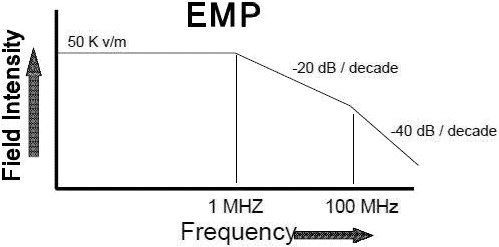
[2] http://www.ushio.co.jp/images/en/products/list/lamp/lamp_07_...

You should probably just admit your error here -- it's light, not radio waves, causing the effect. Sure, they're part of a common spectrum, but your statement "radio waves are light" is obviously false. It's a bit like saying "red is blue".
Edit: I misread the above, lotsofmangos was talking about wavelengths coming from the radio site of the spectrum rather than light, so he didn't get it backwards. The rest of this post stands.
As to saying that radio is light, if calculating the propagation speed of a radio wave, you don't talk about its speed of radio, you talk about its speed of light. In many technical contexts, light is one of the default terms.
Also, there would be no need for the term 'visible light' if light could not be used to describe electromagnetic radiation outside the visible spectrum. Infra-red and ultra-violet are commonly thought of as light and you can even create lensing optics for radio waves and for x-rays.
If there's anything in this world noisier than a spark gap, I don't know what it is.
I think the first radio transmitters were spark gaps.
The energy flies thru the air, and is coupled onto the power line.
The power supply doesn't cope well with the oscillations, and hiccups.
I see the notes about U16 being photosensitive, but if it is a black epoxy like most IC's, I'm not buying that light gets into it.
It's possible that blue tack shields the EMP a bit.