Edit: Though obviously some areas, AT&T is the only broadband providers. But breaking it up won't solve that issue at all.
Then you write a charter which requires the company which owns the cables to sell access to any ISP at the same terms and cost.
Then you implement a law which says that no ISP may own a last mile, and all last mile infrastructure past and future must be under those terms.
That way, you entirely skip the issue of the cable owners having no competition or incentive to expand, and you have competition between ISPs as well, without tying one to the other. ISP implements throttling? You can use another ISP that uses the exact same neutral last mile.
This is more-or-less what the UK does, with the addition of the no-ISP-may-own-a-last-mile law, which I strongly believe we should implement.
The last time AT&T was split up, there weren't any "ISPs".
And at that time AT&T was split into (for the telephone service parts):
1. The reduced AT&T -- long-distance and some other things
2. The "baby bells" -- local service in different geographical regions.
> Then you write a charter which requires the company which owns the cables to sell access to any ISP at the same terms and cost.
Common carrier rules were applied to AT&T's telephone lines, and DSL was also common carrier, covered under Title II until it was reclassified in 2005 (so much of the Title II hand-wringing over Open Internet rules misses the point that consumer internet in the US grew up when the lines were covered by Title II, and it manifestly did not kill innovation.)
Indeed, there were phone companies. It seems obvious now that the breakup was done wrong, but with the technology at the time it likely couldn't have been done how I'd like it to be done today. I over-simplified when I said "you did it wrong".
> Common carrier rules were applied to AT&T's telephone lines, and DSL was also common carrier
But they didn't split last mile cabling from whatever runs on top of it, which is the main issue and the only thing that'd actually work to allow quick reactions to a failure to provide adequate service. Otherwise, you have the ISP giving preferential treatment to itself, even though the law says it really shouldn't be.
The ILECs were permitted to sell to retail customers and required to sell to wholesale customers; and there was preferential treatment (especially around pricing/promotional rates), but it was significantly more competitive than today, and price preferences could have been resolved by narrow regulatory action. Yes, a complete split would be more competitive, but a partial split is probably more likely to go through, and would put us in a much better place.
I would hypothesize that a major part of why cable internet blew past DSL in the 2000-2010 time frame was that the latter was regulated under Title II for so long.
One of the broken off companies reacquired them.
What is currently AT&T is really SBC. SBC acquired AT&T and adopted the AT&T name.
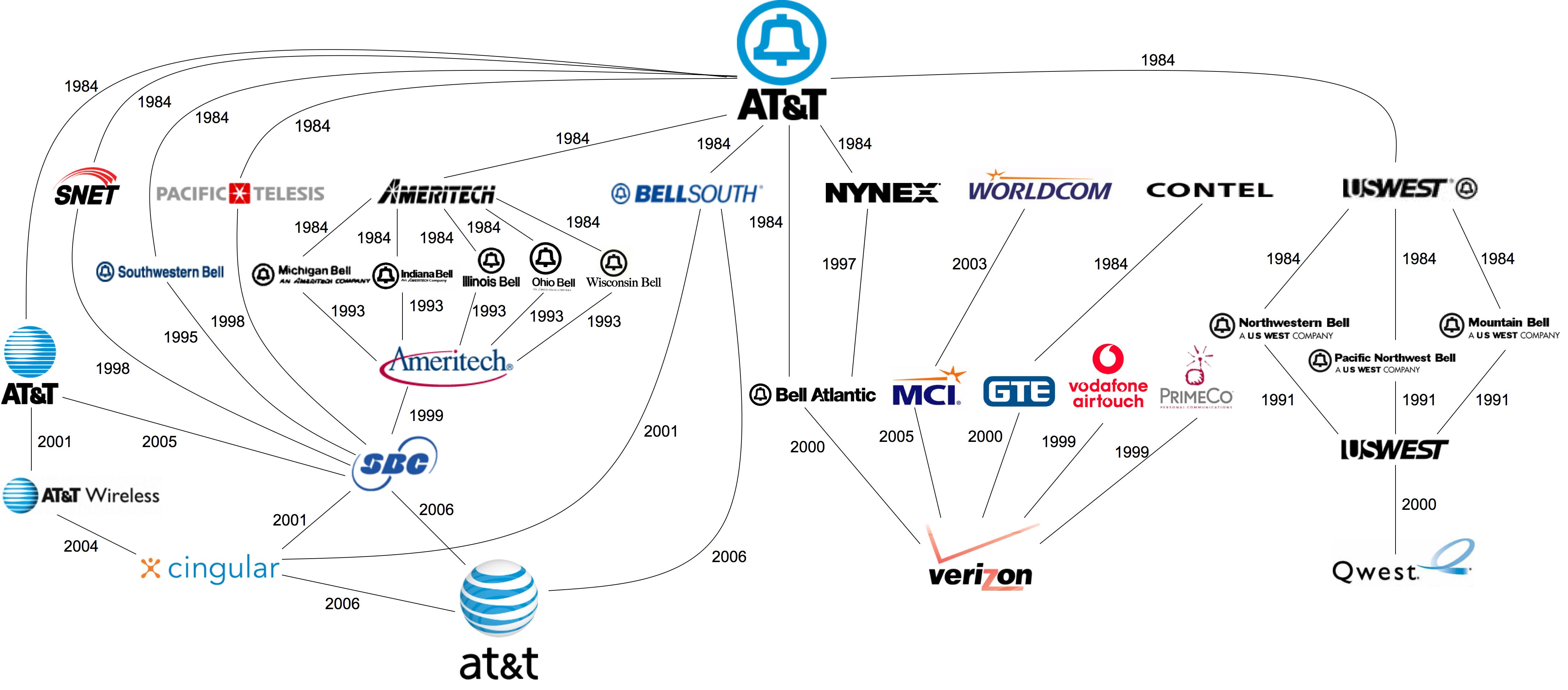
Which from a lobbying/public policy perspective, is often indistinguishable from ATT. They certainly don't act like they view each other as competitors.
Call in Google, they get it.
jr