More generally, your explanation may make sense to you, but it makes no sense to a layperson (i.e. me). But the linked short description, along with the speaker cone visualization, does make a reasonable amount of sense.
I've also seen a similar description in the past with accompanying animated GIFs illustrating the point, instead of the prose about a spinning speaker cone. I thought the animated GIFs made it even easier to understand. Sadly, I don't remember where I saw that.
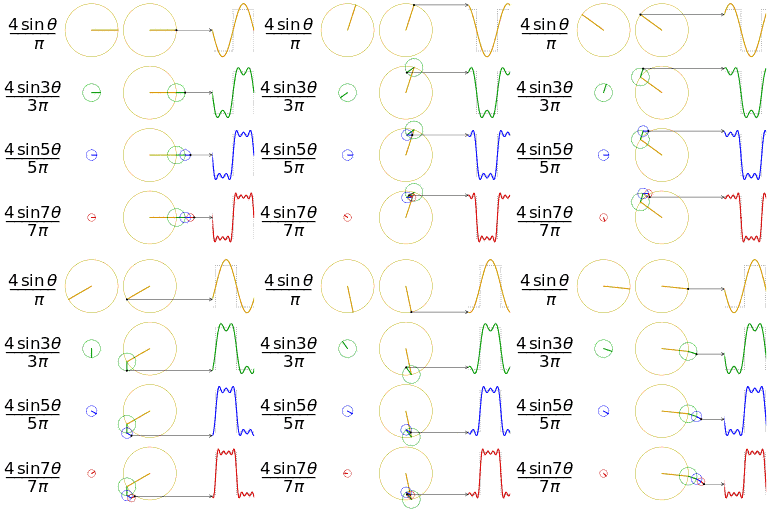
http://nautil.us/blog/the-math-trick-behind-mp3s-jpegs-and-h...
Consider the space around you. Pick some frame of reference with a fixed origin point in space. To specify an object, you must specify the distance along each independent direction (x, y, and z in 3d space) to arrive at the object from the fixed origin. These independent directions are referred to as a basis for the space. Often these independent bases are perpendicular (or orthogonal).
For higher dimensional spaces its the same idea. It turns out we can even have infinite dimensional spaces whose bases are functions that can be perpendicular in a certain sense. It also turns out that complex exponentials (waves) are an orthogonal basis for a certain space of functions. This is really cool! It means we can refer to any function in this space using the complex exponential basis functions just like we referred to objects in 3d space using three independent directions.
Why is this useful? The magnitude in a particular independent direction in this space tells us about frequency content of that function. So instead of the first coordinate telling you how much x distance there is, it says how much of a certain frequency there is.
The Fourier transform is usually used to flip from the time domain representation to the frequency domain representation.
"Time domain representation" means when you plot that information, the x-axis is in units of time; seconds or fractions of seconds, usually, for something humans can perceive as sound. The line tells us how loud the signal is at a given instant of time.
"Frequency domain representation" means when you plot that information, the x-axis is in units of frequency; hertz or kilohertz, usually, for something humans can perceive as sound. The line tells us how loud the signal is at a given frequency.
Here's the bit about basis vectors: The frequency domain representation is possible because we can make any graph by adding enough sine functions, assuming we're allowed to do things like increase or decrease their magnitude, increase or decrease their frequency, and shift them left or right relative to each other (adjust their phase).
Therefore, we can describe the graph were interested in using only sine waves, which are pure frequencies, and when we've done that, we'll know which specific frequencies contributed most to the information we represented in the original graph.
There is, of course, an inverse Fourier transform, which takes a frequency domain representation to the time domain, so we can do things like record a sound (time domain), take it into the frequency domain, remove certain frequencies (typically all frequencies above and/or below some cutoff) by zeroing parts of the graph, and take the result back into the time domain, so it can be played back as a recording.
I always thought this was the definition of Fourier transform, and all the stuff with integrals was just to express the change of basis in an explicit form. What else would the word "transform" mean?
How is it even possible for someone to learn about the Fourier transform without it being very explicitly said that it is a change of basis to a different set of orthogonal functions? Did they just introduce the integral expression for it and hope people would memorize it? I don't understand.
Honestly that is more important to my mental model of the 1D Fourier transform than the algebraic description. It may be slightly inaccurate (are we talking projection or decomposition when calculating the settings on that tide predictor? for example).
2D Fourier transform is more interesting to me as it has applications in graphics. For example, you can synthesise ocean wave-like patterns in a height field by generating a noise image, shaping the noise into a slightly modified disc around the origin, and doing an IFFT. Intuitively you get random wavelength components within a given range, with random orientations. I couldn't write you a formula for that. You can imagine that a 12 year old could understand it, thought. Old paper is here: http://www.computer.org/csdl/mags/cg/1987/03/mcg1987030016.p... Another intuitively comprehensible 2D trick is to use an FFT to implement a simulation of fluid dynamics. That's a more complex one but again, it can be understood without algebra. http://www.dgp.toronto.edu/people/stam/reality/Research/pdf/...
And then you realize -- hey, those are exponentials -- so the rule that integrating/differentiating each component is trivial allows you to solve linear ODE really quickly.
I don't think algebra gets in the way at all -- it just makes this decomposition crystal clear. It makes generalizing easy also -- there are other nice basis like cosine basis, and so on. You can choose any N functions to decompose your N-point function, as long as they are linearly independent, you're guaranteed perfect reconstruction.
Algebra is definitely necessary and useful here, but the concepts can be learnt without knowing algebra, which means they are open to a lot more people.
Unfortunately, yes. The linked article even avoids this language at all costs. And that's just how people work in physics and engineering. They want to talk about spinning functions and all this nonsense instead of just doing some basic linear algebra.
Once you learn enough about mathematics, and here linear algebra, you will start to reduce more complicated concepts to more simple concepts to build the complex ideas up from simple ones. In this case, the notion of a change of basis is definitely much simpler than the notion of an integral transform, so it makes sense to express it that way.
"What it actually calculates" can be a tricky topic in mathematics. It calculates what we want it to calculate, that's how people came up with the definition. So the way to understand "what it calculates" is to understand "what do I want it to calculate". Somewhat like programming, really. If we want to calculate a function's representation in a convenient basis, then that's what we'll make Fourier transform do.
Both of them explain different things. The "it's just a basis transformation" makes invertibility, additivity, etc. obvious. The spinning function things makes it clear why we want to do it and what it means to say, approximate by only the small frequencies. (The basis thing tells you nothing about why looking at just the low coefficients is helpful, sometimes. A basis doesn't care about ordering)
Except for orientability, I guess.
But most ECE undergrads will first see the Fourier transform in a continuous setting. Then it isn't so much an issue of "basic linear algebra"- students have almost certainly never talked about the space of square integrable functions, the inner product on this space, a basis for continuous functions, what it means for an infinite collection of objects to be orthogonal, etc... That is, if they have even taken any linear algebra yet!
Students learn to associate "Fourier Transform" with "complicated math" and then are discouraged when they learn about the DFT. At least, that has been my experience when TAing signal processing classes.
http://www.cc.gatech.edu/~phlosoft/transforms/
It's a bit dated by being a Java applet, but source code is all there, written in Processing. (I should probably update it now that processing.js is a thing. Years pass quickly.)
What I find useful about Laplace and Fourier transform is there is that applied to differential equations there produce algebraic equations, so is a very useful tool when you are working in problems that are modelled via differential equations.
My introduction for someone totally new to this field is to consider y = cos(x) and y= sin(x) as functions whose second derivative satisfie y'' = -y, and the exponential y = e^(ax) as the solution of y'=ay then you can think of solving this kind of equations trying a solution of the form y=e^(kx) then you realize that the constant k is the solution of a first or second order algebraic equation that you know how to solve. Then if your equation has imaginary solutions you need to know what is the exponential of an imaginary number, exp(ik) = cos(k) + i sin(k), then you say ok but that is not a real function, answer the real part and the imaginary part of that are also solutions. Going this way you find that a complex number z=a+bi is the solution of a differential equation that often constitute a model a physical system. z=a+bi is the solution of the second order equation (z-a)^2+b^2 = 0 and this algebraic equation goes to a differential equation just by replacing z^2 with y'' (second derivative) z with y' (first derivative) and finally you have the solutions y=e^(ax)cos(bx) and y=e^(ax)sin(bx) in which the amplitude of the signal is controlled by the exponential so that if a is negative you have a signal that goes to zero and otherwise a signal that explode.
Interestingly, it was actually learning quantum mechanics that made me understand the Fourier Transforms much more easily. You're always projecting the wavefunction into some basis, so the cosines and sines are just one particular basis.
Another benefit is you can see exactly how it is similar to other basis like (orthonormal) wavelets, and dis-similar to so-called "over-complete" basis (complex wavelets, various frames). It also becomes easier to see what the projections onto basis vectors are doing, how/why energy is "concentrated" under a wavelet transform of natural signals, etc.
i.e. you view the entire signal in the original domain as a single point in space of dimensionality equal to number of measurements, and then you project it onto the new (fourier) basis. For example, one of the new basis vectors could be sine signal of some frequency k. You find the component of the original signal along this new basis just as you would do for any other basis vector, with a dot product. The only slight complication is that to get the phase information you have to actually dot with a cosine at that frequency as well. The confusing e^ix complex number multiply "hides" the fact that we are actually doing two simultaneous dot products (since e^ix = sinx + icosx): one with the sine and the other with the cos, to get both the frequency and phase.
this is the intuition for DFT but for FT you just have infinite-dimensional vector space, done. This is much more intuitive to me than "spinning a signal in circle", which I personally find very to be a very confusing statement.
EDIT: granted, basic linear algebra concepts (vectors, basis transform) needed.