If the vote is YES the Prime Minister in office when independence takes effect (most likely to be Labour) would certainly have to resign.
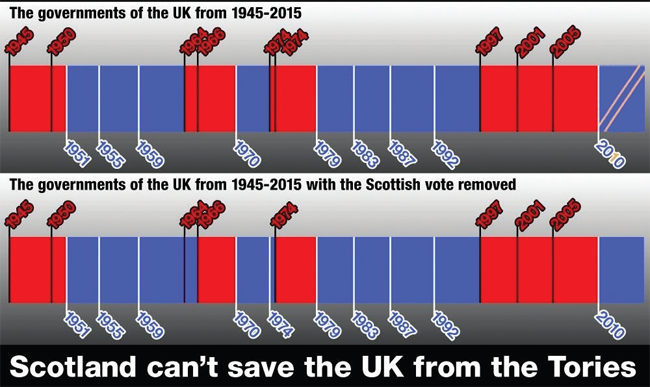
It's true that a Labour government would likely have a far smaller majority without the Scottish MPs, but when Labour has won, it has usually been with far greater majorities than that.
[1]That is, no clear majority, requiring a coalition government
I doubt it, if Scotland votes yes it'd probably cripple Cameron's career, not whoever becomes PM after the vote.
Long term, the Westminster system gravitates towards a two main party or coalition equilibrium. Scottish Labour will be gone. Maybe the Tories will pull right and cede some of the centre. Maybe Labour will pull right.
It's hard not to see this as a precedent. Perhaps even a precedent in international geopolitics. If Scotland has an inalienable right to secede by popular referendum, Why not Iraqi Kurdistan? Why Not Turkish Kurdistan? Why not Crimea?
So what happens when the unionists find themselves left attached to 'the wrong union'?
During the 16th-18th centuries, "The Plantations" there was a lot of migration of Loyalists from the Scottish Lowland. Their descendants make up the majority of the island's Presbyterians. Some still call themselves (or their subdialect of English) Ulster (Norther Ireleand) Scots.
Obviously there is even more weaving and layering. There are mountains of historical threads, cultural similarities. The Highland clan system is related to the Northern Irish system. There was trade dating back to prehistoric times.
When Irish Nationalism was on the rise, strongly Republican and strongly Catholic, these people developed their own Unionist political identity.
The whole thing is predicated on being in the United Kingdom. With political identities UK becoming Welsh, Scottish, English, even Mannish (Is there a Cornish nationalism?), where does that leave the Ulster Scots (who generally don't go by that demonym)?
Confusing.
Maybe it will confuse some sense into the situation.
If the UK releases Scotland peacefully and legally with full international recognition of the process and another region with national aspirations does the same elsewhere in the EU... That's how common law is made. Common law is hard to deny.
Obviously there's hair. Who gets to call a referendum? Who gets to gerrymander it? etc.